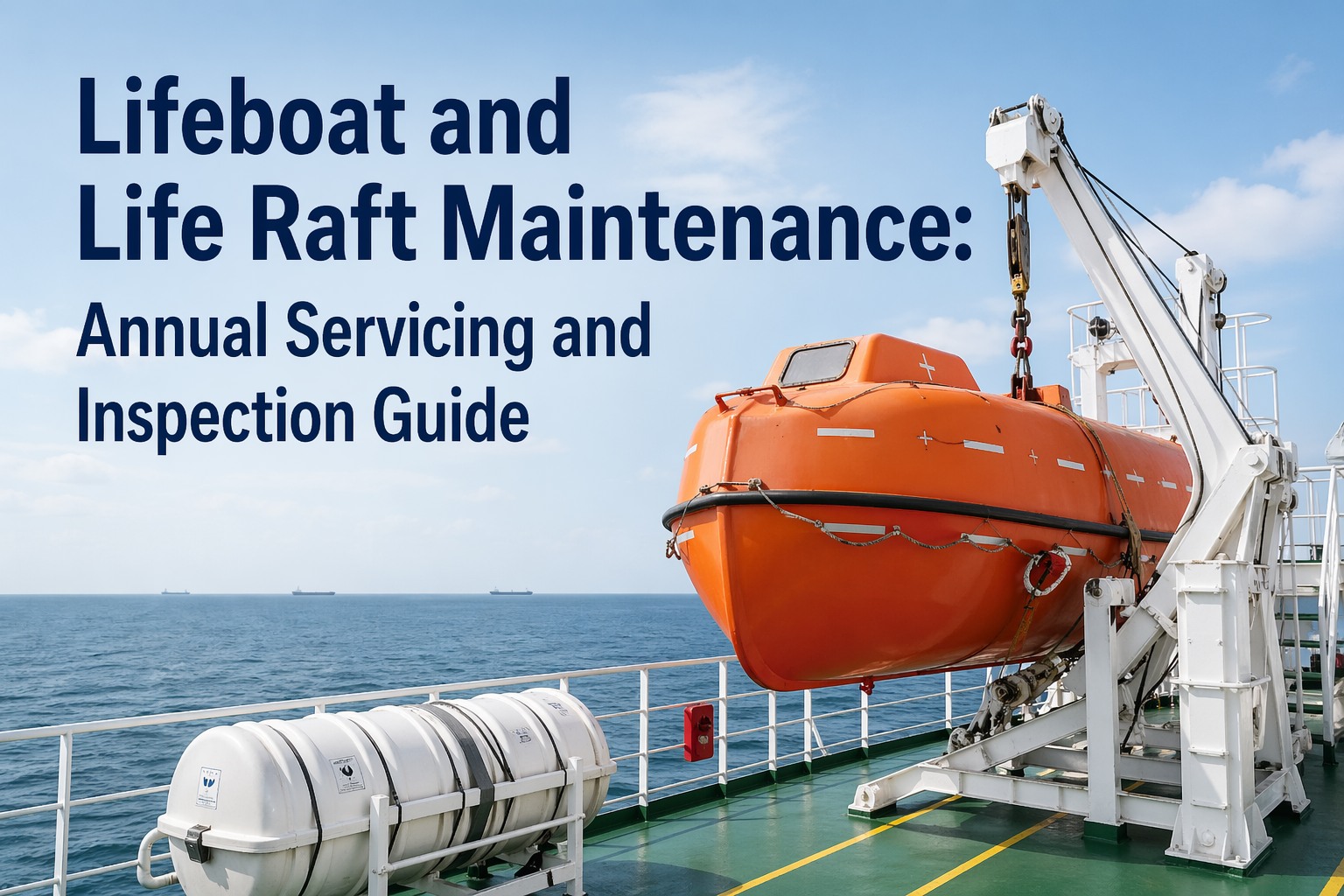
A lifeboat is only as reliable as the davit and release gear that put it in the water. Every year and every five years, SOLAS requires that gear to be examined and tested, and the boat itself to be loaded and launched to prove it. This guide explains what the annual and five-yearly tests cover, who may carry them out, how fall wires fit in and what records to keep, using IMO MSC.402(96) and flag-state notices.
What SOLAS and MSC.402(96) Require for Launching Appliances
How MSC.402(96) splits the work into weekly and monthly, annual and five-yearly levels
Resolution MSC.402(96), in force from 1 January 2020 with the SOLAS III/3 and III/20 amendments, sets out requirements for maintenance, thorough examination, operational testing, overhaul and repair of lifeboats and rescue boats, launching appliances and release gear. It separates routine work from the annual and five-yearly work, and says who may do each.
| Level | Work | Who may do it |
|---|---|---|
| Weekly and monthly | Inspections and routine maintenance per the maintenance manual | Authorised service provider, or shipboard personnel under a senior ship's officer |
| Annual | Thorough examination and operational tests | Certified personnel of the manufacturer or an authorised service provider. The operator may act if authorised. |
| Five-yearly | Examination, overhaul, overload tests and repair | Certified personnel of the manufacturer or an authorised service provider |
Why the service provider's authorisation matters as much as the test itself
A Bermuda shipping notice says annual and five-yearly examinations must be done by a provider authorised by a Recognised Organisation, and that manufacturers may service their own equipment. Where the manufacturer no longer supports the equipment, servicing may be accepted on demonstrated experience, but only in the presence of the Recognised Organisation surveyor. Other flag states have their own versions, so check yours. For the wider LSA picture, see our SOLAS life-saving appliances Chapter III requirements and inspection guide.
The Annual Thorough Examination: Structure, Wires, Brake and Release Gear
What the surveyor and service engineer check on each part of the launching appliance
MSC.402(96) lists the annual checks by part. The davit and launching structure are checked for corrosion, misalignment, deformation and excessive free play. Wires and sheaves are checked for kinks, corrosion and lubrication. Limit switches, stored power and hydraulics are checked where fitted. The winch brake is inspected per the manual, and brake pads are replaced when necessary. The table gives each check, a checkpoint type and the source.
| Part | What is checked | Checkpoint type | Source |
|---|---|---|---|
| Davit and launching structure | Corrosion, misalignment, deformation and excessive free play | Visual | MSC.402(96) 6.2.9.1 |
| Wires and sheaves | Kinks, corrosion and lubrication | Visual | MSC.402(96) 6.2.9.2 to 6.2.9.3 |
| Limit switches, stored power, hydraulics | Correct functioning where fitted | Test | MSC.402(96) 6.2.9.4 |
| Winch | Brake inspected per the winch manual, pads replaced when necessary, foundation, remote control and power supply checked | Measure | MSC.402(96) 6.2.9.5 |
| Release gear | Device activation, free play, hydrostatic interlock, control cables and hook fastening, after the winch brake test | Test | MSC.402(96) 6.2.4 |
| Fall wire terminations | Correct termination of wire ends and suitability of installed wire SWL after any replacement | Record | Bermuda Shipping Notice 2022-016 |
How the brake test, on-load release test and off-load release test follow the boat into the water
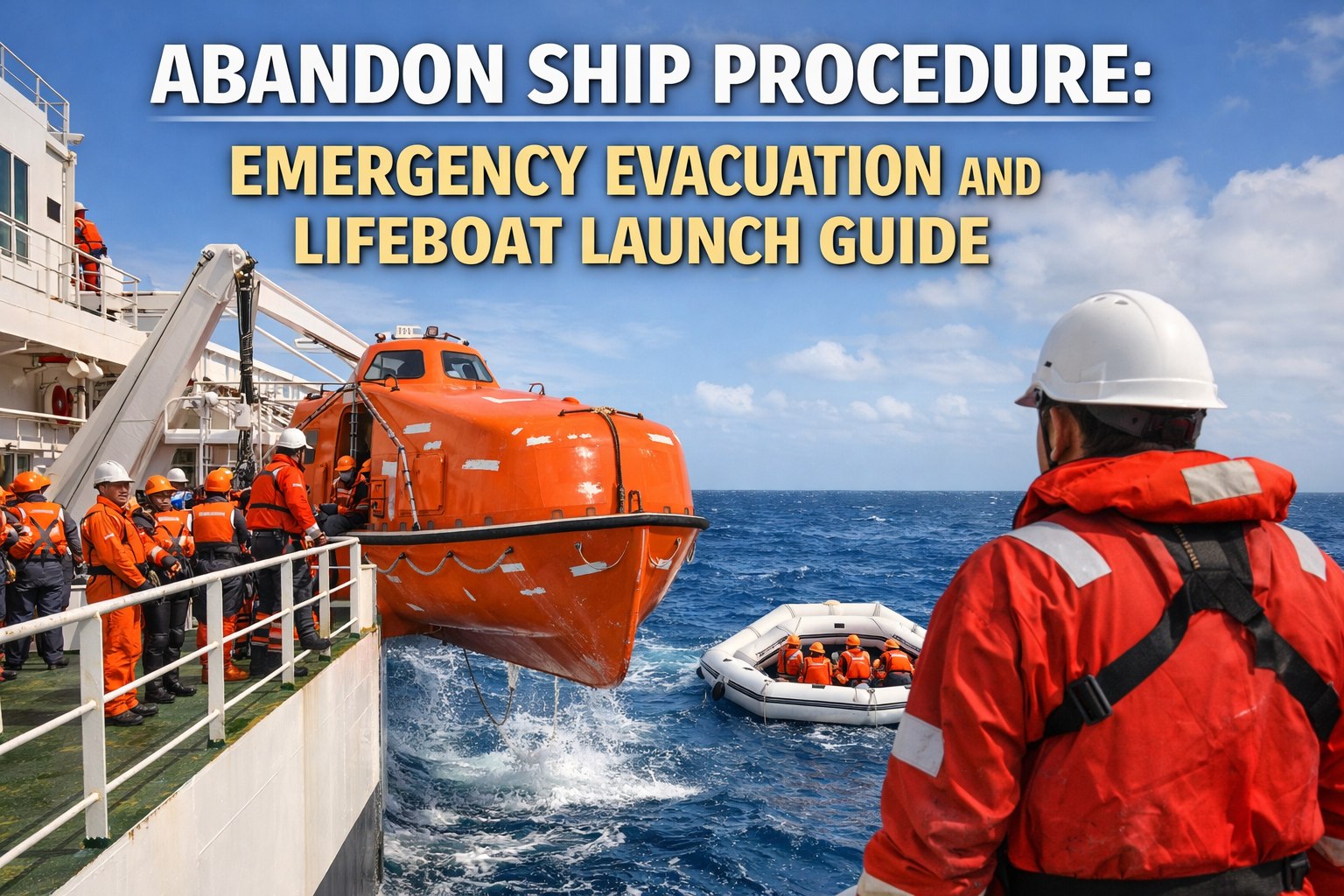
The annual winch brake test lowers the empty craft or an equivalent load, and the brake is applied abruptly at maximum lowering speed before the craft enters the water. Release gear checks follow the brake test. The on-load release test is done partly waterborne, with the falls bearing the boat's mass, and the off-load test fully waterborne. The diagram below shows the three positions.
The Five-Yearly Overhaul and Load Test: What Gets Loaded and How Hard
Which tests use a 1.1 times load, and where the 200 percent static limit comes from
MSC.402(96) sets the five-yearly winch proof load at 1.1 times the weight of the craft plus its full complement and equipment, with the brake applied abruptly at maximum lowering speed. Release gear is dismantled, checked for tolerances, adjusted after assembly and tested at 1.1 times the load. A Bermuda notice sets out methods for applying the load, including a combined method with crane capacity of at least 2.2 times the loaded boat weight, and a static alternative that must not exceed 200%.
How the five-year cycle builds up to one heavier year, and what to plan in the year before
Each of the first four years carries the annual examination, then the fifth carries the annual work plus the overhaul and load test and the latest date for fall renewal. Plan the fifth year early: authorised providers and crane or test weights have to be arranged, and a flag-state notice we read allows little room to move the date.
Fall Wires: Renewal, Terminations and What the Inspector Looks For
When falls must be renewed, and what the Barbados bulletin says about end-for-end turning
Barbados Bulletin 016, Rev. 1.1 (effective 10 December 2025) quotes SOLAS III/20.4: deteriorating falls must be renewed as necessary or at intervals of not more than five years, whichever is earlier. It says end-for-end turning at an intermediate point is no longer required, and that if a company chooses to end-for-end its wires, it must control the joining and termination method. Bulldog grips are not acceptable for primary load-bearing terminations.
How to record wire inspections so the renewal date and wire certificate are easy to prove
The Bermuda notice says the annual examination includes verification of fall wire replacement and that the installed wire's safe working load suits the application. Keep the wire certificate, installation date and each inspection together, and note the renewal due date. This is the single most useful record to hold when a surveyor asks how old the wires are.
In practice, the five-year year is also when the paperwork is most likely to slip. The release gear overhaul, the proof load test, the fall renewal and the statement of fitness are separate items with separate people. Put all four on one task list with one owner, and attach the signed report and the statement as soon as they arrive, so the record is complete before the service provider leaves the ship. This is our suggestion, not a regulatory text.
Rescue Boat Davits and Free-Fall Release: How the Rules Differ
What the Barbados bulletin says about on-load release gear on rescue boats
The bulletin says on-load release mechanisms are not required by SOLAS or the LSA Code for rescue boats, but recommends they meet LSA Code section 4.4.7.6. Annual and five-year examinations, overhauls and overload tests for rescue boats and their launching appliances and release gear must be done by an authorised provider. For free-fall lifeboats, the Bermuda notice says the release function must be tested every five years at 1.1 times the boat's weight, without launching.
Weekly and monthly checks are the part crews see most often and record least well. MSC.402(96) says they follow the maintenance manual and are tied to SOLAS III/20.6 and III/20.7, but we did not find the item lists in the sources we read. Whatever your manual lists, record each check with a date and a name, and photograph anything that looks different from last time. A dated photo of a worn brake pad or a rusted sheave is far more convincing than a ticked box.
Records, Test Preparation and the Five-Year Checklist
What to prepare before the test and what the provider must leave behind
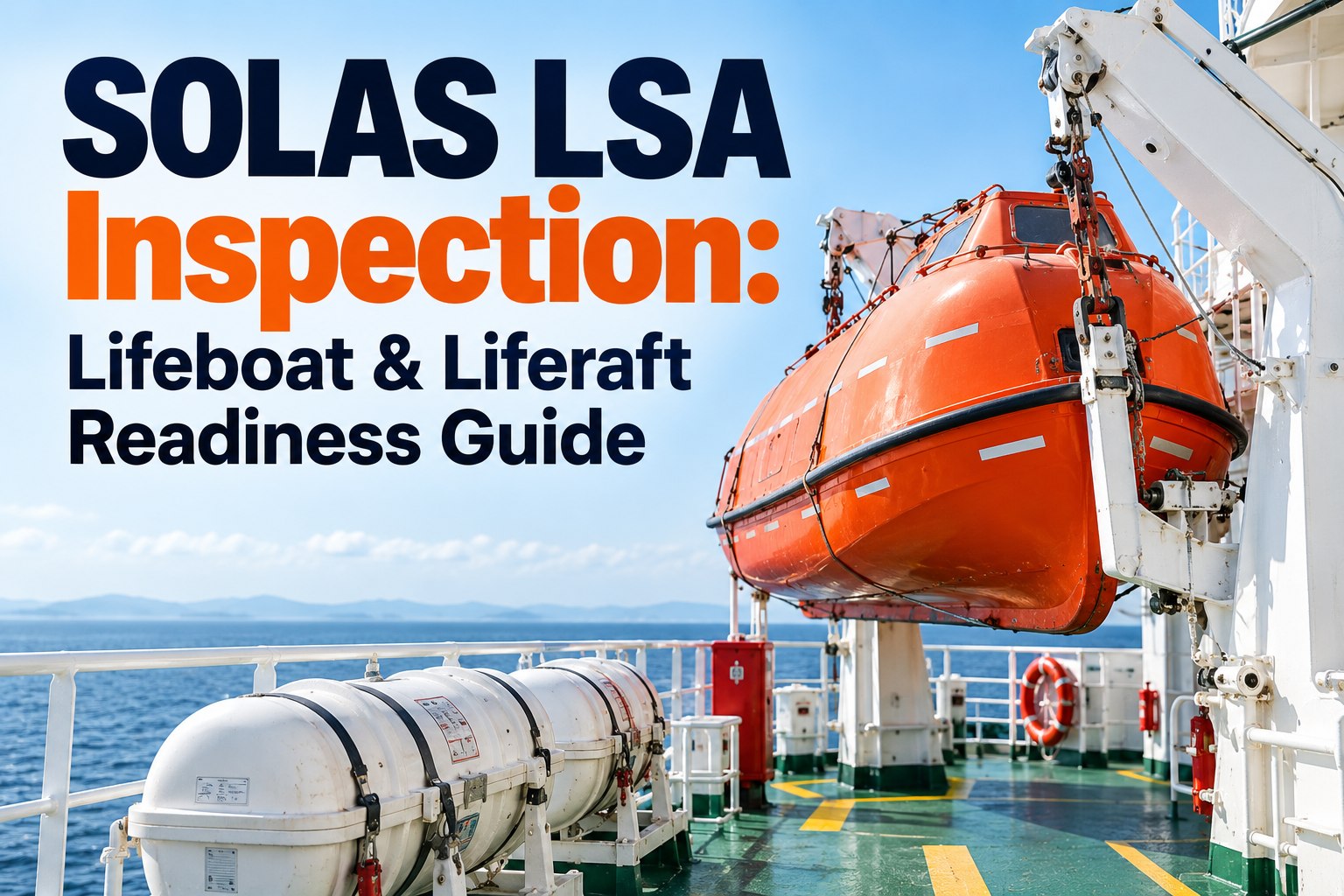
The Bermuda notice says lifeboats must be weighed before testing, and that any weight increase must be recorded, investigated and reported. Load testing is also required after replacing winch or davit holding-down bolts, reinstalling davits, renewing load-bearing structure or completing modifications. After the work, reports must be signed by the person doing it and countersigned by the company representative or the Master. For the ship's readiness more widely, see our SOLAS LSA inspection: lifeboat and liferaft readiness guide.
| Item | Why | Checkpoint type |
|---|---|---|
| Weigh the lifeboat before testing | Any weight increase must be recorded, investigated and reported to the flag state (Bermuda notice) | Measure |
| Confirm the tester's authorisation | Five-yearly work must be by the manufacturer or an authorised provider | Record |
| Agree who is the officer in charge | The test is done by the provider with a ship's officer in charge | Record |
| Confirm test method and crane capacity | Combined method needs crane capacity of at least 2.2 × the loaded boat weight (Bermuda notice) | Measure |
| Reinspect stressed structure afterwards | MSC.402(96) says to reinspect stressed structural parts where possible | Visual |
| Collect the signed report and statement | Signed by the person doing the work and countersigned by company representative or master, kept on board | Record |
Mistakes That Leave Davit Tests Valid on Paper and Weak on the Day
Six gaps that surveyors find in launching appliance records and routines
Systems That Keep Davit, Wire and Release Gear Dates Together
How a dated photo repository, task ownership and deadlines make LSA testing visible
Davit testing is a long cycle with many small dates: weekly and monthly checks, the annual examination, wire renewal and the five-year load test. Marine Inspection supports a dated photo repository, observations turned into tasks with owners, deadlines and evidence, and certificate and equipment tracking. That keeps the cycle visible, so the fifth-year work is planned, not discovered.