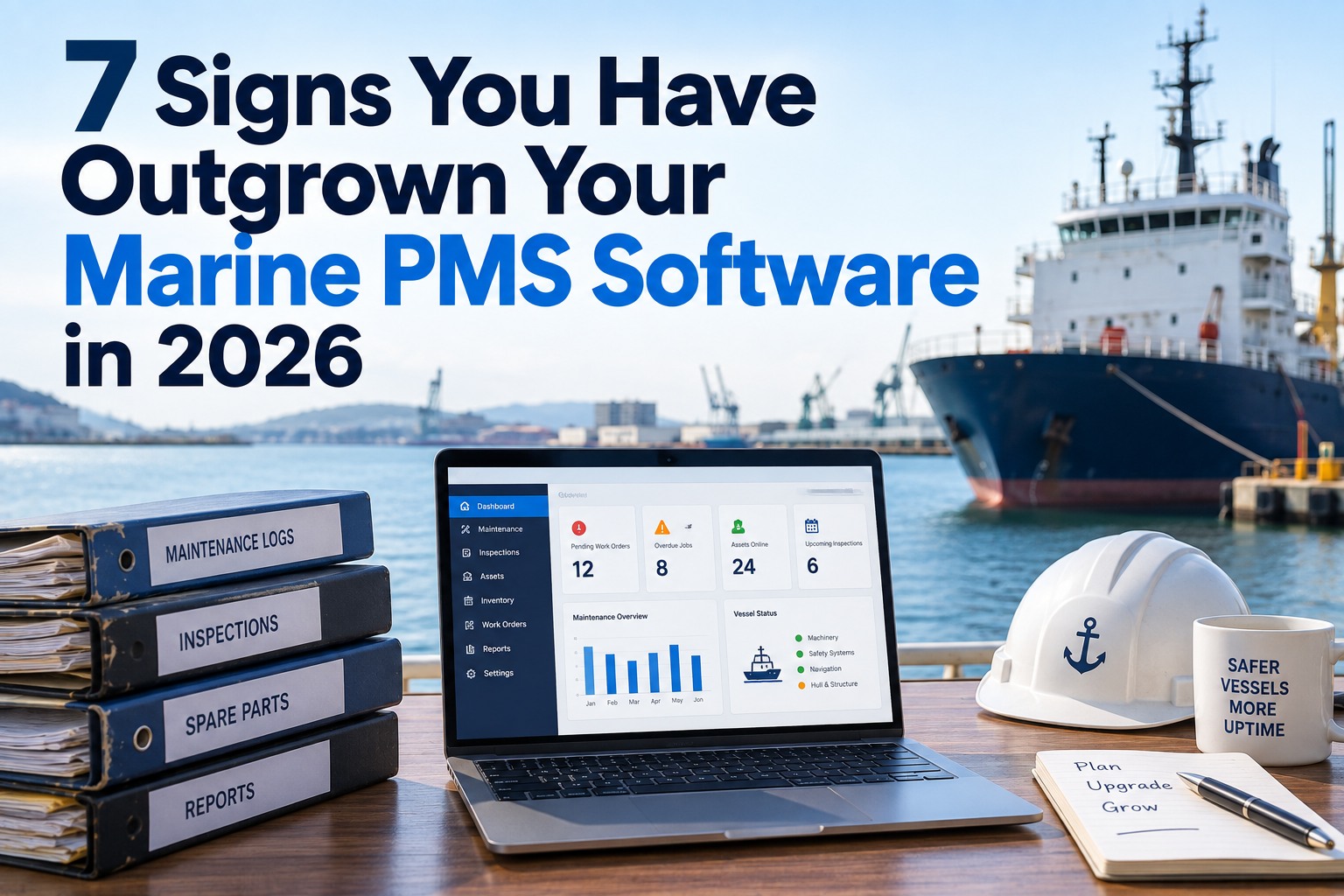
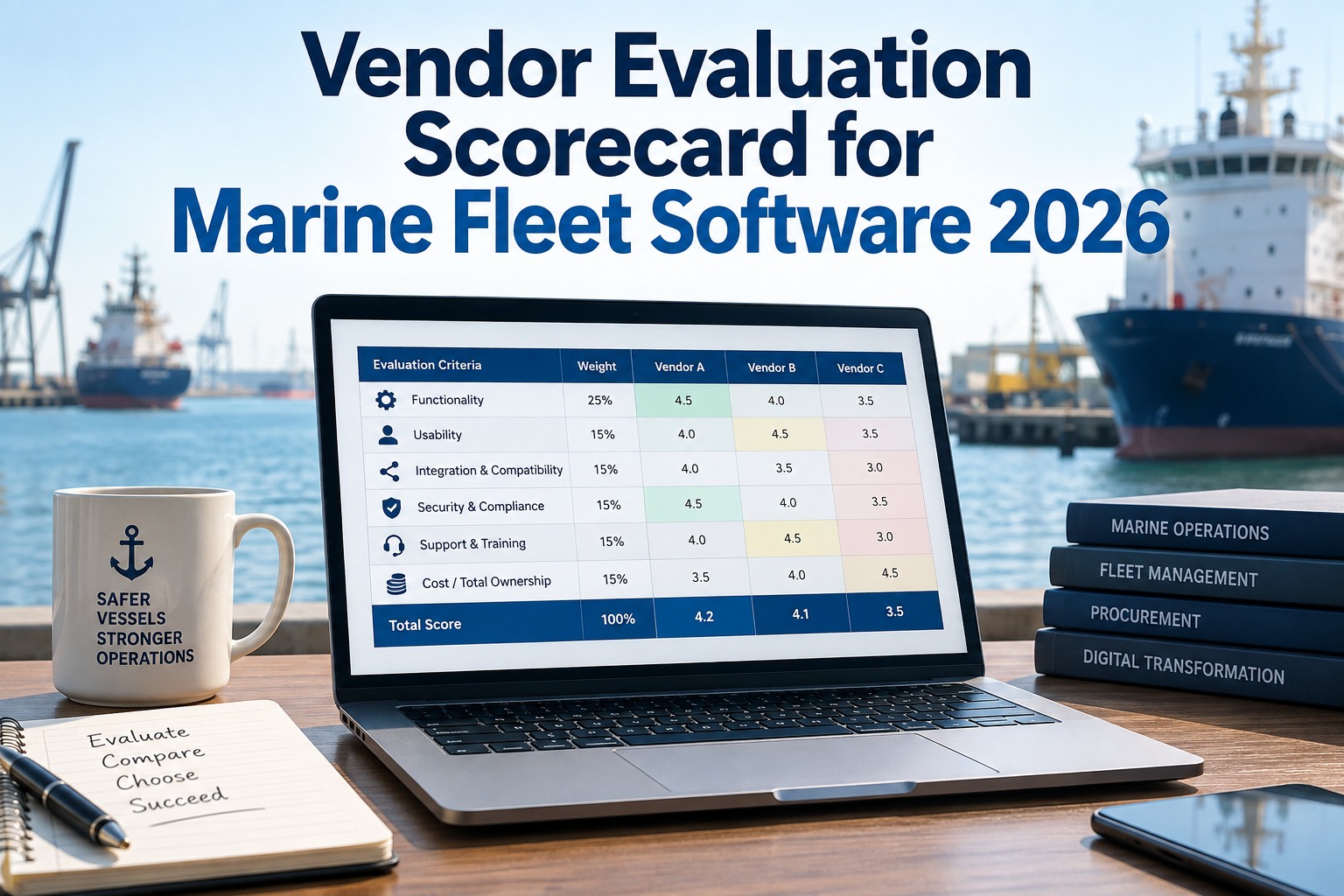
Planned maintenance software rarely fails all at once. It gets outgrown. The fleet adds vessels and types, the office adds people, class and charterers ask for more evidence, and the system that worked for eight ships quietly turns into the bottleneck for twenty. Nobody decides to run maintenance on spreadsheets. It just happens, one workaround at a time, until the superintendent spends the week before every survey rebuilding reports and the chief engineer closes a month of jobs on the night before the auditor boards. Under ISM Code element 10, a functioning maintenance system is not optional, and class surveyors and PSC officers read its outputs as evidence of how the ship is run. The seven signs below show when the software, not the crew, has become the problem. Tick the ones you recognise, and if the total is high, try Marine Inspection free on one vessel and compare the difference.
Is it the crew, the setup, or the software?
Most PMS problems start as a setup issue and end as a software one. Count the signs honestly. Two or three usually point to configuration and training, while four or more usually mean the system itself has reached its limit.
07 signs
0–1 Healthy
2–3 Fix the setup
4+ Outgrown
Quick self-check
Tick every statement that is true for your fleet today. The counter below the list adds them up. Be strict: "sometimes" counts.
The seven signs, and what each one is costing you
Each sign starts with something the crew or office actually says. Below that is what is going on underneath, and what a system that fits your fleet does instead.
1
Overdue jobs nobody sees until the auditor does
"We didn't know the purifier overhaul was two months late until the surveyor asked."
What is happeningThe system lists overdue jobs but escalates nothing. Nobody ashore gets told, and deferrals have no reason or approval attached. Overdue task ratios are tracked as an industry performance indicator for a reason: they predict inspection outcomes.
What fits betterAutomatic escalation to the chief engineer and then the superintendent, deferrals that need a reason and sign-off, and a live overdue count per vessel ashore.
2
Spreadsheets live beside the system
"The PMS has the jobs, but the real spares list is in my Excel file."
What is happeningEvery spreadsheet marks a job the PMS cannot do, usually spares, running hours or deferral tracking. The two sources drift apart, and the version a surveyor sees depends on who prints it. Our comparison of
spreadsheets versus inspection software puts numbers on that drift.
What fits betterSpares, counters and deferrals in the same record as the job, so closing a job updates stock and history at once.
3
Reports rebuilt by hand
"Survey prep means two days of exporting, pasting and formatting."
What is happeningIf the fleet overview only exists after someone assembles it, management is always looking at last month. Classification societies are moving the other way. DNV, for one, lets its surveyors review PMS data for a whole fleet remotely, which needs structured data rather than PDFs.
What fits betterFleet dashboards and survey packs generated from live records. See how
Marine Inspection reports are built from the same data the crew enters.
4
Ship and shore see different numbers
"The office says we have twelve overdue. My screen says seven."
What is happeningOlder ship and shore setups replicate databases on a schedule, or by email packets. When a sync fails or runs late, the two copies disagree and every conversation starts with whose number is right.
What fits betterOne record, cached offline on board and synced automatically when connectivity returns, with conflicts kept and flagged rather than overwritten.
Where each sign hurts most
Compliance risk
High risk, low visible cost
High risk, high cost
Lower risk, low cost
Lower risk, high cost
1
2
3
4
5
6
7
Hidden cost in staff time and workarounds
Our assessment, for comparison between signs, not measured data. Signs in the top half show up in audits, and signs on the right show up in overtime.
5
Jobs closed in batches at month end
"I do all the closures on the last night of the month, it's quicker."
What is happeningWhen the only terminal is a desktop in the ship's office, work gets recorded from memory later. Surveyors read timestamps, and records keyed in bulk just before an audit are a common reason class suspends credit under an approved PMS scheme.
What fits betterClosing the job on a phone at the machine, offline, with the time recorded when the work was done.
6
Every new vessel is a project
"The new bulker has been in the fleet three months and still isn't set up properly."
What is happeningIf each ship needs the vendor to build its equipment tree and job library, growth outpaces the system. Asset trees also end up coded differently on every ship, so fleet comparisons stop working.
What fits betterReusable templates by vessel type, imports from equipment lists, and a standard coding scheme across the fleet.
7
A closed job proves nothing
"The job says done. There's no photo, no reading, and anyone could have edited it."
What is happeningClass surveys under an approved scheme check the evidence of maintenance, not the fact that it was scheduled. A record without readings, photos and a trace of later edits is weak evidence for class, for PSC and in a claim.
What fits betterRequired readings and photos on critical jobs, and an amendment trail that shows who changed what and when. Read more in our
PMS requirements guide.
See all seven fixed on one screen. In a 30-minute demo we close a job offline on a phone with photos and readings, show the escalation when it runs late, and pull a survey pack from live data.
Outgrown, or just badly set up?
Not every sign means new software. Some come from a poor setup or missing training, and those can be fixed in weeks at no licence cost. Try the fix in the middle column first. If it does not hold within a quarter, the system is the limit.
| Sign | Try this first | Replace the system if |
| 1Overdue jobs unseen |
Set up alerts and a weekly overdue review by the superintendent |
The system cannot escalate or record deferral approvals |
| 2Spreadsheets beside it |
Move spares and counters into the PMS modules you already own |
Those modules do not exist or cannot link to jobs |
| 3Reports by hand |
Build saved reports and templates |
Fleet-level views need a separate database or vendor work |
| 4Ship and shore disagree |
Fix replication schedules and check failed syncs |
Replication still breaks on low bandwidth |
| 5Batch closures |
Add a second terminal and set a closure rule in the SMS |
There is no mobile or offline way to close jobs |
| 6Slow vessel setup |
Build type templates from your best-configured ship |
Templates and imports are not supported |
| 7No evidence |
Make readings mandatory on critical job cards |
Photos, mandatory fields or an amendment trail are not possible |
What your score means
Use the self-check total as a starting point for the conversation with your technical director, not as a verdict.
0–1Healthy
Keep the system, and track overdue ratios monthly so drift shows up early.
2–3Fix the setup
Work through the "try this first" column for one quarter, then run the check again.
Frequently asked questions
How do I know if the problem is the software or the crew?
Try the setup fixes in the table first. If the crew still works around the system after training and proper configuration, the software is the limit, not the people.
Is it risky to replace a PMS on a ship under an approved scheme?
It needs planning. Class must accept the new software, and the job history must stay continuous. Time the cutover away from survey windows and speak to class early.
Can we keep our maintenance history if we move?
Yes, if the export is complete. Check that attachments, readings and notes come across, and keep the old system read-only for audits.
What should we test first in a new system?
Offline job closure on a phone, escalation of overdue jobs and the amendment trail. Our 20 demo questions cover these in detail.
Stop working around your PMS
Marine Inspection runs planned maintenance, defects, spares and inspections in one offline-first system that crews use at the machine and superintendents see live ashore.
Offline job closure with photosOverdue escalation and deferralsSurvey packs from live data