Standing up a fleet in 2026 means standing up a compliance system at the same time, and most new operators discover the sequencing problem the hard way. You cannot trade internationally without a Document of Compliance, you cannot hold that document without a functioning Safety Management System, and you cannot demonstrate a functioning system without records that only software produces at any workable scale. The regulator does not wait for a company to grow into its systems. An interim Document of Compliance runs for twelve months and an interim Safety Management Certificate for six, so the audit that tests whether your management system genuinely works arrives well inside your first year of trading. Meanwhile the practical questions pile up: which systems are actually mandatory versus merely useful, whether to buy one integrated platform or assemble best-of-breed tools, what to spend before the first vessel earns anything, and what can safely wait until the third or fourth ship. This guide answers those questions directly — the minimum viable software stack for a new marine fleet operator, organised in layers, with the order to buy it in. To see what a compliance-ready stack looks like running on a first vessel, book a demo or start a free trial.
BUYER RESOURCE · NEW OPERATORS
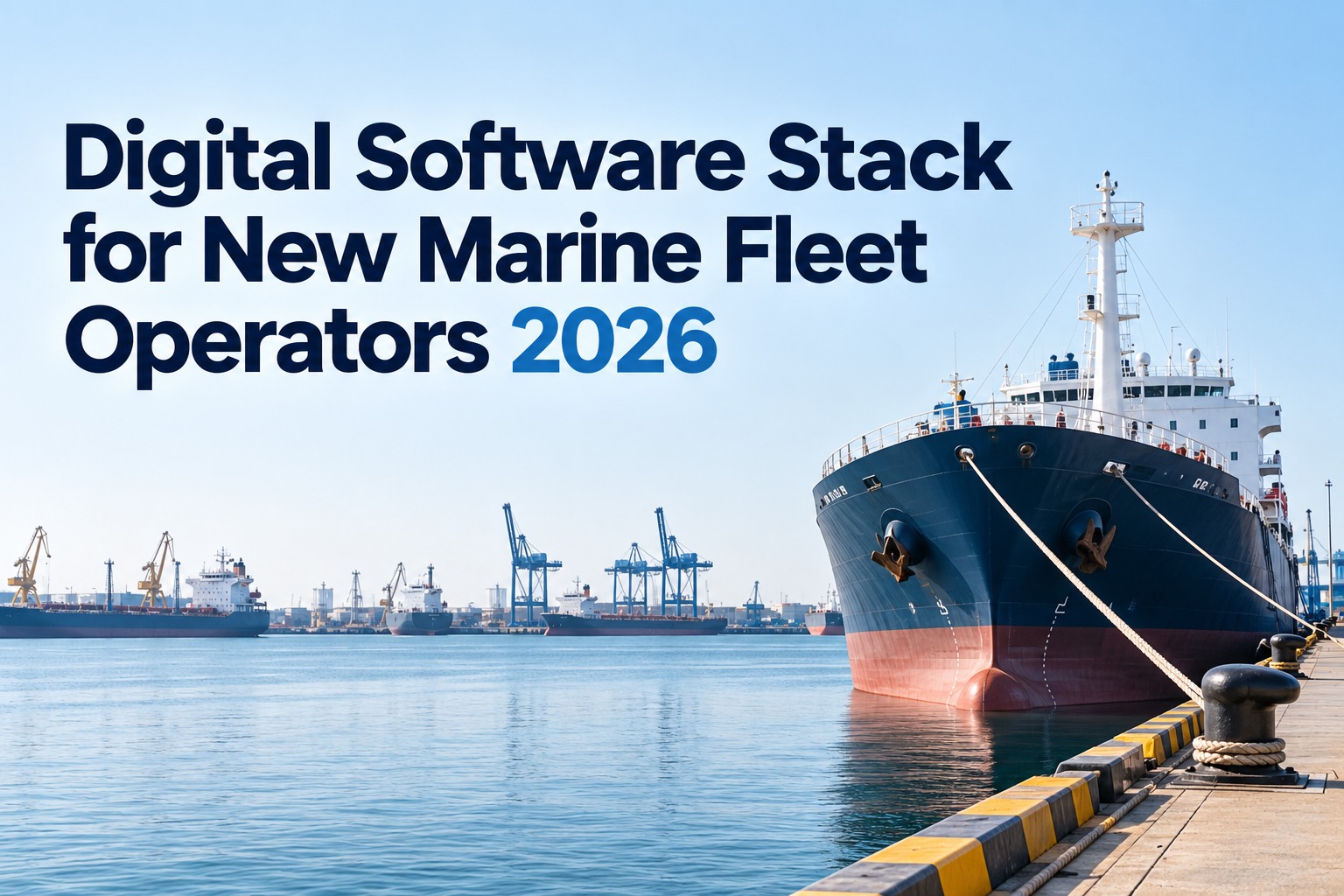
The Digital Software Stack for New Marine Fleet Operators in 2026
The minimum viable stack for compliance, maintenance and crewing — organised in three layers, with the order to buy it in, what is genuinely mandatory, and what can wait until the fleet grows.
Layer 1Compliance and maintenance — mandatory before you trade
Layer 2Crewing and procurement — operational leverage
Layer 3Commercial and finance — buy when scale demands it
The Clock That Starts on Day One
Before choosing any system, understand the deadlines the software exists to serve, because they define what must be working and by when. The ISM Code, made mandatory through SOLAS Chapter IX, applies to all passenger ships and all cargo ships of 500 gross tons and above on international voyages. It requires the company to operate a documented Safety Management System, appoint a Designated Person Ashore, hold a Document of Compliance, and ensure every vessel holds a valid Safety Management Certificate. These are not paperwork; they are the operating licence for international trading.
12 months
Interim Document of Compliance
Issued to a new company, after which the full DOC requires a verified, working system. The full certificate runs five years with annual verification.
6 months
Interim Safety Management Certificate
Issued per vessel, with the full SMC valid five years and an intermediate verification between the second and third anniversary.
3 months
Major non-conformity correction
A major non-conformity must be corrected within this window, or the Document of Compliance and Safety Management Certificate are withdrawn.
The consequence for a new operator is that the systems producing your evidence must be running from the beginning, not retrofitted before the first audit. And the bar has risen: recognised organisations now expect documented evidence rather than asserted compliance, and spreadsheet-based safety-management administration does not survive a serious audit. That single fact is what makes software a founding decision rather than a later efficiency purchase.
Layer One — The Non-Negotiables
The first layer is what you cannot legally or practically trade without. For a new operator, this is the whole of the minimum viable stack, and everything above it is optimisation.
Layer 1
Planned maintenance system
Under ISM Element 10, a functioning planned maintenance system with critical-equipment identification is mandatory for every vessel covered by the SMS. This is not optional operational software — it is a regulatory requirement verified during ISM audits, class surveys, flag inspections and Port State Control boardings, and a poorly functioning system draws non-conformities that can escalate and threaten the vessel's certificate.
Inspections and QHSE
Digital inspection capture, non-conformity workflows tracked from identification through root cause to evidenced closure, drill scheduling against required frequencies, and incident reporting. This is what proves the SMS is implemented rather than merely written, which is the core thing an auditor tests.
Certificate and survey tracking
Every statutory and class certificate with expiry alerting, plus class survey windows, so nothing lapses unnoticed. An expired certificate found on inspection is among the most avoidable and expensive findings a new operator can collect.
Document control
ISM Element 11 requires SMS documents to be controlled, current, available and reviewed, with updates pushed to vessels and acknowledgment captured. Element 12 adds internal audits at intervals not exceeding twelve months and an annual management review, both of which need scheduling and evidence.
Notice that these four are really one system in most modern platforms — inspections, maintenance, certificates and document control share the same underlying records, and separating them creates reconciliation work a small team cannot afford. To see this layer running as one system, book a demo or start a free trial.
Layer Two — Operational Leverage
The second layer is not mandatory to hold a certificate, but it is what stops a growing operation from drowning in manual coordination. Most operators add these once the first vessels are trading steadily.
Layer 2
Crewing and certification
Tracking that every deployed seafarer holds valid documentation and meets the certificate-matrix requirements for the vessel type, alongside rotation planning. STCW and MLC obligations make this unavoidable in substance even before it is worth dedicated software, and a certificate gap discovered at a port call is an operational emergency.
Procurement and spares inventory
Requisitions, purchase workflow and onboard inventory control. The value multiplies when it connects to maintenance: a defect raised aboard becomes a work order and then a spare-part requisition without anyone rekeying it, which is precisely the integration that separate systems cannot deliver.
Vetting readiness
If you intend to fix cargo with major energy or bulk charterers, readiness for SIRE 2.0 on tankers or the RightShip inspection framework on dry bulk is commercially decisive rather than optional, and preparation runs off the same inspection and corrective-action records Layer One already holds.
Start with the layer that is mandatory
Maintenance, inspections, certificates and document control are what the first audit tests — and they are the layer a new operator cannot defer. Marine Inspection covers Layer One as a single system with offline capture and audit-ready evidence, so a first vessel is compliant from the day it trades.
Book a demo to scope it for your fleet, or
start a free trial and load your first vessel.
Layer Three — Buy When Scale Demands It
The third layer covers commercial voyage management, chartering, accounting and payroll, and the heavier analytics and integration capabilities. These matter enormously at scale and almost not at all on day one.
The trap for new operators is buying this layer early, usually by purchasing an enterprise suite that bundles everything on the theory that it saves a migration later. In practice, the enterprise tier carries a steep learning curve from extensive features, opaque pricing, long implementation timelines and complexity a small team will not use, and the modules that would eventually justify it sit idle while the monthly cost does not. Voyage, chartering, accounting and crewing systems are each built around a different user, a different time frame and a different source record, so bundling them does not automatically make them work together anyway. The better path for a small fleet is to run Layer One properly, add Layer Two as the operation demands it, and reach for commercial and finance systems when the volume genuinely justifies them — by which time you will know exactly what you need rather than guessing.
The Order to Buy In
Sequencing matters as much as selection, because a new operator's constraint is attention as much as budget. This is the order that consistently works.
Before the first vessel trades
Stand up the Layer One system — maintenance, inspections, certificates, document control — and configure it around your actual SMS procedures rather than generic templates. This is the system your interim certification will be audited against, so it needs real records accumulating from the first voyage.
First three months
Get crew genuinely using it, on the devices they carry, offline. Adoption is the whole value: a platform the crew work around produces no evidence, and evidence is the entire point. Train hands-on aboard rather than in a classroom.
Before the first full audit
Verify the system produces what an auditor asks for — non-conformities closed with root cause and evidence, drills scheduled and recorded, documents current and acknowledged, maintenance history retrievable per component.
As the second and third vessels arrive
Add Layer Two where the manual load is heaviest — usually crewing certification first, then procurement and spares once inventory across multiple ships becomes unmanageable by spreadsheet.
When volume justifies it
Introduce Layer Three commercial and finance systems, chosen against a workflow you now understand from experience rather than a feature list you guessed at during formation.
One Platform or Best-of-Breed
The perennial question is whether to buy a single integrated suite or assemble specialist tools. For a new operator the honest answer is neither extreme: buy one system that covers Layer One completely, and add specialist tools above it as needed.
The reason to keep Layer One integrated is that its components genuinely share data. A defect raised during an inspection should become a work order in the maintenance system and, later, a spare-part requisition, without anyone retyping it — and when those functions sit in separate products, the data is trapped in silos and your maintenance history cannot talk to your procurement position. That reconciliation burden is precisely what a small shore team has no capacity to absorb. Above Layer One, however, integration matters far less than fit: a specialist crewing or accounting tool that suits your operation is usually better than a mediocre module inside a suite, provided the boundaries are clear. The practical test when evaluating anything is to walk a real workflow end to end with the people who will use it daily, push a difficult exception through it, and confirm how data crosses each system boundary. And for anything going aboard a vessel, offline capability with ship-to-shore synchronisation is non-negotiable, since connectivity at sea is intermittent and a cloud-only tool simply stops working where the work happens. To test that end-to-end workflow on your own first vessel, book a demo or start a free trial.
What New Operators Get Wrong
A handful of mistakes recur among first-time fleet operators, and all of them are avoidable with foresight.
Running the SMS on spreadsheets and shared folders, then discovering at the first external audit that asserted compliance without documented evidence does not pass.
Buying an enterprise suite far too early, paying for modules that sit unused while implementation consumes months the company does not have.
Treating the planned maintenance system as an efficiency tool rather than the regulatory requirement it is under ISM Element 10.
Choosing a platform without genuine offline capability, then finding the crew revert to paper wherever the signal drops, which is where most inspection work happens.
Deferring crew adoption, so records exist in theory but the system holds no real evidence when the auditor arrives.
Ignoring vetting readiness until a charterer asks, by which time the inspection and closure history the screen reads has already been written.
The unifying lesson is that a new operator's software decision is really a decision about evidence. The certificates that permit trading, the vetting screens that permit chartering, and the inspections that permit port calls all read records your systems either captured or did not. Start with the layer that generates those records, get the crew using it, and add the rest as the fleet earns its way into needing them. To build that foundation from the first vessel, book a demo or start a free trial.
Frequently Asked Questions
What software is legally required to operate a fleet?
No regulation names a software product, but the ISM Code requires outcomes that are impractical to achieve without one. Under Element 10 a functioning planned maintenance system with critical-equipment identification is mandatory for every vessel covered by the Safety Management System, and it is verified during ISM audits, class surveys, flag inspections and Port State Control boardings. Element 11 requires SMS documentation to be controlled, current, available and reviewed, and Element 12 requires internal audits at intervals not exceeding twelve months plus a management review. Add non-conformity tracking from identification through root cause to evidenced closure, drill scheduling and certificate management, and you have described a system. The practical position in 2026 is that recognised organisations expect documented evidence rather than asserted compliance, and spreadsheet-based administration does not survive a serious audit.
How quickly does a new operator face its first real audit?
Very quickly, which is why systems must run from day one. A new company receives an interim Document of Compliance valid for twelve months, and each vessel an interim Safety Management Certificate valid for six months, before the full certificates are issued following verification that the management system genuinely works. The full DOC then runs five years with annual verification, and the full SMC five years with an intermediate verification between the second and third anniversary. So the audit that tests whether your SMS is real arrives inside the first year of trading, and it examines records that must already exist by then. A major non-conformity must be corrected within three months or both the DOC and the SMC are withdrawn, which makes the evidence trail from the very first voyage genuinely consequential.
Should a small operator buy an all-in-one enterprise suite?
Usually not at the start. Enterprise suites bring a steep learning curve from extensive features, opaque pricing, long implementation timelines and considerable complexity, and they are generally less suited to small fleets — meaning a new operator pays for modules that sit unused while implementation consumes months. Bundling also does not guarantee the parts work together, since voyage, chartering, accounting and crewing systems are each built around a different user, time frame and source record. The better path is to buy one system that covers the mandatory layer completely — maintenance, inspections, certificates and document control — then add crewing and procurement as the operation demands, and commercial or finance systems only when volume justifies them. By that point you will be choosing against a workflow you understand from experience rather than guessing at formation.
Which system should a new operator buy first?
The compliance and maintenance layer, before the first vessel trades. That means the planned maintenance system, digital inspections and non-conformity workflows, certificate and class-survey tracking, and controlled SMS document management — ideally as one integrated system, since these components share the same underlying records and separating them creates reconciliation work a small shore team cannot absorb. This is the layer your interim certification will be audited against, so it needs genuine records accumulating from the first voyage rather than being retrofitted before the audit. Everything else, including crewing, procurement, commercial and finance systems, is optimisation that can follow once the mandatory foundation is running and the crew are actually using it.
What should a new operator look for when evaluating platforms?
Small operators should prioritise usability, maintenance tracking, inspections, document control and offline access above feature breadth. Offline capability with ship-to-shore synchronisation is non-negotiable, because connectivity at sea is intermittent and a cloud-only tool stops working exactly where inspection and maintenance work happens. Beyond that, the most reliable evaluation method is to walk a real workflow end to end with the people who will use it daily, push a difficult exception through it, and confirm how data crosses each system boundary — rather than comparing feature lists. Check that a defect raised aboard flows into a work order and onward to a spares requisition without rekeying, since that integration is where the practical value sits. Finally, confirm pricing and contract terms in writing, and favour transparent per-vessel pricing with the flexibility to grow.
When does vetting readiness become a concern?
Earlier than most new operators expect, because vetting screens read history rather than current state. If you intend to fix cargo with major energy or bulk charterers, readiness for SIRE 2.0 on the tanker side or the RightShip inspection framework on dry bulk is commercially decisive, and both are effectively required for chartering with those counterparties. The important point is that the inspection record, deficiency trends and quality of corrective-action closure that a vetting screen assesses are generated by ordinary operations long before any charterer looks at them. This means the Layer One system you install at formation is already writing your future vetting profile from the first voyage. Building that record properly from the start costs nothing extra; reconstructing it later is not possible, which is why vetting readiness belongs in the founding systems decision rather than a later commercial one.
Build the Foundation Before the First Voyage
A new operator's software decision is a decision about evidence. The certificates that permit trading, the vetting screens that permit chartering and the inspections that permit port calls all read records your systems either captured or did not. Marine Inspection covers the mandatory layer as one system — maintenance, inspections, certificates and document control, with offline capture and audit-ready evidence — so a first vessel is compliant from the day it trades and the fleet scales on a foundation that holds.
Book a demo or
start a free trial.