The gangway watch calls the bridge: a port State inspector has arrived. Within minutes the Master is the person who sets the tone, produces the documents, decides what to disclose and how to respond to every finding. Can the ship be ready in advance, and what do inspectors actually find? This guide, written for the Master, covers how likely an inspection is, what the 2025 Paris MoU figures show, a documents-and-walkaround checklist with a checkpoint type on every item, the cargo securing campaign running now and how to manage the visit from opening meeting to report. For the wider guide, see our complete port state control preparation guide for ship masters.
How Likely Is an Inspection: Risk Profile, Windows and Triggers
Three risk ratings, three inspection windows
The Paris MoU rates ships as high, standard or low risk using inspection history and generic factors such as age and ship type. The windows run from the last inspection in the region. A ship that arrives inside its window may be inspected at the port State's discretion. A ship that arrives after the window must be, and an overriding factor can make an inspection mandatory regardless of dates. The chart shows the windows. The profile also reflects flag, recognised organisation and company performance, and the Paris MoU says recognised organisation performance lists feed ship risk profiles from 1 July 2026, per IIMS.
Overriding and unexpected factors, and what the Master can influence
The West of England P&I Club's description of the regime, written when the new inspection regime started in 2011, lists overriding factors such as suspended class, a collision or grounding on the way in and an alleged discharge violation, and unexpected factors such as a report from a pilot or an outstanding deficiency. The Master cannot change the ship's age or flag but can control the last two items on the table: outstanding deficiencies and notice before entry.
| Factor | What the sources say | How old is the source |
|---|---|---|
| Time since the last inspection | Inspection is required once the risk window is passed. ANAVE advises that inspection is likely if more than 12 months have passed | Paris MoU current. ANAVE undated |
| Overriding factors, Priority I | Suspended or withdrawn class, reported by another State, collision, grounding or stranding on the way in, alleged discharge violation, erratic navigation | West P&I, describing the 2011 regime |
| Unexpected factors, Priority II | Reports from pilots or port authorities, a complaint, outstanding deficiencies, cargo problems, detained more than three months earlier | West P&I, describing the 2011 regime |
| Ship profile | Flag State on a black list, ship over 10 years old, class deficiency ratio above average, detained or deficiencies in the last 12 months, outstanding deficiencies | Lloyd's Register and UK P&I Club, 2011 |
| Notice before entry | Report broken or missing equipment or damage to the port authority before entry. If notice is not given the port State has clear grounds to inspect | Lloyd's Register and UK P&I Club, 2011 |
What Inspectors Find: The 2025 Figures and the Older Checklists
Fire safety leads, and the same areas keep recurring
The Paris MoU 2025 report page gives fire safety under SOLAS chapter II-2 at 16.8% of non-compliance, structural and electrical items under chapter II-1 at 11.6%, and health protection, medical care, welfare and social security under MLC Title IV at 10.0%. ISM-related deficiencies were 4.5% of the total. Fire doors were 3.1% and Seafarers' Employment Agreements 1.3%. The detention rate was 4.18%, up from 4.03%, and bans numbered 19, a rise after several years of low figures. The inspection and detention counts come from IIMS's summary of the report, not the page we read directly.
A historic comparison: what the 2011 checklist counted
The Lloyd's Register and UK P&I Club pocket checklist, based on deficiencies on Lloyd's Register classed ships between 2009 and 2011, counted maintenance of ship and equipment at 189 deficiencies, auxiliary engines at 181, lifeboats at 179, nautical publications at 144 and engine room cleanliness at 125. These are old and from one class society's fleet, so we use them only to show that fire, lifesaving, maintenance and engine room items have long been inspector favourites.
The Master's Office: Documents, Records and the Questions Behind Them
Inspectors start with the paperwork, so lay it out first
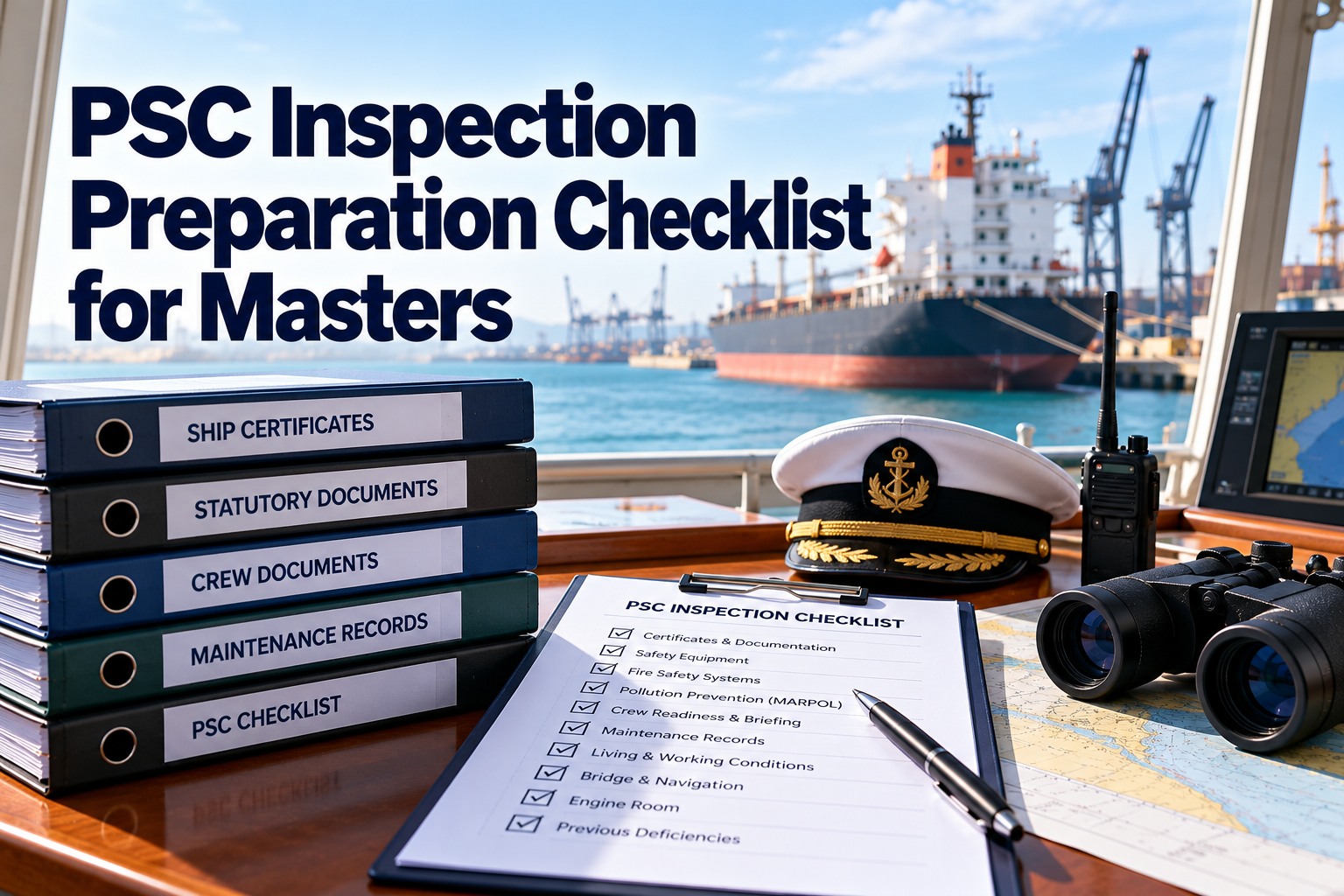
The Lloyd's Register and UK P&I Club checklist says inspectors start in the Master's office, so certificates must be current and valid and the manuals and records required on board must be approved and present. ANAVE adds that documentation should be well organised and lean, and that practical application matters, with the oil record book as its example. The table groups the office items with a checkpoint type for each, so an officer can tick Visual, Test or Record against each one.
| Item | What to check | Checkpoint type |
|---|---|---|
| Certificates | Trading certificates valid, complete and approved. Inspectors start in the Master's office | Record |
| STCW certificates | Certificates for all personnel on board and matching the crew list | Record |
| Safe Manning Document | Original on board and matching the actual manning | Record |
| Rest hour records | Up to date and consistent with the work actually done | Record |
| Drill records | ISM emergency drills regular and documented. Dated photos help | Record |
| ISPS records | Records and arrangements current | Record |
| SOPEP | Approved, current and with correct contacts | Record |
| Oil record book | Entries complete and consistent with tank soundings | Record |
| Previous inspection | Every earlier deficiency confirmed corrected, with evidence | Record |
| Manuals required on board | Approved versions present and the crew can find them | Visual |
The Walkaround: Area by Area, With the Items Inspectors Look At
Bridge, lifesaving, accommodation, deck and machinery
The same 2011 checklist is organised by area. We have condensed it, keeping its items and adding a checkpoint type. Some items are tests, such as starting an emergency pump, and some are visual, such as marking and wastage. Inspectors may also use current campaign questionnaires, so treat the table as a base, not as everything.
| Area | Items the checklist highlights | Checkpoint type |
|---|---|---|
| Bridge | Valid charts and publications, compass deviation card, signals, GMDSS and reserve power, EPIRB and its records, fire detection alarms | Test |
| Life-saving appliances | Lifeboat structure and engine start, inventories and davits, lifejackets and lifebuoys, liferaft hydrostatic release, embarkation arrangements | Test |
| Accommodation | Fire doors close tightly, fire control plan, signs, emergency lighting, sanitary facilities | Visual |
| Deck | Railings and catwalks without wastage, hatch covers weathertight, ventilators and air pipes marked, fire dampers operable, fixed extinguishing bottles dated | Visual |
| Machinery spaces | Emergency fire pump starts and pressurises, emergency generator connects, clean bilges and tank tops, oily water separator and 15 ppm alarm work | Test |
| Steering and emergency lighting | Steering gear, emergency lighting and remotely closed weathertight doors work | Test |
The Current Campaign: Cargo Securing, 1 September to 30 November 2026
What inspectors ask and what documents to have ready
DNV and the Paris and Tokyo MoU announcements describe a joint concentrated inspection campaign on cargo securing, using a questionnaire alongside routine inspections. Hellenic Shipping News summarises the topics: the approved Cargo Securing Manual under SOLAS chapter VI regulation 5, officers' knowledge of the manual and stack and deck limits, cargo plans that match verified gross mass, a Cargo Safe Access Plan where required, the condition of fixed and portable securing equipment, measures to prevent cargo loss and bridge visibility, and heavy weather procedures in the SMS. DNV advises updating the manual for current cargo types, maintaining and replacing lashing gear, and training the crew. We did not see the questionnaire itself, so check the published version.
Briefing the Crew: Roles, Knowledge and Who Speaks
Responsibility by area, English and a speaking order
ANAVE recommends training the Master, chief engineer, deck officers and crew on their responsibilities, and lists knowledge of the SMS, practical application of rules, workwear, ship access and ISPS compliance, and English communication and negotiation skills among the preparation areas. The 2011 checklist says each crew member takes responsibility for their own area. Together they suggest a short pre-arrival briefing that names the escort, who answers questions on which area and the order of speaking. That briefing is our suggestion, not a requirement.
What to do during the visit and at the closing meeting
ANAVE's advice is to make a strong first impression, keep a formal and polite attitude, escort the inspector, let the inspector report deficiencies so they can be rectified immediately or explained and negotiate timetables for repairs that cannot be done on the spot. At the closing meeting, confirm resolved items and clarify each outstanding one with why, what, how and when, and check the report against what was discussed. Before registration, ANAVE says to contest each outstanding deficiency that could lead to detention using technical arguments. If a detention looks likely, the 2011 checklist says to contact class, and the next steps are in your company procedure.
The Master's PSC Readiness Checklist
A checklist with a checkpoint type on each item for the final checks before entry
Use the checklist in the days before arrival. It builds on the lists above and is our template.
| Item | What to check | Checkpoint type |
|---|---|---|
| Risk position | Time since last inspection and any open items checked, so the likelihood of inspection is known | Record |
| Known defects | Any broken or missing equipment reported to the port authority before entry, with class or flag agreement recorded | Record |
| Document set | Office documents laid out in one place and checked against the list above | Record |
| Walkaround by officers | Each officer inspects their own area against the checklist and signs the result | Visual |
| Emergency equipment tests | Fire pumps, emergency generator and steering tested and logged | Test |
| Campaign topic | Documents for the current concentrated inspection campaign, cargo securing, laid out if the ship carries cargo | Record |
| Crew briefing | Roles briefed: who escorts, who answers questions on which area, and the speaking order | Record |
| Opening meeting notes | Class conditions and ISM non-conformities listed to disclose at the opening meeting | Record |
Six Mistakes That Turn an Inspection Into a Detention Risk
What the guidance warns against, in the order they tend to arise
Systems That Keep PSC Preparation and Findings Together
How a dated photo repository, task ownership and deadlines support PSC readiness
Inspectors reward ships that can show they close what they find. Marine Inspection supports a dated photo repository, observations turned into tasks with owners, deadlines and evidence, and certificate and equipment tracking. A dated photo of a closed fire door finding, a task for each walkaround defect with a named owner and due date and tracked certificate expiry give a Master a record to show at the opening meeting. It does not replace the ship's SMS or class. For Tokyo MOU targeting, see our Tokyo MOU port state control inspection regime and targeting system, and for a printable list see our port state control inspections checklist.