Every year, more of the same fire safety items turn up on port State inspection reports: doors that do not latch, ventilation closures that stick, detectors that are covered or disconnected, drills that look good on paper and fall apart on deck. Which items does the evidence say matter most, and what can a ship check before the gangway is lowered? This guide, written for the Safety Officer, uses the joint 2023 fire safety campaign report and the 2025 Paris MoU figures to rank the items, explains each one and sets out a seven-day prevention routine with a checkpoint type on every item. For the wider inspection guide, see our marine fire safety inspections guide for 2026.
Why Fire Safety Leads the Deficiency Tables
Two datasets: the 2025 annual report and the 2023 joint campaign
The Paris MoU 2025 annual report page gives fire safety under SOLAS chapter II-2 as the largest area of non-compliance at 16.8%, ahead of structure and electrical items at 11.6% and welfare under the MLC at 10.0%, with fire doors specifically at 3.1% and ISM-related deficiencies at 4.5%. The detail on individual items comes from the joint Tokyo and Paris MoU concentrated inspection campaign on fire safety, run from 1 September to 30 November 2023. It covered 8,273 inspections, 7,190 of them with the questionnaire, found deficiencies in 1,287 inspections, recorded 2,860 deficiencies of which 572 were grounds for detention and ended in 88 detentions, a campaign detention rate of 1.22%.
The report describes a generally good level of compliance and cautions that the industry had advance notice of the campaign and that most questions are part of a standard initial inspection. We use it for what it shows about inspector focus. Its own text contains small arithmetic inconsistencies in the detention percentages, which we flag rather than repeat.
The League Table: Which Items Produce the Deficiencies and the Detentions
By count of deficiencies recorded
Fire doors and openings in fire-resisting divisions topped the list with 490 deficiencies, followed by fire fighting equipment and appliances, emergency lighting, ventilation closing appliances, fixed fire extinguishing installations, detection, drills and fire pumps. The chart shows the counts. The campaign report names fire doors and fire drills as the main remaining concerns.
By how often a deficiency became a ground for detention
Counts can mislead, because an item that is found often but rarely detainable may matter less than one found less often and detainable more often. We divided detention grounds by deficiencies for each item. On that simple measure fire pumps and pipes and fixed installations stand out, while emergency lighting and portable firefighting equipment are lower. This is our arithmetic on the report's figures, it ignores differences in how inspectors apply the guidance, and it is a way to see priority, not a prediction.
| Item | Deficiencies | Recorded as detention grounds | Ratio (our calculation) |
|---|---|---|---|
| Fire pumps and pipes | 115 | 37 | 32.2% |
| Fixed fire extinguishing installations | 260 | 73 | 28.1% |
| Fire detection and alarm systems | 245 | 61 | 24.9% |
| Fire drills | 238 | 59 | 24.8% |
| Ventilation closing appliances | 336 | 68 | 20.2% |
| Fire doors and openings | 490 | 86 | 17.6% |
| Fire fighting equipment and appliances | 392 | 57 | 14.5% |
| Emergency lighting, batteries and switches | 361 | 42 | 11.6% |
The Items One by One: What Inspectors Find and What Prevents It
Fire doors and openings in fire-resisting divisions
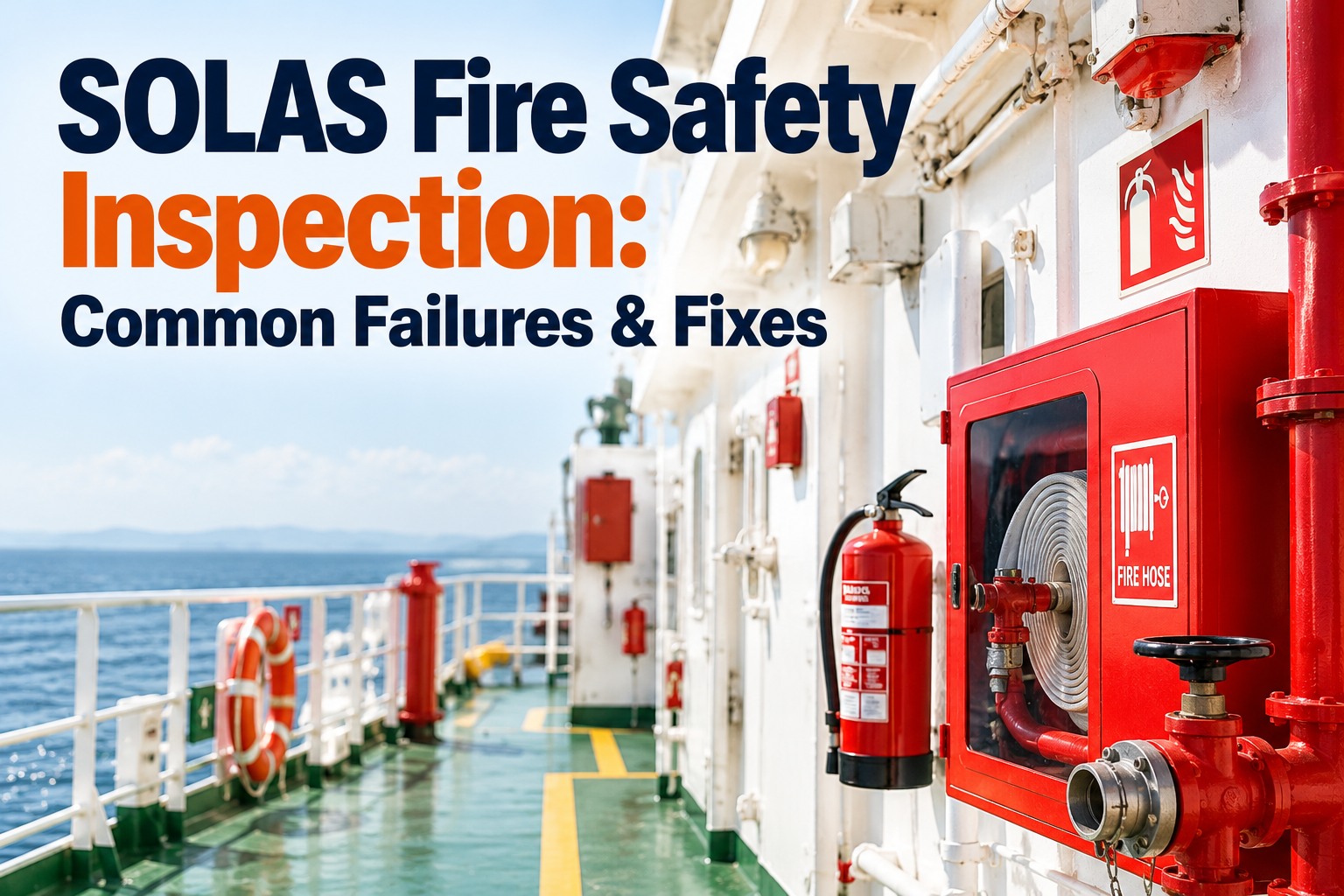
Fire doors were the largest category, with 490 deficiencies and 86 detention grounds, and 6.47% of ships failed the specific questionnaire question on whether doors operate, about 464 ships. A Tokyo MoU detention review case summary also lists a self-closing stairway door that did not close fully among the findings behind an ISM detention. Prevention is simple in principle: walk every door, test closing and latching, remove anything holding a door open and report doors that cannot be repaired aboard. The campaign report recommends stringent maintenance protocols for fire doors.
Ventilation closing appliances and fire dampers
Ventilation closing appliances had 336 deficiencies and 68 detention grounds, and 3.39% of ships failed the question. DNV lists fire dampers and fire doors together among detainable fire safety items, and Lloyd's Register's older pocket checklist called inoperable dampers a common detaining item. Check closing appliances move, are marked and can be reached, and keep a record of each test so an inspector can see the history.
Fire detection and alarm systems
Detection had 245 deficiencies and 61 detention grounds, with 2.05% of ships failing the testing question. Gard's article reports US inspectors regularly finding disconnected or inoperable detectors, sometimes with plastic bags over smoke detectors. Test detectors and the panel, check that none is covered, disconnected or isolated without a record and keep the test log current.
Fixed fire extinguishing installations and machinery space controls
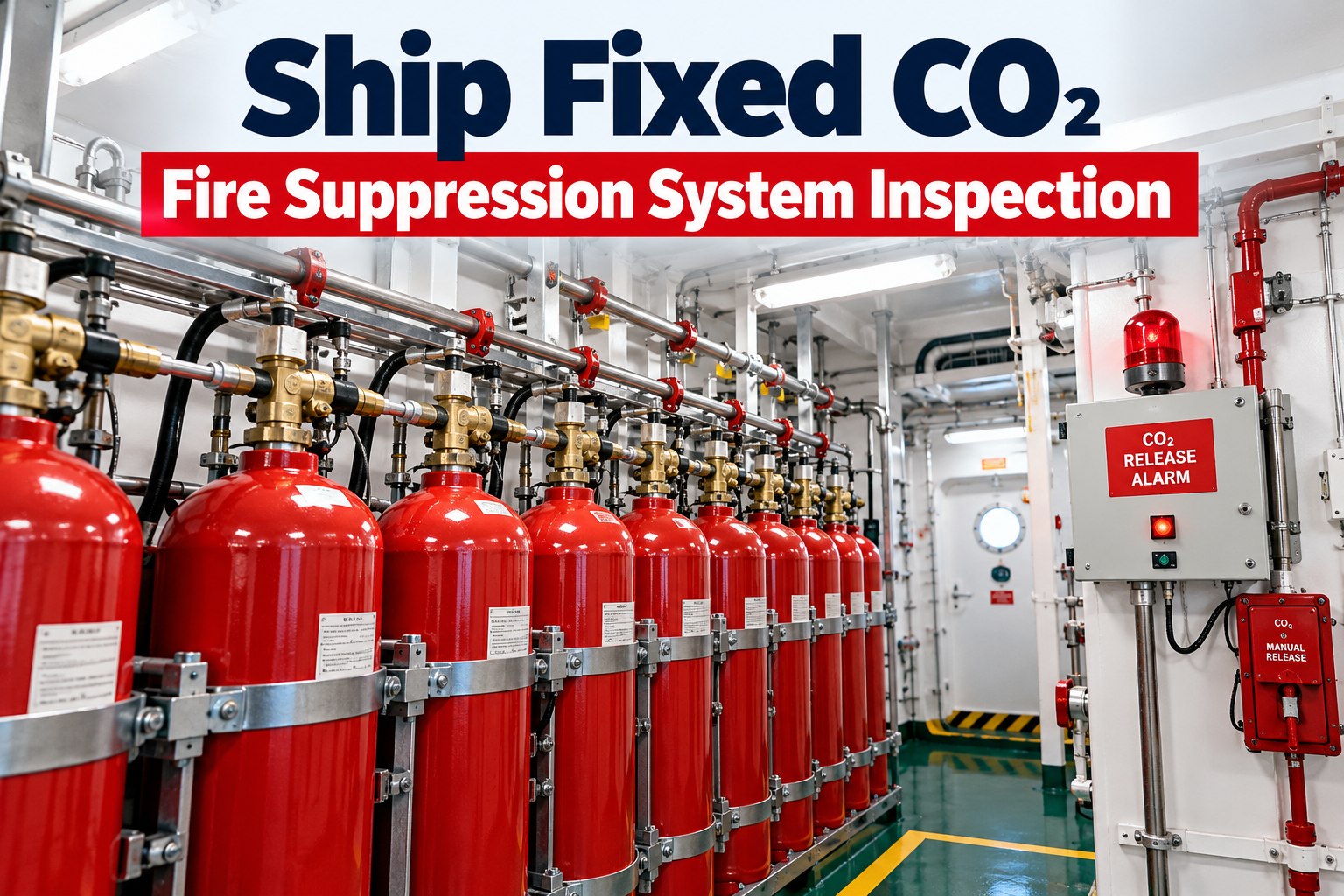
Fixed installations produced 260 deficiencies and 73 detention grounds, a high conversion in our calculation. Gard lists inoperable fixed systems from valves left in the wrong position and clogged nozzles. DNV lists means of control of openings and pumps in machinery spaces, mainly quick-closing and isolation valves, among detainable items, and Gard notes quick-closing fuel valves propped open as a housekeeping problem. Check valve positions against the instructions posted at the system, confirm quick-closing valves operate and are not held open, and follow the maker's instructions for any test.
Fire pumps, fire mains, hoses and portable firefighting equipment
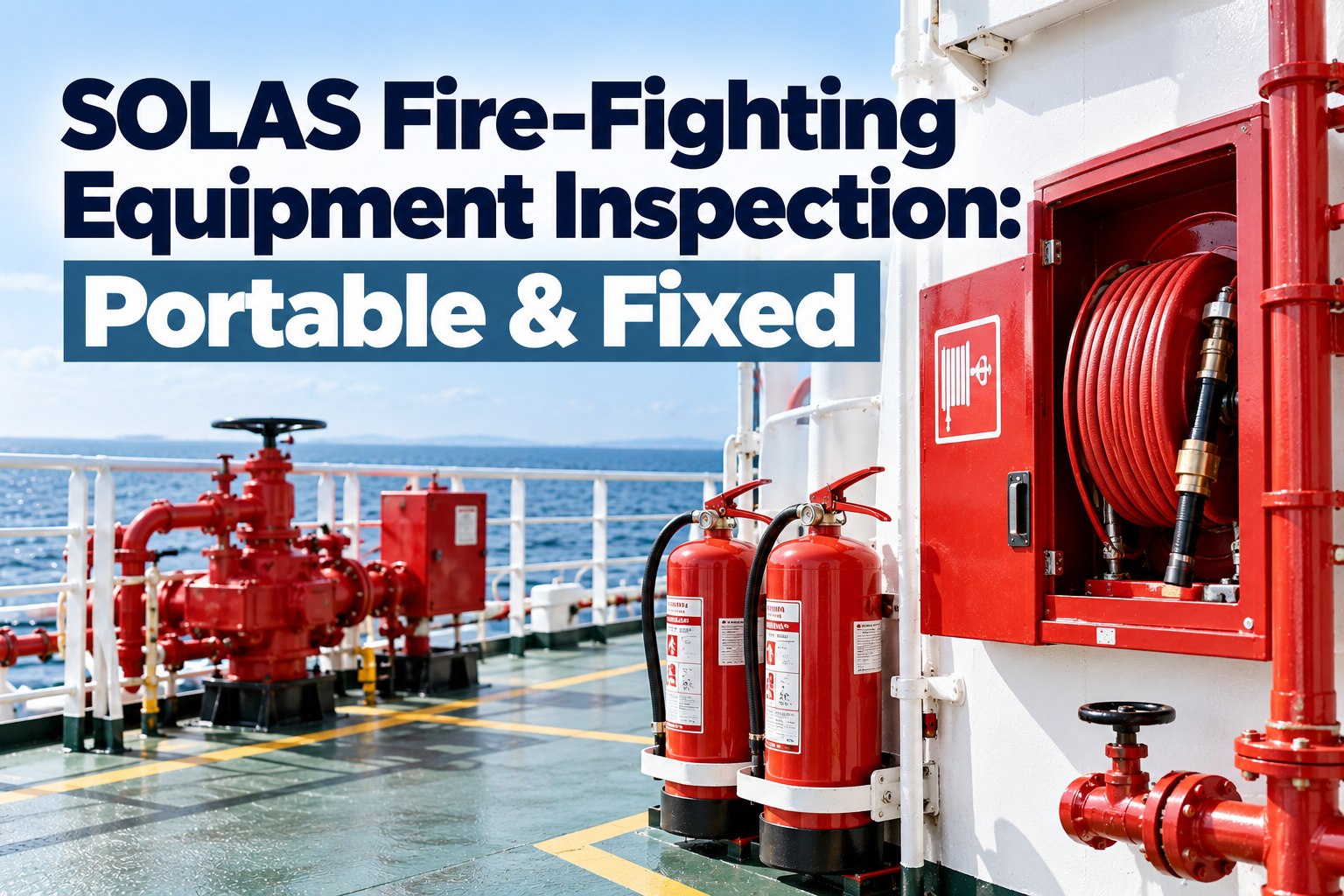
Fire pumps and pipes had 115 deficiencies and 37 detention grounds, and 2.08% of ships failed the fire main valve question, with 25 detentions. Fire fighting equipment and appliances had 392 deficiencies. Gard lists malfunctioning fire pumps, damaged or dry-rotted hoses and portable extinguishers with little or no pressure. DNV also lists the emergency fire pump and its pipes among emergency systems. Run the pumps, test the valves, inspect hoses and nozzles and check extinguisher pressure and service dates.
Fire drills, and why a minority of ships produce the failures
Drills drew the most detentions of any question, 43. On 8.44% of the drills assessed, about 373 ships, the result was unsatisfactory, and the question was not applicable on 38.53% of inspections because no drill was assessed. The report says the problem resembles the 2012 campaign and recommends regular, realistic drills and that port States witness drills more often. In our view this means a drill should test roles, communication and equipment use. A drill that only tests the alarm will not show what an inspector asks the crew to demonstrate.
| Question topic | Share answered no | Detentions recorded |
|---|---|---|
| Emergency escape routes | 2.80% | 10 |
| Fire doors operate and close | 6.47%, about 464 ships | 13 |
| Fire detection and alarm testing | 2.05% | 7 |
| Ventilation closing appliances | 3.39% | 13 |
| Power ventilation controls grouped in two positions | 0.31% | 3 |
| Fire pump jets | 0.55% | 9 |
| Remote stopping of ventilation and oil transfer | 0.83% | 10 |
| Fire main valves | 2.08% | 25 |
| Fire drill satisfactory | 8.44%, 373 ships | 43 |
A Seven-Day Prevention Routine Before Arrival
Order the checks by what the data says matters
The routine below orders the checks by the campaign deficiency counts and puts a realistic drill near the end so any weakness can still be corrected. It is our suggestion, built from the report and the P&I advice, and the days should be adjusted to the voyage. The readiness checklist later in this guide lists each item with a checkpoint type.
Why Fire Deficiencies Come Back: Maintenance, Housekeeping and the SMS
The P&I view: fires start in the engine room and risk peaks around maintenance
Gard's 2022 article, drawing on a Nordic marine insurers' annual report, says most shipboard fires start in the engine room, with low-pressure fuel leaks reaching hot surfaces a major concern, and that poor housekeeping such as fuel leaks, oil-soaked lagging and oily bilges contributes. Risk peaks during and just after maintenance, with missing hot-work permits and no fire watch as typical examples. SOLAS II-2/14 requires fire protection equipment to be kept in good order and readily available. DNV's campaign advice is to give the Top 18 items special attention in maintenance and to use the SMS effectively, since fire safety deficiencies often trace back to gaps in SMS implementation.
Fire Safety Readiness Checklist for the Safety Officer
A checklist with a checkpoint type on each item for the final week
Use the checklist on each vessel. Pair it with your ship's own fire control plan and maker's instructions. For equipment procedures, see our shipboard fire-fighting equipment procedures and SOLAS requirements, and for the broader inspection, see our complete port state control preparation guide for ship masters.
| Item | What to check | Checkpoint type |
|---|---|---|
| Fire doors | Each door closes fully and latches, with no wedges, damaged seals or modified closers | Test |
| Openings in divisions | Penetrations and openings in fire-resisting divisions intact, with no unapproved holes | Visual |
| Ventilation closing appliances | Closing appliances operate and are marked, with controls accessible | Test |
| Fire detection | Detectors present, uncovered and connected. Panel shows no unexplained isolations. Test records current | Test |
| Fixed installations | Control valves in the right positions, nozzles clear, instructions posted, release controls accessible | Visual |
| Machinery space controls | Quick-closing and isolation valves work and are not propped open | Test |
| Fire pumps, mains and hoses | Pumps start and deliver pressure, hoses free of rot, nozzles present, main valves operate | Test |
| Portable extinguishers | Pressure and service tags current, units in place and not discharged | Visual |
| Drill record | Recent drills recorded, varied and consistent with crew knowledge | Record |
| Defect reporting | Any defect reported to class and flag where required, with a dated repair plan | Record |
Six Fire Safety Habits That Invite a Deficiency
What the campaign and the P&I article point to
Systems That Keep Fire Safety Evidence and Findings Together
How a dated photo repository, task ownership and deadlines support fire safety
Fire safety findings recur when nobody owns the fix. Marine Inspection supports a dated photo repository, observations turned into tasks with owners, deadlines and evidence, and certificate and equipment tracking. A dated photo of a repaired fire door, a task for each walkaround finding with a named owner and due date and tracked extinguisher and system service dates give a Safety Officer a record to show an inspector. It does not replace the ship's SMS, class or the maker's instructions. For inspection software for firefighting equipment, see our firefighting equipment inspection software for ships.