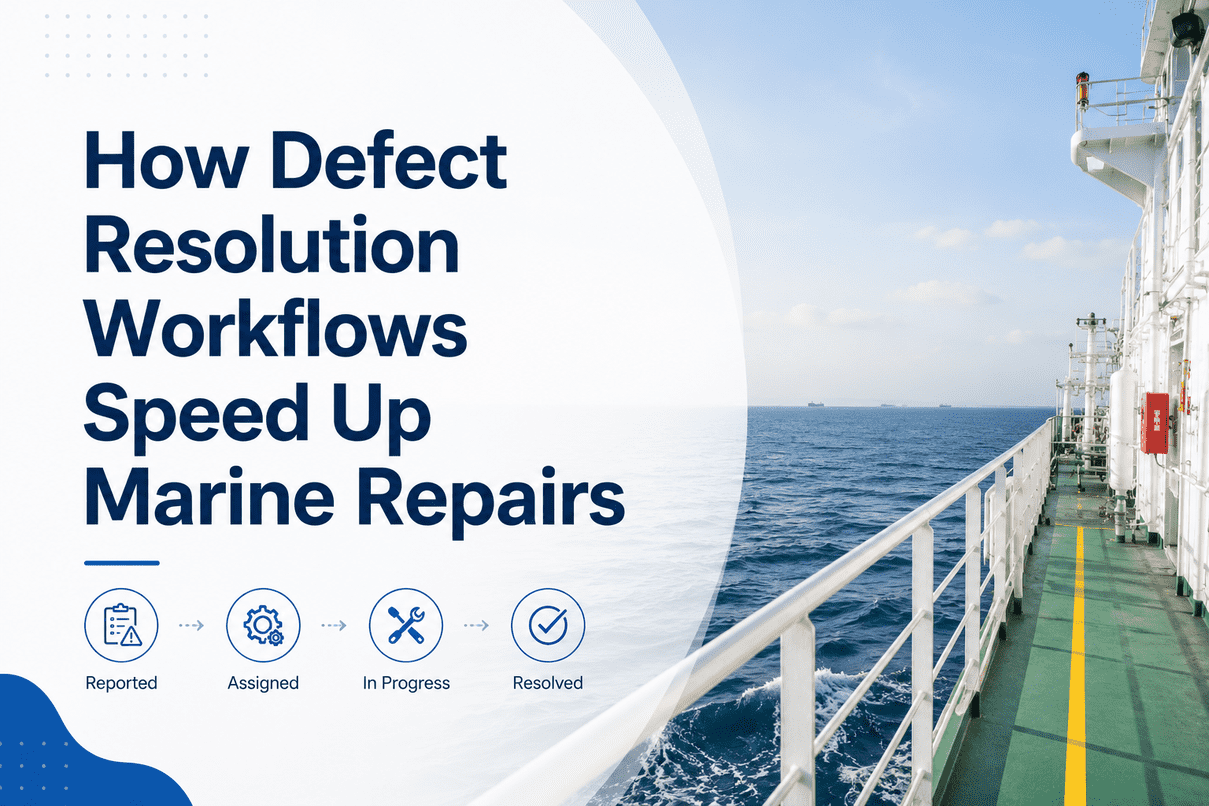
The single hardest-to-improve metric in fleet operations is defect cycle time — the elapsed days from when a defect is reported on a vessel to when it is verified closed in the system. The 2026 benchmark is unforgiving. Manual defect workflows running on email, spreadsheets, and paper handovers settle at three-week-plus cycles, and three-week cycles correlate directly with higher recurrence rates because the conditions that caused the defect have shifted by the time the corrective action is formally assigned. Automated resolution workflows compress the same cycle to five-to-ten business days through structured routing, automated containment tasks, owner-assigned corrective actions with deadlines, and verification-of-effectiveness checks at closure. The 2026 audit environment treats this as table-stakes. ISM Code Section 12 requires verification, review, and evaluation of corrective action effectiveness. PSC inspectors and class surveyors now read closure metrics and re-finding rates as primary signals of safety management system maturity. Start a free trial of Marine Inspection to move every defect from reported to verified closed in days rather than weeks.
Defect Resolution Workflow · 2026
Reported. Routed. Assigned. Executed. Verified. Closed. In Days, Not Weeks.
Automated workflow routing, owner-assigned actions, verification-of-effectiveness gates, and un-editable audit trail — the 2026 cycle-time discipline PSC, class, and charterer vetting expect.
2
Routed
Day 0 · +2hr
Auto
4
In Progress
Day 2-4
Owner
The Six-Phase Resolution Workflow Every Defect Must Pass Through
A credible resolution workflow runs every defect through six phases with automated transitions between most of them. Skip a phase and the defect re-emerges as a PSC repeat-finding, an ISM audit gap, or an insurance claim weakness. Each phase produces specific evidence required for the next.
Phase 1
Reported & Documented
Crew captures the defect with timestamp, equipment ID, location, severity, photo evidence with GPS coordinates, initial assessment. Capture happens on the vessel app at the discovery moment, offline-capable for engine room and cargo deck.
Phase 2
Immediate Containment
Automated task generated to contain the affected equipment or area. Master and chief engineer notified for safety-critical defects. Operational mitigation deployed before formal investigation starts.
Phase 3
Root Cause Investigation
Investigation assigned to the right engineer or superintendent based on defect category, with deadline and escalation rule. Structured root cause analysis tools — 5 Whys, fishbone, fault tree — applied to the captured evidence.
Phase 4
Corrective Action Assignment
Each corrective action assigned to a named owner with due date and required evidence attachment. Work order generated, parts requisitioned, contractor engaged. Preventive actions defined alongside corrective.
Phase 5
Verification Of Effectiveness
After corrective action closure, verification task generated to confirm the defect has not recurred. Effectiveness data collected over weeks or months for systemic defects. Provisional closure pending VOE completion.
Phase 6
Record Closure
Record closes only when all corrective actions are verified and all documentation complete. Audit trail finalized, lessons-learned disseminated across fleet, trend analysis updated for pattern detection.
The Notification Routing Rules That Cut Cycle Time From Weeks To Days
Most fleet defect cycles run three weeks because the workflow was designed for paper and email — and paper and email cannot route, escalate, or close investigations automatically. By the time a corrective action is formally assigned, three watches have changed. The conditions that caused the defect have shifted. Five notification routing rules collapse the cycle.
01
Category-Based Auto-Routing
Defect categorized at capture (mechanical, electrical, structural, safety, navigation) automatically routes to the responsible superintendent. No manual triage step. No back-and-forth email chain to identify the owner.
02
Severity-Routed Escalation
Critical-severity defects notify fleet manager and DPA within minutes. High severity notifies technical director within the hour. Medium and low queue for standard routing. Severity drives velocity automatically.
03
Time-Window SLA Triggers
Defect overdue on assigned SLA triggers escalation to next authority level. 24-hour SLA escalates to fleet manager. 7-day SLA escalates to technical director. 30-day SLA escalates to DPA. Slippage cannot hide.
04
Stakeholder Visibility
Master, chief engineer, charterer, P&I notified per severity and category. No information silo between vessel and shore. No surprise at the gangway when a defect surfaces that shore did not know existed.
05
Closure Notification
Closure with verification of effectiveness notifies the original reporter, the responsible owner, and any escalation-chain stakeholders. Loop closes visibly rather than silently.
The Verification Of Effectiveness Gate That Prevents Recurrence
The hardest discipline in defect resolution is what regulators call Verification of Effectiveness, or VOE — confirming the corrective action actually fixed the underlying problem rather than just removing the symptom. Skipping VOE produces the recurring-finding pattern that FDA flags in medical device CAPAs and that PSC inspectors flag in marine inspection histories. Book a VOE walkthrough to see how the gate operates on a real fleet defect.
Defined VOE Criteria At Assignment
When corrective action is assigned, the verification criteria are defined alongside the action itself. What measurement, what observation period, what threshold confirms effectiveness. No retrospective interpretation at closure.
Data Collection Over Observation Period
Effectiveness data collected over weeks or months for systemic defects. Equipment runtime, inspection findings, near-miss reports, performance metrics all tracked against the corrective action implementation date.
Provisional Closure Until VOE Complete
Defect can move to provisional closure once corrective action implementation is complete — but full closure waits for VOE completion. Open visibility on the gap prevents the false-closure pattern.
Re-Opening On VOE Failure
If verification data shows the corrective action did not work, defect re-opens with new corrective action assignment. Original closure record preserved. FDA's "ineffective CAPA" warning pattern avoided structurally.
Resolution Workflow Demo · 30 Minutes
Compress Your Defect Cycle Time From Three Weeks To One
A 30-minute session with a Marine Inspection product expert. Bring your current defect backlog with average cycle times. Walk through the six-phase workflow, notification routing rules, VOE gate, and audit trail discipline on real fleet data with a sourced consolidation plan.
Three-Week Manual Cycle Versus One-Week Automated Cycle
The cycle-time difference is not incremental. It is structural — produced by automation of phases two through six. The comparison shows what changes between the manual and automated models, and why the automated cycle produces fewer recurring findings.
3-WEEK MANUAL CYCLE
Email-based triage adds 2-3 days
Manual owner identification per defect
No automated containment task
Root cause assigned to whoever is available
VOE skipped or done retrospectively
Closure depends on superintendent memory
Higher recurrence rate measurably
5-10 DAY AUTOMATED CYCLE
Category-routed in under 2 hours
Owner assigned by responsibility matrix
Containment task auto-generated at capture
Root cause assigned by expertise category
VOE criteria defined at action assignment
Closure gated on documentation completeness
Lower recurrence rate verified by trend data
The Audit Trail Discipline PSC, Class, And Charterer Vetting Expect
An audit trail that survives PSC, class society, and charterer vetting scrutiny has six structural properties. Each property must be built into every workflow transition. Together they produce the defensible record that closes audits rather than opens them.
A
Timestamp Per Transition
Every phase transition timestamped against authoritative time source. Cannot be backdated or modified. Cycle-time metrics calculated from these timestamps for fleet KPI reporting.
B
Identity Per Transition
Identity of the person initiating each transition cryptographically bound to the record. Cannot be reassigned. Establishes responsibility chain for audit and dispute defence.
C
Evidence At Each Phase
Photo evidence, measurements, signatures, documents attached at the phase they were captured. Cannot be added retroactively without surfacing the change. Closure pack assembles automatically.
D
Decision Rationale Logged
Why severity assigned, why owner selected, why VOE criteria chosen — decision rationale logged at the transition. Auditor sees the reasoning, not just the outcome.
E
Un-Editable Originals
Modifications produce new versions; originals preserved. Severity upgraded after capture re-triggers escalation but original severity stays in the audit trail. Closure rewinds visible to auditors.
F
Export-Ready Audit Pack
PSC inspector, class surveyor, or charterer requesting defect history receives the complete record with audit trail in a single export. Days collapse to minutes for audit defence.
Why Marine Inspection For Defect Resolution Workflow
Marine Inspection delivers automated defect resolution workflow on the six-phase pipeline, five-rule notification routing, VOE gate discipline, and six-property audit trail that PSC, SIRE 2.0, class society, and charterer vetting expect. Start a free trial or book a 30-minute demo to see the platform on your fleet's defect backlog.
Six-Phase Workflow Engine
Reported, Containment, Root Cause, Corrective Action, VOE, Closure — every defect runs the phases with automated transitions between them. No phase skippable. No manual triage step.
Five-Rule Notification Routing
Category-based auto-routing, severity-routed escalation, time-window SLA triggers, stakeholder visibility, closure notification — built in rather than relying on superintendent memory.
VOE Gate Discipline
Verification of effectiveness criteria defined at corrective action assignment, data collected over observation period, provisional closure until VOE complete, re-opening on VOE failure.
Six-Property Audit Trail
Timestamp per transition, identity per transition, evidence per phase, decision rationale logged, un-editable originals, export-ready audit pack. Every property built into every transition by default.
PMS & Procurement Integration
Corrective actions generate work orders in the PMS. Parts requisitions raised automatically. Contractor engagement workflow triggered. Duplicate systems eliminated rather than tolerated.
Cycle-Time KPI Dashboard
Fleet cycle-time metrics tracked continuously — median days reported-to-closed, time-to-assignment, time-in-VOE, recurrence rate. ISM Element 12 management review pack generated on demand.
Frequently Asked Questions
What does marine defect resolution workflow software do?
Marine defect resolution workflow software moves every defect from reported to verified closed through automated routing, owner-assigned corrective actions, verification-of-effectiveness gates, and an un-editable audit trail. The six-phase pipeline runs every defect through Reported and Documented, Immediate Containment, Root Cause Investigation, Corrective Action Assignment, Verification of Effectiveness, and Record Closure. Five notification routing rules collapse the cycle time from three weeks (manual email-based) to five-to-ten business days (automated) — category-based auto-routing, severity-routed escalation, time-window SLA triggers, stakeholder visibility, and closure notification. VOE gate prevents the FDA-flagged "ineffective CAPA" recurring pattern by defining verification criteria at action assignment and gating closure on effectiveness data. Six-property audit trail (timestamp per transition, identity per transition, evidence per phase, decision rationale, un-editable originals, export-ready audit pack) produces the defensible record PSC, SIRE 2.0, class society, and charterer vetting expect.
What is the six-phase resolution workflow?
Every defect must pass through six phases with automated transitions between most of them. Phase 1 Reported and Documented — crew captures the defect with timestamp, equipment ID, location, severity, photo evidence with GPS coordinates, and initial assessment, with capture on the vessel app at the discovery moment and offline-capable. Phase 2 Immediate Containment — automated task generated to contain the affected equipment or area, master and chief engineer notified for safety-critical defects, operational mitigation deployed before formal investigation. Phase 3 Root Cause Investigation — investigation assigned to the right engineer or superintendent based on defect category with deadline and escalation rule, structured tools (5 Whys, fishbone, fault tree) applied. Phase 4 Corrective Action Assignment — each action assigned to a named owner with due date and required evidence attachment, work order generated, parts requisitioned, preventive actions defined. Phase 5 Verification of Effectiveness — verification task generated after corrective action closure, effectiveness data collected over weeks or months, provisional closure pending VOE. Phase 6 Record Closure — record closes only when all actions verified and documentation complete.
How does automation reduce cycle time from weeks to days?
A three-week defect cycle is not slow because the team is understaffed or disorganized. It is slow because the process was designed for paper and email — and paper and email cannot route, escalate, or close investigations automatically. Manual cycles add 2-3 days for email-based triage, require manual owner identification per defect, lack automated containment tasks, assign root cause to whoever is available rather than the right expertise category, skip VOE or do it retrospectively, and depend on superintendent memory for closure. Automated cycles route by category in under 2 hours, assign owners by responsibility matrix, auto-generate containment tasks at capture, route root cause by expertise category, define VOE criteria at action assignment, and gate closure on documentation completeness. The automation of phases two through six transforms a three-week cycle into a five-to-ten day cycle — and shorter cycles correlate directly with lower recurrence rates because the conditions that caused the defect have not yet shifted by the time the corrective action is formally assigned.
What is Verification of Effectiveness and why does it matter?
Verification of Effectiveness, or VOE, is the discipline of confirming the corrective action actually fixed the underlying problem rather than just removing the symptom. Skipping VOE produces the recurring-finding pattern that FDA flags in medical device CAPA warning letters and that PSC inspectors flag in marine inspection histories as repeat findings. The VOE gate operates on four principles. Defined VOE Criteria At Assignment — when corrective action is assigned, the verification criteria are defined alongside the action (what measurement, what observation period, what threshold confirms effectiveness) without retrospective interpretation at closure. Data Collection Over Observation Period — effectiveness data collected over weeks or months for systemic defects with equipment runtime, inspection findings, near-miss reports, and performance metrics tracked against implementation date. Provisional Closure Until VOE Complete — defect can move to provisional closure once corrective action implementation is complete but full closure waits for VOE. Re-Opening On VOE Failure — if verification data shows the corrective action did not work, defect re-opens with new action assignment and the original closure record preserved.
What notification routing rules cut cycle time?
Five routing rules collapse the cycle. Category-Based Auto-Routing — defect categorized at capture (mechanical, electrical, structural, safety, navigation) automatically routes to the responsible superintendent with no manual triage step and no email back-and-forth to identify the owner. Severity-Routed Escalation — critical-severity defects notify fleet manager and DPA within minutes, high severity notifies technical director within the hour, medium and low queue for standard routing, with severity driving velocity automatically. Time-Window SLA Triggers — defect overdue on assigned SLA triggers escalation to the next authority level (24-hour SLA escalates to fleet manager, 7-day to technical director, 30-day to DPA) so slippage cannot hide. Stakeholder Visibility — master, chief engineer, charterer, P&I notified per severity and category with no information silo between vessel and shore. Closure Notification — closure with VOE notifies the original reporter, responsible owner, and escalation-chain stakeholders, closing the loop visibly rather than silently.
What audit trail discipline must the workflow preserve?
Six structural properties define an audit trail that survives PSC, class society, and charterer vetting scrutiny. Timestamp Per Transition — every phase transition timestamped against authoritative time source, cannot be backdated or modified, with cycle-time metrics calculated from these timestamps for fleet KPI reporting. Identity Per Transition — identity of the person initiating each transition cryptographically bound to the record, cannot be reassigned, establishing responsibility chain for audit and dispute defence. Evidence At Each Phase — photo evidence, measurements, signatures, documents attached at the phase they were captured, cannot be added retroactively without surfacing the change, closure pack assembling automatically. Decision Rationale Logged — why severity assigned, why owner selected, why VOE criteria chosen, decision rationale logged so auditor sees the reasoning not just the outcome. Un-Editable Originals — modifications produce new versions while originals are preserved, closure rewinds visible to auditors. Export-Ready Audit Pack — inspector or auditor requesting defect history receives complete record in single export.
How does Marine Inspection automate defect resolution?
Marine Inspection delivers automated defect resolution workflow on the six-phase pipeline (Reported, Containment, Root Cause, Corrective Action, VOE, Closure) with automated transitions between phases. Five-rule notification routing combines category-based auto-routing, severity-routed escalation, time-window SLA triggers, stakeholder visibility, and closure notification. VOE gate discipline defines verification criteria at corrective action assignment, collects data over observation period, supports provisional closure until VOE complete, and re-opens on VOE failure. Six-property audit trail covers timestamp per transition, identity per transition, evidence per phase, decision rationale logged, un-editable originals, export-ready audit pack. PMS and procurement integration generates work orders and parts requisitions automatically. Cycle-time KPI dashboard tracks median days reported-to-closed, time-to-assignment, time-in-VOE, and recurrence rate for ISM Element 12 management review. 6-12 week deployment for typical mid-size fleets with free trial available before any commitment.
Ready When You Are
From Reported To Verified Closed. In Days. With Audit-Grade Trail.
Six-phase workflow engine, five-rule notification routing, VOE gate discipline, six-property audit trail, PMS and procurement integration, cycle-time KPI dashboard — all in one platform built for the 2026 defect resolution reality.