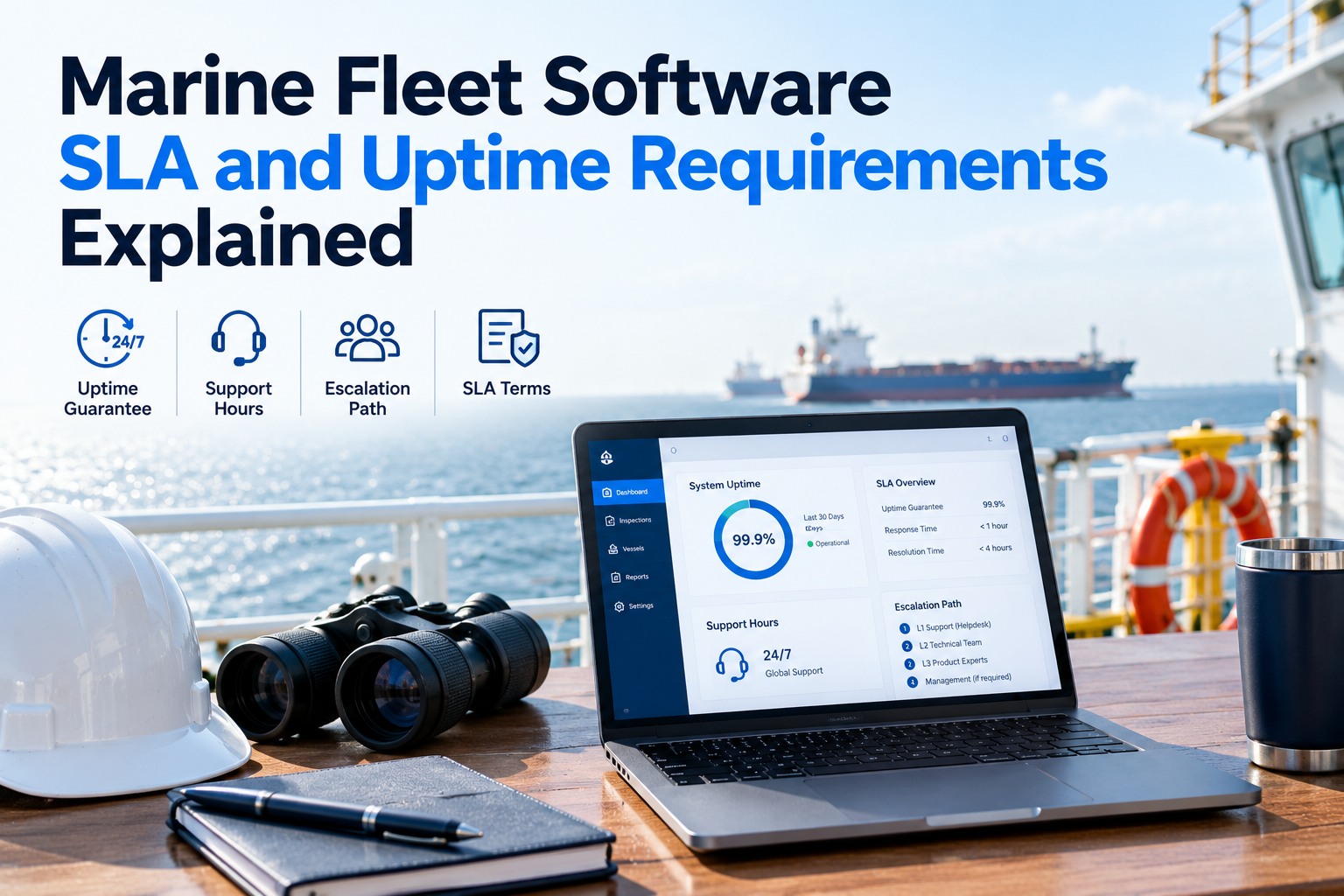
A 99.9% uptime promise is measured at the vendor’s servers, not on your bridge or in your engine room. For a trading fleet, the SLA terms that matter are what counts as downtime, who answers at 03:00 ship’s time, and how fast a stuck problem moves up the chain. This guide sets out those terms and the questions to ask. See it in a live demo.
Marine fleet software SLA: the uptime promise covers one link in a longer chain
Your crew needs every link to work. A typical SLA only promises the last one.
What an uptime guarantee in SaaS actually allows
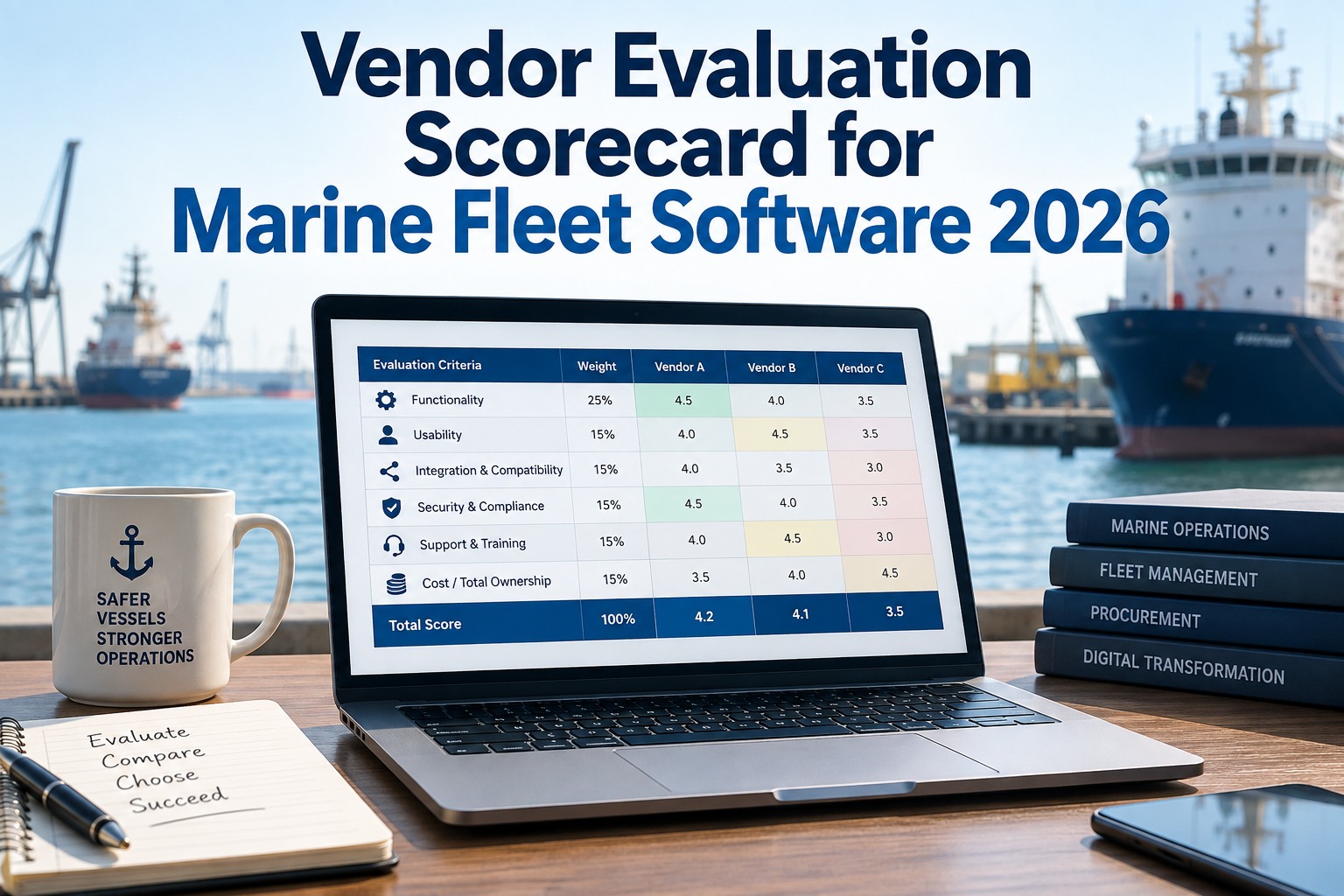
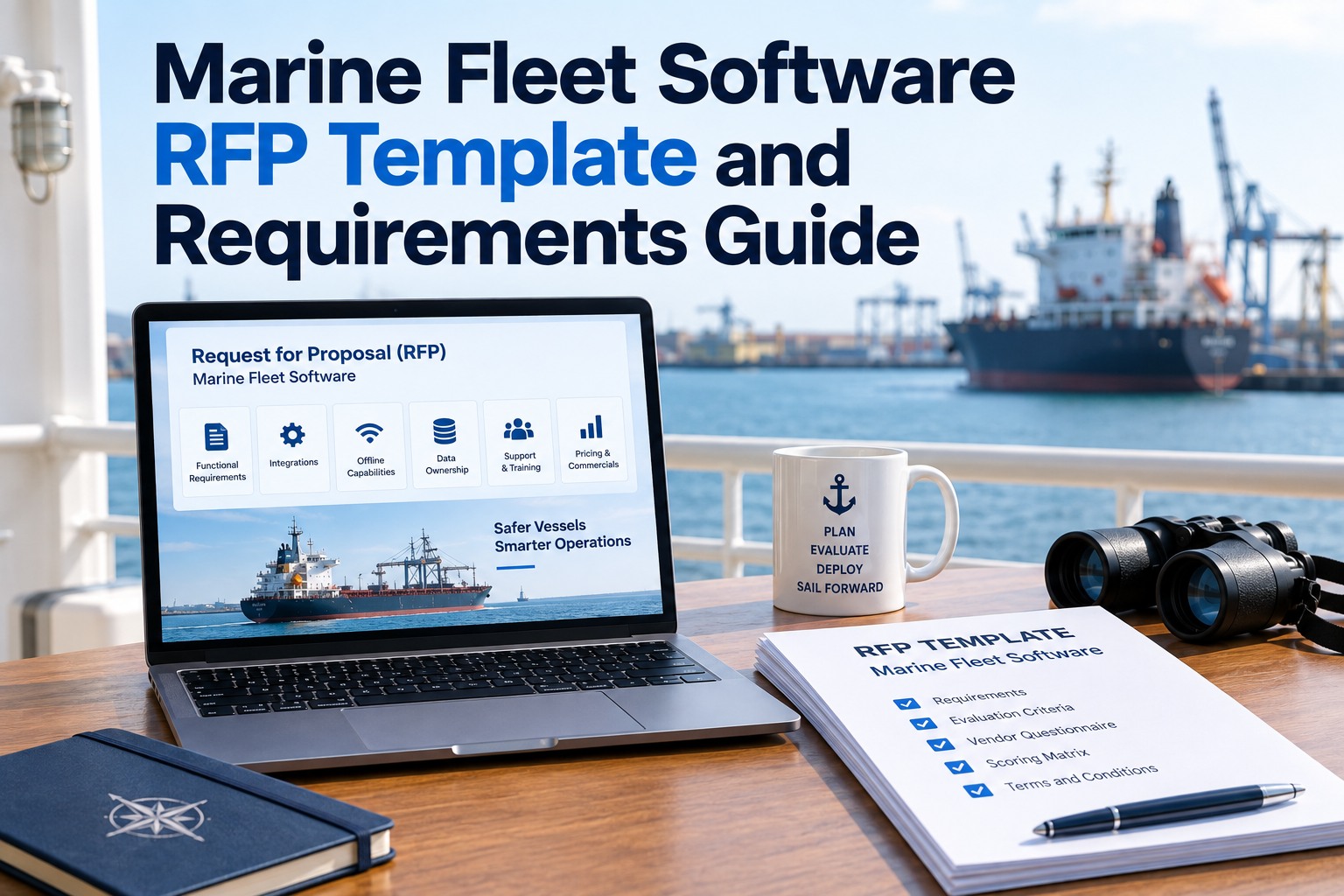
Uptime percentages sound alike but allow very different amounts of downtime. Convert every promise into hours before comparing vendors, then read how the month is measured. Our fleet software RFP template shows where to ask for these figures. Start a free trial.
| Uptime promise | Downtime allowed per 30-day month | Downtime allowed per year | What it feels like on board |
|---|---|---|---|
| 99% | 7 h 12 min | about 3.7 days | A full working day lost every month |
| 99.5% | 3 h 36 min | about 1.8 days | Half a shift, monthly |
| 99.9% | 43 min | about 8 h 46 min | One delayed sync or report a month |
| 99.95% | 22 min | about 4 h 23 min | Rarely noticed if the app works offline |
| 99.99% | 4 min | about 53 min | Usually beyond what fleet software needs |
Before exclusions. Planned maintenance and third-party failures are often left out of the count, so the real allowance can be larger.
Why a software SLA in maritime has to assume no connection
Outages happen at every layer, including the biggest providers. A ship cannot wait for any of them, so the most valuable SLA term is not a percentage but a promise that the crew can keep working offline and sync safely later. Our roundup of offline vessel inspection apps compares how tools handle this.
Sources: ISPreview (Jul 2025); AWS post-incident summary via InfoQ (Nov 2025); Uptime Institute Annual Outage Analysis 2025.
Exclusions that hollow out a service level agreement for a fleet
The uptime figure is the headline; the exclusions are the small print that decides it. For each common exclusion, ask for the limit on the right.
Severity levels in a fleet software SLA, written around ship operations
Generic severity labels let a vendor call your urgent problem routine. Define severity by what is happening on board, with examples in the contract. The targets below are example starting points to negotiate, not an industry standard. Ask how we classify issues.
| On board situation | Severity | Example response | Example progress reports |
|---|---|---|---|
| PSC boarding or vetting in hours and reports will not generate | P1 | 1 hour, 24/7 | Every 2 hours |
| No vessel in the fleet can sync, or data appears lost | P1 | 1 hour, 24/7 | Every 2 hours |
| One vessel cannot sync for more than a day | P2 | 4 hours, 24/7 | Every 8 hours |
| A checklist or module fails, with a workaround | P3 | 1 business day | On change |
| Question, setup help or cosmetic issue | P4 | 3 business days | On close |
Ask the hard support questions live
Bring your severity examples and time zones to the demo, and see how inspections keep running when the connection does not.
Support hours a vendor should cover for a trading fleet
Your ships, your office and the vendor’s support desk rarely share a time zone. The example below shows a ship in Singapore, an office in Athens and a support desk working 09:00 to 17:00 London time. Shaded hours are when each can act.
Illustrative summer times. In this example the ship’s working day and the vendor desk overlap by only about six hours, all in the ship’s afternoon and evening.
Escalation path in software support, with time triggers
An escalation path should move on its own when the clock runs out, without you chasing it. Name the role at each step in the contract. The times are examples for a P1 issue.
Service credits and remedies in a fleet software SLA
Service credits are usually a share of one month’s fee, so they rarely cover what an outage costs you. Treat them as a signal, and put the real protection in other remedies. For what happens if you decide to leave, read our guide to data ownership and lock-in.
What a credit is worth (illustrative)
Example figures in any currency. Compare with a delayed vetting or a missed survey slot.
Remedies worth more than credits
Checklist: SLA and support terms for marine inspection software
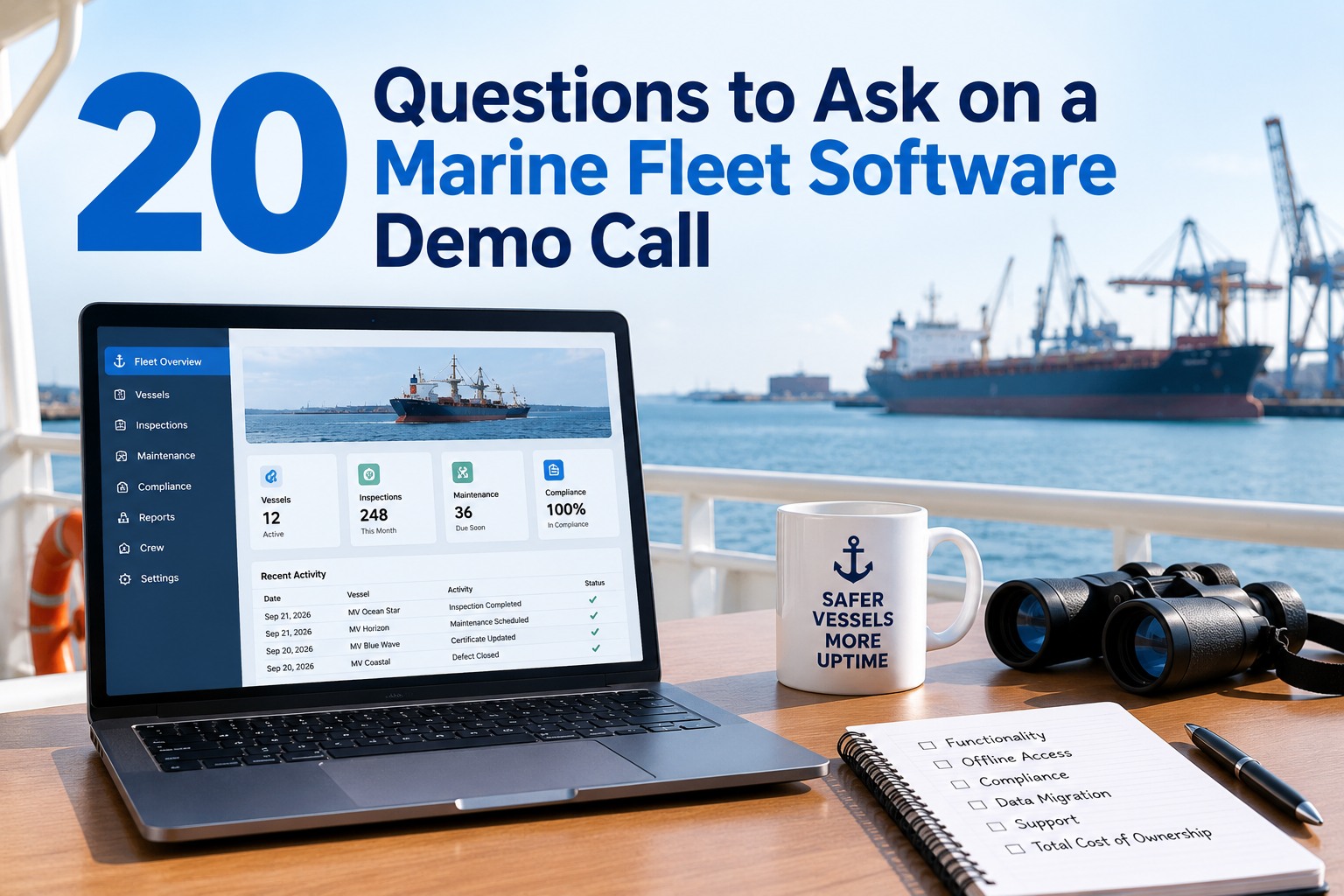
Tick these off against the vendor’s draft. Our list of 20 questions for a demo call pairs well with it.
How Marine Inspection keeps inspections running when the link fails
We build for the fact that ships lose connection. Inspections, findings and photos are captured on the device whether or not the ship is online, and sync when a link returns, so an outage anywhere in the chain does not stop work on board. The timeline below is an illustrative six-hour loss of connection.
Marine fleet software SLA FAQs
What uptime should marine fleet software guarantee?
Around 99.9% measured monthly is a common target for business software. For ships, solid offline working matters more than an extra decimal place.
Does the SLA cover my satellite connection?
Usually not. The software SLA covers the vendor’s service; your connectivity has its own contract. That is why offline capture belongs in the requirements.
What support hours do we need?
At least 24/7 cover for critical issues, and business-hours support that overlaps with both your ships and your office. Get the time zone in writing.
What is an escalation path?
A written ladder of who takes over an unresolved issue and when, from the support desk up to an executive sponsor, with time triggers at each step.
Are service credits worth negotiating?
Yes, but mainly as a signal. Make them automatic, then add a termination right, a root-cause report and exclusions from the sole-remedy clause.
Can we see how Marine Inspection handles an outage?
Yes. Book a live demo and we will show offline capture and sync, and walk through support and escalation.
Judge the SLA by what happens at sea
Offline working, ship-based severity, 24/7 critical cover and a clear escalation ladder protect a trading fleet better than any uptime figure.