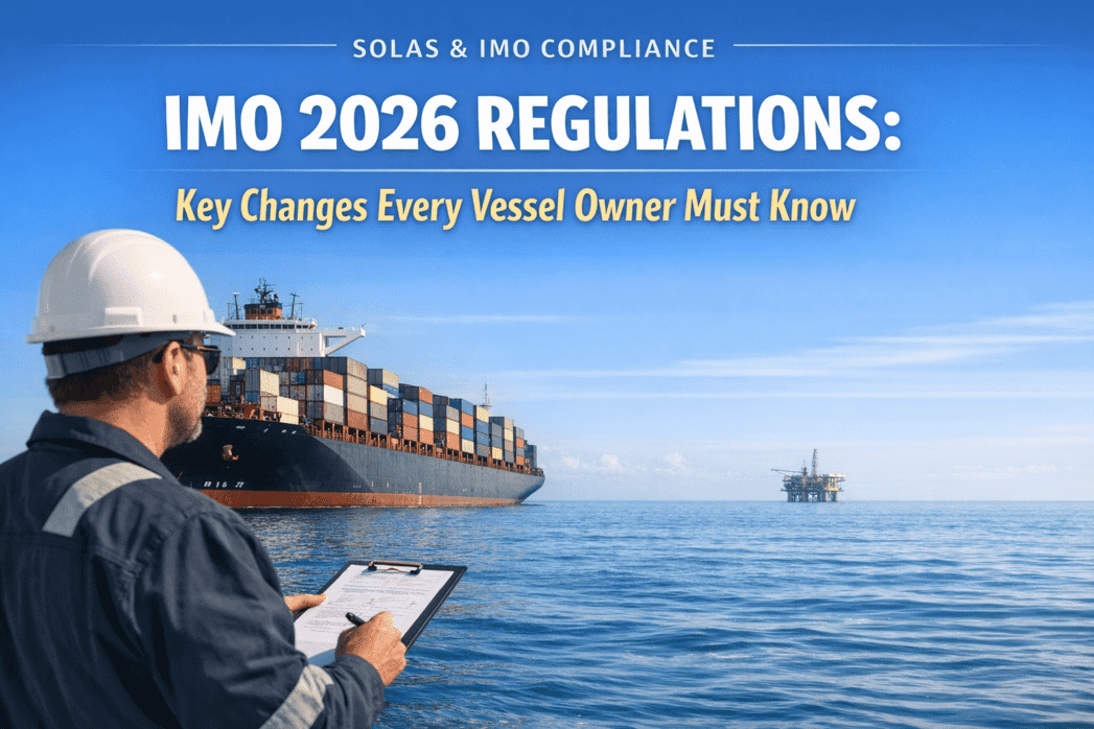
The International Maritime Organization kicked off 2026 with one of the most sweeping regulatory updates in recent years. From January 1, coordinated amendments across SOLAS, MARPOL, STCW, the IMDG Code, and multiple technical codes entered into force simultaneously — touching everything from how crews are trained, to how fires are fought, to how containers are reported when lost overboard. Then on March 1, two new Emission Control Areas in the Canadian Arctic and Norwegian Sea began enforcement, tightening NOx, SOx, and particulate matter limits for vessels transiting polar waters. For vessel owners and fleet managers, this isn't one regulation to track — it's a dozen changes across multiple conventions, each with different applicability dates, vessel-type thresholds, and compliance deadlines. This guide maps every IMO 2026 change that affects your fleet, when each takes effect, and what action you need to take. Start a free trial of Marine Inspection to manage all your IMO compliance requirements in one platform.

IMO 2026 Regulatory Landscape at a Glance
6
Conventions Amended
SOLAS, MARPOL, STCW, IMDG, IGF, IGC
3
Key Dates
1 Jan, 1 Mar, 1 Sep 2026
7
Global ECAs
2 new Arctic areas added in March 2026
All
Vessel Types Impacted
Tankers, bulkers, containers, Ro-Ro, gas carriers

Complete IMO 2026 Amendments: Convention-by-Convention Breakdown

Every amendment that entered force in 2026 is listed below, organized by the convention it amends. Use this as your compliance reference — and book a Marine Inspection demo to see how digital workflows can track each requirement across your fleet.

Table 1: All IMO 2026 Amendments — Sorted by Convention
Convention Amendment IMO Resolution Effective Date Applies To
SOLAS Lifting appliances & anchor-handling winches under statutory control MSC.532(107) 1 Jan 2026 All ships with lifting equipment
SOLAS PFOS-based firefighting foam banned MSC.550(108) 1 Jan 2026 All ships (new & existing by first survey)
SOLAS Fire detection in cargo control rooms & Ro-Ro/vehicle spaces MSC.550(108) 1 Jan 2026 New cargo ships, Ro-Ro vessels
SOLAS Fuel flashpoint declarations on Bunker Delivery Notes MSC.520(106) 1 Jan 2026 All ships
SOLAS Mandatory container loss reporting MSC.550(108) 1 Jan 2026 All ships (primarily container vessels)
SOLAS Electronic inclinometers for new builds MSC.532(107) 1 Jan 2026 New container ships & bulk carriers 3,000 GT+
SOLAS Polar Code extended to smaller vessels MSC.550(108) 1 Jan 2026 Fishing vessels 24m+, yachts 300 GT+, cargo 300-500 GT
MARPOL Container loss reporting aligned with SOLAS MEPC.384(81) 1 Jan 2026 All ships carrying harmful substances
MARPOL Canadian Arctic & Norwegian Sea ECAs (NOx) MEPC.392(82) 1 Mar 2026 New ships in designated ECA waters
MARPOL Canadian Arctic & Norwegian Sea ECAs (SOx/PM) MEPC.392(82) 1 Mar 2027 All ships in designated ECA waters
MARPOL NOx Technical Code — engine certification updates MEPC.398(83) 1 Sep 2026 Modified/retrofitted engines
STCW Anti-harassment & bullying training mandatory MSC.560(108) 1 Jan 2026 All seafarers (phased at next refresher)
STCW STCW-F Code for fishing vessel personnel MSC.560(108) 1 Jan 2026 Fishing vessels under STCW-F
IMDG Amendment 42-24 — dangerous goods classification updates MSC.556(108) 1 Jan 2026 All ships carrying packaged DG
IGF LNG fuel safety — pump suction, fire protection, fuel prep rooms MSC.551(108) 1 Jan 2026 New gas-fuelled ships
IGC High manganese steel for gas carriers, alternative fuel cargoes MSC.523(106), MSC.566(109) 1 Jan 2026 Gas carriers (new builds)
Grain New loading condition class for special compartments MSC.552(108) 1 Jan 2026 All cargo ships carrying grain, incl. <500 GT

The 8 Changes That Matter Most to Vessel Owners

Not every amendment impacts every fleet equally. Below are the eight highest-impact changes ranked by the breadth of vessels affected and the severity of non-compliance consequences.

01
SOLAS II-2
PFOS Firefighting Foam Ban
All firefighting foams containing perfluorooctane sulfonic acid (PFOS) are now prohibited for use and storage onboard. New ships must comply from January 1, 2026. Existing ships must remove and replace PFOS-based foam stocks by their first survey after January 1, 2026. This requires manufacturer certification confirming PFOS content is below thresholds, proper disposal of legacy foam per environmental regulations, and system flushing to eliminate residual contamination.
Action: Verify all foam concentrates onboard. Obtain manufacturer declarations. Schedule replacement before next survey.
02
SOLAS II-1
Lifting Appliances Under Statutory SOLAS Control
All onboard lifting appliances — cargo cranes, stores cranes, engine-room cranes, hose-handling cranes, anchor-handling winches — now fall under direct SOLAS regulation. Valid Certificates of Test and Thorough Examination, documented SWL markings, and a Register of Ship's Lifting Appliances must be maintained. Deficiencies in testing records or documentation now carry SOLAS-level consequences including PSC detention.
Action: Audit all lifting equipment. Ensure certificates, SWL markings, and register comply before next renewal survey.
03
SOLAS V
Mandatory Container Loss Reporting
Masters must now immediately report lost or observed containers to nearby ships, the nearest coastal state, and the flag administration. Reporting includes position, number lost, circumstances, time, and cargo nature. If the ship cannot report, the company must. This removes discretionary reporting and makes container loss a formal navigational safety obligation under both SOLAS and MARPOL.
Action: Update SMS procedures. Train all bridge officers on the reporting chain and mandatory information fields.
04
STCW
Anti-Harassment & Bullying Training
The STCW Code now mandates training on prevention of violence, harassment (including sexual harassment), bullying, and sexual assault as part of Personal Safety and Social Responsibilities (PSSR). Seafarers with valid PSSR certificates are not required to immediately retake the course — the new component will be incorporated at the next scheduled refresher cycle per flag state guidance.
Action: Confirm flag state transition timeline. Update training plans to incorporate the new module at next PSSR refresher.
05
MARPOL VI
New Emission Control Areas — Canadian Arctic & Norwegian Sea
Two new ECAs entered force March 1, 2026, bringing the global total to seven. NOx Tier III requirements apply to new-build engines immediately. SOx compliance (fuel sulphur max 0.10%) is enforced from March 1, 2027 after a 12-month grace period. The Canadian Arctic ECA extends the existing North American ECA to all Arctic waters; Norway's ECA extends north of 62° covering the full Norwegian EEZ.
Action: Review fleet routes through Arctic/Norwegian waters. Ensure fuel switching procedures and engine certifications are ready.
06
SOLAS II-2
Enhanced Fire Safety for Ro-Ro & Vehicle Spaces
New ships with vehicle, special category, or Ro-Ro spaces must install individually addressable smoke and heat detectors for faster fire location identification. Cargo control rooms on new cargo ships require fire detection and alarm systems. Fuel suppliers must declare flashpoint compliance (minimum 60°C) on Bunker Delivery Notes — applicable to all ships.
Action: Verify fuel supplier flashpoint declarations on BDNs. For new builds, specify individually addressable detectors.
07
IMDG
IMDG Code Amendment 42-24
The updated IMDG Code is now mandatory for all ships carrying packaged dangerous goods. Key changes include new classifications and UN numbers for lithium batteries (UN 3556, 3557 for vehicles), updated charcoal transport requirements, and revised emergency response procedures. Voluntary application was permitted from January 2025; mandatory compliance began January 1, 2026.
Action: Ensure DG officers and cargo teams are trained on updated classifications, especially lithium battery and charcoal rules.
08
SOLAS V
Electronic Inclinometers on New Builds
New container ships and bulk carriers of 3,000 GT and above must carry electronic inclinometers capable of monitoring, displaying, and recording roll motion. This addresses parametric rolling risks that have caused major cargo losses. Does not apply to ships occasionally carrying bulk cargo or general cargo ships with deck containers.
Action: For new-build orders, include compliant inclinometer specifications. Existing vessels are exempt from retrofit.
Stay Ahead of Every IMO 2026 Deadline
Marine Inspection tracks certificate renewals, survey deadlines, crew training records, and equipment compliance across all conventions — SOLAS, MARPOL, STCW, and IMDG — in one platform with automated alerts.

2026 Compliance Timeline: When Each Rule Takes Effect

IMO 2026 regulations don't all start on the same date. This timeline shows the critical compliance milestones vessel owners must track throughout 2026 and into 2027. Sign up for Marine Inspection to get automated deadline alerts for each milestone.

Table 2: IMO 2026-2027 Compliance Calendar
Date Regulation Convention What Happens Who Must Act
1 Jan 2026 PFOS foam ban SOLAS New ships must comply immediately. Existing ships by first survey after this date. All vessel operators
1 Jan 2026 Lifting appliances regulation SOLAS All lifting appliances under SOLAS statutory control. Existing ships comply at first renewal survey. All ships with cranes/winches
1 Jan 2026 Container loss reporting, STCW anti-harassment, IMDG 42-24, inclinometers, fire detection, IGF/IGC, Grain Code Multiple All January 2026 amendments in force. SMS, training, and equipment updates required. All vessel types per applicability
1 Mar 2026 Canadian Arctic & Norwegian Sea ECAs (NOx) MARPOL NOx Tier III applies to new-build engines in both ECA zones. New ships transiting Arctic/Norwegian waters
1 Sep 2026 NOx Technical Code updates MARPOL Amended certification for engine retrofits, dual-fuel conversions, power limitation measures. Ships with modified engines
1 Mar 2027 Canadian Arctic & Norwegian Sea ECAs (SOx/PM) MARPOL Fuel sulphur max 0.10% enforced. Low-sulphur fuel or EGCS required. All ships in ECA waters

New Emission Control Areas: The 2026 ECA Map

With the Canadian Arctic and Norwegian Sea ECAs activated on March 1, 2026, there are now seven global ECAs under MARPOL Annex VI. An eighth — the North-East Atlantic ECA — is expected to be adopted at MEPC 84 in April 2026. For operators with routes through any of these zones, schedule a demo to see how Marine Inspection tracks fuel compliance and ECA transit documentation.

Established
Baltic Sea
Established
North Sea
Established
North American
Established
US Caribbean Sea
Established
Mediterranean Sea
New — Mar 2026
Canadian Arctic
New — Mar 2026
Norwegian Sea
Upcoming — 2027
North-East Atlantic

What Happens If You Don't Comply

IMO 2026 regulations are enforced through Port State Control inspections, flag state surveys, and commercial vetting. Non-compliance triggers a chain of consequences that go far beyond fines.
PSC Detention
Ship cannot sail until deficiencies corrected
Insurance Risk
P&I and H&M coverage may be voided
Port Access Bans
Paris MoU record affects all EU/EEA ports
Charter Rejection
Vetting failures block commercial access

Frequently Asked Questions

What are the main IMO 2026 regulatory changes?
The key changes span six conventions: SOLAS amendments covering PFOS foam ban, lifting appliance regulation, container loss reporting, fire detection upgrades, electronic inclinometers, and fuel flashpoint declarations; MARPOL amendments adding two new ECAs and updating the NOx Technical Code; STCW mandatory anti-harassment training; IMDG Code Amendment 42-24 for dangerous goods; and IGF/IGC Code updates for gas-fuelled vessels.
When do the new Emission Control Areas take effect?
The Canadian Arctic and Norwegian Sea ECAs entered force on March 1, 2026 for NOx Tier III requirements (new-build engines). SOx/PM compliance (fuel sulphur max 0.10%) takes effect March 1, 2027 after a 12-month grace period. A North-East Atlantic ECA is expected to be adopted at MEPC 84 in 2026.
Do existing ships need to comply with the PFOS foam ban?
Yes. All ships built before January 1, 2026 must remove and replace PFOS-containing firefighting foam by their first survey (initial, annual, periodical, or renewal) after January 1, 2026. Manufacturer documentation confirming PFOS content is below thresholds is required.
Is the STCW anti-harassment training required immediately?
No. Transitional arrangements apply. Seafarers with valid PSSR certificates are not required to immediately retake the course. The new training component will be incorporated at the next scheduled PSSR refresher cycle, per flag state guidance from administrations including the UK MCA, Polish, and Norwegian authorities.
How can vessel inspection software help manage IMO 2026 compliance?
Digital platforms like Marine Inspection centralize compliance across all conventions — certificate tracking with automated renewal alerts, equipment inspection checklists for PFOS verification and lifting appliance audits, crew training records for STCW, and corrective action workflows for PSC and vetting deficiencies. One platform replaces scattered spreadsheets across every convention.
One Platform for Every IMO 2026 Requirement
SOLAS lifting appliances, PFOS foam replacement, STCW training records, MARPOL ECA fuel compliance, IMDG dangerous goods documentation — Marine Inspection connects every convention into one audit-ready system.