Dry Dock Steel Renewal & Thickness Measurement Planning
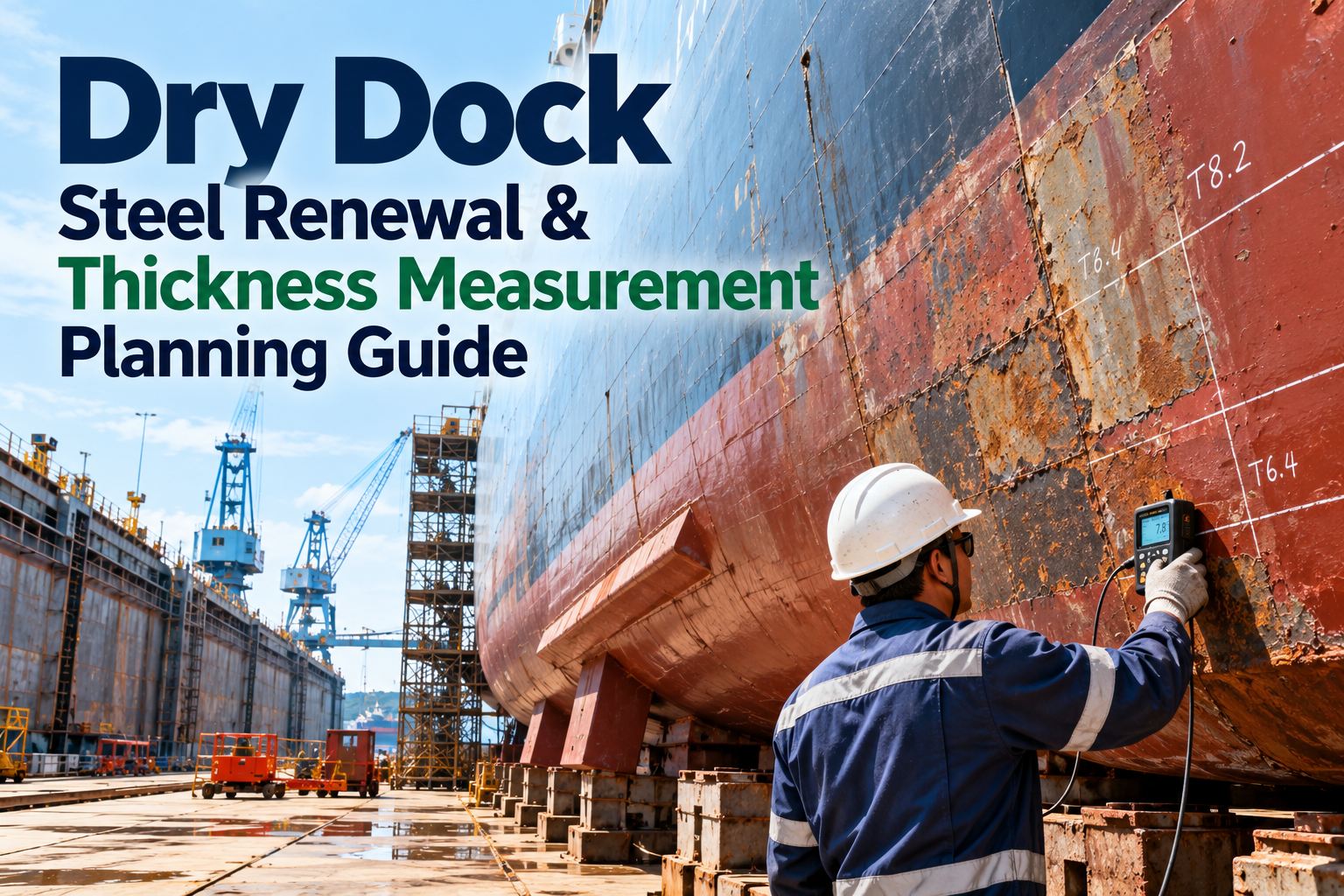
Steel is the only line in a docking budget whose price depends more on when you found it than on what it weighs. The same wasted plate costs one rate when it is in the tender and a different rate entirely when a surveyor finds it on the third morning with the ship already on the blocks, the staging somewhere else and the yard holding every card.Which makes steel renewal a measurement and timing problem long before it is a repair problem. This guide works through how renewal thickness is actually calculated, what substantial corrosion obliges you to do, where wastage reliably appears, how to read a gauging report as a forecast rather than a snapshot, how to decide what to renew now and what can safely wait, and how to get steel priced before the ship stops earning.
01
Dry dock · steel renewal planning
Wasted steel does not get more expensive because it corrodes further. It gets more expensive because you found it later.
Nothing about the plate changes across these four columns. What changes is how many options you still have when the number lands.
MI
Hold every gauging report, suspect area and renewal decision against the vessel
Why unplanned steel renewal wrecks a docking budget
The mechanism is commercial rather than technical. Work inside the agreed specification is priced competitively, because the yard won the job against others on those numbers. Work added after arrival is priced by a yard that knows the ship cannot leave, and it lands on a schedule that was already committed down to the day.
Reported total costs for docking a bulk carrier span roughly 1.5 to 4.5 million US dollars, with steel replacement volume named as one of the three variables that moves the figure most. The same commentary puts unplanned delays of seven to ten days as the point at which the financial position changes character — which is about what an unexpected renewal in a ballast tank costs in time once staging, gas-freeing, access and coating are counted.
The steel is the small part
Cropping and renewing plate is a fraction of the job. Access, staging, gas-freeing and tank cleaning, segregation from other trades, then blasting and recoating the renewed area — those carry the hours, and none of them were in the dock plan.
It arrives on the critical path
Steel discovered late is usually in a space that other work also needs. One tank held open for renewal holds up the coating programme, which holds up undocking, which is where the real money is.
The survey will not be credited
Where substantial corrosion is found, extended measurement has to be carried out before the survey is credited as completed. That is not a negotiation; it is a stop on the ship’s certificates until the measuring is done.
How renewal thickness is actually calculated
Most arguments about steel renewal happen because the parties are using different numbers for the same plate. The structural rules define the limit precisely, and it is not a percentage of as-built thickness.
trenewal=tas built−tC−tvoluntary
tas builtAs built thickness in millimetres, including any voluntary addition
tCThe corrosion addition defined by the rules for that structural item
tvoluntaryThickness voluntarily added as the Owner’s extra margin at build
treserve0.5 mm, covering the diminution anticipated across a 2.5-year survey interval
Renewal is required where the gauged thickness has fallen below the renewal thickness. The planning value sits in the band immediately above it: where the gauged thickness lies between the renewal thickness and the renewal thickness plus the 0.5 mm reserve, coating of the area or annual gauging may be accepted in place of renewing it.
Above the band
Sound for now. The question is the wastage rate, not the reading.
Inside the 0.5 mm reserve band
The decision point. Coating or annual gauging may be accepted instead of renewal — this is where staging across dockings is won or lost.
Below renewal thickness
Renewal. No discretion, no deferral, and an argument you will not win at the dock gate.
Two further criteria sit alongside the plate-by-plate one. Globally, the hull girder section modulus is not to be less than 90 per cent of the modulus calculated with gross offered thicknesses, and that global check is automatically satisfied where wastage is under 10 per cent in the deck and bottom zones and 15 per cent in the neutral axis zone. Locally, pitting is assessed against remaining thickness of more than 75 per cent of as built in frame webs and flanges, and 70 per cent in plating adjacent to frames.
Substantial corrosion and what it obliges you to do
The term has a precise definition and it carries consequences that catch planners out. Substantial corrosion is an extent of corrosion such that assessment of the corrosion pattern indicates a wastage in excess of 75 per cent of allowable margins, while still within the limits the rules permit. It is therefore not a failure — it is a warning with obligations attached.
1
The measurement widens on the spot
Where substantial corrosion is found, the extent of thickness measurement is increased to establish how far the affected area reaches. Plating is measured on a five-point pattern over one square metre; stiffeners take three measurements across the web and three across the flange.
2
The area becomes a suspect area
Suspect areas are locations showing substantial corrosion, or considered by the surveyor to be prone to rapid wastage. Once an area carries that label it is measured again at every subsequent survey, which turns a one-off finding into a standing commitment.
3
It can be re-measured annually
Thickness measurements are taken of areas of substantial corrosion at annual survey too, with the extent increased as needed. Plan on the assumption that a substantial-corrosion finding buys you an annual gauging commitment, not a quiet five years.
4
It gates the survey
The extended measurements are to be carried out before the survey is credited as completed. A finding on the last day of a docking is a finding that keeps the ship there.
Where hull thickness goes: the corrosion hot spots
Wastage is not evenly distributed and never has been. A planning gauging that covers the eight areas below will find most of what a special survey is going to find, months earlier and at a fraction of the disruption.
Ballast tank upper regions
Under-deck structure and the top of the tank, where coating breaks down first and the wet and dry cycling is harshest. The classic place a ship loses steel without anybody looking.
Inner bottom and bilge wells
Cargo abrasion, grab damage on bulk carriers and standing water in the wells. Damage here is mechanical as much as chemical, which makes it fast.
The wind and water band
Side shell around the operating waterline, wetted and dried continuously and abraded by ice, quay walls and fenders. Visible from outside and therefore often assumed to be understood.
Hatch coamings and covers
Exposed, mechanically worked every port, and dependent on drainage that stops working quietly. Coaming top plating and the stiffening underneath both deserve readings.
Cargo hold frames and brackets
On single-side-skin bulk carriers this remains the highest-value area to measure, and the one most likely to turn a routine docking into a structural project.
Bulkhead lower stools and shedders
Residues, washing water and poor drainage collect exactly where the structure is hardest to stage and most awkward to renew.
Structure beside heated tanks
Boundaries adjacent to heated cargo or fuel run warmer than the rest of the ship, and corrosion rates follow temperature. Easy to overlook because the structure looks ordinary.
Deck plating under fittings
Beneath pipe supports, lashing arrangements and deck fittings, where water sits and coating was thin from the start. Small areas, but they generate suspect-area status.
Suspect areas that carry forward, instead of a finding somebody remembers
Marine Inspection keeps gauging readings, suspect areas, coating condition and renewal decisions against the structural location on each vessel — so the next survey starts from the last one rather than from a fresh walk round.
This is the heart of the planning job. Each occasion to measure answers a different question and unlocks a different decision, and skipping the early ones is what pushes discovery into the dock.
Occasion
What to measure
What it tells you
The decision it unlocks
Routine, in service
Ship’s own spot readings in accessible hot spots, logged by location
Direction of travel between surveys, at almost no cost
Whether to bring a planning gauging forward
Annual survey
Areas of substantial corrosion, with extent increased as found
Whether known suspect areas are holding or moving
Whether the renewal list is growing before the special survey
Intermediate survey
The required scope plus every suspect area carried forward
The best mid-cycle picture you will get, with time to act on it
Whether steel goes into the next docking spec or the one after
Twelve months out
Owner’s own planning gauging across the hot spots and anything near the reserve band
A renewal list while there is still time to tender it
Scope, budget and whether the docking window is long enough
Pre-docking
Full required scope, by a firm certified by the class society, witnessed by a surveyor
The number the specification and the tender are built on
Fixed steel rates, agreed access and a credible dock programme
Variation scope — the one column you are trying to keep empty
After renewal
Readings on renewed areas as the new baseline, with the welds examined
A clean datum for the next cycle and proof the work was done
What the next docking inherits
Measurements for ships under the enhanced survey programme are carried out by a firm certified by the classification society, and where they are not carried out by the society itself they are to be witnessed by its surveyor, who reviews the final report and countersigns the cover page. The report has to carry the location, the measured and original thicknesses, the dates, the equipment used and the operator’s signature and qualification — which is also exactly what makes an old report useful years later.
Reading a thickness measurement report as a forecast
A gauging report is usually read as a verdict: pass or renew. Read that way it is almost useless for planning, because it only describes today. Read as the latest point in a series, the same report tells you when each item will reach its limit — which is the only question a docking plan actually needs answered.
The amber band is the 0.5 mm reserve above renewal thickness. Both plates are still above the limit at this docking. Only the slope separates the one that has to be renewed now from the one that can be coated and gauged instead.
Working out the slope needs two things most fleets half have: readings taken at the same locations each time, and the original build thicknesses to measure against. Where those exist, a wastage rate in millimetres per year falls out of simple arithmetic, and the projection to the next special survey takes minutes. Where they do not, every docking argues the same case from a single data point, which is how deferral decisions end up being made on tone of voice. Keeping the readings attached to the vessel in the planned maintenance system rather than in a folder from the measuring firm is what makes the second docking cheaper than the first.
Staging steel renewal across dockings
Not everything found has to be done now, and a superintendent who renews everything at the first opportunity is spending money as carelessly as one who defers everything. Five tests decide it.
Where does it sit against the limitBelow renewal thickness it is not a decision. Inside the reserve band, coating or annual gauging may be accepted instead — that is the mechanism the whole staging argument runs on.
What is the slopeAn item inside the band with a slow, well-evidenced wastage rate is a defer. The same reading with a steep rate is a renewal now, because the next opportunity is five years away.
What is going on top of itNever defer steel that is about to disappear under new coating or new equipment. Renewing it later means destroying work you have just paid for, which quietly doubles the cost of the deferral.
What does the access costIf the staging is already up and the tank already gas-free and clean, the marginal cost of renewing now is small. Access is most of the bill, so group work by space rather than by urgency.
What obligation comes with deferringDeferral usually buys an annual gauging commitment and a suspect area that follows the ship. Price that in rather than treating the deferral as free.
Getting steel priced properly in the yard tender
The specification is where a superintendent still has leverage. Six items decide whether the steel number holds.
A named rate per tonne, with bands
Agreed before arrival, with separate rates for straightforward plating and for difficult or overhead work, so additional steel is priced at a rate you negotiated rather than one you are handed.
What the rate includes
Cropping, fit-up, welding, examination of the new welds, and surface preparation and coating of the renewed area. If coating sits outside the steel rate, the cheap tonne rate is not the real number.
Access and staging, priced separately
Staging, gas-freeing, cleaning and ventilation per space, so the first tonne in a tank and the tenth are not priced as if they cost the same.
A material standard, not a description
Grade and thickness to the approved drawing, with mill certificates, because substitution shows up at the next survey rather than at handover.
No doubling as a permanent repair
Say so in writing. A doubler over wasted plate is a temporary measure that hides what is underneath, and the next surveyor will treat it as exactly that.
A procedure for additional work
How extra steel is measured, agreed, recorded and signed for, by whom, before it is cut. Agreeing this on day one is worth more than any other clause in the spec.
Running the steel renewal work in the dock
Once the work starts the superintendent’s job is verification at a short list of points, each of which is impossible to check afterwards.
Marking out
Boundaries agreed with the surveyor before anything is cut, against the gauging that justified the renewal.
Material check
Grade and thickness verified against the approved plan, with certificates to hand rather than promised.
Fit-up and welding
Gaps, alignment and the approved welding procedure, with qualified welders and the sequence agreed to manage distortion.
Weld examination
Non-destructive examination of the new welds to the agreed extent, with the records collected as they are produced.
Coating the renewed area
Preparation and the full scheme applied to new steel, logged. Bare new plate in a ballast tank is next cycle’s suspect area.
Baseline readings
Fresh thicknesses recorded on what was renewed, so the next cycle starts from a known datum instead of an assumption.
The coating step is the one most often compressed when the dock runs late, and it is the one that decides whether this renewal lasts a cycle or three. The relationship between coating condition and the rate at which structure wastes is set out further in our guide to hull maintenance and inspection.
Building a wastage history across the fleet
The single highest-value output of a docking is not the renewed steel. It is a record that makes the next docking, and the sister ship’s docking, hold no surprises.
01
Fix the locations
Readings are only comparable if they are taken at the same places. Agree a location scheme once, in the ship’s own structural terms, and hold every firm to it.
02
Keep as built alongside gauged
A gauged figure without its original is not a measurement of anything. Store both, with the corrosion addition for that item, and the renewal thickness falls out directly.
03
Carry suspect areas forward by name
Every area that earned the label stays on the list with its history attached, so a new surveyor inherits the picture instead of rediscovering it.
04
Compare across sisters
Ships built together and traded similarly waste similarly. A hot spot confirmed on one hull is a planning gauging target on the others, which is the cheapest forecasting a fleet ever gets.
Where that record lives matters more than its format. The workflows that hold gauging grids, corrosion mapping and the docking specification together are covered in our guide to hull inspection software for tankers and cargo ships.
Dry dock steel renewal: frequently asked questions
How is renewal thickness calculated?
Renewal thickness equals the as built thickness minus the corrosion addition for that item minus any voluntary thickness the Owner added at build. Renewal is required where the gauged thickness falls below that figure. A reserve of 0.5 mm sits above it, representing the diminution anticipated across a 2.5-year survey interval.
What does substantial corrosion mean?
An extent of corrosion such that assessment of the corrosion pattern indicates a wastage in excess of 75 per cent of allowable margins, while still within the limits the rules permit. It is not a failure, but it widens the measurement, makes the location a suspect area carried forward, and has to be resolved before the survey can be credited as completed.
Can steel renewal be deferred to the next docking?
Below renewal thickness, no. Where the gauged thickness lies between renewal thickness and renewal thickness plus the 0.5 mm reserve, coating of the area or annual gauging may be accepted instead of renewal. Whether that is wise depends on the wastage rate, on what is being applied over the area, and on what the access would cost to set up again later.
Who is allowed to take the thickness measurements?
For ships under the enhanced survey programme, a company certified by the classification society. Where the measurements are not carried out by the society itself they are to be witnessed by its surveyor, who reviews the final report and countersigns the cover page.
How many readings are taken where corrosion is found?
Where substantial corrosion is identified the measurement is extended: plating on a five-point pattern over one square metre, and stiffeners with three measurements across the web and three across the flange, carried out before the survey is credited as completed.
Which areas should a planning gauging cover?
The known high-wastage locations: ballast tank upper regions and under-deck structure, inner bottom and bilge wells, the wind and water band on the side shell, hatch coamings and covers, cargo hold frames on single-side-skin bulk carriers, bulkhead lower stools, structure adjacent to heated tanks, and deck plating under fittings — plus every suspect area carried forward.
When should gauging be done before a docking?
Early enough that the result can still change the tender, which in practice means a planning gauging around twelve months out and the full required scope before the specification is issued. Measurements taken after arrival price the work as additional scope rather than as part of the job the yard competed for.
Can doubler plates be used instead of renewal?
Treat doubling as a temporary measure rather than a repair. It conceals the condition of the plate underneath and tends to be assessed accordingly at the next survey, so writing it out of the specification avoids an argument at handover.
What happens if hull girder strength is affected?
Beyond the plate-by-plate check, the hull girder section modulus is not to be less than 90 per cent of the modulus calculated with gross offered thicknesses. That global criterion is automatically satisfied where wastage is below 10 per cent in the deck and bottom zones and 15 per cent in the neutral axis zone.
Dry dock & planned maintenance
Find the steel while you still have options
Marine Inspection holds gauging readings by structural location, suspect areas and their history, coating condition, renewal decisions and the docking specification against every vessel in the fleet — so the next renewal list is a forecast you produced, not a surprise the yard hands you.