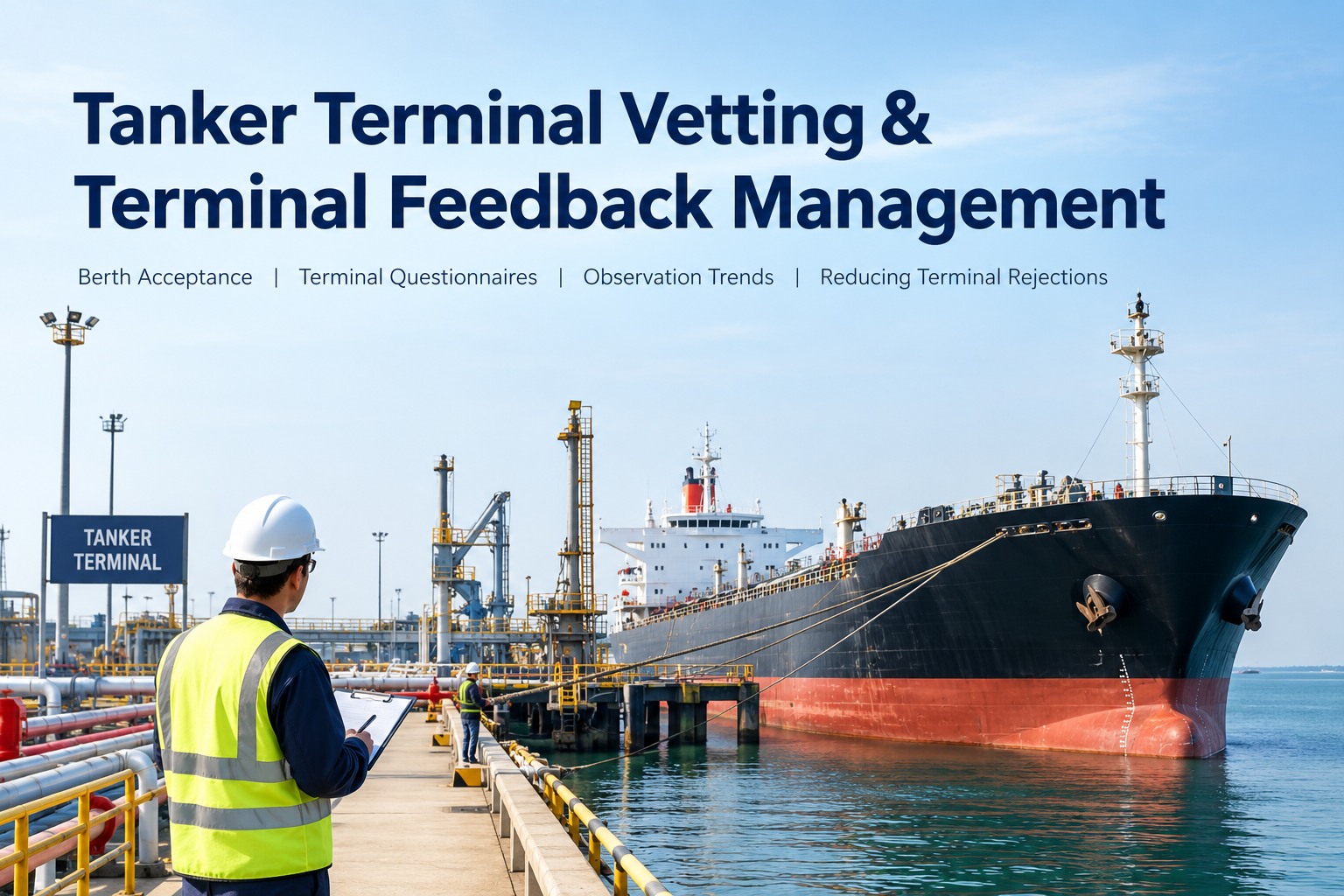
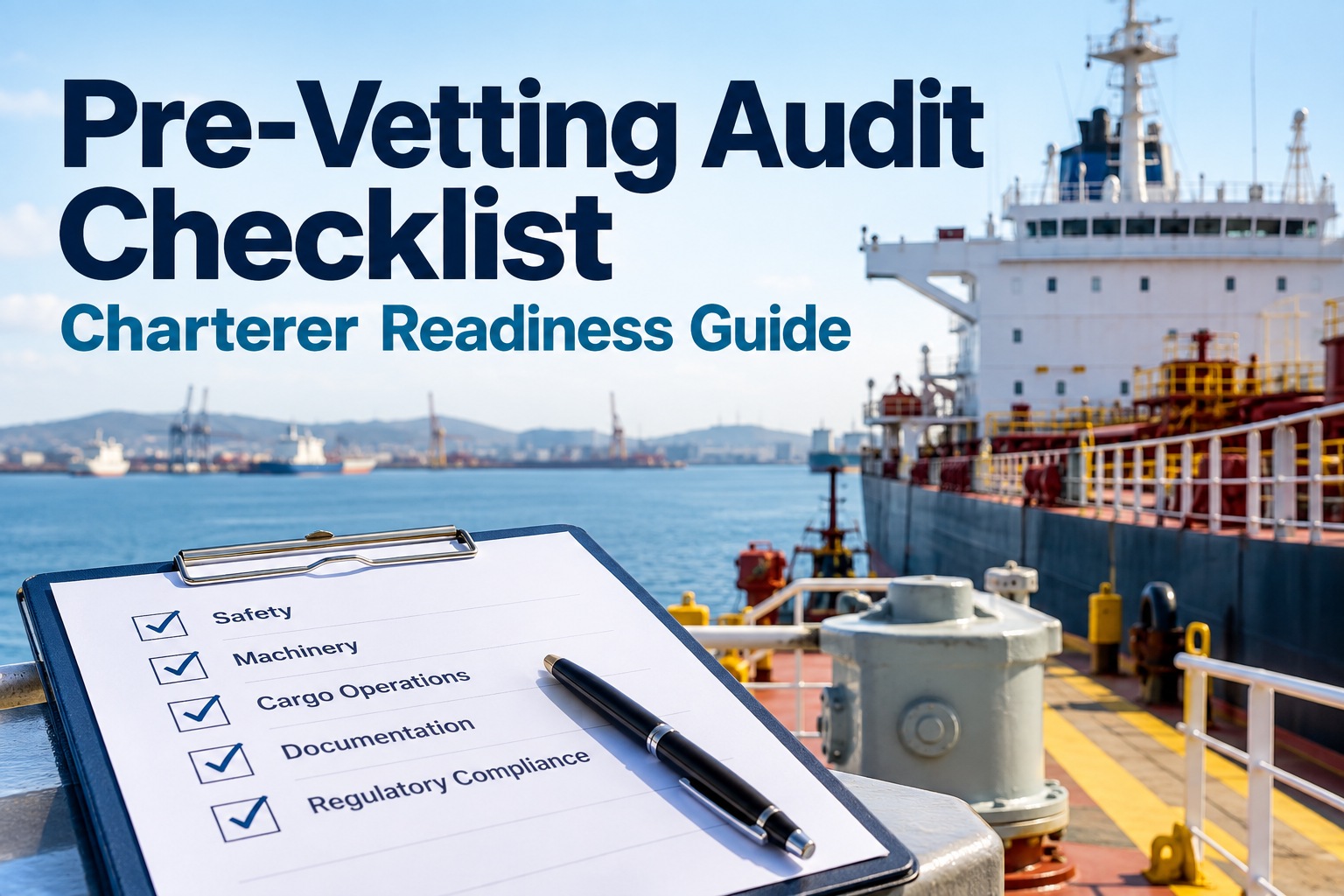
A charterer clears the ship. A terminal clears the ship at that berth — and the two are not the same decision. A tanker can hold a perfectly good vetting clearance and still be turned away at the jetty because her manifold sits outside the arm envelope, because the mooring study was never done for that berth, or because a questionnaire went back half-completed by an agent who had never seen the vessel. Terminal approval is a physical and operational question first, and a paperwork question only after that.
This guide covers the terminal side of vetting: how a berth approves a vessel and on what parameters, what the pre-arrival exchange and the ship/shore safety checklist actually require, which observations terminals raise most, and how feedback from a completed call works its way back into the next nomination weeks later.
Terminal vetting and the ship/shore interface
The berth is not assessing your certificates. It is assessing whether you fit, and how you behaved last time.
Hold the berth data, the questionnaires and the feedback in one place
Tanker terminal vetting: how a berth approves a ship
Terminal approval runs as a sequence, and the order is deliberate: the cheap desk work happens first and the expensive operational test happens last. The structure below follows a published terminal approval procedure and is representative of how most import and export facilities handle it.
Stage 1
Preparatory information exchange
Vessel particulars, general arrangement, manifold drawings, pump capacity curves, class status and the OCIMF questionnaire go to the terminal. Nothing is assessed until the set is complete.
Stage 2
Ship/shore interface study
The technical compatibility analysis: does the ship physically fit this berth, these arms, these hooks. A mooring analysis is normally part of it.
Stage 3
Ship safety inspection
An inspection by an inspector the terminal endorses, which may be a SIRE inspection or the terminal’s own, depending on the facility and the trade.
Stage 4
Operational test and approval
The first call is itself part of the assessment. Transfer rates, communications and the interface are verified in practice before approval is confirmed.
Stage 5
Approval follow-up
Ongoing monitoring. Approval persists only while the conditions it was granted under persist, which is where most owners stop paying attention.
Approval periods are finite. The procedure examined grants a three-year approval, with a requirement that vessels over 20 years old hold a valid condition assessment certificate less than two years old. Approval is withdrawn if the vessel fails an inspection — or is rejected at another terminal, which the shipper is obliged to report promptly. A refusal elsewhere is not a private matter.
Ship/shore compatibility: what the terminal is actually measuring
Compatibility is where terminal vetting differs most sharply from charterer vetting. None of it is about the management system; all of it is about geometry and equipment.
Manifold position and spacingHeight above deck and above the waterline across the loaded and ballast range, and spacing between connections against the arm centres
Arm or hose envelopeWhether the connection stays inside the working envelope of the arms through the full range of movement during transfer
Mooring arrangementA mooring analysis for that berth, using the actual line arrangement, winch brake capacities and environmental criteria
Emergency shutdown compatibilityThat the ship’s and the terminal’s shutdown systems speak to each other and that the link is proven before transfer
Gangway landing areaA defined clear footprint for the terminal’s access equipment — in the procedure examined, 1.5 metres square
Pumping and transfer ratesCapacity curves against the berth’s accepted rates, including the ramp-up and topping-off regime
Two of these are chronically out of date in owners’ files. Manifold drawings are often the original builder’s, not reflecting modifications made since; and mooring analyses are frequently done once for one berth and then assumed to transfer, which they do not. Both are cheap to correct ashore and expensive to discover alongside.
The terminal questionnaire and the pre-arrival exchange
The terminal questionnaire is raised by the terminal as part of ship scheduling, typically reaching the master or agent as a pre-populated form before berthing. It asks for operationally specific information — mooring configuration, loading and deballasting rates, helicopter suitability where relevant — and it is not optional. A vessel without an acceptable, validated questionnaire may be refused entry to the terminal regardless of her vetting status elsewhere.
Who completes it matters
These forms are routinely delegated to an agent who has never been on board. The result is figures that do not match the ship, which the terminal discovers when the rates do not materialise — and that becomes an observation about the vessel, not about the agent. The master or chief officer should verify every operational figure before it is returned, even where the agent submits it.
The ISGOTT ship/shore safety checklist at the berth
The ship/shore safety checklist in ISGOTT 6 is not a single form. It is a staged system that runs from before arrival through to the end of transfer, with parts allocated to the ship, the terminal or both jointly.
Before arrival
1A / 1BTanker pre-arrival checks, including inert gas system verification
2Terminal pre-arrival checks
After mooring
3Tanker checks after mooring
4Terminal checks after mooring
Before transfer
5A – 5CPre-transfer conference — general, chemical, gas
6Documented agreements between the parties, signed by both
7A – 7CSpecialised checks — general, crude oil washing, tank cleaning and gas freeing
During transfer
8Tanker repetitive checks
9Terminal repetitive checks
Part 5A and part 6 are completed jointly, with separate status columns for ship and terminal, and the declaration is signed by both representatives confirming that the applicable sections were checked. That joint signature is the point of the whole system: it converts a set of assumptions into an agreement that either side can hold the other to.
Repetitive checks during transfer
Parts 8 and 9 are the part crews treat as a formality and terminals read as a reliability signal. Both carry identical columns for recording check times, and the agreed interval is written into the declaration itself — the parties record that repetitive checks will be carried out at intervals of not more than a stated number of hours for the tanker and not more than a stated number for the terminal.
Because the interval is agreed rather than fixed, it is auditable. A terminal that sees a four-hour interval agreed and six-hour gaps recorded has a concrete, dated observation that needs no interpretation. Set the interval at something the watch can actually keep through a cargo operation, then keep it.
Every berth has its own data set. Most ships carry one copy of each.
Marine Inspection holds the manifold and mooring data, the terminal questionnaires, the checklist records and the feedback from each call against the vessel — so the next pre-arrival exchange starts from what was verified, not from what was on file.
Terminal observations, what triggers them, and how to prevent them
The observations below are the ones that recur across facilities and trades. The third column is where the work is: almost all of them are prevented ashore or before arrival rather than at the berth.
Observation
What usually triggers it
Where it is prevented
Transfer rate not achieved
Questionnaire figures taken from the ship’s file rather than her current condition
Verifying pump and rate figures on board before the questionnaire is returned
Mooring not to the berth plan
No mooring analysis for that berth, or lines run to the arrangement used at the last one
A berth-specific mooring plan carried on board and briefed before arrival
Repetitive checks not at the agreed interval
An interval agreed at the conference that the watch routine cannot sustain
Agreeing an interval the watch can keep, and logging it as it happens
Emergency shutdown link not proven
Connection made but not tested, or tested without a record either side accepts
Testing the link as a numbered step with both parties signing for it
Gangway or access arrangement
Landing area obstructed, or access rigged in a position the terminal equipment cannot reach
Knowing the required clear footprint for that berth and preparing it before arrival
Record book entries incomplete
Entries left to be caught up after the operation rather than made as it runs
A watch that has not run this berth type before and was not briefed
A pre-arrival brief covering this berth specifically, not cargo operations generally
Equipment defect visible at the berth
A known defect carried as acceptable on board that reads differently from the jetty
Closing it in the planned maintenance system, or declaring it before arrival rather than being found with it
Terminal requirements are facility-specific and published by each operator. Where a ship trades regularly to one berth, that terminal’s own information and regulations document is worth more than any general list.
Terminal feedback reports and the loop back into vetting
The feedback report is the mechanism that connects a call you have finished to a nomination you have not yet made. It is submitted by the terminal or operator after the vessel sails, it records how the call actually went, and it becomes part of the operational history used when the vessel’s suitability is assessed in future vettings.
Negative feedback is pursued to resolution rather than simply filed, which cuts both ways. It means an unanswered report does not quietly expire — but it also means there is a defined route for the owner to respond, correct the record and close the item. Silence is the one option that does not work.
Managing observation trends across a fleet
A single observation is an event. The same observation at three terminals is a system, and that is what both terminals and charterers are reading for. Managing the trend is therefore a fleet exercise rather than a ship one.
1
Code the observations
Record every terminal observation against a consistent category, not as free text in a voyage report. Free text cannot be counted, and what cannot be counted cannot show a trend.
2
Count across the fleet, not the ship
Three ships each raising the same observation once looks clean at ship level and alarming at fleet level. The charterer sees the fleet view; the owner should see it first.
3
Close with evidence, not assertion
A corrective action with a date, a named owner and a photograph or record attached closes an item. “Crew briefed” does not, and it is the phrase that appears most often in reports that fail to convince.
4
Feed it back into the brief
The pre-arrival brief for the next similar berth should name the observation raised at the last one. That is the only mechanism that stops a trend forming.
Why berth approvals lapse
Approvals end quietly, and almost never because the terminal changed its mind about the ship.
The period simply ran out
A three-year approval with no diary entry against it. The first anyone notices is a nomination that does not clear.
A supporting certificate expired
The condition assessment certificate required for older tonnage has its own validity, and the approval rests on it. Letting it lapse withdraws the approval by implication.
The ship changed
Modifications to manifold, mooring equipment or cargo system move the ship outside the compatibility study the approval was based on.
A refusal somewhere else
Rejection at another terminal is reportable and causes withdrawal. Terminals in the same trade are better connected than owners expect.
Reducing terminal-driven rejections
Most terminal-driven refusals are information failures rather than condition failures, which makes them unusually tractable.
Keep one authoritative data setCurrent manifold drawings, mooring equipment details with brake capacities, pump curves and general arrangement — one version, verified, used for every submission so terminals never receive conflicting figures.
Treat each berth as its own caseA mooring analysis and a compatibility position per berth, not per ship. The question is never “can this ship moor” but “can this ship moor here”.
Verify questionnaires on boardWhoever submits them, the operational figures are checked by the master or chief officer against the ship as she is today.
Brief the berth, not the cargoA pre-arrival brief covering this terminal’s arrangement, its shutdown link, its access requirement and the observations raised at the last comparable call.
Arrive having done the passage workPilotage, under-keel clearance and the approach planned to the standard the chapter V navigation regime expects, because the terminal watches the arrival as closely as the transfer.
Close feedback before the next callRespond to every report, attach evidence, and confirm the item is closed. An open report travels with the ship.
Terminal vetting and feedback: frequently asked questions
How is terminal vetting different from charterer vetting?
A charterer clears the ship for business; a terminal clears the ship for a specific berth. Terminal assessment is dominated by physical compatibility — manifold position, arm envelope, mooring arrangement, shutdown link, access — and by how the vessel performed during previous calls at that facility.
What is a terminal questionnaire?
A form raised by the terminal as part of ship scheduling, usually reaching the master or agent pre-populated before berthing. It asks for mooring configuration, loading and deballasting rates and similar operational detail. Without an acceptable validated questionnaire a vessel may be refused entry to the terminal.
What is in the ISGOTT ship/shore safety checklist?
A staged system rather than one form: tanker and terminal pre-arrival checks, checks after mooring by each party, a pre-transfer conference with documented agreements signed by both, specialised checks for operations such as crude oil washing and tank cleaning, and repetitive checks by both parties during transfer.
How often are repetitive checks carried out?
At an interval agreed between the ship and the terminal and written into the declaration — stated as not more than a set number of hours for the tanker and not more than a set number for the terminal. Because it is agreed rather than fixed, the record is auditable against it.
How long does a terminal approval last?
In the procedure examined, three years — with vessels over 20 years old required to hold a condition assessment certificate less than two years old. Approval is withdrawn on a failed inspection or on rejection at another terminal, which the shipper must report promptly.
What is a terminal feedback report?
A report submitted by the terminal or operator after the vessel sails, recording how the call went. It forms part of the operational history used in future vetting assessments. Negative feedback is pursued to resolution rather than filed, so an unanswered report does not expire.
Does a rejection at one terminal affect others?
Yes. In the procedure examined, rejection at another terminal is reportable and causes the existing approval to be withdrawn. Terminals in the same trade share more information than owners generally assume.
What is the most common preventable terminal observation?
Operational figures that do not match the ship — most often transfer rates taken from a file rather than verified on board, which the terminal discovers when the rate is not achieved. It is prevented entirely by having the master or chief officer check the questionnaire before it is returned.
The berth remembers. Make sure you do too.
Marine Inspection keeps every terminal call against the vessel — the questionnaire submitted, the checklist record, the observations raised and how each was closed — so the trend is visible to you before it is visible to a charterer, across the whole fleet.