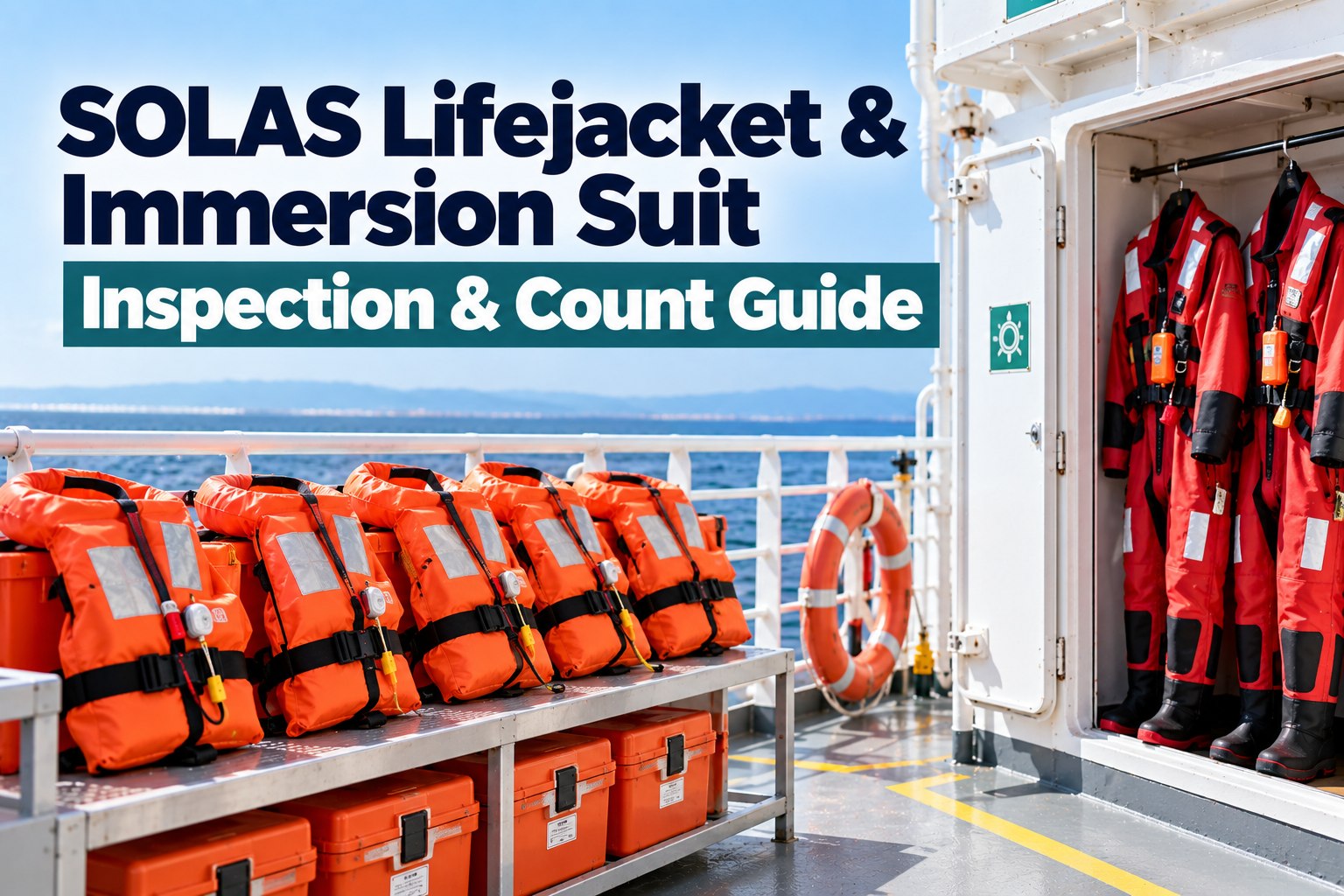
Lifejackets and immersion suits are the only life-saving appliances issued to a person rather than to the ship, and that is exactly why they fail inspection. A lifeboat is one item with one certificate. Personal appliances are dozens of items, spread across cabins, the bridge, the engine control room and the muster stations, each with its own light, whistle, tape and expiry date, and each counted against a number that changes every time the manning changes. The equipment is rarely defective. The count is wrong, or the extras nobody thinks about are missing.
This guide covers the counts SOLAS actually requires, including the ones that sit on top of “one per person”, what has to be attached to each jacket, how immersion suits are inspected and pressure tested, and how an inspector verifies the whole lot against the muster list in about ten minutes.
One per person is where the count starts. It is almost never where it ends.
SOLAS lifejacket and immersion suit counts: what must be on board
The base rule is one lifejacket for every person on board. Everything below is carried in addition to that number, which is where ships fall short — the extras are not spares, they are separate requirements.
Per person on board
At the manned watch stations
At remotely located survival craft
Immersion suits, cargo ships
Rescue boat and MES crews
Lifejacket counts on passenger ships: the child and infant percentages
Passenger ships carry two further layers on top of the adult count, and they are expressed as percentages of passengers rather than as absolute numbers — so they move with every voyage.
Two practical points. The child percentage is a floor, not a target — if more children are carried than the 10 per cent provides for, more jackets are required. And on voyages of 24 hours or more the infant requirement stops being a percentage and becomes one for each infant actually on board, which means the count has to be done against the manifest rather than against the certificate.
Lifejacket lights, whistles and retro-reflective tape
Each lifejacket must be fitted with a lifejacket light, and the light has a specification worth knowing because it is what makes the item either compliant or decorative.
The light carries a battery expiry date, and it is the single most common lifejacket finding on any ship. The dates are staggered across the fleet of jackets because batteries were renewed at different times, so a ship that checks “the lifejacket lights” as one item will always miss the handful that have gone past. Check them individually and hold the dates per jacket, which is the only way the next expiry surfaces before an inspector finds it.
What a lifejacket has to do in the water
The performance requirements are worth knowing because they explain the inspection criteria. An adult lifejacket has to lift the mouth of an exhausted or unconscious person not less than 120 mm clear of the water, and it has to turn the body of an unconscious person from any position to one where the mouth is clear within five seconds.
That is why a compressed, waterlogged or oil-soaked jacket is condemned rather than cleaned: the buoyancy material has lost the reserve it needs to do those two things, and neither can be judged by looking at the outside. It is also why straps and buckles matter as much as the foam — a jacket that cannot be secured tightly will ride up and do neither.
Immersion suit requirements on cargo ships
On a cargo ship an immersion suit of an appropriate size is provided for every person on board. The sizing clause does real work here and is regularly where ships come unstuck.
Sizing
Stowage
Condition
Donning
Immersion suit inspection: the monthly check and the pressure test
Two separate regimes apply, and crews frequently do the first while assuming it covers the second.
Monthly, by the crew
Air pressure test, periodically
Tighter intervals for older suits
Who may carry it out
Inflatable lifejacket servicing and the approved station
Inflatable lifejackets are a different item from foam jackets for maintenance purposes. They are serviced at approved servicing facilities, normally within a twelve-month period, and where servicing cannot be completed within that window an extension has to be sought from the flag administration rather than assumed.
The components inside carry their own dates — the inflation cylinder, the automatic inflation head and the light. An extension granted on the jacket does not extend the dated components inside it, which is the detail that turns a tidy servicing record into a finding. Keep the cylinder and head dates against each jacket in the ship’s planned maintenance system alongside the service date itself.
Lifejacket and immersion suit rejection criteria
The list below is what a thorough check is actually looking for. The right-hand column is the useful part: the point at which the item comes out of service rather than getting a note in the book.
| Item | What to look for | Take it out of service when |
|---|---|---|
| Buoyancy material | Compression, hardening, oil or chemical soaking, waterlogging | The material is compressed, saturated or hardened anywhere — reserve buoyancy cannot be judged by eye and is not recoverable |
| Cover and stitching | Tears, perished fabric, failed seams, UV degradation on jackets stowed in daylight | Any seam failure or tear that exposes the buoyancy material |
| Straps and buckles | Fraying, corroded or distorted buckles, missing adjusters | The jacket cannot be secured firmly enough to stay in position when the wearer is in the water |
| Lifejacket light | Battery expiry date, corrosion at the contacts, secure attachment | The date has passed, or the light is missing or detached — renew rather than defer |
| Whistle and cord | Present, audible, firmly secured by its cord | Missing, or attached by anything other than a sound cord |
| Retro-reflective tape | Coverage, adhesion, tape that has gone dull or lifted | Tape is missing, lifting or no longer reflective |
| Immersion suit seams and seals | Face, wrist and ankle seals, cracking along stowage folds | Any crack, perished seal or seam that will admit water — a leaking suit is worse than none, because it is trusted |
| Immersion suit zip | Runs freely and fully, lubricated, no missing teeth | The zip cannot be closed fully and unassisted by the person it is issued to |
| Inflatable jacket components | Cylinder weight and date, inflation head date, oral tube valve | Any dated component has expired, or the cylinder weight is below the stated figure |
Maker’s instructions and flag requirements sit above this list. Where a ship’s own procedures are stricter, the ship’s procedures are the standard an auditor will hold it to.
Thermal protective aids and where they fit in the count
Thermal protective aids are frequently confused with immersion suits and counted as though they were interchangeable. They are not. A TPA is a bag or suit of waterproof material with low thermal conductance, intended to restore body temperature of a person who is already out of the water and in a survival craft. It is not swimwear and it is not an immersion suit.
The practical inspection points are that TPAs are in the survival craft rather than in a store, that the packets are intact and the material has not perished, and that the crew know the difference. A lifeboat inventory that lists immersion suits where TPAs should be, or the reverse, is a finding on the inventory as much as on the equipment.
How Port State Control verifies the count against the muster list
The verification is quick and it always runs the same way, which means it can be rehearsed.
The failure mode is nearly always the third step. The cabins are fully stocked, the certificate quantities are met in aggregate, and the additional jackets at the engine control room or at the remote liferaft position are missing because they were borrowed for a drill and never returned.
Lifejacket and immersion suit records
The record that answers all of this is a register by location rather than a total. Cabin numbers, watch stations and muster positions, each with the items stowed there, each item with its light expiry, service date and last inspection. A single figure for “lifejackets on board” cannot answer the question an inspector is actually asking, which is whether the right items are in the right places.
Monthly LSA inspections are carried out against a checklist and the results entered in the log book, and that entry needs to record findings rather than completion. A year of monthly entries with nothing ever found is not evidence of a well-maintained ship; it is evidence that nobody is looking properly.
Did lifejacket and immersion suit rules change in 2026?
No. The counts, the light specification, the whistle and tape requirements, the immersion suit provision on cargo ships and the servicing regimes are all unchanged by the amendments that entered into force on 1 January 2026.
The life-saving appliance changes in that package are narrower than the discussion around them suggests, and the substantive equipment work in the 2026 amendments sits elsewhere — principally in the new lifting appliance requirements, which do reach ships already in service and carry real deadlines. If you are planning work for this year, that is where the budget goes.