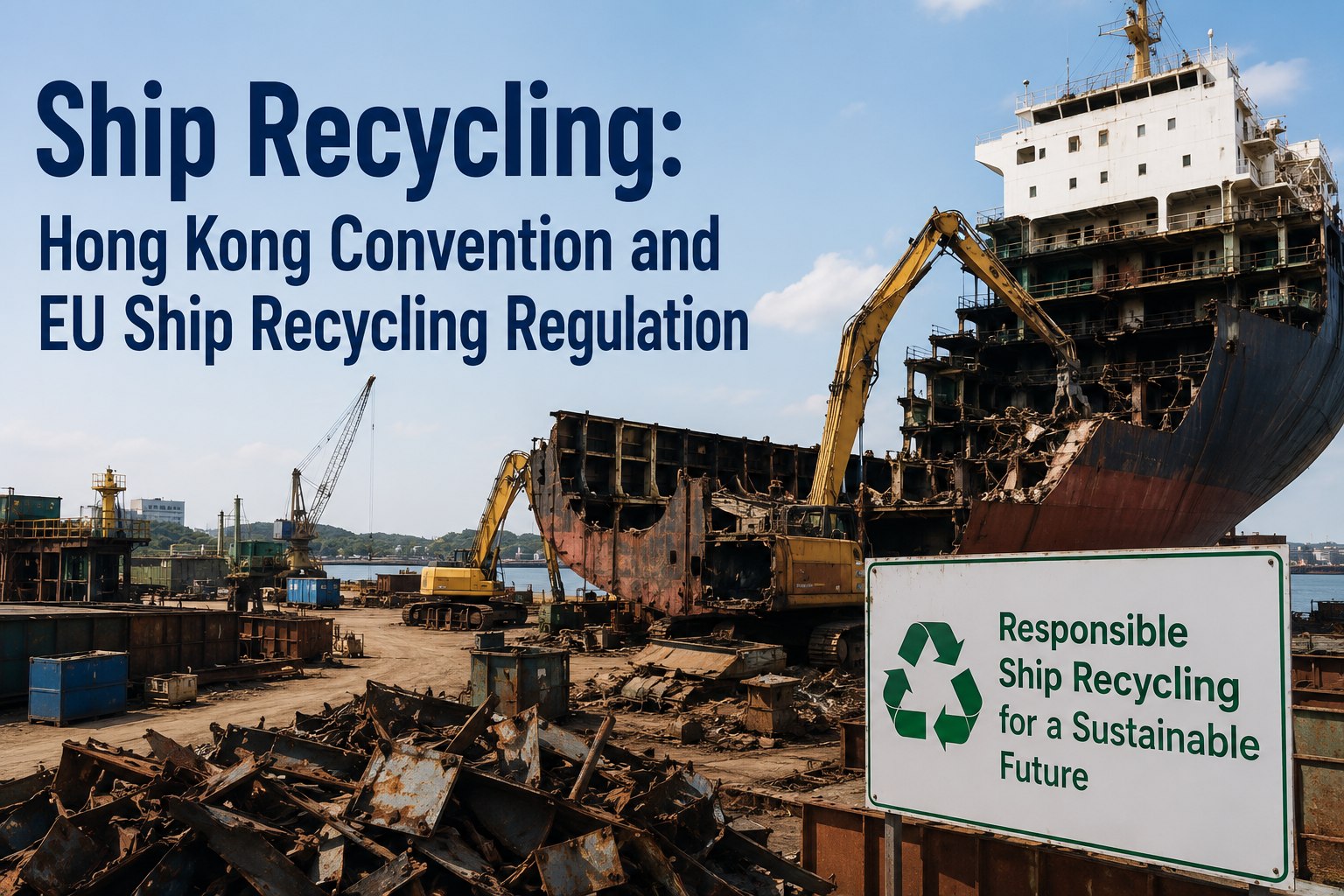
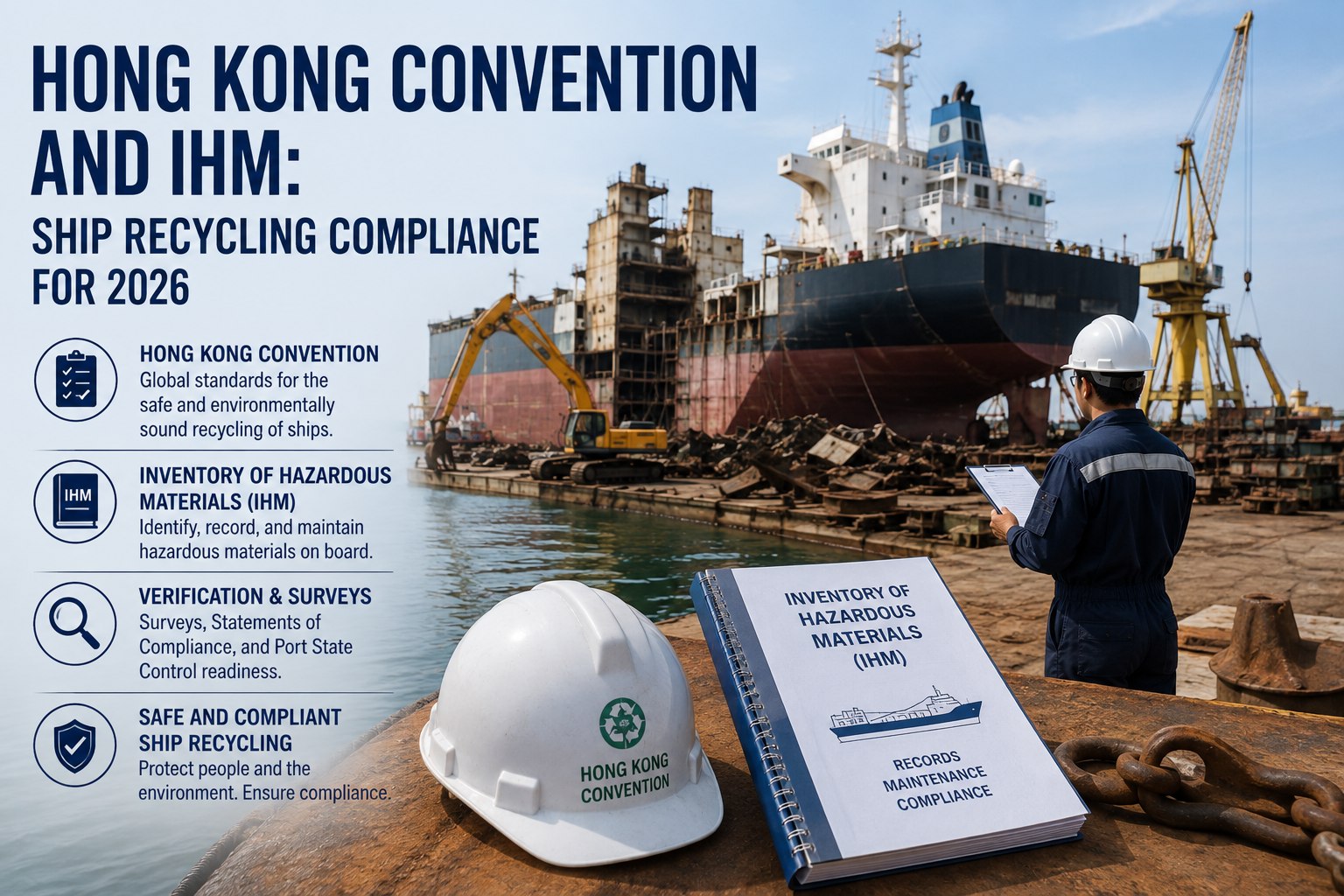
On 26 June 2025, ship recycling stopped being a matter of conscience and became a matter of law everywhere. The Hong Kong International Convention entered into force that day — sixteen years after adoption — establishing the first globally binding regime for the safe and environmentally sound recycling of ships. For fleet managers and legal officers, the change is structural. Every ship of 500 gross tonnes and above on international voyages must now carry a certified Inventory of Hazardous Materials, maintained across its whole operating life; every vessel sent for recycling must go to a facility holding a valid Document of Authorization, under a ship-specific recycling plan, with an International Ready for Recycling Certificate that is valid for just ninety days. And the Hong Kong Convention does not replace the EU Ship Recycling Regulation — it sits alongside it. Two overlapping regimes now govern the same vessels with different hazardous-material lists, different certificates, and critically different rules on which yards you may use. Getting that overlap wrong exposes owners to detainable deficiencies, fines, and liability under civil, administrative, and environmental criminal law. This guide is built for that problem: what each regime requires, where they diverge, the deadlines that bind, the documents a ship needs on its final voyage, and how the Basel Convention complicates the picture. To maintain the IHM, track certificate validity, and manage recycling compliance across a fleet, book a Marine Inspection demo.
Green shipping · ship recycling
Ship Recycling: Hong Kong Convention & EU Ship Recycling Regulation
A compliance guide to the two overlapping regimes governing end-of-life vessels — IHM requirements, certification, facility authorisation, the deadlines, and where the EU rules go further than the global convention.
Hong Kong Convention
In force 26 June 2025 · global · ships 500 GT and above · 13 hazardous materials · any authorised (DASR) facility
EU Ship Recycling Regulation
Reg (EU) 1257/2013 · EU/EEA flags and EU port calls · 15 hazardous materials · European List facilities only
What Changed on 26 June 2025
The Convention's entry into force was triggered in June 2023, when Bangladesh and Liberia acceded and the dual criteria — ratification by at least 15 states representing 40% of world merchant tonnage, with sufficient recycling capacity — were finally met. Twenty-four months later it took effect. See certificate tracking in a demo.
Scope
Ships of 500 gross tonnes and above engaged in international voyages, across their whole lifecycle — design, construction, operation, and dismantling.
Cradle to grave
Owners must control hazardous materials throughout design, construction, operation, and maintenance; installation or use of listed materials is prohibited or restricted.
Authorised yards only
A ship flying a party's flag may be recycled only at a facility holding a valid Document of Authorization for Ship Recycling (DASR).
No more favourable treatment
Non-party flagged ships are expected to comply, and must hold a Statement of Compliance on IHM before entering the waters of a party state, or face inspection.
Enforcement teeth
Port State Control can verify certificate validity and the underlying IHM evidence at any port; failure is a detainable deficiency, with penalties and liability exposure.
The IHM: Three Parts, One Living Document
The Inventory of Hazardous Materials is the spine of both regimes. It identifies hazardous materials on board with their location and approximate quantities, so that recycling workers know what they are cutting into. It has three parts, and only one of them lives with the ship permanently.
Part I
Structure and equipment
Hazardous materials contained in the ship's structure, equipment, and systems, with location and approximate quantities. Prepared at construction or in service, certified, and then maintained and updated throughout the ship's operational life.
Part II
Operationally generated wastes
Wastes produced by normal operation — wastewater, residues — that are potentially hazardous to human health and the environment at the recycling facility. Compiled prior to recycling.
Part III
Stores
Regular consumable goods and stores that may contain hazardous materials but are not integral to the ship's structure. Also compiled prior to recycling, completing the picture for the yard.
Part I is the maintenance burden. It must be revised whenever hazardous materials are installed or removed, or when their quantities change, and the cover page updated on any change of the ship's name, flag, owner, or manager. Parts II and III are assembled only when the ship heads for the yard. This is where fleets get caught: an IHM that was accurate at certification and never touched again will not survive a final survey, and Part I discipline over decades is what makes the end-of-life process straightforward rather than expensive.
The Two Certificates
The Convention's architecture rests on two distinct certificates that many owners confuse. One governs the operating life; the other authorises the final voyage. See survey and certificate records in a demo.
ICIHM — operational life
International Certificate on Inventory of Hazardous Materials
Issued after an initial survey verifying IHM Part I
Valid for a period not exceeding five years
Renewal surveys at intervals of no more than five years; additional surveys after significant changes or repairs
Non-party flags hold a Statement of Compliance (SoC IHM) instead
IRfRC — the final voyage
International Ready for Recycling Certificate
Issued only after a final survey before recycling
Valid for no more than three months — roughly 90 days
Requires completed IHM Parts I, II and III, verified
Requires an approved ship-specific Ship Recycling Plan from an authorised yard
The IRfRC's ninety-day validity is a planning constraint that catches owners out. It exists solely to cover the ship's final voyage, so the sequence — final survey, plan approval, certificate, delivery — has to be scheduled tightly. A slipped voyage can expire the certificate before the vessel reaches the yard.
The IHM is a decades-long obligation
Keep the Inventory Current, Not Just Certified
IHM Part I must be updated whenever hazardous materials are installed or removed, and whenever the ship's name, flag, owner, or manager changes. Marine Inspection tracks IHM revisions, certificate and survey validity, and hazardous-material changes against each vessel — so the inventory stays audit-ready across the whole operating life. Book a 30-minute demo to see IHM and certificate management, or start a free trial today.
The Compliance Deadlines
The Convention distinguishes new ships from existing ships, and the dates are precise. Missing them turns a routine survey into a detention risk.
26 Jun 2025
Convention in force; new ships certified at delivery
New ships must hold an approved, certified IHM and a valid ICIHM on delivery, verified by initial survey before entering service. A ship counts as new if its building contract falls on or after this date; absent a contract, if the keel is laid on or after 26 December 2025; or if delivery falls on or after 26 December 2027.
26 Jun 2025
Recycling rules bite immediately
From this date any ship going for recycling needs a DASR-holding facility, approved IHM Parts I, II and III, a ship-specific recycling plan from that facility, and an IRfRC on board. Facilities must hold a valid DASR and issue ship-specific plans.
First renewal
Existing ships begin converting
Existing vessels obtain the ICIHM or SoC at the first harmonised renewal survey falling on or after 26 June 2025, typically aligned with the main class renewal survey.
26 Jun 2030
Hard deadline for the existing fleet
By this date every existing ship of 500 GT and above must have an approved, certified IHM Part I and the ICIHM on board — or earlier, if it goes for recycling before then.
A practical note on date management: because the ICIHM is valid for at most five years, converting an existing Statement of Compliance at the wrong moment can leave the certificate expiring out of step with the ship's other convention certificates. Class societies recommend converting before a periodical survey, then renewing at that survey, so all expiry dates harmonise.
Hong Kong Convention vs EU Ship Recycling Regulation
This is the crux for any European owner or any ship calling at EU ports. The EU regulation largely mirrors the Convention but goes further in ways that materially change where a ship may be scrapped. Scroll the table on mobile.
Comparing the Two Regimes
The European List has, at points, run to around 48 facilities — the large majority in Europe, with a handful in Türkiye and one in the United States — and has excluded some of the biggest yards in India and Bangladesh even where those yards hold Hong Kong Convention statements of compliance from classification societies. That gap is the single most consequential difference in practice, because it determines whether a European owner can use the world's dominant recycling capacity at all.
Flag-Hopping, Cash Buyers and Legal Risk
The EU List's exclusions created a well-documented evasion pattern, and it is the reason legal officers now sit in recycling decisions. The compliance risk has moved from environmental to corporate.
The evasion pattern
Owners have changed a vessel's flag before recycling, or sold to cash buyers, to move the ship outside the EU regime's reach — a practice the regulation was designed to prevent and enforcement increasingly targets.
The scale of the gap
Europeans own around 40% of the world fleet, roughly 15,000 ships, about 10,000 EU-flagged — yet historically only a small fraction of EU-flagged tonnage has been dismantled within EU territory.
Liability exposure
Non-adherence now carries compliance and liability risk under civil, administrative, and environmental criminal law, with significant penalties and fines and an expectation of greater enforcement.
Due diligence duty
Owners must exercise due diligence to confirm the chosen facility is properly authorised by its competent authority, and must notify the flag state of the intention to recycle.
The commercial counterpoint is that a legitimate market is forming. As legally compliant recycling capacity becomes scarce relative to demand, yards that invested early in infrastructure, authorisation, and certification stand to benefit — and owners with clean IHMs and documented compliance will find the disposal process faster and cheaper than those reconstructing decades of records under deadline pressure.
The Basel Convention Overlap
One unresolved complication sits over everything. The Basel Convention governs transboundary movement of hazardous waste and treats an end-of-life ship as hazardous waste — a characterisation that does not sit comfortably alongside the Hong Kong Convention's ship-recycling framework.
The tension
Basel regulates the movement of hazardous waste across borders; the HKC regulates the safe recycling of ships. Both address hazardous materials, from different angles, and their interplay creates uncertainty.
Provisional guidance
Pending resolution between the IMO and Basel parties, the IMO approved provisional guidance (HKSRC.2/Circ.1) on implementing both instruments for ships intended for recycling.
EU waste rules too
EU-flagged ships must also account for the EU Waste Shipment Regulation (EU) 2024/1157 during their operational and end-of-life periods, layering a third instrument onto the analysis.
Practical stance
Until the interplay is settled, owners should treat the strictest applicable requirement as governing and document the reasoning behind facility selection.
What the Recycling Facility Must Provide
Half the compliance burden sits ashore, and owners must verify it before committing a vessel. A yard cannot lawfully take a ship under either regime without these in place. See documentation tracking in a demo.
Document of Authorization
A valid DASR issued by the facility's competent authority, confirming it meets the Convention's standards. Under EU rules, the yard must additionally sit on the European List.
Ship Recycling Facility Plan
A standing plan covering worker safety and training, protection of human health and the environment, personnel roles and responsibilities, emergency preparedness, and monitoring and record-keeping.
Ship-specific Recycling Plan
Prepared by the facility with the owner for each individual vessel, setting out its particulars, the hazardous materials aboard per the IHM, and the methodology for dismantling it.
Government oversight
States must ensure facilities under their jurisdiction comply. Almost all ship recycling occurs in five countries — Bangladesh, China, India, Pakistan, and Türkiye — four of which are Convention parties.
The takeaway for a fleet manager is that recycling compliance is decided long before the ship reaches the beach. It is decided by whether IHM Part I was maintained honestly across twenty years of refits, whether certificate and survey dates were harmonised, and whether facility due diligence was documented. Those are record-keeping disciplines, and the fleets that run them well convert an end-of-life liability into a clean, defensible transaction. Book a demo to see IHM and compliance management.
Frequently Asked Questions
When did the Hong Kong Convention enter into force?
On 26 June 2025, twenty-four months after the entry-into-force criteria were met in June 2023 when Bangladesh and Liberia acceded. It is the first globally binding regime for safe and environmentally sound ship recycling, applying to ships of 500 gross tonnes and above engaged in international voyages, across their entire lifecycle.
What is the Inventory of Hazardous Materials?
The IHM identifies hazardous materials on board with their location and approximate quantities. Part I covers materials in the ship's structure and equipment and must be maintained throughout the operational life. Part II covers operationally generated wastes and Part III covers stores; both are compiled before recycling. It lets the yard dismantle the ship safely.
What is the difference between an ICIHM and an IRfRC?
The International Certificate on Inventory of Hazardous Materials (ICIHM) covers the ship's operational life, issued after an initial survey of IHM Part I and valid for up to five years. The International Ready for Recycling Certificate (IRfRC) is issued only before recycling, after a final survey verifying IHM Parts I, II and III plus an approved Ship Recycling Plan, and is valid for no more than three months.
How does the EU Ship Recycling Regulation differ from the Hong Kong Convention?
The EU regulation largely mirrors the Convention but is stricter. It lists 15 hazardous materials rather than 13, adding PFOS and HBCDD, and it requires recycling only at facilities on the European List of Approved Ship Recycling Facilities — which has excluded many major South Asian yards even where those hold Hong Kong Convention statements of compliance.
By when must existing ships have an IHM certificate?
Existing ships of 500 GT and above obtain the ICIHM or Statement of Compliance at the first harmonised renewal survey falling on or after 26 June 2025, and must hold an approved, certified IHM Part I with the certificate on board no later than 26 June 2030 — or earlier if the ship goes for recycling before that date.
Does the Hong Kong Convention apply to non-party flagged ships?
Indirectly, yes. Under the principle of no more favourable treatment, non-party flagged ships are expected to comply and must hold a Statement of Compliance on IHM before entering the waters of a party state, or face inspection. Port State Control can verify certificate validity at any port, and failure is a detainable deficiency.
What must a recycling facility hold?
A valid Document of Authorization for Ship Recycling (DASR) from its competent authority, and a Ship Recycling Facility Plan covering worker safety and training, human health and environmental protection, personnel roles, emergency preparedness, and monitoring and record-keeping. It must also prepare a ship-specific Ship Recycling Plan for each vessel it takes.
Built for lifecycle compliance
Twenty Years of Records, One Clean Handover
Maintain IHM Part I across refits and ownership changes, track ICIHM and survey validity against every vessel, document facility due diligence, and keep the evidence a final survey demands — so end-of-life becomes a defensible transaction rather than a scramble. Marine Inspection keeps recycling compliance on the record from delivery to dismantling. Book a tailored walkthrough or start a free trial today.