Ship Cargo Securing & Lashing Equipment Inspection in 2026
Cargo securing is the rare shipboard discipline where the rules, the equipment and the arithmetic all have to agree before anything leaves the berth. SOLAS requires cargo units to be loaded, stowed and secured throughout the voyage in accordance with a Cargo Securing Manual approved by the Administration — not according to what the lashing gang usually does, not according to what fitted last time. The manual names the equipment, states its maximum securing load, sets out the arrangements for each cargo type and carries the inspection and maintenance scheme that keeps the gear fit to use. What goes wrong is rarely the arithmetic. It is a twistlock nobody rejected, a turnbuckle at the end of its thread, a stack loaded heavier than the plan allows, and a manual that has not matched the ship’s actual fittings since a refit three years ago. This guide covers the securing arrangement element by element, what the manual must contain, the MSL figures behind every calculation, inspection and rejection criteria for lashing gear, twistlocks in particular, stack weight limits, safe working conditions for lashing crews, and the deficiencies Port State Control writes up most. Start a free trial of Marine Inspection to run lashing gear inspections with photo evidence and keep the records the manual requires.
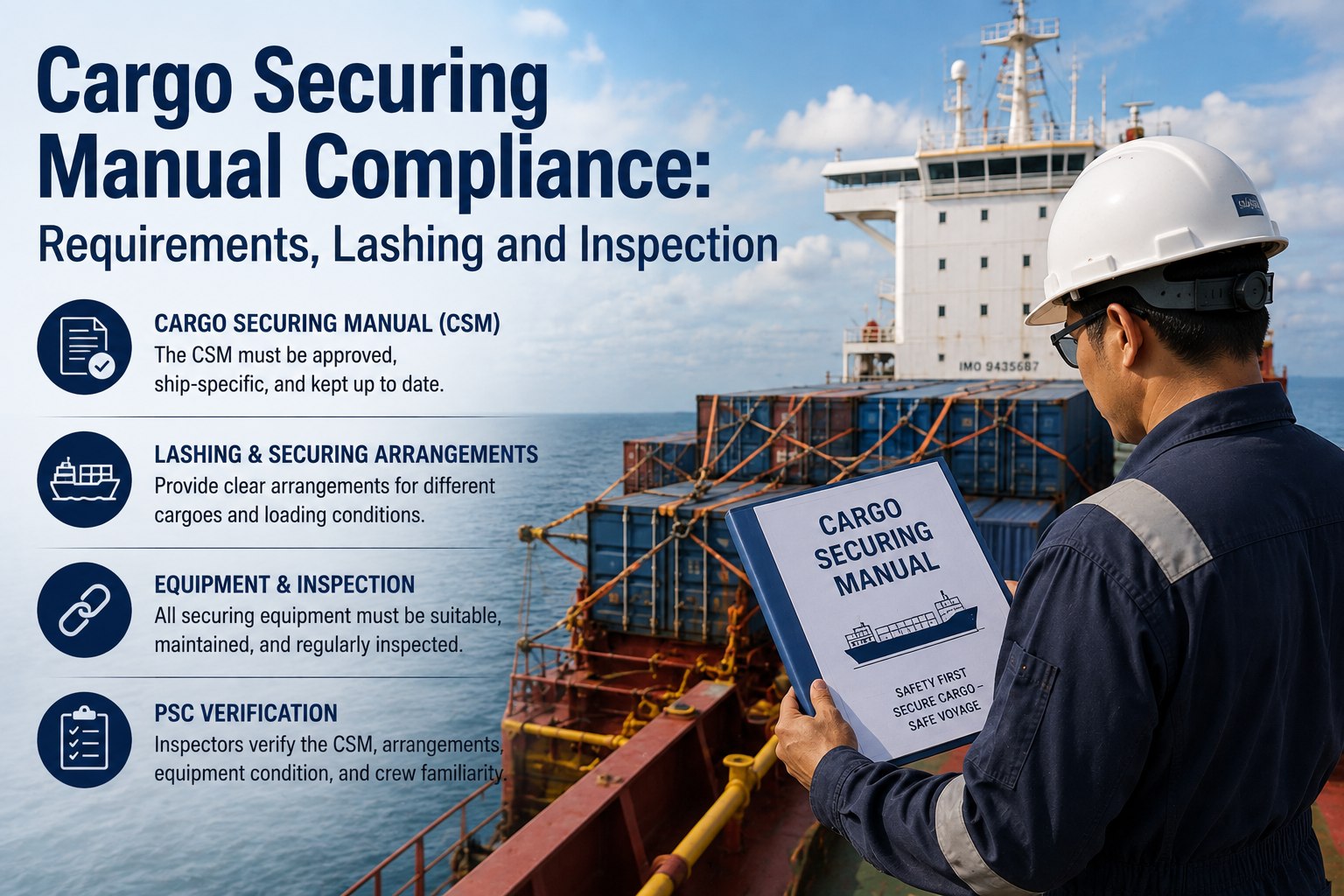
SOLAS VI/5 — the Cargo Securing Manual
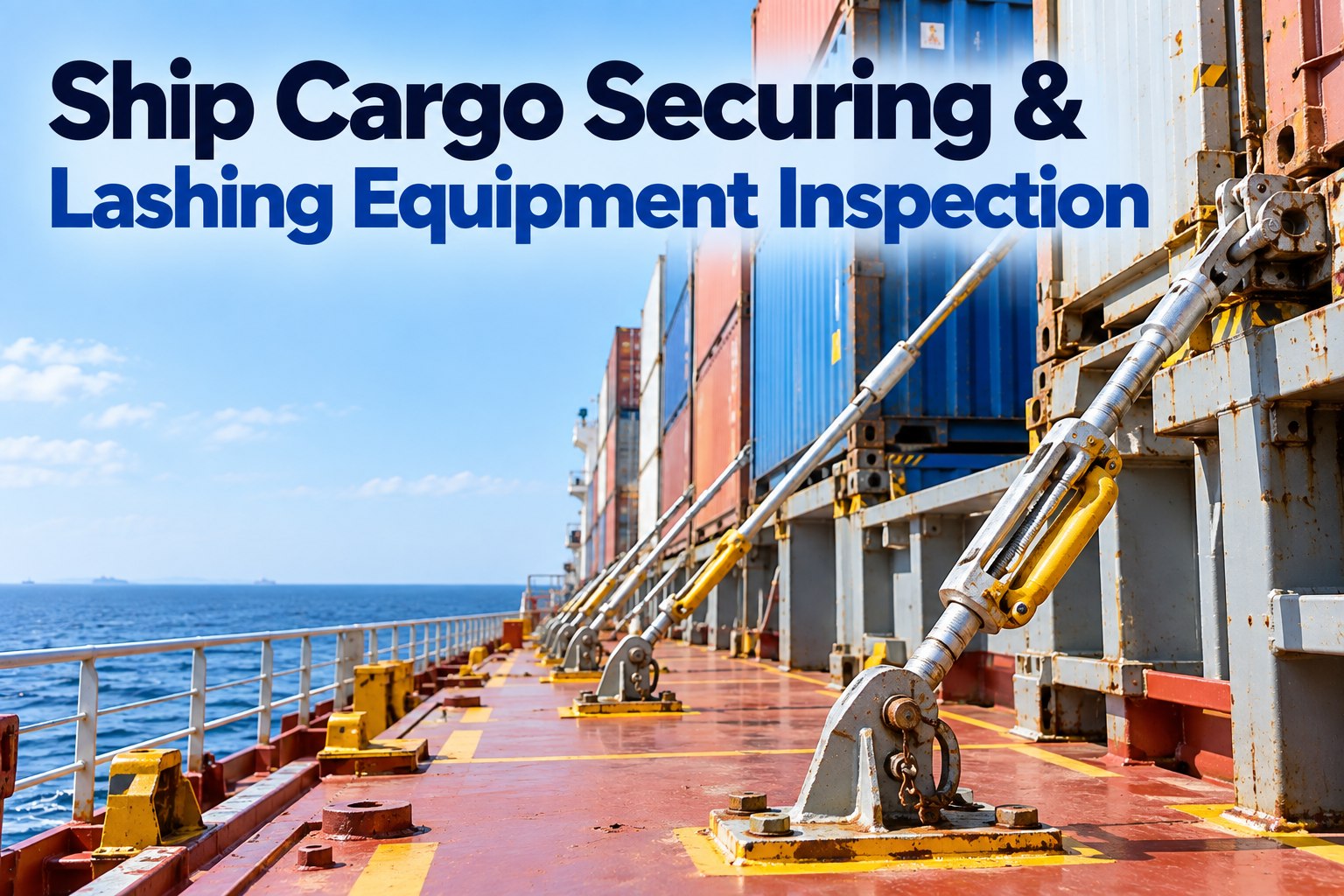
Six components carry the whole stack, and each one has its own reject criteria
A container stow is a load path from the corner casting to the deck fitting. Any element failing its criteria breaks that path, and the arithmetic in the manual stops being true.
Corner castingThe standardised fitting at each container corner and the only point the stow may be secured to. Damaged, distorted or corroded castings transfer nothing reliably, and a container with a damaged casting should not be stowed where it carries lashings.
2
TwistlockLocks tier to tier. Semi-automatic types are the standard on box ships and the single most inspected item of loose gear. Wear in the cone, a weak or broken spring, a bent stem or a lock that does not positively engage are all rejection criteria.
3
Lashing rodTakes tension from the corner casting down to the deck or bridge. Bends, stretch, cracks at the head, and damaged or worn eyes remove it from service. A rod that has been straightened is not repaired.
4
TurnbuckleTensions the rod. Thread condition and remaining adjustment are what matter: a turnbuckle run to the end of its thread has no tension left to give, and one with a damaged or seized body cannot be checked during the voyage.
5
Deck socket and base fittingThe load path into the ship. Sockets fill with dirt and paint, corrode at the deck, and are frequently found with the securing pin missing. Structure around the fitting matters as much as the fitting itself.
6
Lashing bridgeRaises the lashing point so rods can reach higher tiers at a workable angle. Its condition, access, guardrails and the sockets on it are all part of the securing arrangement and all inspected.
What the Cargo Securing Manual has to contain
The manual is ship-specific and approved. If it does not describe the fittings actually welded to your deck, it is not the ship’s manual any more — and a refit that changed the fittings without a manual revision is a finding waiting to be written. See how securing gear is held per ship against its own manual rather than as a generic checklist.
The ship’s fixed securing devices
Location, type and number of every fixed fitting — deck sockets, eyeplates, lashing bridges, container foundations — with drawings that match what is on board today.
Portable securing devices and their MSL
The inventory of loose gear carried, each item with its maximum securing load, so the arrangements can be calculated and the right quantity confirmed before loading.
Stowage and securing arrangements
Drawings of how each cargo type is to be secured, including containers, vehicles, unit loads and non-standardised cargo, with the number and pattern of lashings.
Stack weight and height limits
Permissible stack weights, tier limits and where they apply. This is the part deck officers use most and the part most often exceeded by a stow planned ashore.
The inspection and maintenance scheme
How securing devices are inspected, how often, by whom, and what is recorded. Its absence is a deficiency in itself, independent of the condition of the gear.
Handling and safety instructions
How the gear is used and how lashing work is done safely, including the arrangements for access, lighting and securing positions.
MSL: the number every calculation starts from
Maximum securing load is the figure used for securing calculations, and for most materials it is a defined fraction of breaking strength. The two single-use entries are the ones to watch — the high percentage applies because the item is used once and discarded, not because it is stronger.
MSL as a percentage of breaking strength, by material
Timber is given as a stress rather than a percentage — 0.3 kN/cm² normal to the grain. A safe working load may be used in place of MSL where it equals or exceeds the strength MSL defines. The rule-of-thumb method assumes a transverse acceleration of 1g and requires the total MSL of the devices on each side to equal the weight of the cargo item.
Lashing gear inspections that produce a record, not a recollection
Twistlock, rod and turnbuckle checks against the rejection criteria, photographed at the point of inspection, with rejected gear logged out of service and the inventory kept current against the manual.
Inspection and rejection criteria for lashing gear
Gear is inspected against defined criteria, and anything meeting a rejection criterion is withdrawn immediately rather than put back in the bin for someone else to find. The rule that matters most: damaged securing equipment is never repaired by straightening, welding or heating.
Item
What to check
Reject when
Semi-automatic twistlock
Cone and locking action, spring, handle and lanyard, stem, body for cracks and distortion
Does not positively lock or release; spring weak or broken; cone worn beyond the maker’s gauge; stem bent; any crack
Manual twistlock and stacking cone
Locking pin engagement, body wear, distortion, corrosion
Will not engage fully; body distorted; wear past the maker’s limit; heavy section loss from corrosion
Lashing rod
Straightness, head and eye condition, cracks at the head, stretch, thread on the rod end
Bent or previously straightened; cracked; measurably stretched; head or eye worn or deformed
Turnbuckle
Thread condition and remaining travel, body cracks, locking arrangement, free operation
Thread damaged or seized; no adjustment left when set up; body cracked or distorted; locking device missing
Deck socket and base fitting
Cleanliness, locking pin present, wear in the aperture, corrosion and the surrounding deck
Pin missing; aperture worn oversize; wastage at the fitting or the deck around it; fitting loose
Bridge fitting and stacker
Wear at bearing faces, distortion, cracks, pin retention
Distorted or cracked; wear past the limit; pins or retaining devices missing
Shackles, rings and deckeyes
Pin security, wear at the crown and pin, distortion, marking legible
Worn past the criterion; distorted; pin or retaining arrangement not original; marking unreadable
Chain and tensioner
Link wear and elongation, distortion, cracks, tensioner function and marking
Elongated or worn past the criterion; any distorted or cracked link; tensioner not functioning
Web lashing
Cuts, abrasion, chemical attack, ultraviolet degradation, stitching, label and MSL marking
Cut or abraded; stitching failed; label missing or illegible; visibly degraded by sun or chemicals
Wire rope lashing
Broken wires, corrosion, deformation, diameter reduction, condition of terminations
Broken wires or diameter loss past the discard criteria; birdcaging or kinking; corroded or slipping terminations
Corroded or damaged structure; missing or damaged guardrails; sockets unusable; access unsafe
All portable gear
Identification and MSL marking, inventory count against the manual, segregation of rejected items
Unmarked or untraceable gear; count short against the manual; rejected items still in the working stock
Twistlocks deserve their own attention
Mixing types is a real hazard
Different makes and models look similar and do not behave identically. Mixed twistlocks in one bay produce inconsistent locking and unpredictable load sharing, and crews cannot reliably tell them apart at night in the rain.
Check with a gauge, not by eye
Cone wear is the criterion that decides most rejections and the one least visible. Use the maker’s gauge, check a defined sample every voyage, and increase the sample when rejections rise.
Segregate rejected units immediately
A rejected twistlock left in the bin goes back into a stow within days. Paint it, bag it and land it, and record the quantity so the inventory against the manual stays honest.
Left in place means loaded wrong
Twistlocks left in the bottom castings of a container being landed damage both the lock and the casting, and they are a dropped-object hazard over the quay. It is a discharge-planning issue as much as an equipment one.
Stack weight is where stows come apart
The limit is per stack, not per container. A stow can be within every individual container’s rating and still exceed what the stack and its fittings may carry.
Heavy on top is the classic error. Weight distributed upward raises the centre of gravity of the stack and increases the racking forces the lashings must absorb.
Declared weights are frequently wrong. The verified gross mass regime exists because they were, and a stow calculated on bad numbers is not calculated at all.
Lashing patterns are not optional variations. The manual’s pattern is what the calculation assumes. Fewer rods, different tiers or crossed arrangements change the result.
Excessive GM makes the ship the problem. A stiff ship rolls violently and short, generating accelerations beyond what the securing arrangement was designed for.
Re-check after every port. Lashings slacken as the ship works and as stows are disturbed. The walk-round after departure is not a formality.
Lashing work kills people, and the conditions are part of the regulation
Securing containers means working at height, near unguarded edges, over moving equipment, often at night and in weather. The CSS Code carries guidance specifically on providing safe working conditions for the securing of containers, and it is a genuine requirement rather than an appendix — safe access, adequate lighting, guardrails and fall protection, clear communication with the terminal, and lashing positions that do not require reaching from an unprotected edge. If the only way to reach a fitting is to climb a stack or lean out over the side, the arrangement is wrong, not the crew.
What Port State Control actually writes up
01
Cargo Securing Manual not on board or not approvedOr approved for a different ship, or superseded by a refit that changed the fittings.
02
Manual does not match the shipDrawings showing fittings that are not there, or missing the ones that are.
03
Securing devices damaged or deficientBent rods, cracked turnbuckles, twistlocks that do not lock — found in the working stock, not in a reject bin.
04
Insufficient securing devicesCount short against the manual’s inventory for the cargo actually carried.
05
No inspection and maintenance recordsThe scheme exists in the manual and nothing shows it was ever followed.
06
Cargo not secured in accordance with the manualLashing pattern different from the drawing, or tiers lashed that the manual does not cover.
07
Gear not marked with MSLUnmarked or unreadable portable devices with no traceability.
08
Lashing bridge or access defectiveCorroded structure, missing guardrails, unsafe access to securing positions.
Inspection intervals that hold up
Before and after each cargo operation
Visual check of the gear in use and of the fittings in the bays worked. Rejected items pulled out at the point they are found, not at the end of the operation.
During the voyage
Walk the stow after departure and after heavy weather, re-tension where the manual allows it and it is safe to do so, and record what was found and done.
Sampled each voyage
A defined sample of twistlocks gauged and function-tested, with the rejection rate trended. A rising rate is the signal to widen the sample rather than to accept it.
Periodically, per the manual’s scheme
The full inspection the manual specifies, covering all portable devices and the fixed fittings, with the inventory reconciled against the manual and the result recorded.
Annually, and at survey
Fixed securing devices, lashing bridges, sockets and the surrounding structure examined with the rest of the ship’s structural inspection regime.
After any change
A refit, a new fitting arrangement or a change of trade means the manual is revisited and re-approved. Equipment changed without the manual following it is the commonest silent non-compliance.
Frequently asked questions
The manual and the rules
Which ships need a Cargo Securing Manual?
Ships carrying cargoes other than solid and liquid bulk. SOLAS requires cargo units to be loaded, stowed and secured throughout the voyage in accordance with a manual approved by the Administration, and the manual is ship-specific.
What must the manual contain?
The ship’s fixed securing devices, the portable devices with their MSL values, stowage and securing arrangements for the cargoes carried, stack weight and height limits, handling and safety instructions, and the inspection and maintenance scheme for the securing equipment.
What is MSL and how does it differ from SWL?
Maximum securing load is the load capacity used for securing calculations, defined for most materials as a percentage of breaking strength. A safe working load may be used in its place provided it equals or exceeds the strength MSL defines.
What are the MSL percentages?
Wire rope for single use 80 per cent, steel band single use 70 per cent, shackles, rings, deckeyes and turnbuckles of mild steel 50 per cent, web lashing 50 per cent, chains 50 per cent, fibre rope 33 per cent, and re-usable wire rope 30 per cent. Timber is given as 0.3 kN/cm² normal to the grain.
Equipment and inspection
Can damaged lashing gear be repaired?
No. Bent rods are not straightened, cracked components are not welded, and nothing is heated back into shape. Damaged securing equipment is withdrawn from service and landed, because repair changes properties the MSL figure depends on.
How are twistlocks inspected?
Function-tested for positive locking and release, and gauged for cone wear against the maker’s criteria, alongside checks of the spring, handle, stem and body. Rejected units are segregated immediately and landed rather than returned to the bin.
Why does mixing twistlock types matter?
Different makes look alike but do not lock or share load identically, and crews cannot distinguish them reliably in working conditions. Mixed types in one bay produce inconsistent securing that the calculation does not account for.
What is the most common securing deficiency?
Damaged or deficient securing devices still in the working stock, closely followed by an absence of inspection records and by cargo secured differently from the manual’s drawings. All three are found by looking, which is why they are written up so often.
Keep the gear, the records and the manual saying the same thing
Rejection-criteria inspections with photographs, twistlock sampling and rejection rates, inventory reconciled against the manual, and records that exist where the inspection happens — across every ship in the fleet.