A checklist item reads: confirm the remote closing arrangement for the ventilation flap operates satisfactorily from the emergency station. An officer whose working English is perfectly adequate for daily operations reads that line, understands roughly eighty per cent of it, cannot be certain which arrangement is meant, and ticks satisfactory. Nothing in the record indicates a problem. There is no blank field, no query raised, no sign at all that the item was confirmed on the basis of partial comprehension rather than verification. This is the failure mode that matters in multilingual inspection, and it is invisible by design. The evidence around language and maritime safety is substantial: human factors are cited in the large majority of casualties, communication problems have been assessed as contributing up to forty per cent of them, and analysis of voyage data recorder logs across hundreds of accidents and near-misses found linguistic imprecision implicated in well over a third of accidents and around three-fifths of near-miss and high-risk situations. Research also finds that what matters is not simply the presence of several languages but the balance between them, since heterogeneous crews often cannot establish an effective common working language. This page covers where language actually degrades inspection data, how bilingual checklists should be built, and what translation has to get right.
CAPABILITY GUIDE · MULTILINGUAL CREWS
Multi-Language Inspection Checklists for Mixed-Nationality Crews
Crews read and answer in the language they think in. The record, the report and the evidence stay in one canonical language for shore, class and port state control.
OneChecklist defined once, centrally
ReadDisplayed in the crew member's own language
ReportOutput in English for inspectors and shore
The Failure Nobody Sees
Most discussion of language at sea concerns spoken communication on the bridge, which is well studied and genuinely serious. Inspection checklists present a quieter problem with a different shape, and it is worth stating precisely.
A crew member completing a checklist in a second language has three possible responses to an item they do not fully understand: ask someone, leave it blank, or answer on the basis of partial comprehension. Only the third leaves no trace. Blanks get chased and questions get answered, but a confident tick against a misunderstood item enters the record as verified fact and travels onward into the report, the trend analysis and eventually the evidence file. The error is not that the crew member lacks diligence — it is that the item's technical vocabulary exceeded their reading comprehension at that moment, and the interface offered no way to signal partial understanding. Research on this is pointed: crews with uniformly lower English proficiency amplify the effect of language diversity rather than averaging it out, and seafarers of different nationalities are observed to exhibit distinct reporting practices, which means the same condition may be recorded differently depending on who inspected it. To talk through where this is most likely happening across your own vessels, book a short discussion.
Where Language Actually Costs You
The impact is not evenly spread across inspection work. These are the points where a language gap converts into a measurable operational cost rather than a minor inconvenience.
| Inspection activity | What the language gap produces | Operational consequence |
|---|
| Answering technical checklist items | Confident answers given on partial comprehension, with no signal in the record | False confirmations that hide real conditions until an inspector or failure finds them |
| Writing defect observations | Short, vague free-text entries because precision is hard in a second language | Shore cannot scope the repair, so a superintendent must call the vessel to reconstruct the finding |
| Recording corrective action | Closure described in terms that do not evidence what was actually done | Weak closure evidence that an auditor or next inspector reopens |
| Following procedural steps | Steps performed in the wrong order or omitted where wording is ambiguous | Inconsistent execution that shows up as variation between vessels |
| Completion time | Slower reading, re-reading and cross-checking of every item | Longer inspections taken from working or rest hours, with adoption suffering |
| Crew adoption of the system | Reluctance to use a tool that feels like an examination in a foreign language | Reversion to paper or to the most senior English speaker completing everything |
The last row deserves particular attention because it is the one that quietly defeats an implementation. When a checklist is hard to read, the work concentrates on whoever is most comfortable in English — usually a senior officer already carrying the heaviest administrative load — and the distributed inspection model the platform was bought to enable never materialises. To test how quickly your own crew completes a checklist in their first language, start a free trial.
Watch the same inspection run twice, in two languages
The difference in completion time, in the length and usefulness of defect descriptions, and in how many items get queried rather than assumed, is visible immediately. Bring a checklist your fleet uses and we will run it both ways.
One Record, Many Readers
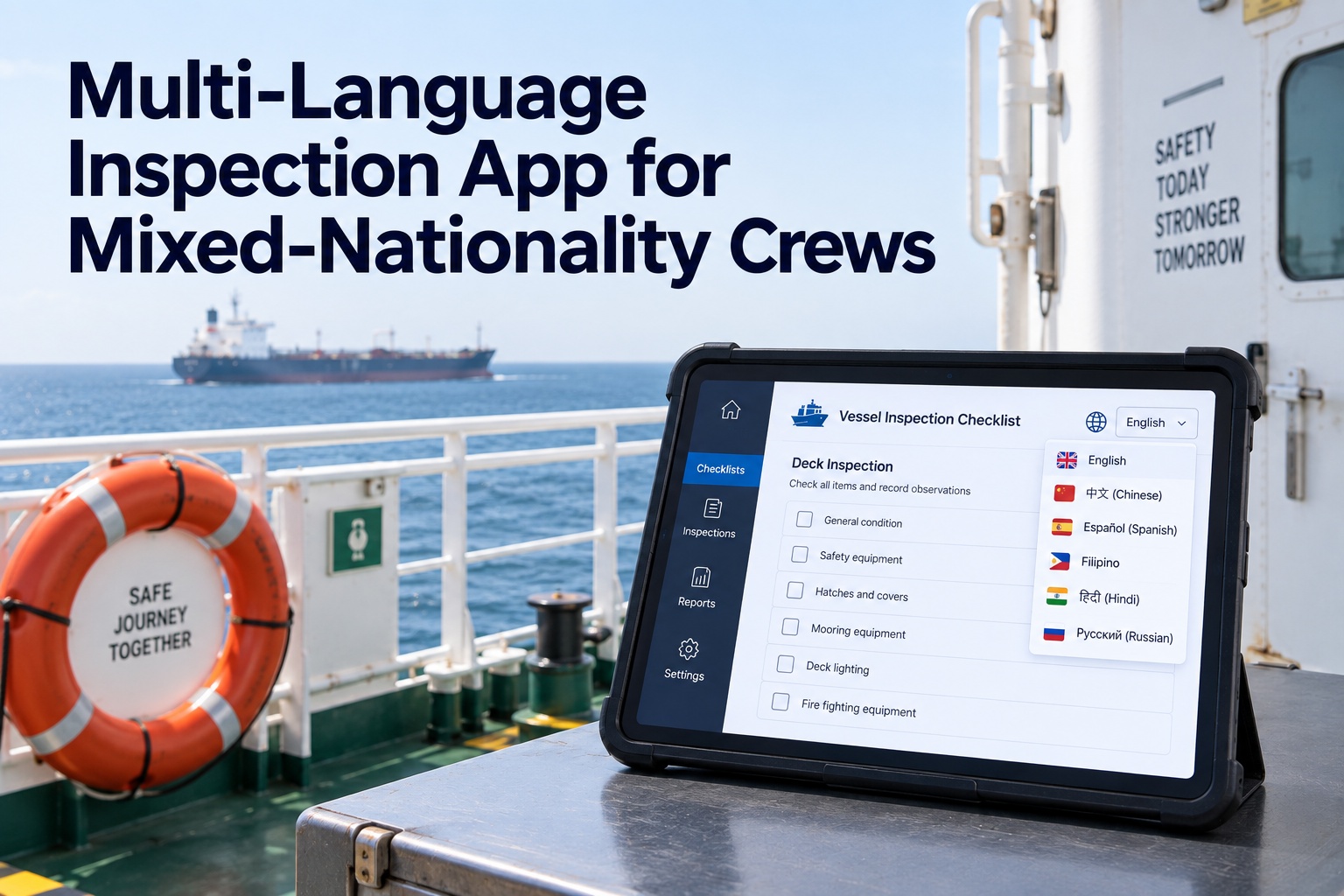
The architectural requirement is easy to state and frequently got wrong. Translation must apply to the interface, not to the data. Crew read and answer in their language; the record itself remains canonical.
Defined once
The checklist is authored centrally with each item carrying a stable identifier. Language versions attach to that identifier rather than existing as separate documents that drift apart over time.
Displayed natively
Each user sees items in their selected language, with the option of viewing the original alongside — useful where a technical term is more familiar in English than in translation.
Answered structurally
Results, severities and selections are stored as structured values rather than as translated text, so an answer means the same thing regardless of the language it was entered in.
Reported canonically
Output renders in the working language of the recipient — typically English for port state control, class and charterers — from the same underlying record, without a translation step after the fact.
Two consequences follow. Free text is the one genuinely difficult case, since an observation written in Tagalog or Russian must reach a superintendent who does not read it — which is an argument for capturing as much as possible as structured selections and photographs, leaving free text for the detail that truly needs prose. And version control becomes critical: when the master checklist changes, every language version must change with it, because a fleet running a revised English checklist alongside last year's translated version has two different inspections happening under one name. To see how language versions stay synchronised when a master checklist is revised, request a walkthrough.
Translation Quality Decides Everything
A poorly translated checklist is worse than an English one, because it replaces known uncertainty with false confidence. If a crew member knows their English is imperfect they proceed carefully; if the item reads fluently in their own language but means something subtly different, they proceed with conviction.
Technical terms must survive
Equipment names, system descriptions and regulatory references carry precise meanings. A general-purpose translation of a term like remote closing arrangement, sounding pipe or means of access can produce a phrase that is grammatically correct and operationally wrong.
Regulatory language should not be paraphrased
Where an item derives from a convention requirement, the translation should preserve the obligation exactly. Softening a shall into a should changes what the crew member believes is being asked.
Keep the original visible
Allowing the English text to be shown alongside the translation lets an experienced officer resolve ambiguity themselves, since many technical terms are learned in English during training even by non-native speakers.
Have seafarers review it
The only reliable check is whether crew of that nationality, doing that job, read the item and understand the same thing an English-speaking officer would. Linguistic accuracy and operational accuracy are not the same test.
Terminology review is worth doing before rollout rather than after the first confused inspection, since the vocabulary that matters differs sharply between a tanker, a bulk carrier and a workboat. To review the translated terminology for your own vessel types, explore it in a free trial.
What Improves, and How You Would Know
This capability is worth evaluating on evidence rather than on principle, and the measurements are straightforward to take during a trial on one or two vessels.
Completion time per checklist is the most immediate signal, since reading in a first language removes the re-reading and cross-checking that slows second-language completion. The length and specificity of free-text observations is a better quality indicator — a defect description that lets a superintendent scope a repair without telephoning the vessel represents real value, and second-language entries tend toward brevity that loses exactly the detail shore needs. Query rate is informative in the opposite direction: more items questioned rather than silently assumed is a sign the system is working, because it means partial comprehension is surfacing instead of hiding. Adoption breadth matters too — how many different crew members actually complete inspections, rather than the work concentrating on the best English speaker aboard. And distribution of findings between vessels with different crew nationalities will show whether recorded conditions were previously varying by who inspected rather than by what was there. To set up a two-vessel trial with these measures captured from the start, arrange a scoping call.
Where It Sits in the Platform
Language support is a property of the whole system rather than a feature of the checklist screen, and partial implementation produces its own frustrations.
Checklists and inspection forms
The primary surface, where item text, guidance notes and answer options all need to render in the user's language rather than only the headings.
Defect and corrective action screens
Where crew describe problems and record what was done — the highest-value place for native language, and the hardest for free text.
Notifications and alerts
An alert nobody reads is not an alert. Overdue items and assignments should reach people in the language they respond to.
Procedures and guidance
The instructional text explaining how an item should be checked, which is often where the real technical content sits.
Offline, on the device
Language packs available locally, since the inspection happens in a tank with no signal and a translation fetched on demand is no translation at all.
Shore-side output
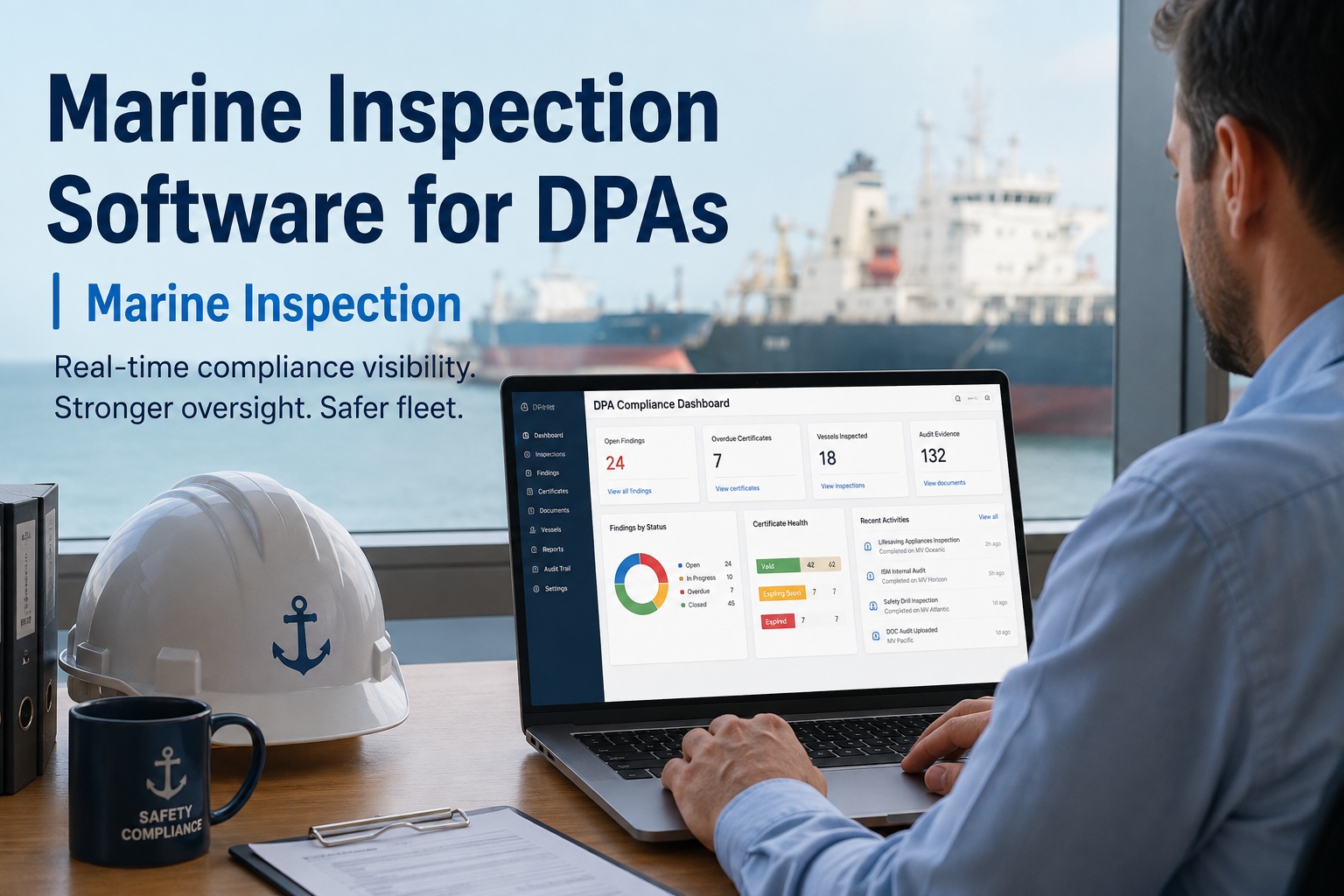
Reports, dashboards and evidence exports rendering in the reader's language from the same record, so the office never receives something it cannot read.
The offline point is easily overlooked in an office demonstration and decisive in practice. Language support that depends on a connection fails in precisely the spaces where inspections happen, which returns the crew member to reading English on a screen in a ballast tank — the exact situation the capability was meant to remove. To confirm offline language support behaves correctly on your own devices, book a technical demonstration.
Frequently Asked Questions
Crews are required to work in a common language, so why translate checklists?
A working language requirement establishes that communication is possible, not that every crew member reads technical documentation with full comprehension. The distinction matters because inspection items carry precise technical and regulatory vocabulary well beyond conversational competence. Research indicates that what affects safety is not simply the presence of multiple languages but the balance between them, with heterogeneous crews often unable to establish an effective common working language, and that crews with uniformly lower English proficiency amplify rather than average out the effect. Translation of checklists does not replace the working language; it removes reading comprehension as a variable in data quality.
See how bilingual display works alongside your working language policy.
What is the actual risk if a crew member misreads an item?
The risk is a false confirmation that leaves no trace. Faced with an item they do not fully understand, a crew member can ask someone, leave it blank, or answer on partial comprehension — and only the third option is invisible. Blanks get chased and questions get answered, but a confident tick against a misunderstood item enters the record as verified fact and carries forward into the report, the trend data and eventually the evidence file. Nothing flags it. Given that linguistic imprecision has been implicated in a substantial share of accidents and an even larger share of near-misses in voyage data recorder analysis, the aggregate effect across a fleet is not trivial.
Try a checklist in your crew's language and compare query rates.
If crew answer in their own language, how does shore read the report?
Because translation applies to the interface rather than to the data. Each checklist item carries a stable identifier with language versions attached to it, and answers are stored as structured values — results, severities, selections — rather than as translated text. The report then renders in whichever language the reader needs, typically English for port state control, class and charterers, generated from the same underlying record with no translation step afterwards. Free text is the genuinely difficult case, which is an argument for capturing as much as possible as structured selections and photographs and reserving prose for detail that truly requires it.
See the same inspection render in two languages.
Could a bad translation make things worse?
Yes, and this is the main risk to manage. A poorly translated checklist is worse than an English one because it replaces known uncertainty with false confidence — a crew member aware their English is imperfect proceeds carefully, whereas one reading a fluent but subtly wrong translation proceeds with conviction. Technical terms must survive translation intact, since a general-purpose rendering of a specific piece of equipment or system can be grammatically correct and operationally wrong. Regulatory language should not be paraphrased in ways that soften an obligation. The original text should remain viewable alongside, and the only reliable validation is seafarers of that nationality confirming the item means what an English-speaking officer would understand.
Review our maritime terminology handling with a specialist.
How would we measure whether it actually improved anything?
Five measures, all obtainable from a trial on one or two vessels. Completion time per checklist, which drops as the re-reading and cross-checking of second-language work disappears. The length and specificity of free-text defect descriptions, where the test is whether a superintendent can scope a repair without telephoning the vessel. Query rate, which should rise rather than fall, since more items questioned means partial comprehension is surfacing instead of hiding. Adoption breadth, measured as how many different crew members complete inspections rather than the work concentrating on the best English speaker. And variation in recorded findings between vessels with different crew nationalities, which indicates whether conditions were previously being recorded according to who inspected.
Start a trial and capture these baselines.
Does language support need to work offline?
Absolutely, and it is easy to miss in an office demonstration. Inspections happen in engine rooms, cargo holds and ballast tanks where there is no connectivity, so language packs must be available locally on the device. A system that fetches translations on demand fails in exactly the spaces where the capability matters, returning the crew member to reading technical English on a screen several decks down — the precise situation the feature was meant to eliminate. The same applies to guidance text and answer options, not just item headings. When evaluating any platform, put the device in airplane mode, switch languages, and complete a full inspection before accepting the claim.
Test offline language support on your own hardware.
Remove Reading Comprehension From Your Data Quality
Every checklist completed in a second language carries a silent risk of confident answers given on partial understanding, shorter defect descriptions that shore cannot act on, and inspection work concentrating on whoever speaks the best English. Marine Inspection displays checklists, guidance, defects and alerts in the crew member's own language, offline on the device, while keeping one canonical record that reports in English for inspectors, class and charterers. Bring a checklist your fleet uses and see it run both ways.