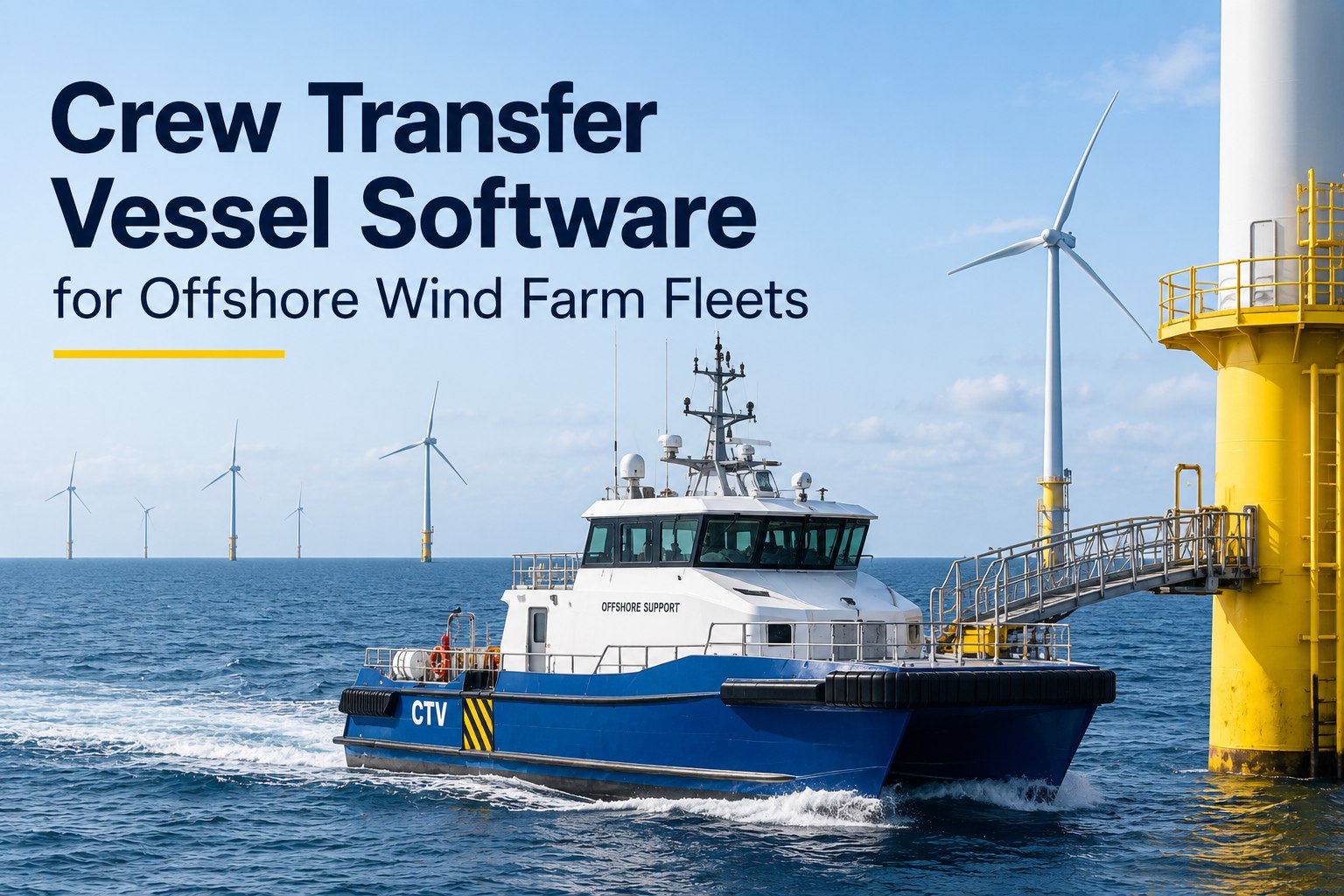
Crew transfer vessels run the highest contact-cycle count of any commercial vessel type afloat, against the tightest weather ceiling in the industry. A CTV is typically an aluminium catamaran of 20 to 30 metres carrying twelve to twenty-four technicians at 25 to 30 knots, and it performs its work by driving its bow onto a turbine's boat landing and holding there under power while people step across. That is the push-and-hold transfer, and a busy vessel does it dozens of times a day, every working day, all season. The limiting sea state for the operation is typically around 1.5 metres significant wave height for most CTV designs, and in the southern North Sea that threshold is exceeded perhaps 30 to 40 percent of the time across a year, constraining access most severely in winter when turbines most need attention. So roughly a third of your calendar is already gone before anything mechanical happens. Every hour of technical downtime is therefore competing for what remains of an already-rationed window, which is the reverse of most shipping, where the vessel is available and the question is merely utilisation. Start a free trial of Marine Inspection and protect the window you actually have.
The Availability Arithmetic Nobody Puts in a Business Case
1.5 m
Significant wave height
The typical limiting sea state for push-and-hold transfer on most CTV designs. Above it, the bow cannot maintain reliable friction on the boat landing and the transfer stops being safe.
30-40%
Of the year exceeded
In the southern North Sea, that threshold is exceeded for roughly a third of the annual calendar, concentrated in the winter months when turbine faults are most frequent and most costly.
The rest
Is what you are defending
Weather takes what it takes. Everything else — fender condition, engine availability, gangway readiness, a certificate that lapsed — is a self-inflicted reduction in an already-constrained operating window, and it is entirely within your control.
The Push-and-Hold Transfer
Understanding the mechanics matters, because every maintenance priority on a CTV follows from them. Book a Marine Inspection demo and see fender condition tracked as the transfer parameter it actually is.
How it works
The vessel's bow is fitted with foam fenders that allow it to press against the turbine's boat landing structure. The master holds the vessel on the landing under power, maintaining positive contact through friction, while technicians transfer across the bow onto the ladder.
Transfers from CTVs to offshore structures were the original access method in offshore wind and remain prevalent today, with best practice developed steadily across the industry over the years. The technique is simple and proven, and it is also physically demanding and sharply limited by wave height.
Standard commands govern the moment of transfer. "Over" indicates stepping over to a vessel or structure. "Hold" indicates holding position. Three-way or repeat-back communication should be used, because the transfer is a coordinated act between a person on a ladder and a master holding a vessel against a fixed structure in a seaway.
What is under load
The bow fender takes the entire contact force of every transfer, repeatedly, for the whole working day. Nothing else in commercial shipping carries a load-bearing contact event at that frequency, and the component absorbing it is a consumable.
What depends on it
Friction on the landing, the geometry a technician steps across, and the vessel's ability to hold position without descending. All three degrade together as the fender wears, and all three degrade gradually rather than failing visibly.
What that implies
Fender condition is a transfer safety parameter with a measurable tolerance, not a housekeeping item. It belongs in the record with dimensions and dates, assessed against a standard, rather than assessed by eye each morning by whoever is on the bow.
The Interface Nobody Measures Until Somebody Requires It
Transfer guidance is specific about the geometry, and specific in a way that turns fender wear into a numerical compliance question. Sign up for Marine Inspection and hold step-over measurements per vessel and per site.
500-650 mm
Step-over distance
Industry transfer guidance recommends that before transfers are initiated at a project site, the interface between the vessel fender, the boat landing and the fall arrest system should be verified. For a boat landing, the step-over distance between the fender and the ladder rungs should sit between roughly 500 and 650 millimetres, or 19.5 to 25.5 inches, unless otherwise justified.
Read that as an engineering tolerance rather than as advice. It is a dimension, on a vessel, that changes as a consumable component wears, and it has to be verified per site because boat landing geometry differs between projects and sometimes between turbine positions within one.
Why the number moves
Foam fenders compress, abrade and lose profile across thousands of contacts. As the fender wears, the bow sits closer to the landing and the step-over distance changes. Nobody notices on any single day, because the change per transfer is imperceptible and the change per season is not.
Why it matters so much
One of the major historical safety issues the industry addressed was the time needed to unhook from a self-retracting lifeline when disembarking from a transfer ladder, particularly in rising weather. Wearing gloves and working a three-way carabiner meant long periods hooked on. If the boat lost friction on the landing and descended, the transferring technician could be left hanging — and in some cases was struck by the boat fender on its way back up.
What to record
Fender profile and condition per fender with dates, step-over distance measured per site and re-measured after any fender change, and the verification of the fender, boat landing and fall arrest interface completed before transfers begin at a new project. All of it attributed to a named person on a recorded date.
Dozens of contacts a day
The Fender Is a Wear Part and a Safety Interface at the Same Time
Fender condition tracked per unit with profile measurements and replacement history, step-over distance recorded per site and re-verified after every change, transfer interface verification captured before work starts at a project, and the whole record retrievable when a charterer or an HSE inspector asks who checked it and when.
What a CTV Actually Has to Track
Below is the register a wind farm support operator needs, and where each item usually goes missing on a vessel that returns to base every night and sails again at first light. Schedule a walkthrough and load one vessel's register during the evaluation.
Table 1: The CTV Inspection and Maintenance Register
Transfer logs and the maintenance record in one system — because contact count is what actually consumes a fender, and only one of those two currently knows it.
SOVs and Walk-to-Work Are a Different Animal Entirely
The same operator frequently runs both, and applying CTV thinking to an SOV produces poor results. The access method, the standards regime and the maintenance shape all differ. Start a free trial and configure each vessel type to its own regime rather than to one template.
The access model
Technicians sleep on board close to the field and walk across a motion-compensated gangway each morning. That extends the workable weather window, reduces travel fatigue and enables higher turbine availability on projects far from shore, at the cost of a considerably more capital-intensive vessel.
The positioning standard
DP2 is the industry default for SOVs and most construction SOVs in offshore wind: loss of any single active component — a thruster, a generator, a sensor, a control system — will not result in loss of position. That brings the whole DP assurance regime with it, including trials and FMEA obligations.
The gangway standards
The framework here is young. DNV's ST-0358 gangway standard was published in December 2015, IMCA's walk-to-work guidelines under M254 were finalised in 2022, and the HSE issued a safety bulletin in 2023 warning of serious injury risk from motion-compensated gangways.
The operating discipline
Guidance is explicit that enough time must be allowed for the DP model to build and for excursions to settle before transfer commences, and that communications between bridge and gangway are crucial. Procedures should focus on the roles of the DP and gangway operators in establishing and maintaining gangway positioning and giving early warning as positioning limits are approached.
The sentence worth pinning up
If a walk-to-work gangway is correctly integrated, maintained and operated, the probability of emergency retraction is minimised. Maintenance sits in the middle of that sentence, alongside integration and operation, which places gangway upkeep directly in the safety case rather than adjacent to it.
The fleet context
The Tier 1 SOV fleet has been forecast to double from around 32 vessels to roughly 64 working units by the end of 2026, against a background of thousands of new turbines entering service through the decade. The standards regime governing these vessels is barely ten years old and still consolidating.
Maintenance on a Boat That Sleeps Ashore
CTVs have no overnight facilities and return to base daily, which produces a maintenance window structure unlike anything else in this series — short, frequent, and entirely predictable. That predictability is an advantage very few operators actually exploit. Book a walkthrough and filter your backlog by the window it fits.
Alongside overnight
Every working night
The single most valuable and most wasted window in the sector. The vessel is at a base, shore power and technicians are available, and it happens every night rather than once a quarter. Work that fits here should never reach a docking list.
Requires knowing before the vessel berths what fits in the hours available
Weather day
A third of the year
Sea state above the transfer limit means no transfers, but the vessel and crew are available. Fleets with a standing weather-day list convert lost operational days into completed maintenance instead of into idle time.
Requires a ready, current list that does not need assembling that morning
Between transfers
Minutes on station
Belongs to inspection and observation, not to maintenance. It is when fender damage gets noticed, when a defect gets seen, and when nothing gets recorded because the vessel is about to make the next approach.
Requires capture in seconds or the observation is lost
Off-charter and dock
Scarce and expensive
On a vessel earning against a day rate and a wind farm's availability targets, off-charter time is the most costly window there is. Anything reaching it that could have been done alongside overnight represents a direct and avoidable loss.
Audit the docking list afterwards for work that belonged in an overnight
The Charterer Is Reading Your Availability, Not Your Paperwork
Wind farm operators measure their service vessels on a single number, and every maintenance decision eventually surfaces in it. Start a free trial and produce availability reporting from the same record that holds the maintenance.
What the client actually tracks
Vessel availability against contracted days, transfers achieved against transfers planned, and aborted or missed transfers with their causes. Those figures determine whether technicians reached turbines, and turbine access determines wind farm availability, which is the number the asset owner is judged on.
Weather is accepted as an unavoidable cause and is usually excluded from performance judgement, because everyone in the chain understands the sea state limit. Technical unavailability is not excluded, and it is attributed to the vessel operator by name in a monthly report.
That makes the distinction between weather-caused and technical-caused loss the single most commercially important classification a CTV operator records — and it is frequently captured loosely, in a comment field, by someone summarising a day that had several causes in it.
Classify at the moment, not at month end
A missed transfer has a cause, and the person who knows it is the master at the time. Recording it as a coded reason at the point it happens produces a defensible record; reconstructing a month of causes from a logbook produces an argument.
Tie downtime to the defect
Technical unavailability that traces to a specific defect, with the defect's discovery date, the work done and the return-to-service time attached, is a far stronger position in a performance review than a total with no structure behind it.
One record, two audiences
The maintenance record and the charterer report should be the same underlying data in two output formats. Where they are separate systems, they disagree, and the disagreement always surfaces in the meeting where it is least useful.
Evaluating a Platform for a Wind Support Fleet
Most maritime software assumes a vessel that is away for weeks with a technical department ashore. A CTV is back every night with a crew of four. These questions expose the difference. Schedule a demo with a master and a fleet manager present.
Table 2: Buyer Questions Specific to CTV and SOV Operators
2026 OFFSHORE WIND SUPPORT REALITY
The guidance framework is young and still consolidating. The DNV gangway standard dates from December 2015, IMCA's walk-to-work guidelines were finalised in 2022, and the HSE issued a safety bulletin in 2023 on injury risk from motion-compensated gangways. Expect further development and confirm current editions directly rather than relying on any summary including this one. Sea state limits are design-specific. The commonly quoted figure of around 1.5 metres significant wave height is typical for most CTV designs rather than universal, and SWATH and other hull forms are being adopted specifically to improve it. Establish your own vessels' actual workability limits rather than applying a sector average. Transfer geometry guidance may vary by region and client. The step-over distance range cited here comes from published transfer guidance; confirm the applicable requirement with your client and the relevant guidance body for each project. Statutory obligations apply underneath everything. CTVs are typically certificated passenger vessels with the safety equipment, manning and survey regime that implies, independently of any wind sector guidance.
Frequently Asked Questions
What is the limiting sea state for a CTV transfer?
Typically around 1.5 metres significant wave height for most CTV designs, though it varies by hull form and by the specific vessel. That limit determines the operational availability of the entire maintenance programme, because above it the bow cannot maintain reliable friction on the boat landing. In the southern North Sea the threshold is exceeded roughly 30 to 40 percent of the time across a year, concentrated in winter when turbines most need attention. Interest in SWATH and similar hull forms is driven substantially by the desire to raise that limit and reduce weather downtime, and operators have been moving toward larger vessels with better seakeeping for the same reason.
Why does fender condition matter so much?
Because the fender is simultaneously a consumable wear part and a safety-critical interface. It takes the full contact force of every transfer, dozens of times a day, and its condition governs the friction holding the vessel on the landing and the geometry a technician steps across. Published transfer guidance recommends verifying the interface between vessel fender, boat landing and fall arrest system before transfers begin at a project site, with the step-over distance between fender and ladder rungs sitting between roughly 500 and 650 millimetres. As foam fenders compress and lose profile, that dimension moves — imperceptibly per transfer and materially across a season.
What was the historical safety issue with transfer ladders?
The time required to unhook from a self-retracting lifeline when disembarking from a transfer ladder, particularly in rising weather when technicians needed to come off the asset quickly. Working a three-way carabiner while wearing gloves meant significant time spent hooked on. If the vessel lost friction on the boat landing and descended during that period, the transferring technician could be left hanging, and in some cases was struck by the boat fender as the vessel rose again. The industry addressed it through equipment and procedure changes, and the episode is why fender condition and step-over geometry are treated as safety parameters rather than as maintenance details.
How do SOV and walk-to-work operations differ from CTV work?
Fundamentally. Technicians sleep on board an SOV close to the field and walk across a motion-compensated gangway each morning rather than making a daily round trip from a shore base. That extends the workable weather window, reduces travel fatigue and supports higher turbine availability on projects far from shore, at the cost of a much more capital-intensive vessel. DP2 is the industry default for SOVs and most construction SOVs, meaning loss of any single thruster, generator, sensor or control system will not cause loss of position — which brings a full DP assurance regime with it. The gangway carries its own standards, guidance and safety-bulletin history.
Where does gangway maintenance sit in the safety case?
Directly inside it. Published guidance states that if a walk-to-work gangway is correctly integrated, maintained and operated, the probability of emergency retraction is minimised — placing maintenance alongside integration and operation as one of three conditions. Procedures should focus on the roles of the DP and gangway operators in establishing and maintaining positioning and providing early warning as limits are approached, and enough time must be allowed for the DP model to build and excursions to settle before a transfer commences. Communications between bridge and gangway are described as crucial, and the training and competence of all crew involved as critical.
How should a CTV operator plan maintenance around the operating pattern?
Around two windows most operators underuse. The vessel is alongside at a base every working night with shore power available, which is the most frequent maintenance opportunity in the sector and the one most often wasted because nobody knows before berthing what would fit in the hours available. And roughly a third of the year is above the transfer limit, when the vessel and crew are available but no transfers are possible — fleets carrying a standing, current weather-day list convert those into completed maintenance rather than idle time. Anything reaching an off-charter period that could have been done overnight is a direct and avoidable cost.
CTV, SOV and wind support fleets
Weather Takes a Third. Do Not Give Away More.
Every technical hour comes out of the window that was left
Fender condition and step-over geometry tracked as measured values, transfer logs feeding cycle-based wear thresholds, missed transfers classified by cause at the moment they happen, overnight and weather-day work filtered by what actually fits, gangway and DP records held per component on the SOVs, and availability reporting produced from the same data the maintenance sits in — captured in seconds on station, offline, by a crew of four.