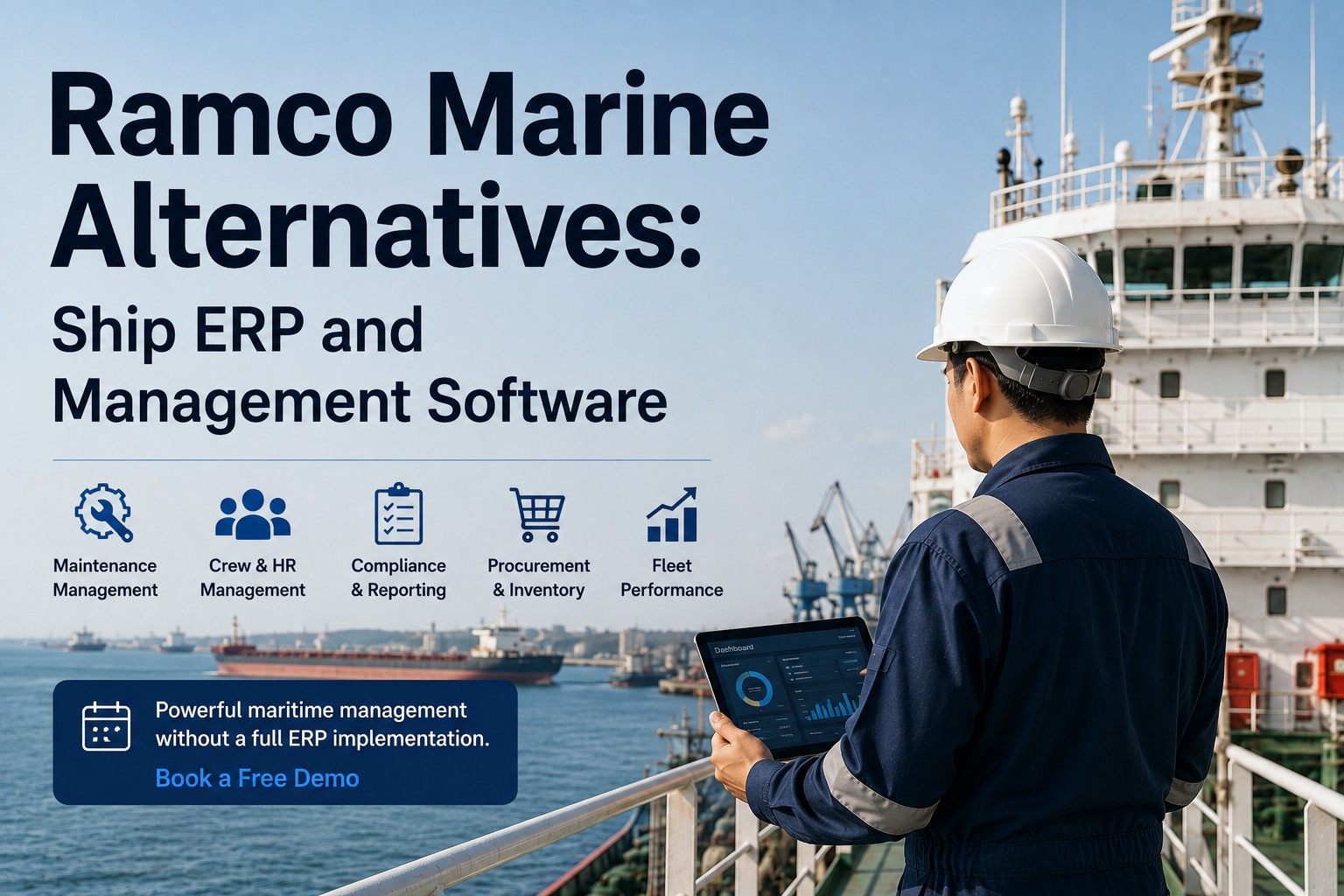
Ramco is the only platform in this category that did not begin in shipping. Ramco Systems is a cross-industry enterprise software company whose maritime offering sits alongside aviation and logistics suites, and its marine product is consistently described as an aviation-inspired, cloud-native ERP covering planned maintenance and MRO, procurement, inventory, crew management with rostering and payroll, dry docking, warranty claims, voyage planning and commercial operations, with compliance mapped to ISM, ISPS and MLC. Independent reviewers credit it for genuine strengths that maritime-born vendors struggle to match: a mobility-first design with offline onboard access, AI and machine learning applied to predictive maintenance, no-code configurability, and payroll depth inherited from an enterprise HR heritage. The same reviewers flag the same reservations with unusual consistency: a steep learning curve driven by the breadth of customisation available, pricing that is not published, and implementation complexity that suits mid-to-large operators. Neither the strengths nor the reservations are the deciding factor. The deciding factor is a question most shipowners never ask out loud before signing. Start a free trial of Marine Inspection and answer it with a working system in front of you.
Platform Heritage Against Domain Heritage
Ramco brings enterprise software heritage to maritime. Its competitors bring maritime heritage to enterprise software. Both directions carry real advantages and real costs, and the ledger below sets them against each other line by line rather than declaring a winner. Book a Marine Inspection demo to see what the domain-heritage column looks like in practice.
The Implementation Effort Ladder
Every platform in this market sits on one of four rungs, and the rung matters more than the feature list because it determines what your organisation has to do rather than what the software can do. Find the rung your fleet can actually resource. Sign up for Marine Inspection and see what rung one looks like on your own equipment register.
Capability Comparison: Enterprise ERP Against Focused Technical Platform
Both are cloud-native and both are mobile-capable, so the usual architecture arguments do not separate them. What separates them is breadth, and breadth is a cost as well as a benefit. Schedule a walkthrough and settle each line against your own vessel data.
| Line | Maritime ERP Pattern | Focused Technical Platform Pattern | Test in the Demo |
|---|---|---|---|
| Functional breadth | Maintenance and MRO, procurement, inventory, crewing and payroll, dry docking, warranty claims, voyage planning and commercial operations | Maintenance, inspection, defect management, spares and compliance evidence only | Name the departments that will genuinely move onto one system |
| Configurability | No-code customisation bending the platform to your processes, with a learning curve reviewers attribute directly to that breadth | Opinionated defaults with equipment templates, configured rather than built | Ask how many configuration decisions must be made before go-live |
| Predictive maintenance | AI and machine learning applied to condition and failure prediction, with IoT connectivity | Interval and running-hour triggers with defect trending from recorded values | Ask what instrumentation the predictive models require on your tonnage |
| Crewing and payroll | Rostering, scheduling and payroll inherited from enterprise HR capability | Competency and certificate visibility tied to jobs, without payroll | Establish who runs payroll today and whether they would actually move |
| Mobility | Mobility-first with offline onboard access, which is a genuine differentiator within the ERP tier | Every core workflow native to phone or tablet, offline by default | Airplane mode, close a job with photos, reconnect and watch the sync resolve |
| Class specialisation | Compliance mapped to ISM, ISPS and MLC; independent reviewers note less specialisation than class-society-backed platforms | Certificate windows, class survey due dates and audit trails native to the record | Generate the ISM Element 10 evidence pack live from your own data |
| Time to value | Rung three or four on the ladder above, measured in quarters | Rung one, measured in weeks | Request a phased plan with named milestones, not an average timeline |
| Pricing | Custom enterprise quotation with nothing published, which reviewers identify as a barrier for smaller fleets | Published per-vessel or per-user subscription with the module set fixed at signature | Year-one and year-three totals in writing, services and support included |
| Best-fit operator | Mid-to-large fleets reshaping several functions at once with capacity to run a programme | Fleets of any size whose failing workflow sits inside the technical department | Be honest about which description fits your organisation today |
Total Cost of Breadth
Enterprise ERP cost sits mostly outside the licence, and the largest lines are the ones your own organisation absorbs rather than pays an invoice for. Market analysis puts unlisted items at 20 to 40 percent of first-year total cost of ownership when they are not surfaced before signature. Start a free trial to see per-vessel pricing applied to your fleet without a custom-quote cycle.
| Cost Line | Enterprise ERP Pattern | Focused Platform Pattern | Put This in Writing |
|---|---|---|---|
| Internal programme cost | A full-time internal owner for six to fifteen months, plus departmental time, none of which appears on a vendor invoice | A part-time technical owner for six to ten weeks | Who inside our company owns this, and what do they stop doing |
| Configuration | No-code flexibility means decisions, and every decision needs an owner and a sign-off | Defaults applied, with exceptions configured rather than everything designed | Number of configuration decisions required before go-live |
| Learning curve | Absorbed by every user across every function, and reviewers identify it as the platform's most cited drawback | Scoped to technical and crew users, with a new joiner productive without classroom training | Hours of training per user role, and who delivers it |
| Professional services | Frequently adds twenty to thirty percent to first-year spend at this tier | Bundled or a fixed onboarding fee | Fixed-fee ceiling for go-live across the whole fleet |
| Predictive readiness | Sensor and connectivity investment where the AI capability is part of the business case | Not applicable; the input is a person with a phone | Instrumentation cost for your least equipped vessel |
| Crew turnover | Per-user training repeated as crews rotate, against a broader interface | Role-based onboarding and in-product guidance for new joiners | Retraining cost for a full crew change on a single vessel |
| Unused breadth | Modules licensed during a programme that quietly go unopened by year two | Defined module set at a published price point | Itemised price per module and the renewal cost of dropping one |
When Breadth Turns Into Adoption Decay
The learning curve that independent reviewers flag is not an abstract usability score. It shows up as four specific behaviours, and each one degrades the data that every downstream report, dashboard and prediction depends on. Check your own operation against them honestly. Book a walkthrough and test whether a narrower tool removes the behaviour.