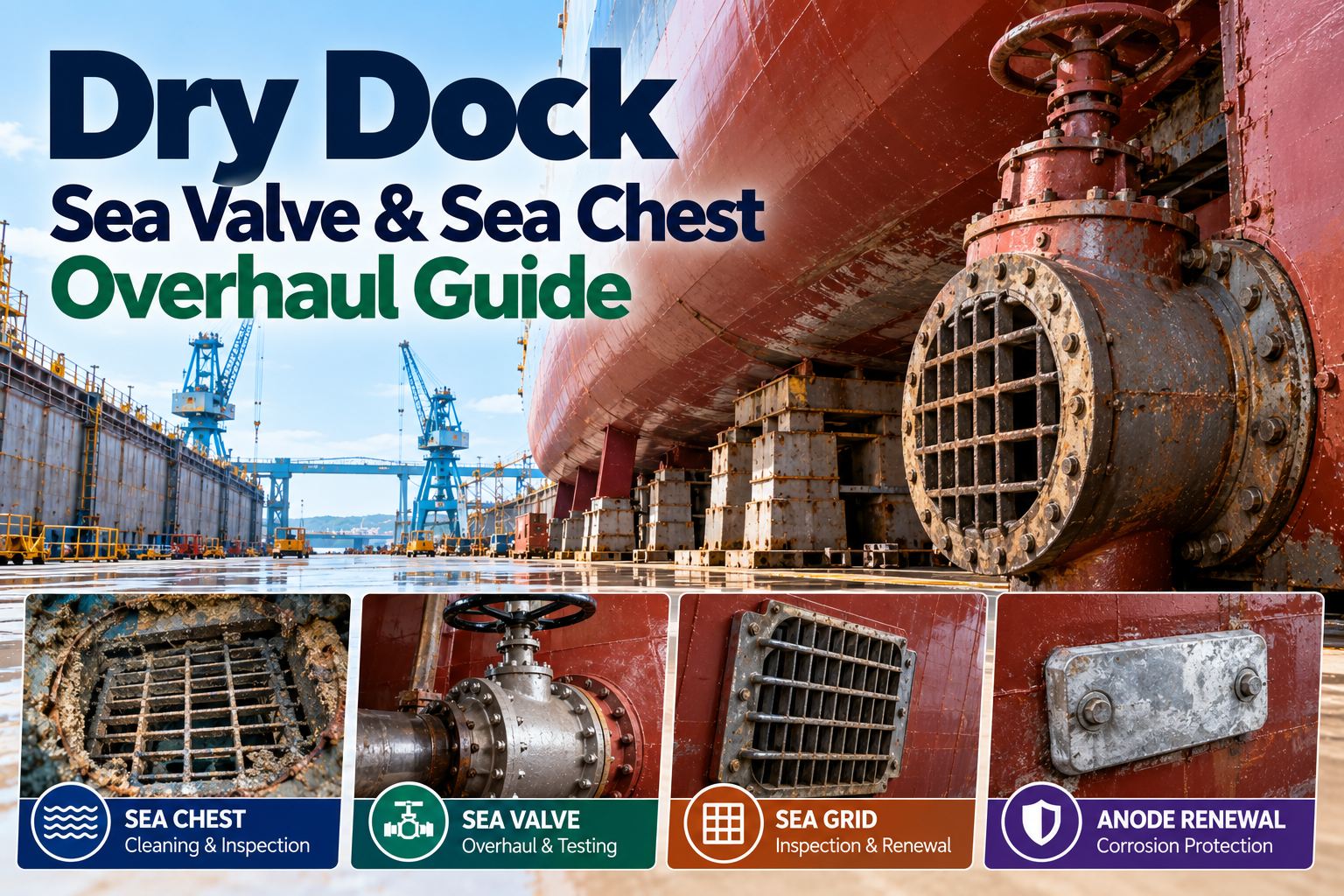
Every sea connection is a hole in the ship with a lid on it. There are more of them than most people carry in their head — main and auxiliary sea chests, their valves, the emergency bilge suction, overboard discharges, sounding and vent connections, the transducers — and the only time any of them can be opened, cleaned, measured or properly closed again is the handful of days the ship is sitting on blocks.
This guide covers what to do with those few days: building the inventory, cleaning and examining sea chests and their grids, overhauling ship-side valves and proving them, running anodes and growth prevention properly, and the blanking discipline that keeps the dock itself safe.
Dry dock · sea valves and sea chests
The openings you cannot reach for the next five years
One inventory per vessel, carried from docking to docking
The constraint is physical and absolute. A valve bolted to the shell below the waterline cannot be opened afloat without either a diver-fitted blank over the opening or an acceptance of flooding. That makes the docking the only practical window, and it has two consequences worth stating plainly.
A missed valve is a five-year miss
Anything left unopened because it was awkward, or because nobody had it on a list, stays unopened until the next docking — by which time its condition is a matter of hope rather than record.
The failure mode is flooding
These are the only valves on the ship whose failure admits the sea directly. That is why they justify attention out of proportion to their size, and why shortcuts in reassembly are not a schedule decision.
The work is cheap, the access is not
Overhauling a ship-side valve is modest work. Being in a position to do it costs a docking, which is why doing the whole set properly is almost always better value than doing the ones that seemed worst.
The sea connection inventory
Before any work is planned, somebody has to be able to state how many openings the ship has and where each one is. Surprisingly few fleets can, and the list is the cheapest thing on this page to produce.
Main sea chests
High and low, port and starboard, with their shell valves and any cross-connections between them.
Auxiliary and service chests
Serving auxiliary cooling, fire and general service, ballast and any dedicated supply.
Emergency bilge suction
The one that is never used, never exercised and expected to work on the worst day. It belongs at the top of the list, not the bottom.
Overboard discharges
Cooling water, bilge and oily water, sewage, ballast and scuppers — each with its own shell valve and its own corrosion history.
Grids, strainers and blow connections
Grid condition and fastenings, strainer baskets, and the steam or compressed air connections used to clear a chest.
Small fittings and sensors
Transducers, sounding connections, vents and anything else that penetrates the shell. These are the ones that get forgotten and then leak.
Build the list once, from the shell expansion plan and a walk round, with each item given a tag that matches the maintenance record. After that it is maintained rather than rebuilt, and the next superintendent inherits a scope instead of a search. Keeping it against the vessel in the planned maintenance system is what stops it living in one person’s spreadsheet.
Sea chest cleaning and grid inspection
A sea chest is a box that spends five years collecting whatever the sea offers. Cleaning it is straightforward; examining it properly while it is empty is the part that pays.
01
Clear it out and look at what came out
Shells, weed and silt are expected. Metallic debris, paint flakes in quantity or anode fragments are information about something else, and the only moment to notice is while it is in front of you.
02
Examine the grid and its fastenings
Bars wasted thin, missing sections and corroded fixings. A grid that departs at sea takes its protection with it and may find its way into a pump, so the fastening arrangement deserves as much attention as the bars.
03
Check the internal coating and the steel behind it
Sea chests are coated for a reason and the coating takes a beating. Breakdown here sits in the most aggressive galvanic environment on the ship, directly against shell plating.
04
Prove the blow connections
Steam or compressed air connections for clearing a blocked chest are worth nothing untested. Confirm the line is clear and the valve works, because the time it is needed is the time nobody can check it.
05
Photograph it empty
The only picture anybody will ever have of this space. Take it by chest, with the tag visible, so the next docking starts from a comparison.
Sea valve defects, causes and what to do about them
Ship-side valves fail in a small number of recognisable ways. The useful question is not what is wrong but what the wrongness is telling you about the next five years.
What you find
Usual cause
What it means
Action this docking
Seat and disc pitting
Erosion and galvanic attack over years of flow
The valve will not shut tight, which is the whole purpose of it
Lap if light, renew the seat or the valve if the pitting is through the sealing face
Body wastage
Internal corrosion, often worst where flow turns
The pressure boundary itself is thinning, not just the sealing
Measure it rather than judging by eye, and renew the valve where wastage is significant
Spindle wear and stiffness
Corrosion at the gland, lack of exercise, bent spindle
A valve that cannot be closed quickly in an emergency
Renew packing, clean and examine the spindle, and prove full travel both ways
Gland leakage
Packing hardened or compressed over the cycle
A small leak that is tolerated afloat and should not be
Repack as routine on every ship-side valve, not only the ones seen weeping
Fastener corrosion at the shell
Galvanic action between the valve, the doubler and the plating
The connection to the hull is weakening even though the valve is sound
Renew studs and nuts as a set, and examine the shell around the opening
Remote operation not working
Linkage seized, hydraulic actuator leaking, position indication wrong
The emergency closing arrangement would not have functioned
Prove the remote and the local, and confirm the indication agrees with the valve
A valve nobody can name
Missing tag, no entry in the record
An opening in the hull that is outside any maintenance system
Identify it, tag it, add it to the inventory and give it a job
Overhauling a ship-side valve
The sequence matters less for its technical content than for its discipline. These valves are reassembled under schedule pressure by people who have been in a cold dock bottom for a week.
Secure and blank firstThe opening is blanked and the system isolated before anything is opened, with the isolation under a tagging regime that somebody owns. More on this below, because it is where the real risk sits.
Open, clean and examine as foundRecord the condition before cleaning it away. The as-found state is the evidence of how the last five years went; the as-cleaned state tells you nothing about that.
Measure the body, do not eyeball itThickness readings on the body where wastage concentrates, compared against the last set. A valve that looks sound and measures thin is the one that fails in service.
Lap or renew the sealing facesLight pitting laps out; pitting through the face does not. Lapping a face that should have been renewed produces a valve that passes a test and leaks within a year.
Repack and reassemble to torqueNew packing, new joints, fasteners tightened properly rather than by feel, and nothing reused because it looked fine in the bucket.
Prove it, and prove it shutPressure testing to the agreed standard where required, full travel confirmed in both directions, and the closed position verified rather than assumed from the handwheel.
Where compressed air is used for testing or for blowing chests through, the supply arrangement carries its own requirements — set out in our guide to marine compressed air system maintenance.
A valve record that still exists in five years
Marine Inspection holds the sea connection inventory, the as-found condition, body thickness readings, what was renewed and the test results against each valve and each chest — so the next docking opens with a scope rather than a search.
Blanking, isolation and the flooding risk in the dock
The hazard people prepare for is a valve failing at sea. The hazard that actually occurs is a hull opening left open in a dock that is then flooded, or a system pressurised against a valve somebody had taken apart.
One register of open penetrations
Every opening that is unbolted goes on a single list with the time it was opened, who opened it, and what has to happen before the dock can be flooded. The list is owned by one person on the ship, not by the yard.
Blanks that are visible and tagged
A blank that looks like a flange is a blank that gets left in. Tag them, count them out and count them back, as deliberately as any other critical item.
Isolation that somebody owns
Systems serving an opened valve are isolated and tagged, and the authority to remove the tag belongs to a named person. Several trades working the same space is how an isolation is removed by someone who did not place it.
A closing-up check before flooding
A walk-through against the register before the dock takes water, with every item signed off physically rather than confirmed verbally. This is the last defence and it costs an hour.
Anodes and marine growth prevention
The sea chest is where corrosion protection and fouling protection meet, and both are set up during the docking for the whole cycle.
Where the anodes sit
Mounted in the sea chest, where they are sized to last until the next docking; in strainers, where they can be changed without interrupting the seawater supply; or in a treatment tank with a spray nozzle where neither is practical. Which arrangement a ship has determines whether this is a five-year decision or a routine one.
What each alloy does
Copper alloy anodes are the usual choice against fouling in piping, strainers, heat exchangers and pumps. Aluminium alloy anodes run alongside them to protect ferrous piping from corrosion, and ferrous alloy anodes pair with copper where the pipework is copper-nickel.
Reading the system
The ammeter is the health indicator. Currents typically sit in the 0 to 2 amp range per anode and are adjusted in 0.2 amp steps; a reading that has fallen a long way is consumption rather than a fault, and the answer is renewal at the next opportunity.
Fitting them properly
Avoid mechanical stress on the cables during the docking, and remove the rust-preventive coating with white spirit before an anode goes back in. An anode fitted with its protective coating intact is an anode doing nothing.
Neglect shows up as deposits that restrict seawater circulation and force more frequent cleaning of the whole cooling side, which is a cost paid continuously rather than once. The wider corrosion protection picture, including cathodic protection of the hull itself, is covered in our guide to hull maintenance and inspection.
Galvanic conditions inside the sea chest
A sea chest holds steel plating, a bronze or gunmetal valve, possibly copper-nickel pipework, anodes of two different alloys and permanent seawater. It is the most electrically active space on the ship, and three things follow.
Coating is doing real work
Internal coating breakdown here progresses faster than almost anywhere else. Treat recoating the chest as part of the job rather than as cosmetic.
Mixed metals need deliberate separation
Where dissimilar metals meet at the shell connection, the insulating arrangement is part of the design and is routinely lost during a rushed reassembly.
Anode consumption tells a story
Anodes that have gone unusually fast, or unevenly between chests, point at something electrical rather than at the anodes. Record which went and how far.
What to leave behind for the next docking
The inventory, correctedEvery opening found, tagged and recorded, including the ones that were not on the list when the dock started.
Body thickness readingsPer valve, at the same points, so the next cycle has a rate rather than an impression.
What was renewed and what was laid upIncluding the valves that were lapped and deferred, because those are next docking’s renewals and should be budgeted now.
Anode type, count and positionPer chest, with consumption observed, so the next order is placed from a record instead of a guess.
Photographs of every chest, emptyTagged and dated. In five years this is the only evidence of what the inside of the ship looked like.
Test results, with the standard appliedSo that a later question about a valve is answered by a record rather than by whoever happens to remember the dock.
How Marine Inspection handles sea connection work
Everything above fails in the same way: the knowledge exists, but it exists in a person rather than in the ship’s record. Five years later that person has moved, and the next docking starts by rediscovering what was already known. This is the part the software is for.
The problem in the dockWhat the system does about it
Nobody can say how many openings the ship has. The list lives in a spreadsheet belonging to whoever built it.
A permanent sea connection inventory held against the vessel, each chest, valve and penetration tagged, so the scope exists before the dock is booked.
As-found condition is cleaned away before it is recorded. What the last five years did is lost in the first hour.
Condition captured at the item with photographs attached to the tag, so the state on arrival is evidence rather than recollection.
Body thickness readings have nothing to compare against. Each docking judges the valve from a single number.
Readings stored per valve at fixed points across cycles, so wastage shows as a rate and renewal is forecast rather than discovered.
Deferred valves are forgotten. The ones lapped and left become next docking’s surprise and next budget’s overrun.
Deferred items carried forward as open work with their reason and their due docking, visible when the next specification is written.
Open penetrations are tracked on a whiteboard. The register that keeps the dock safe disappears when the dock ends.
Open penetrations and blanks logged as a controlled checklist with owners and sign-off, closed out item by item before flooding.
Anode orders are guesswork. Type, count and position are reconstructed from memory or from the last invoice.
Anode type, count, position and observed consumption held per chest, so the next order and the next renewal interval come from the record.
None of this makes the work shorter. It makes the second docking cheaper than the first, which is the only durable saving available on a job that can only be done once every five years.
Dry dock sea valve and sea chest work: frequently asked questions
Why can sea valves only be overhauled in dry dock?
Because a valve bolted to the shell below the waterline cannot be opened afloat without blanking the opening from outside. The docking is the only practical window, which means anything skipped stays skipped for the whole cycle.
What should the sea connection inventory include?
Main sea chests high and low with their shell valves and cross-connections, auxiliary and service chests, the emergency bilge suction, every overboard discharge, grids and strainers with their blow connections, and the small penetrations — transducers, soundings and vents — that are usually left off the list.
How should sea valve condition be assessed?
As found, before cleaning, and by measurement rather than appearance. Body thickness readings at the points where wastage concentrates, compared with the previous set, tell you more than the condition of the sealing faces, because the body is the pressure boundary.
When is lapping enough and when must a valve be renewed?
Light pitting on the sealing faces will lap out. Pitting that goes through the face, or significant wastage of the body, will not. A face lapped when it should have been renewed produces a valve that passes its test and leaks within the year.
What is the main safety risk during the work?
Not a failure at sea but an opening left open when the dock is flooded, or a system pressurised against a dismantled valve. Keep one register of open penetrations owned by a named person on board, tag and count the blanks, control the isolations, and walk the register physically before flooding.
How do marine growth prevention anodes work?
Copper alloy anodes are the usual choice against fouling in piping, strainers, heat exchangers and pumps; aluminium alloy anodes run alongside them to protect ferrous piping; ferrous alloy anodes pair with copper where pipework is copper-nickel. They may be mounted in the sea chest, in strainers, or in a treatment tank with a spray nozzle.
When should MGPS anodes be renewed?
When the current has fallen well down its range. Most anodes operate between 0 and 2 amps each, adjusted in 0.2 amp steps, so a persistent low reading indicates consumption. Sea-chest mounted anodes are sized to last to the next docking; anodes in strainers can be changed in service.
What is commonly got wrong when refitting anodes?
Two things: mechanical stress on the cables during the docking, and leaving the rust-preventive coating on the anode. That coating has to be removed with white spirit before fitting, or the anode is installed and doing nothing.
Does a blocked or fouled sea chest matter if cooling still works?
Yes. Growth restricts seawater circulation, which forces more frequent cleaning across the cooling side and erodes margin on every heat exchanger downstream. It is a cost paid continuously rather than at a single point.
Sea connections
Know every opening, and what was done to it last time
Marine Inspection holds the sea connection inventory with tags, as-found condition, thickness readings, renewals, anode records and test results against each vessel — so the shortest job in the dock stops being the one nobody can account for.