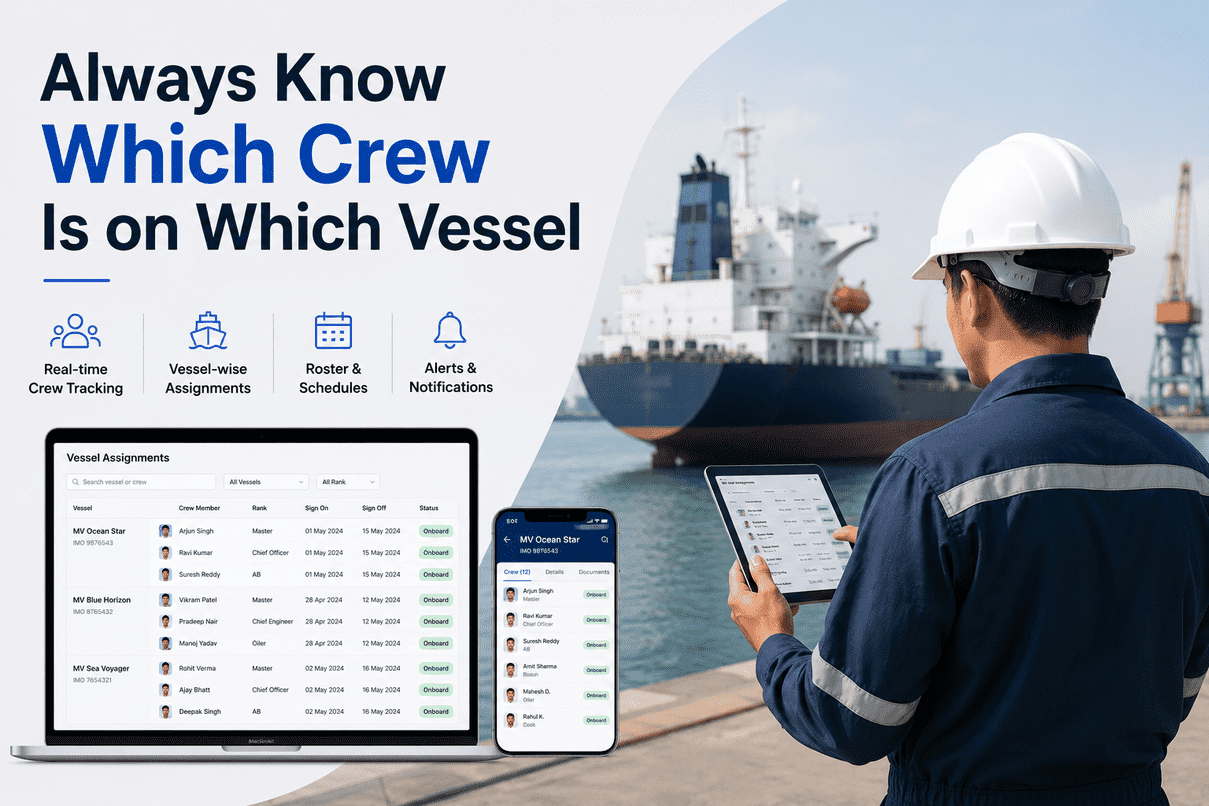
Every commercial vessel sails under a Minimum Safe Manning Document issued by its flag state administration under IMO Resolution A.1047(27) Principles of Minimum Safe Manning, with the MSMD valid for a maximum of five years and the ship considered safely manned only when proceeding to sea with not less than the specified numbers and grades of personnel. STCW Regulation I/14 places the responsibility on the company to ensure compliant manning. STCW Table A-II/5 and A-III/5 govern rating functions; STCW Chapter VIII governs watchkeeping with at least two watch keepers required at the bridge during darkness and restricted visibility, one of whom must be a Deck Officer. US 46 CFR Part 15 complements with Certificate of Inspection manning levels. Beyond the regulatory baseline, real-time knowledge of which seafarer is on which vessel, with which certificates valid through what date, on what rotation, and at what point in their watch cycle, is the operational gate through which every other crew workflow runs: PSC defence, charterer vetting, payroll, travel, repatriation, training, claims investigation. Yet most fleets in 2026 still track crew-to-vessel assignment across crew manager spreadsheets, manning agent emails, and the rotation board in the office — producing inconsistent visibility, last-minute manning gaps, and the recurring "which vessel is he actually on now?" moment that costs hours of phone calls to resolve. Start a free trial of Marine Inspection to know which crew is on which vessel in real time across your entire fleet.
Crew Vessel Assignment Tracking · 2026
Always Know Which Crew Is On Which Vessel. In Real Time. Across The Fleet.
Live roster per vessel, drag-and-drop rotation planning, minimum safe manning monitoring, and one-click manning evidence packs — built on STCW Regulation I/14 and IMO Resolution A.1047(27).
M/V Pacific Star
22 / 22
Full manning
M/V Aurora
20 / 22
Rotation pending
M/V Helena
19 / 22
Below MSMD
M/V Sirius
22 / 22
Full manning
Five Manning Failures That Hit Fleets In 2026 — And How They Surface Late
The cost of imperfect crew-to-vessel assignment tracking is not abstract. Five specific failure modes recur across mid-market and enterprise fleet operations in 2026, each producing measurable revenue loss, regulatory exposure, or operational disruption. The pattern is consistent: the failure is structurally caused by fragmented assignment data, surfaces too late to prevent the consequence, and is usually attributed to the human caught in the gap rather than the missing system.
FAILURE 01
Below-MSMD Sailing Discovery
Vessel departs port with manning one position short of the Minimum Safe Manning Document specification. Crew change scheduled but flight delay arrival missed. Discovery happens at PSC inspection days later. Detention follows. The gap was visible in the roster 72 hours earlier — but not surfaced.
FAILURE 02
Wrong-Vessel Document Despatch
Manning agent ships joining crew documents to the wrong vessel because the assignment was updated in one system but not the other. Crew arrives at port, documents are elsewhere, embarkation delayed 24-48 hours, charter terms breached, vessel demurrage accumulates.
FAILURE 03
Certificate Expiry Mid-Tour
Officer ENG1 medical expires while at sea between port calls. PSC inspection at next port. Officer no longer qualified to perform watch. Vessel detained. The 60-day window before expiry was visible in the roster — but the rotation planning workflow did not surface it.
FAILURE 04
Double-Booked Seafarer
Two vessels both list the same officer as joining at the next port. Crew change planning happened in two disconnected processes. One vessel proceeds short-handed. Manning agent scrambles for replacement. Charter customer notified. Operator credibility damaged.
FAILURE 05
Claims Investigation Blank
Cargo damage claim filed six months after a voyage. Insurer asks who was on watch at the relevant time. Historical roster reconstruction takes two weeks across email, spreadsheets, manning agent records. Coverage dispute opens with reduced recovery position.
The Real-Time Crew Vessel Tracking Model — Six Data Layers
A credible crew-to-vessel assignment tracking system maintains six data layers per active assignment. Each layer answers a question a different stakeholder will ask. Together they produce the single source of truth that PSC officers, charterers, insurers, claims managers, and crew managers all consult. Lose any one layer and the model starts producing the failures above.
L1
Identity Layer
Who: seafarer name, IMO Seafarer Identification Number, passport, nationality, photo, contact details. Foundation for every other layer. Verified against issued credentials.
L2
Position Layer
Where: current vessel, current port if applicable, sign-on date and port, expected sign-off date and port, rotation pattern (4/4, 6/6, 3/3 months). Updated continuously.
L3
Role Layer
What rank: Master, Chief Officer, 2nd Officer, 3rd Officer, Chief Engineer, 2nd Engineer, Electro-Technical Officer, Ratings, Cook. Matched to MSMD specified grades.
L4
Qualification Layer
Why qualified: STCW Certificate of Competency, endorsements, BST modules, ENG1 medical, flag state CoE, vessel-specific familiarization. Validity dates per credential.
L5
Watch Layer
When working: watch schedule per STCW Chapter VIII, work-and-rest hours per MLC 2006 Regulation 2.3 (10 hr in 24, 77 hr in 7 days), bridge presence in pilotage waters.
L6
Compliance Layer
SEA per MLC Title II, wage payment records, training completion, drill participation, observation card submission. Foundation for ISM Element 6 evidence and TMSA 3 Element 3 scoring.
The Live Fleet Roster Grid
The visual centrepiece of any credible crew vessel assignment platform is the live fleet roster grid — one row per vessel, current manning count against MSMD-specified strength, watch coverage status, certificate currency rollup, upcoming rotation events, and exception alerts. The grid below illustrates the standard layout. Scroll horizontally on mobile for the full view.
| Vessel |
Manning |
MSMD Status |
Watch Coverage |
Certs Expiring < 60 Days |
Next Rotation |
Exception |
| M/V Pacific Star |
22 / 22 |
Full manning |
Compliant |
2 |
14 Apr · Port Klang |
None |
| M/V Aurora |
20 / 22 |
Rotation gap |
Compliant |
3 |
09 Apr · Rotterdam |
Replacement booked |
| M/V Helena |
19 / 22 |
Below MSMD |
At risk |
1 |
07 Apr · Singapore |
Action required |
| M/V Sirius |
22 / 22 |
Full manning |
Compliant |
5 |
22 Apr · Fujairah |
Cert renewal in flight |
| M/V Orion |
22 / 22 |
Full manning |
Compliant |
0 |
28 Apr · Houston |
None |
| M/V Vega |
21 / 22 |
Rotation gap |
Compliant |
4 |
11 Apr · Antwerp |
Replacement booked |
| M/V Polaris |
22 / 22 |
Full manning |
Compliant |
2 |
30 Apr · Yokohama |
None |
| M/V Atlas |
22 / 22 |
Full manning |
Compliant |
1 |
03 May · Santos |
None |
The Rotation Planning Cycle — Three Months Out To Sign-On Day
Assignment tracking is inseparable from rotation planning. Crew change planning runs on a three-month forward window — earlier for officers in scarce supply, later for ratings in common circulation. Each phase has stakeholder dependencies, decision gates, and consequences when missed. Book a rotation planning walkthrough to map your fleet's current cycle against the structured five-phase standard.
T-90
Slot Identification
Sign-off dates surfaced across the fleet 90 days ahead. Replacement candidates identified from active pool. Officer scarcity surfaced for early action. Multi-vessel rotation impact mapped.
T-60
Candidate Selection
Replacement candidates confirmed. Certificate currency through rotation end validated. Vessel-specific endorsement match verified. Wage scale and SEA prepared.
T-30
Travel & Visa
Flights booked, visas confirmed for crew change port. Joining-crew pre-joining briefing scheduled. Departing-crew repatriation logistics confirmed. Travel allowance disbursed.
T-14
Pre-Joining Validation
Full pre-joining check: certificate validity through rotation end, visa coverage, medical validity, vessel-specific familiarization status, recent travel restrictions. Gaps surfaced for action.
T-0
Sign-On / Sign-Off
Crew change executed at port. Sign-on logged with timestamp, location, and witnessing officer. Departing crew sign-off logged. Assignment record updated in real time. Master notified.
The Six Workflows Centralized Assignment Tracking Unlocks
Real-time crew-to-vessel assignment data is the foundation that other operational workflows depend on. Six specific workflows pay off the centralization investment — each previously taking hours or days of cross-system reconciliation, each now produced in minutes. Book a workflow walkthrough to see how each pattern operates on a real fleet roster.
A
Daily MSMD Compliance Check
Every vessel checked daily against its Minimum Safe Manning Document. Below-MSMD status surfaced before vessel proceeds to sea. PSC defence pack ready if challenged at port state inspection.
B
Pre-Crew-Change Pipeline
Five-phase rotation cycle (T-90 / T-60 / T-30 / T-14 / T-0) runs automatically with phase-specific alerts. Officer scarcity flagged early. Travel and visa workflows triggered on schedule.
C
Charterer Vetting Documentation
Charterer requests current crew list with ranks, certificates, and rotation pattern. Platform produces vetting pack from live roster in minutes rather than days. Voyage fixing window protected.
D
Claims Defence Roster Lookup
Insurance claim filed referencing a specific voyage period. Platform produces historical roster snapshot for that period with watch schedules, certifications current at the time, and signed evidence.
E
Double-Booking Prevention
Centralized assignment surface prevents the same officer being committed to two vessels simultaneously. Fleet-level visibility eliminates the cross-process double-booking that two-system fleets routinely produce.
F
Watch Hour Compliance Monitoring
MLC 2006 Regulation 2.3 work-and-rest hour compliance monitored per officer per day. STCW Chapter VIII watch coverage tracked. Violations surfaced before they become PSC findings.
Why Marine Inspection For Crew Vessel Assignment Tracking
Marine Inspection delivers centralized real-time crew vessel assignment tracking built on the six-layer data model, five-phase rotation cycle, daily MSMD compliance monitoring, and 2026 regulatory pre-alignment under STCW Regulation I/14, IMO Resolution A.1047(27), MLC 2006 Regulation 2.3, and STCW Chapter VIII. Start a free trial or book a roster walkthrough to see what live fleet roster management looks like. Operators can also sign up free with no credit card or commitment to test the live roster grid against their own fleet manning data.
Live Fleet Roster Grid
One row per vessel with manning count vs MSMD, watch coverage status, certificate currency rollup, next rotation event, and exception alerts. Drill-down to per-seafarer assignment detail in one click.
Drag-And-Drop Rotation Planning
Visual rotation board across vessels and time horizon. Drag seafarer cards between vessels and rotation slots. Conflict detection and certificate currency validation built into the drop action.
MSMD Compliance Monitoring
Every vessel checked daily against its Minimum Safe Manning Document. Below-MSMD status surfaced before vessel proceeds to sea. Per-grade compliance tracked, not just total headcount.
Historical Roster Archive
Every assignment, every sign-on, every sign-off logged with timestamp and signed evidence. Roster snapshot retrievable for any prior date. Foundation for claims defence and audit response.
Watch Hour Tracking
MLC 2006 Regulation 2.3 work-and-rest hour monitoring per officer. STCW Chapter VIII watch coverage tracked. Real-time compliance, not retrospective reconstruction.
6-12 Week Deployment
Roster setup and MSMD configuration weeks 1-2. Historical assignment migration weeks 3-5. Rotation planning workflows weeks 6-8. Live operations and tuning weeks 9-12.
Frequently Asked Questions
What is a Minimum Safe Manning Document and why does it matter?
The Minimum Safe Manning Document (MSMD) is issued by the vessel's flag state administration under IMO Resolution A.1047(27) Principles of Minimum Safe Manning, with maximum validity of five years subject to validity of the Certificate of Registry provided there is no change of name, navigating area, operating company, or major modification of the ship. The MSMD specifies the minimum number and grades of personnel that must be on board for the vessel to be considered safely manned when proceeding to sea. STCW Regulation I/14 places the responsibility on the company (as defined under the ISM Code) to ensure manning meets the MSMD specification. Proceeding to sea below MSMD specification produces PSC detention exposure. The MSMD is the operational ground truth that any crew vessel assignment tracking system must measure against — total headcount alone is insufficient because the MSMD specifies grades (Master, Chief Engineer, Officers, Ratings, ETO if required).
What are the six data layers of a crew assignment record?
A credible crew-to-vessel assignment tracking system maintains six data layers per active assignment. Identity Layer — seafarer name, IMO Seafarer Identification Number, passport, nationality, photo, contact details. Position Layer — current vessel, current port if applicable, sign-on date and port, expected sign-off date and port, rotation pattern (4/4, 6/6, 3/3 months). Role Layer — rank held: Master, Chief Officer, 2nd Officer, 3rd Officer, Chief Engineer, 2nd Engineer, Electro-Technical Officer, Ratings, Cook — matched to MSMD specified grades. Qualification Layer — STCW Certificate of Competency, endorsements, BST modules, ENG1 medical, flag state CoE, vessel-specific familiarization with validity dates per credential. Watch Layer — watch schedule per STCW Chapter VIII, work-and-rest hours per MLC 2006 Regulation 2.3, bridge presence in pilotage waters. Compliance Layer — SEA per MLC Title II, wage payment records, training completion, drill participation, observation card submission.
What are the five common manning failures in 2026?
Five specific failure modes recur across fleet operations in 2026, each structurally caused by fragmented assignment data. Below-MSMD Sailing Discovery — vessel departs port with manning one position short, discovery happens at PSC inspection days later, detention follows. Wrong-Vessel Document Despatch — manning agent ships joining crew documents to the wrong vessel because assignment was updated in one system but not the other, embarkation delayed, charter terms breached, demurrage accumulates. Certificate Expiry Mid-Tour — officer medical or STCW expires while at sea between port calls, PSC finds officer no longer qualified at next port, vessel detained. Double-Booked Seafarer — two vessels both list the same officer as joining, one proceeds short-handed, charter customer notified, operator credibility damaged. Claims Investigation Blank — cargo damage claim filed months after a voyage, insurer asks who was on watch, historical roster reconstruction takes two weeks across email and spreadsheets, coverage dispute opens with reduced recovery.
How does the five-phase rotation cycle work?
Crew change planning runs on a structured five-phase cycle. T-90 days Slot Identification — sign-off dates surfaced 90 days ahead, replacement candidates identified from active pool, officer scarcity surfaced for early action, multi-vessel rotation impact mapped. T-60 days Candidate Selection — replacement candidates confirmed, certificate currency through rotation end validated, vessel-specific endorsement match verified, wage scale and SEA prepared. T-30 days Travel and Visa — flights booked, visas confirmed for crew change port, joining-crew pre-joining briefing scheduled, departing-crew repatriation logistics confirmed, travel allowance disbursed. T-14 days Pre-Joining Validation — full pre-joining check including certificate validity through rotation end, visa coverage, medical validity, vessel-specific familiarization status, recent travel restrictions. T-0 Sign-On / Sign-Off — crew change executed at port, sign-on logged with timestamp and witnessing officer, departing crew sign-off logged, assignment record updated in real time, Master notified.
What workflows does centralized assignment tracking enable?
Six specific workflows pay off the centralization investment, each previously taking hours or days of cross-system reconciliation. Daily MSMD Compliance Check — every vessel checked against its MSMD, below-MSMD status surfaced before vessel proceeds to sea. Pre-Crew-Change Pipeline — five-phase rotation cycle runs automatically with phase-specific alerts. Charterer Vetting Documentation — current crew list with ranks, certificates, rotation pattern produced from live roster in minutes. Claims Defence Roster Lookup — historical roster snapshot retrievable for any prior date with watch schedules and certifications current at the time. Double-Booking Prevention — centralized assignment surface prevents the same officer being committed to two vessels simultaneously. Watch Hour Compliance Monitoring — MLC 2006 Regulation 2.3 work-and-rest hour compliance monitored per officer, STCW Chapter VIII watch coverage tracked, violations surfaced before they become PSC findings.
How does Marine Inspection track crew vessel assignments?
Marine Inspection delivers centralized real-time crew vessel assignment tracking on the six-layer data model (Identity / Position / Role / Qualification / Watch / Compliance) with daily MSMD compliance monitoring and 2026 regulatory pre-alignment under STCW Regulation I/14, IMO Resolution A.1047(27), MLC 2006 Regulation 2.3, and STCW Chapter VIII. Live fleet roster grid with one row per vessel showing manning count vs MSMD, watch coverage status, certificate currency rollup, next rotation event, and exception alerts. Drag-and-drop rotation planning board across vessels and time horizon with conflict detection built into the drop action. Historical roster archive with every assignment, sign-on, sign-off logged for claims defence retrieval. Watch hour tracking with real-time MLC and STCW compliance. 6-12 week deployment for typical mid-size fleets. Book a 30-minute roster walkthrough to map your current process and identify exception gaps.
How do we get started?
Two paths. Start a free trial directly — the platform loads with sample fleet roster data including pre-configured MSMD specifications, rotation patterns, certificate templates, and exception alerts so crew managers, DPAs, and superintendents can explore the live roster grid, drag-and-drop rotation planning, and six-layer assignment model before any commitment. Or book a 30-minute roster walkthrough with a Marine Inspection product expert — the walkthrough maps your fleet's current assignment tracking against the six-layer standard, identifies bottlenecks producing the five common failure modes, surfaces double-booking and below-MSMD exposure, and produces a sourced consolidation plan with deployment timeline. Most operators identify exception risks in the session itself. Both paths converge if you decide to implement — phased onboarding with roster setup in weeks 1-2 and full multi-vessel live operations within a fiscal quarter.
Ready When You Are
Always Know Which Crew Is On Which Vessel. Real Time. Across The Fleet.
Live fleet roster grid, drag-and-drop rotation planning, daily MSMD compliance, historical archive, watch hour tracking, 6-12 week deployment — all in one platform built for the 2026 crew assignment tracking reality.

.png)