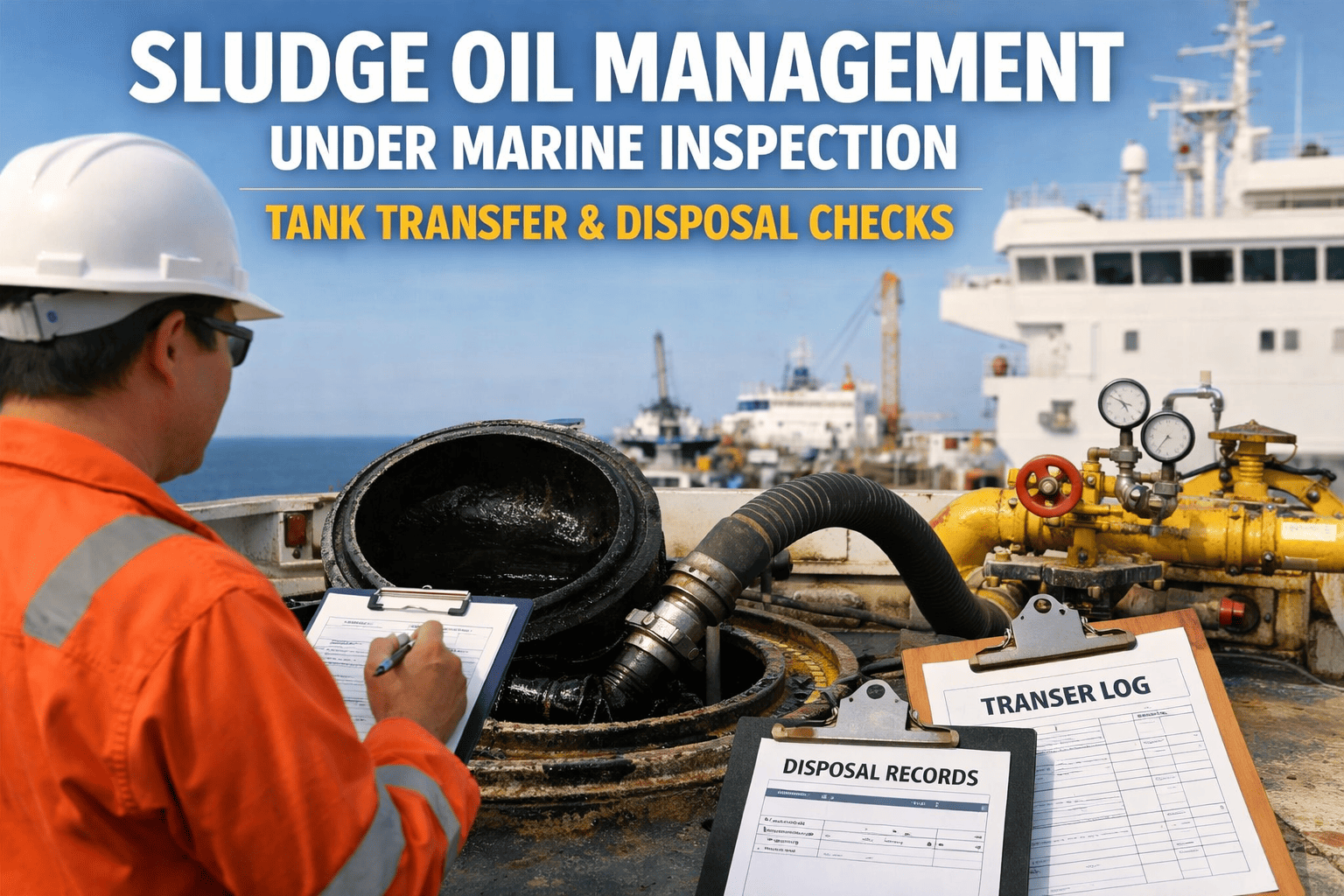
Sludge oil management is where marine environmental compliance becomes physically measurable — inspectors can take a sounding of your sludge tank, compare it to your Oil Record Book, calculate whether the volume makes sense against your fuel consumption and purifier hours, and within minutes determine whether your vessel's waste management adds up. No other MARPOL Annex I area is so easily cross-verified — and no other area exposes operators to criminal prosecution so quickly when the numbers don't match. The sludge system encompasses everything from purifier waste collection through internal tank transfers, heating, settling, incineration, and shore disposal — each step requiring documented evidence. This guide covers the complete sludge oil management chain as inspectors see it: tank design and condition, transfer procedures, disposal documentation, and the common findings that lead to deficiencies and detentions. Fleet managers and engineers can sign up for Marine Inspection or schedule a demo to see how sludge tracking, ORB management, and disposal receipts connect in one auditable platform.
Sludge Oil Management: Inspection Reference Numbers
Code C
ORB Entry Code
Collection & disposal of oil residues (sludge)
Weekly
ORB Sludge Recording
Quantities retained must be recorded weekly minimum
IOPP 3.1
Certificate Reference
Form A/B lists designated sludge tanks & capacities
3 Years
ORB Retention
Onboard from last entry — with disposal receipts
Where Sludge Comes From: The Collection Chain
Understanding the sludge generation and collection system is essential — because inspectors trace the chain from source to disposal, and every link must be documented. Book a demo to see how Marine Inspection maps your vessel's sludge flow.
Sludge Sources & Collection Points
1
HFO purifier sludge — The largest volume source. Residue from fuel oil separation: water, catalytic fines, ash, and degraded fuel. Volume directly related to fuel consumption and purifier running hours.
2
LO purifier sludge — Residue from lubricating oil separation. Lower volume than fuel sludge but still significant. Contains wear metals, oxidation products, and water.
3
Settling & service tank drains — Water and sediment drained from fuel oil settling and service tanks. Oily water that must be routed to sludge collection, not to bilge.
4
OWS separated oil — Oil retained by the oily water separator during bilge water processing. Transferred to sludge tank or waste oil tank for disposal.
5
Air bottle drains — Small quantities of oily condensate from compressed air systems. Routed to sludge collection via dedicated drain piping.
6
Used lubricating oil — Drained crankcase oil from engines, generators, and auxiliary equipment. Should be stored separately where possible for disposal or incineration.
Sludge Tank Design & Condition: What Inspectors Examine
The sludge tank itself is inspected for design compliance, physical condition, and operational readiness. Tanks that can't be emptied or inspected properly are a finding before any documentation is reviewed.
Design Requirements
Tank Construction Standards
Minimum height: 400mm. Floor slope: Minimum 15° to ensure complete drainage. The tank must be easy to empty and inspect — meaning access hatches, manhole covers, and internal arrangements allow thorough cleaning. All designated sludge tanks must match those listed in IOPP Certificate supplement item 3.1 (Form A for non-tankers, Form B for tankers).
Operational Condition
What PSCOs Check Physically
Heating system: Sludge tanks require heating coils — high-viscosity sludge must be heated to 60°C+ for pumping. Inspectors verify heating system is functional. Level indicators: Must be operational and readable. Sounding pipes: Clear and accessible for manual sounding. Capacity: Adequate for the vessel's operational profile between disposal opportunities. Insufficient capacity creates the pressure that incentivizes illegal disposal.
Red Flag
Tank Arrangement Doesn't Match IOPP
If the actual sludge tank arrangement differs from what's listed on the IOPP Certificate supplement — modified tanks, added connections, decommissioned tanks — this is an immediate finding. Any change to oil pollution prevention equipment or tank arrangements requires the IOPP to be re-endorsed or reissued. Unauthorized modifications to the sludge system are treated as potential evidence of bypass capability.
Red Flag
Tank Nearly Full with No Disposal Planned
A sludge tank approaching capacity with no disposal arranged at the next port creates a situation where the crew may be incentivized to dispose of sludge illegally. Inspectors note the current tank level and compare it against available capacity and the vessel's schedule. Proactive disposal planning eliminates this risk — and demonstrates a responsible management culture.
Transfer Procedures: The Internal Sludge Flow
Sludge moves between tanks for settling, water separation, heating, and preparation for disposal or incineration. Every transfer must be documented — and the piping must match the IOPP diagram. Schedule a demo to see how Marine Inspection logs every internal transfer.
Internal Transfers — Procedure & Documentation
Every internal transfer recorded in the ORB under Code C — Tank identification (from and to), quantity transferred, and total quantity remaining in each tank. Even transfers between sludge tanks within the same system must be logged. Missing transfer entries are the most common ORB gap inspectors find.
Water settling before incineration — Sludge transferred to the waste oil tank must be settled and heated to evaporate water before burning. Temperature reaches 100°C for water evaporation; above 100°C indicates oil is heating. Critical safety rule: never transfer sludge into a waste oil tank already above 90°C — the pressure spike from instant boil-off is dangerous.
Sludge pump operational and tested — The sludge/waste oil pump must be functional, able to transfer between internal tanks and to the deck discharge connection for shore disposal. Pump failure = inability to dispose ashore = accumulation problem. Include sludge pump in your planned maintenance schedule.
No portable bends or unauthorized connections — Portable bends and spool pieces must only be connected when required for a specific operation and removed immediately after. Each must be conspicuously labelled with its intended purpose. Unauthorized portable connections left in place between sludge piping and overboard discharge piping are evidence of illegal bypass arrangements.
Track Every Transfer, Every Sounding, Every Disposal
Marine Inspection logs sludge tank levels, internal transfers, disposal receipts, and ORB entries — cross-referencing them automatically so your records are always consistent and audit-ready.
Disposal Documentation: The Evidence Chain
Every litre of sludge that leaves the vessel must be documented. Inspectors reconstruct the complete lifecycle: how much was generated, where it was stored, and how it was disposed. Book a demo to see how Marine Inspection connects generation to disposal.
Pumped ashore via the standard sludge discharge connection to a port authority-authorized waste contractor. The contractor provides MARPOL receipts documenting quantity, waste type, date, port, and receiving facility. Receipts must be retained onboard with the ORB. Only use authorized contractors — unauthorized disposal creates liability even if the disposal itself was proper.
ORB Code C entry + MARPOL receipt required
Burned in IMO-approved incinerator meeting MEPC 76(40): minimum 850°C combustion temperature (1,200°C for PVC). Water must be evaporated from sludge first for efficient burning. All incineration operations documented with date, quantity, waste type, and operating temperature. May be restricted in port — check local regulations before operating.
ORB Code C entry + incinerator log required
Authorized waste barges collect sludge at anchorage in major port areas (Singapore, Fujairah, Panama). The barge operator must be port authority-certified. Same documentation requirements as shore disposal — MARPOL receipts with quantities and waste categories retained onboard. Verify the barge has proper authorization before transfer begins.
Same documentation as shore disposal
The ORB Cross-Reference: How Inspectors Verify the Numbers
This is the area that catches more operators than any other. Inspectors don't just read the ORB — they cross-reference it against every other available data source to verify the numbers add up.
Step 1 — Physical sounding: The PSCO takes an actual sounding of the sludge tank and compares it to the volume recorded in the ORB. Any significant discrepancy is an immediate red flag — where did the unrecorded sludge go?
Step 2 — Generation calculation: The inspector reviews fuel consumption records, purifier running hours, and purifier efficiency data. They calculate approximately how much sludge should have been generated since the last disposal — and compare this against the ORB accumulation entries. A sludge tank that shows no increase despite weeks of purifier operation is suspicious.
Step 3 — Disposal verification: Shore disposal receipts are matched against ORB Code C disposal entries. Quantities, dates, and ports must align exactly. Receipts without matching ORB entries — or ORB entries without receipts — are both serious findings.
Step 4 — Weekly recording check: MARPOL requires the quantity of sludge retained onboard to be recorded at least weekly. Missing weekly entries — or entries that show mathematically impossible volumes — indicate the records are not being maintained in real time. Schedule a demo to see how Marine Inspection automates this cross-referencing.
Common Inspection Findings & How to Avoid Them
These findings appear repeatedly across PSC reports, USCG exams, and class surveys. Every one is preventable. See how Marine Inspection flags these issues before inspectors find them.
Detention Risk
Sludge Tank Sounding Doesn't Match ORB
Why it happens: ORB entries made retrospectively, not at time of operation. Estimated volumes rather than actual soundings. Unrecorded internal transfers. Prevention: Sound sludge tanks daily and record in the sounding logbook. Make ORB entries at the time of each operation. Cross-check your own numbers before the inspector does — if they don't reconcile, investigate why before port arrival.
Detention Risk
Missing Weekly Sludge Quantity Records
Why it happens: Crew unaware that MARPOL requires weekly recording even when no disposal occurs. Entries only made when sludge is transferred or disposed, not as a routine weekly inventory. Prevention: Record total sludge quantity retained onboard once per week minimum — identified by tank and volume. This is a standalone requirement, independent of any transfer or disposal activity.
Serious Finding
Shore Receipts Missing or Don't Match ORB
Why it happens: Receipts not collected from waste contractor, lost after collection, or quantities on receipt differ from ORB entry. Prevention: Collect MARPOL receipt immediately upon completion of disposal. Verify quantity matches before the barge or truck departs. Attach receipt to the ORB. Photograph the receipt as backup. Enter the disposal in the ORB with quantities matching the receipt exactly.
Serious Finding
Piping Arrangement Doesn't Match IOPP Diagram
Why it happens: Modifications made to sludge piping without updating the IOPP. Portable bends left connected after temporary operations. Cross-connections that shouldn't exist. Prevention: Ensure all piping matches the IOPP supplement diagram. Remove all portable bends immediately after use. Any modification to sludge/waste oil piping requires IOPP re-endorsement from class.
Pre-Inspection Sludge Management Checklist
Run this before every port call where PSC inspection is possible. Schedule a demo or sign up for Marine Inspection to run this digitally across your fleet.
ORB Code C entries complete and current — All sludge transfers, disposals, and weekly retention quantities recorded. Every entry signed by Officer-in-Charge. Every completed page signed by the Master.
Sludge tank sounding matches ORB — Take a fresh sounding and verify it reconciles with the last ORB entry. If it doesn't, investigate and resolve the discrepancy before arrival.
All disposal receipts filed with ORB — MARPOL receipts from every shore disposal and barge collection, with quantities matching ORB entries. Available for immediate presentation.
Sludge tank heating operational — Heating coils functional, steam supply available. High-viscosity sludge must be pumpable for shore disposal.
Sludge pump and discharge connection ready — Pump operational, deck discharge connection accessible and fitted with correct coupling. Transfer system tested.
Piping matches IOPP diagram — No unauthorized connections. All portable bends removed and stowed. No oil traces in clean-side piping. Valve positions correct.
Engineers can explain the sludge management process — Chief Engineer and watch engineers can describe how sludge is generated, collected, transferred, and disposed. They can explain ORB entries and locate all related documentation immediately when asked.
Sludge Compliance That Runs Itself
Marine Inspection tracks sludge generation, tank levels, internal transfers, disposal scheduling, receipt management, and ORB consistency — giving your fleet continuous sludge compliance without the pre-port-call scramble.
Frequently Asked Questions
How often must sludge quantities be recorded in the ORB?
MARPOL requires the quantity of oil residues (sludge) retained onboard to be recorded at least once per week — even if no transfer or disposal has occurred that week. This weekly inventory must identify each designated sludge tank and the volume retained. Additionally, every transfer between tanks and every disposal (ashore, incineration, or barge) requires its own separate ORB Code C entry at the time of the operation.
How do inspectors verify sludge quantities?
PSCOs cross-reference multiple data sources: they may take an actual sludge tank sounding and compare it against the ORB; calculate expected sludge generation from fuel consumption and purifier running hours; verify shore disposal receipts match ORB entries in quantity, date, and port; and check that weekly retention records show a plausible accumulation pattern. Any discrepancy between physical measurement and documented records triggers deeper investigation.
What tanks must be listed on the IOPP Certificate?
All designated sludge tanks (oil residue tanks) must be listed in item 3.1 of the IOPP Certificate supplement (Form A for non-tankers, Form B for tankers), including tank identification and capacity in cubic metres. Only tanks listed in the IOPP can be used for sludge retention. If the physical arrangement differs from the certificate — modified tanks, additional connections, or decommissioned tanks — the IOPP must be re-endorsed or reissued by the classification society.
What temperature is needed to pump sludge for shore disposal?
High-viscosity sludge typically requires heating to at least 60°C before it can be pumped effectively. Some heavy residual fuel sludge may require higher temperatures. The sludge tank heating system must be functional and tested before arranging shore disposal. If the heating system is defective and the sludge cannot be pumped, shore disposal cannot be completed — creating an accumulation problem that inspectors will note.
What happens if portable piping connections are found in the sludge system?
Portable bends, spool pieces, and flexible hoses must only be connected when required for a specific authorized operation and removed immediately after. Each must be conspicuously labelled with its intended purpose. Portable connections found installed between sludge piping and overboard discharge lines — or any arrangement that could allow sludge to bypass the OWS — are treated as evidence of illegal bypass capability. This can trigger criminal investigation, not just a deficiency finding.