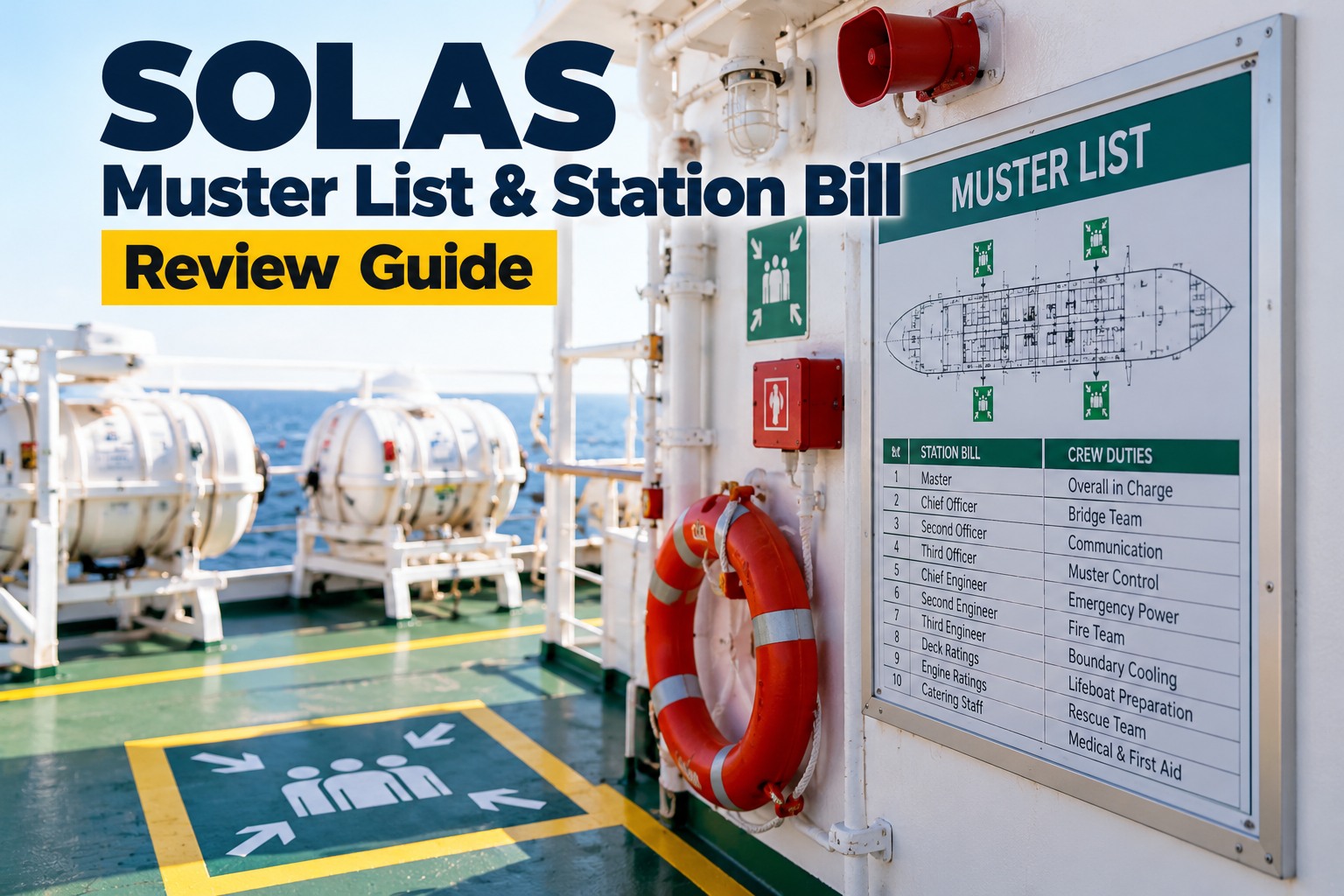
A muster list works when a crew member who has never read it can still do the right thing at the sound of the alarm. For a Safety Officer, the test is not whether the list looks complete on paper, but whether every duty on it is assigned to a real person, has a named substitute and gets exercised in drills. Port state control found muster-list detail to be the weakest result of the 2019 SOLAS emergency preparedness campaign. This guide covers what the list must contain, how to design it, and how to align the station bill with the way drills actually run.
- The muster list must set out the emergency signals, what everyone does on each, crew duties, officers responsible for appliances and substitutes for key persons.
- Copies belong on the bridge, in the engine room and in crew accommodation, in the languages the crew need.
- Prepare it before sailing and revise it after crew changes.
- Muster-list detail was the main weak result of the 2019 SOLAS emergency preparedness campaign: 178 deficiencies at Tokyo MoU and 201 at Paris MoU in the campaign period.
- Test the list in drills, and measure how often each duty and each substitute is actually exercised.
What a SOLAS Muster List Must Contain
SOLAS Chapter III covers muster lists and emergency instructions in Regulation 8 and, for passenger ships, Regulation 37. We could not obtain the SOLAS text directly. The table below is built from national implementations that follow it: the UK Merchant Shipping (Musters, Training and Decision Support Systems) Regulations 1999 and MCA guidance note MGN 071, with a Canadian regulation for the signal. Your flag state's rules and your class guidance are the authority for your ship.
| Element | What the list must show | Where we found it |
|---|---|---|
| General alarm and other signals | The general emergency alarm and other signals, and what crew and passengers do on each | UK Muster Regulations 1999 reg 5, MGN 071 |
| Abandon ship order | How the order to abandon ship will be given | UK Muster Regulations 1999 reg 5 |
| Crew duties | Closing watertight and fire doors, preparing survival craft and life-saving appliances, communications, fire parties and firefighting equipment | UK Muster Regulations 1999 reg 5 |
| Stations and craft | Survival craft or launching station assignments, and muster or assembly stations | MGN 071, UK Muster Regulations 1999 |
| Maintenance officers | Name or rank of officers responsible for keeping life-saving and fire appliances ready | MGN 071 |
| Substitutes | Substitutes for key persons who may be disabled, in detail or as a general statement | MGN 071, UK Muster Regulations 1999 |
| Languages | Translations where many crew do not speak English | MGN 071 |
| Posting | Copies on the bridge, in the engine room and in crew accommodation, plus clear instructions for every person | MGN 071, UK Muster Regulations 1999 |
| Timing and updates | Prepared before the ship goes to sea, kept current, revised or reissued after crew changes | UK Muster Regulations 1999 reg 5(2) |
Emergency Signals and What Each Means
The list must describe every signal and the response to it. The general emergency alarm is a succession of seven or more short blasts followed by one long blast. The other signals depend on the ship: a fire alarm, public address announcements and any ship-specific codes. The crew emergency instructions must carry the same descriptions as the list.
| Signal | What it is | What happens |
|---|---|---|
| General emergency alarm | Seven or more short blasts followed by one long blast on whistle or siren | Muster at stations, as the list specifies |
| Fire alarm | Continuous sounding of the ship's fire alarm in the Canadian regulations | Fire party response |
| Public address | Used with the alarm where fitted, and recorded in the list | Information and instruction |
| Order to abandon ship | Given by the Master, as the list describes | Abandon only on the Master's order |
What Port State Control Finds
The 2019 joint concentrated inspection campaign asked inspectors whether the muster list specified the details required by SOLAS Chapter III Regulation 37. Gard reported that this produced one of the campaign's least favourable results. The Tokyo MoU recorded 178 muster-list deficiencies and called it the most notable deficiency of the campaign. The Paris MoU recorded 201 during the campaign period and 407 across 2019. Inspectors looked for lists with enough detail on crew response, and for translations where many crew do not speak English.
Designing a Muster List That Works Under Pressure
A good muster list is built around duties and positions. Names change with every crew change, but duties and positions do not. Start with the emergencies the ship can face, assign each duty to a position, then map names from the current crew list.
- List the emergencies. Fire, man overboard, abandon ship and oil spill are the standard set in trade guidance. Add blackout and any ship-specific cases.
- Assign duties to positions. Closing watertight and fire doors, preparing survival craft, communications, fire parties and medical teams.
- Name the maintenance officers. The list must show who keeps life-saving and fire appliances ready.
- Assign stations and craft. Spread certificated persons and officers across survival craft.
- Add substitutes. For every key person, show who takes over.
- Add languages. Where many crew do not speak English, add translations.
- Issue muster cards. Each person should have their station, duty and signals in the cabin.
A role-by-emergency matrix
A matrix shows at a glance whether any role is overloaded and whether each emergency has a lead, support and standby. The example below is our own illustration for a cargo ship. Roles and duties differ on every ship, so build yours from your own emergency organisation.
| Role | Fire | Man overboard | Abandon ship | Pollution | Blackout |
|---|---|---|---|---|---|
| Master | Command | Command | Orders abandon | Command | Command |
| Chief Officer | Fire team lead | Recovery lead | Craft in charge | Response lead | Deck support |
| Second Officer | Bridge support | Search plan | Craft in charge | Reports | Bridge |
| Third Officer | Relays orders | Rescue boat | Second in command | Response gear | Standby |
| Chief Engineer | Engine room lead | Engines ready | Machinery shutdown | Source control | Restore power |
| Second Engineer | Standby team | Standby | Standby | Containment | Emergency generator |
| Bosun | Hose party | Rescue boat crew | Launching | Deck containment | Standby |
| Cook and stewards | Medical team | Medical team | Muster check | None | None |
Substitutes: No Single Point of Failure
The list must show provision for replacing key persons who may be disabled, either in detail or as a general statement. A substitute is only useful if that person is trained for the duty and not already needed elsewhere. The ladder below is our illustration of how a list can name first and second substitutes, so no key duty depends on one person.
| Key person | First substitute | Second substitute | Check |
|---|---|---|---|
| Master | Chief Officer | Second Officer | Command passes up the chain; deck and engine officers must both be covered |
| Fire team lead | Second Officer | Bosun | Substitute must know the fire plan and equipment |
| Craft in charge | Third Officer | Second Officer | Certificated persons must be spread across craft |
| Engine room lead | Second Engineer | Third Engineer | Cover engineers on watch and off watch |
| Medical team lead | Chief Officer | Cook | Check training, not just rank |
| Principal communicator | Second Officer | Third Officer | Everyone must know the radio and PA arrangements |
Keeping the List Current After Crew Changes
The UK regulations require the list to be prepared before the ship goes to sea, kept current and revised or reissued if a crew change requires alterations. In practice, treat the following as triggers for a review: signing on or off of any person named on the list, a change of rank or role, a change of survival craft or equipment, a change of trading pattern or a new type of emergency, and the findings of a drill or inspection.
Aligning the Station Bill With How Drills Actually Run
A list can be compliant and still wrong if drills do not follow it. UK guidance says each crew member must take part in at least one abandon ship drill and one fire drill every month. The Canadian regulations add a 24-hour rule: drills must be held within 24 hours of embarkation if more than 25% of the crew did not take part in one during the previous month. Check your flag state's rule for your ship.
A drill alignment test
- Pick lines at random. Choose five duties from the list before the drill and observe whether each is done as written.
- Test a substitute. Take one key person out of the drill and see who steps in.
- Check equipment locations. Confirm the equipment is where the list says it is.
- Check cards. Compare three muster cards with the list.
- Debrief and record. Note the gaps, then change the list, the training or the equipment.
Common Muster List Mistakes
Systems for Muster Lists and Drill Records
A muster list is a living record that depends on the crew list. Marine Inspection supports crew and certificate tracking, checklists, observations turned into tasks with owners, deadlines and evidence, and a dated photo repository, as described in its dry docking guide for project work. For a Safety Officer, that means each crew change can trigger a muster list check, each drill can record which duties were exercised, and each gap becomes a task with an owner and a deadline.