SOLAS 2026 Amendments Checklist: What Changed for Ships
The 2026 SOLAS package is unusual in that most of it lands on ships already in service rather than on newbuildings. Three changes in particular reach every vessel afloat: fire-extinguishing media containing PFOS is now prohibited and has to physically leave the ship, onboard lifting appliances have moved from class rules into SOLAS itself with a register and examination regime, and oil fuel now arrives with a flashpoint declaration that has to be checked and filed. Each of those has a deadline tied to a survey date rather than to a calendar date, which is why some ships were compliant on 1 January and others have until their next survey to finish the work. Set against that are a number of changes that apply only to ships constructed on or after 1 January 2026 — electronic inclinometers and several fire-safety items among them — and a smaller group with deadlines running out to 2027, 2028 and 2029. This guide sorts the whole package by what a safety officer has to do and when, with the regulation numbers, the ships affected and the evidence each change expects you to produce. Start a free trial of Marine Inspection to run the 2026 changes as a live checklist across the fleet.
SOLAS amendments in force 1 January 2026
Sort it by urgency first, regulation number second
Most of this package is not about newbuildings. The items in the first two columns reach ships that are trading today, and the middle column is the one that catches people out because the deadline moves with the survey date.
In force now, all ships
Container loss reporting procedures
Oil fuel flashpoint declaration and BDN entry
Oil fuel quality requirement
Lifeboat ventilation added to annual examination
Life jackets newly provided must meet the in-water turning standard
By your first survey on or after 1 Jan 2026
PFOS fire-extinguishing media removed and disposed ashore
Existing lifting appliances tested and thoroughly examined
Register of lifting appliances in place on board
Dry powder extinguisher in IGF fuel preparation rooms
New ships only, keel or contract from 2026
Electronic inclinometer, containerships and bulk carriers 3,000 GT and above
Fire detection covering all control stations and cargo control rooms
Ro-ro passenger ship vehicle space fire safety package
New lifting appliances to class or Administration standards
PFOS fire-extinguishing media — SOLAS II-2/1.2.10 and II-2/10.11
Use and storage of fire-extinguishing media containing perfluorooctane sulfonic acid is prohibited. The threshold is 10 mg/kg, which is 0.001 per cent by weight, and it covers fixed systems and portable equipment alike. Existing ships comply by the first survey on or after 1 January 2026, and non-compliant media must be landed to a shore facility rather than used up or discharged. This is the one change on the list that involves physically removing something from the ship, arranging disposal and proving what was there in the first place.
02
Lifting appliances and anchor handling winches — SOLAS II-1/3-13
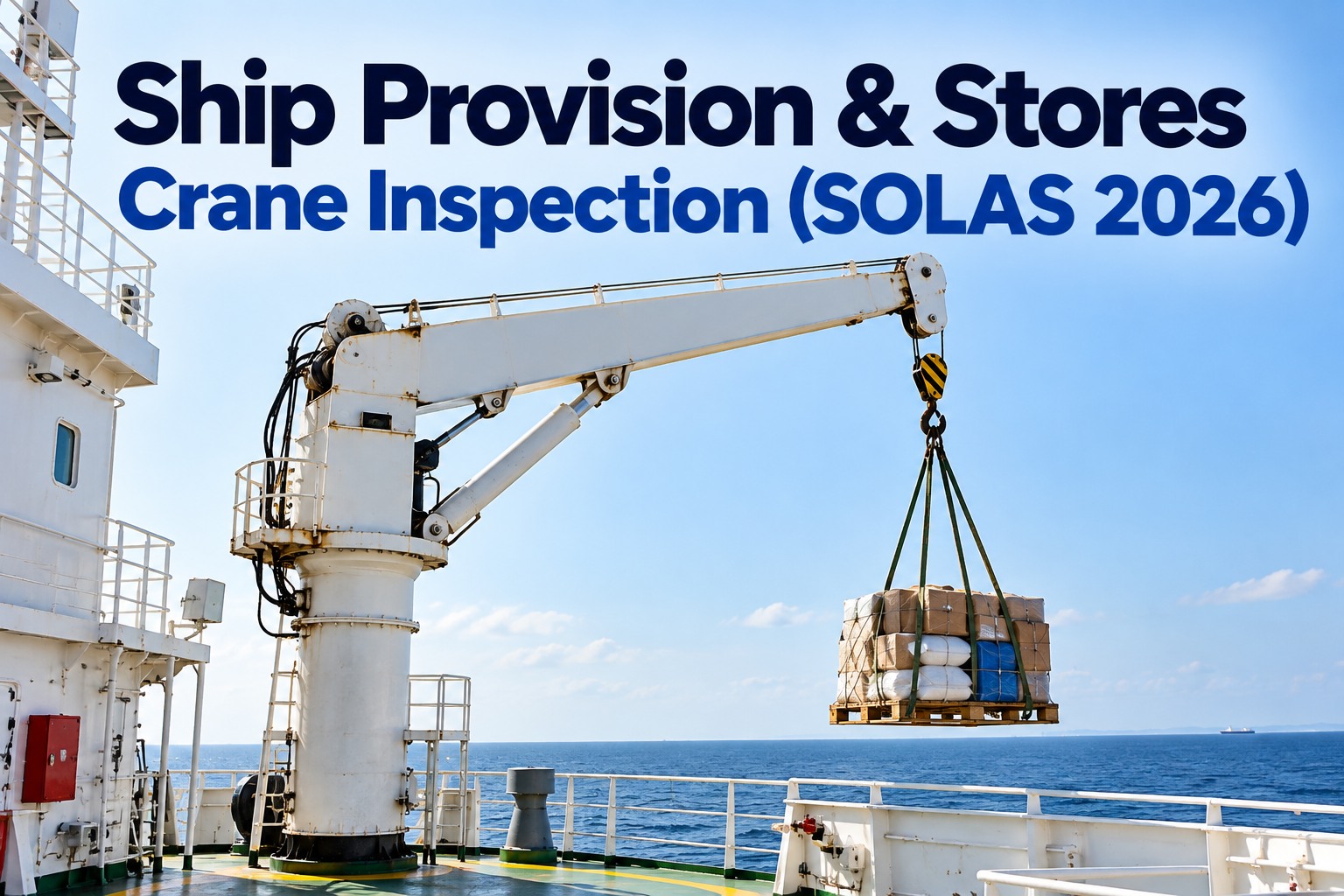
Onboard lifting appliances move from class rules into SOLAS, bringing design and construction to recognised standards, permanent safe working load marking with documentary evidence, load testing and thorough examination, manufacturer manuals, and a register kept on board. New appliances comply from installation; existing ones are tested and thoroughly examined by the first renewal survey on or after 1 January 2026. For most ships the work is not the cargo gear but the provision, stores and engine-room cranes that never had a certificate.
03
Oil fuel flashpoint and quality — SOLAS II-2/3.59–3.61, 4.2.1.6–4.2.1.9
Suppliers must provide a declaration before bunkering confirming the fuel meets the flashpoint requirement, and the bunker delivery note must either state the measured flashpoint or confirm it was measured at or above 70 °C. A separate amendment requires that oil fuel quality does not jeopardise the safety of the ship or the performance of the machinery. Both apply to all ships, including those built before 2012, so there is no construction-date exemption to fall back on.
Every deadline in the package
Two of these dates are fixed and three move with the ship. Mapping your own fleet against this is the fastest way to find out which vessels still have work outstanding. See how survey-linked deadlines are tracked per vessel rather than as a single fleet-wide date.
When each change bites
Survey-linked deadlines mean two sister ships can have different compliance dates. Work from each vessel’s own survey schedule, not from a fleet-wide assumption.
Run the 2026 package as a checklist, per ship
Each amendment as a check item against each vessel, with its own survey-linked due date, the evidence attached, and a fleet view showing which ships still have PFOS media on board or lifting appliances without a certificate.
Existing ships by first survey on or after 1 Jan 2026
Lifting appliances and anchor handling winches
SOLAS II-1/3-13 and II-1/2.30–2.33
All ships with onboard lifting appliances
New from installation; existing by first renewal survey on or after 1 Jan 2026
Oil fuel flashpoint declaration and BDN entry
SOLAS II-2/3.59–3.61, 4.2.1.6–4.2.1.8
All ships, including those built before 2012
In force 1 Jan 2026
Oil fuel quality
SOLAS II-2/4.2.1.9
All ships, including those built before 2012
In force 1 Jan 2026
Container loss reporting
SOLAS V/31.2 and V/32.3
All ships
In force 1 Jan 2026
Electronic inclinometer connected to the VDR
SOLAS V/2.8, 2.9, 18, 19.2.12
Containerships and bulk carriers of 3,000 GT and above
Ships constructed on or after 1 Jan 2026 only
Fire detection in control stations and cargo control rooms
SOLAS II-2/7.5.5
Cargo ships
Constructed on or after 1 Jan 2026
Ro-ro passenger ship vehicle space fire safety
SOLAS II-2/20 and related
Ro-ro passenger ships
New from 1 Jan 2026; existing ships by first survey on or after 1 Jan 2028
Polar Code navigation and voyage planning extended
SOLAS chapter XIV, Polar Code ch. 9-1 and 11-1
Fishing vessels 24 m and over, pleasure yachts 300 GT and over, cargo ships 300–500 GT in polar waters
New from 1 Jan 2026; existing by 1 Jan 2027
Lifeboat ventilation added to annual examination
Resolution MSC.402(96) as amended
Ships with lifeboats fitted with ventilation systems
Examinations on or after 1 Jan 2026
Life jacket in-water turning performance
LSA Code ch. II, 2.2.1.6.2
Life jackets newly provided
Provided on or after 1 Jan 2026
Survival craft lowering speed limits
LSA Code ch. VI, 6.1.2.8 and 6.1.2.10
Launching appliances
Installed on or after 1 Jan 2026
Totally enclosed lifeboat ventilation standard
LSA Code ch. IV, 4.6.6–4.6.7
Totally enclosed lifeboats
Lifeboats installed on or after 1 Jan 2029
Coating inspector qualification renamed
Performance Standards for Protective Coatings
Coating inspections
AMPP Certified Coating Inspector replaces NACE Level 2 from 1 Jan 2026
PFOS: the one with real work attached
This is the change most likely to produce a deficiency, because compliance is not a procedure or a drill — it is proving a negative about a liquid already sitting in a tank on your ship.
Find out what you actually have
Fixed deck foam systems, engine room foam, portable and wheeled extinguishers, and any drums in store. The prohibition covers use and storage, so a drum of old concentrate in a locker is a non-compliance even if nothing is connected to it.
Get a declaration from the manufacturer
A PFOS-free declaration should identify the foam type, production period and batch number, and reference the type approval or marine equipment certificate. Vague assurances that a product is modern or fluorine-free are not the same thing.
Test where the paperwork is missing
Where original documentation cannot be produced — common on older ships and after changes of management — sampling and laboratory analysis against a recognised standard is the fallback. Budget time for it rather than discovering the gap at the survey.
Dispose ashore, and keep the receipt
Non-compliant media goes to a reception facility. It is not used up in a drill, not discharged and not left on board pending a decision. The disposal evidence is part of demonstrating compliance.
Match the replacement to the system
Replacement foam needs the same mixing ratio and comparable viscosity, equivalent approvals, and a certificate explicitly confirming the absence of PFOS. A foam that meets the ban but not the system’s induction characteristics leaves you compliant and unprotected.
Flush the system properly
Residue in tanks and lines can carry contamination into the new charge. Follow the maker’s changeover procedure, and record what was done — a new certificate on a system that was never flushed is not a defensible position.
Electronic inclinometers: new ships only
This one is widely misread. The requirement for an electronic inclinometer, connected to the voyage data recorder, applies to containerships and bulk carriers of 3,000 gross tonnage and above — but only to ships constructed on or after 1 January 2026. There is no retrofit obligation on existing tonnage under this amendment. If you operate an older box ship or bulker, the correct answer to an auditor asking about it is that the regulation applies to ships constructed from 2026, not that the ship is overdue a fit.
Two things that catch people out on application dates
“First survey” is not a single date. Two identical ships in the same fleet can have compliance dates a year apart, because the deadline attaches to each vessel’s own survey schedule. A fleet-level tracker that shows one date for the whole fleet will quietly miss ships. “Constructed on or after” has a definition. For several of these amendments it turns on contract date, keel laying or delivery, and the IGF Code carries its own explicit definition tying the three together. Where a newbuilding sits close to the boundary, confirm which limb applies rather than assuming the keel date decides it.
Ro-ro passenger ships: a 2026 and 2028 split
New ships from 1 Jan 2026
Individual fixed fire detection with smoke and heat detectors throughout vehicle spaces, fixed water-based systems with water monitors on weather decks used for vehicles, video monitoring with seven days of storage and immediate playback, and specified opening and closure arrangements.
Existing ships by first survey on or after 1 Jan 2028
Water monitors on weather decks to existing capacity standards, enhanced fire detection in vehicle spaces with twenty-four hours of data storage, and video monitoring. Two years looks generous until you price a retrofit and find the yard slots.
What to do in 2026
Scope the retrofit now and get it into the docking plan. The ships that struggle in 2028 will be the ones that started scoping in 2027.
Life-saving appliance changes worth knowing
Lifeboat ventilation enters the annual examination. Where a lifeboat has a ventilation system, it is included in the annual thorough examination and operational test by the approved service supplier, from 2026. Check your service report covers it.
Life jackets must turn an unconscious wearer face-up. Applying to jackets newly provided from 1 January 2026, with both nose and mouth clear of the water. This affects procurement, not the jackets already on board.
Lowering speeds are now bounded at both ends. Minimum lowering speed capped at 1.0 m/s and maximum restricted to 1.3 m/s, for launching appliances installed on or after 1 January 2026.
Single fall and hook systems clarified. Systems without on-load release capability are exempt from the on-load provisions, and the hook must not be able to carry load unless reset — for release mechanisms installed from 2026.
Totally enclosed lifeboat ventilation from 2029. Powered or passive ventilation at 5 m³ per hour per person, preventing overheating and carbon dioxide build-up. It applies to lifeboats installed on or after 1 January 2029, so it is a procurement issue rather than a retrofit one.
What a safety officer should do this quarter
1
Establish each ship’s own deadline. Pull the survey schedule per vessel and write the PFOS and lifting appliance dates against each one. Stop thinking of this as a fleet date.
2
Inventory foam, everywhere it lives. Fixed systems, portables, wheeled units and store stock, with type, batch and the documentation you hold for each.
3
Chase declarations before you commission testing. Manufacturers can often supply a PFOS-free declaration quickly, and that is far cheaper than sampling and laboratory analysis.
4
Inventory every lifting appliance, including the forgotten ones. Provision and stores cranes, engine-room cranes and fixed lifting beams, with the SWL marking and the evidence behind it.
5
Find the pre-2026 certificates. Appliances holding valid certificates issued before 1 January 2026 under other instruments are accepted, so locate them before booking testing you may not need.
6
Brief the bunkering routine. The supplier’s pre-bunkering flashpoint declaration and the BDN entry are checked on receipt and filed, not chased afterwards.
7
Check the container loss reporting procedure exists. Reporting responsibilities for master, operator and Administration are defined; make sure the ship has the procedure rather than the intention.
8
Scope the ro-ro retrofit if it applies. 2028 arrives through a docking plan that is being written now.
Frequently asked questions
What changed in SOLAS on 1 January 2026?
The main items are the prohibition of fire-extinguishing media containing PFOS, new requirements for onboard lifting appliances and anchor handling winches under II-1/3-13, oil fuel flashpoint declaration and quality requirements, container loss reporting, electronic inclinometers on new containerships and bulk carriers of 3,000 GT and above, fire detection in control stations and cargo control rooms on new cargo ships, a ro-ro passenger ship fire safety package, extension of Polar Code requirements to certain non-SOLAS ships, and several LSA Code and IGF Code amendments.
Does the PFOS ban apply to ships already in service?
Yes. All ships must comply, with existing ships required to do so by the first survey on or after 1 January 2026. Both use and storage are prohibited, at a threshold of 10 mg/kg — 0.001 per cent by weight — and non-compliant media must be landed to a shore reception facility.
How do we prove our foam is PFOS-free?
With a declaration from the manufacturer identifying the foam type, production period and batch number and referencing the type approval or marine equipment certificate. Where that documentation is unavailable, sampling and laboratory testing against a recognised standard is the fallback, and disposal evidence for anything removed should be retained.
Do existing ships need an electronic inclinometer?
No. The requirement applies to containerships and bulk carriers of 3,000 GT and above constructed on or after 1 January 2026, and it includes connection to the voyage data recorder. Existing tonnage is not required to retrofit under this amendment.
Which lifting appliances are caught by II-1/3-13?
Onboard lifting appliances including cargo, engine-room, stores and hose-handling cranes, together with anchor handling winches. New appliances comply from installation; existing ones must be tested and thoroughly examined by the first renewal survey on or after 1 January 2026, with a register kept on board. Appliances below 1,000 kg safe working load may be treated differently at the Administration’s discretion.
What changed about bunkering?
Suppliers must provide a declaration before bunkering confirming the fuel meets the flashpoint requirement, and the bunker delivery note must state the measured flashpoint or confirm it was measured at or above 70 °C. A separate amendment requires that fuel quality does not jeopardise the safety of the ship or the performance of the machinery. Both apply to all ships regardless of construction date.
Why do sister ships have different deadlines?
Because several of these requirements attach to the first survey on or after 1 January 2026 rather than to the calendar date. Two identical vessels with survey windows months apart will have compliance dates months apart, which is why the package has to be tracked per ship.
When do the ro-ro passenger ship changes apply?
New ro-ro passenger ships constructed on or after 1 January 2026 must meet the full vehicle space fire safety package. Existing ships have retroactive requirements — water monitors on weather decks, enhanced vehicle space fire detection with twenty-four hours of data storage, and video monitoring — by the first survey on or after 1 January 2028.
Turn the 2026 package into per-ship due dates before the surveys arrive
Each amendment as a tracked item against each vessel, with survey-linked deadlines, the evidence attached at the point of inspection, and a fleet view of what is still outstanding.