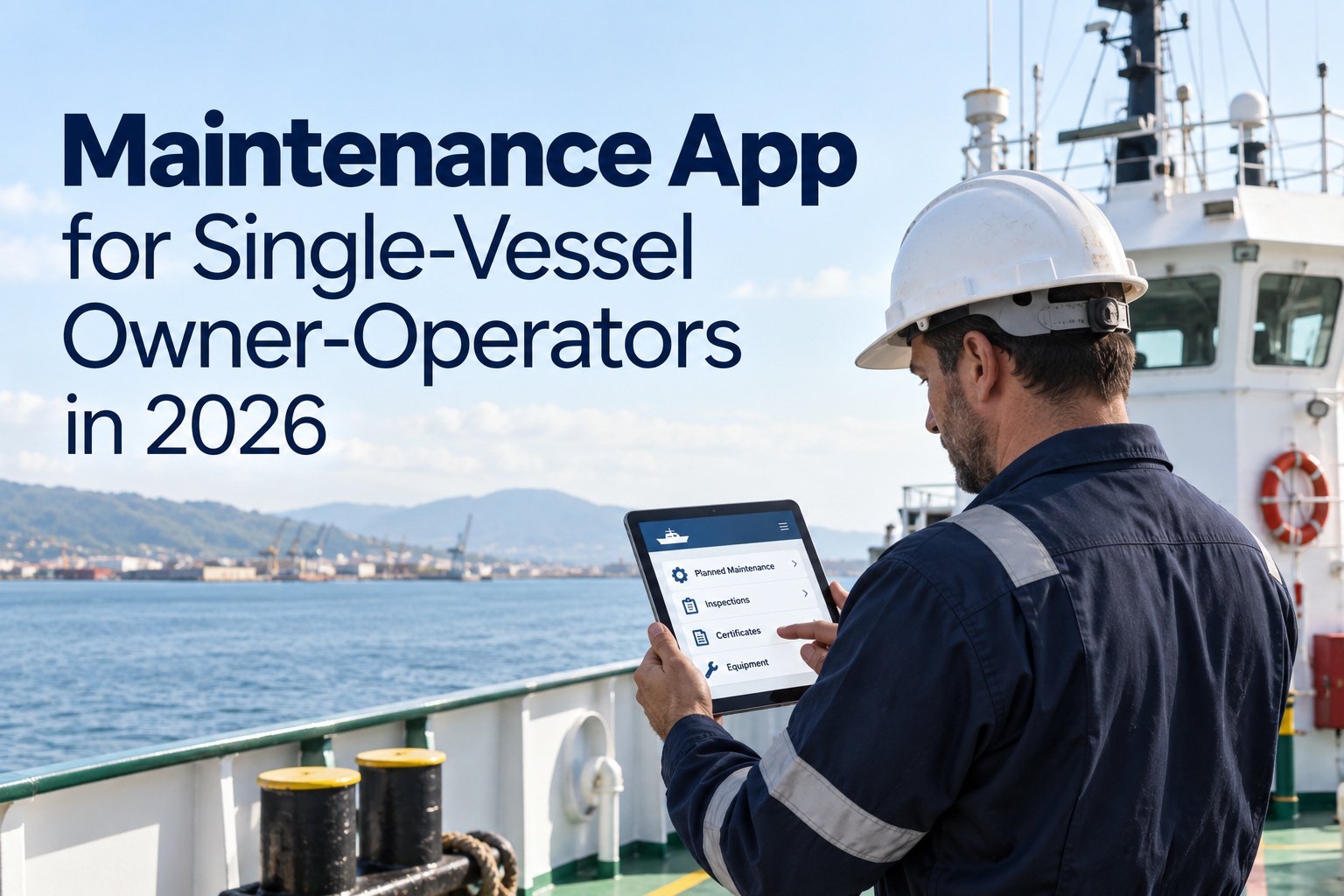
The ISM Code is built on a separation. Ship and shore. Master and company. A Designated Person Ashore with direct access to the highest level of management, existing precisely so that a safety concern can travel upward without passing through the people it might reflect on. For a single-vessel owner-operator, that separation collapses into one person. You are the company, the highest level of management, frequently the master, and in practice the designated person too — which means the mechanism the Code relies on to catch problems has nobody independent to perform it. That is not a criticism of owner-operators and it is not a compliance failure. It is a structural fact about running one ship, and it changes what a maintenance and inspection system is actually for. A fleet manager buys visibility. A small operator buys de-concentration of knowledge. An owner-operator buys something narrower and more useful: the second pair of eyes the regulatory framework assumes you have and you do not. A timestamped, attributed record made at the moment of work is the closest thing available to independent verification when there is no independent verifier. Start a free trial of Marine Inspection and see what that looks like on one vessel.
What the framework assumes
Company
Highest level of management
Designated Person Ashore
Master
What a single-vessel owner-operator has
One person
The Code's core mechanism — a route by which a concern reaches the top without being filtered by the people it concerns — has no independent participant to operate it. Nothing about that is illegitimate, and every well-run owner-operated vessel manages it somehow. What it does mean is that the checks a larger organisation gets from having several people have to come from somewhere else, and a contemporaneous record is the most practical substitute available.
First: Establish Which Side of 500 GT You Are On
The regulatory position for one vessel is decided by a small number of facts, and a surprising number of owner-operators are unsure which set applies to them. Book a Marine Inspection demo once you know, because it determines what the system needs to hold.
500 GT and above
The ISM Code applies mandatorily through SOLAS Chapter IX to all passenger ships and cargo ships of 500 gross tonnage and above on international voyages. That means a documented safety management system, a Document of Compliance issued to the company, a Safety Management Certificate issued to the vessel, and a designated person — with the two certificates dependent on one another.
Below 500 GT
ISM is not mandatory under SOLAS — and that is almost never the end of the answer. The flag ecosystem has filled the gap: most flags require a scaled-down safety management system proportionate to the size and mode of operation, frequently referred to as a mini-ISM, with the expected rigour increasing with tonnage. So the practical question is not whether you need a system but which one your flag expects.
Commercial or private
Commercial operation changes the position considerably. Security requirements under the ISPS Code apply to commercial vessels above the threshold and not to those below it or to privately operated ones, and privately registered vessels below 500 GT are generally outside the mandatory ISM scope — though some administrations encourage voluntary compliance.
The excluded categories
Domestic implementing regulations typically carve out government ships on non-commercial service, fishing vessels and pleasure vessels from the ISM requirements — and exemptions can be granted by the administration in defined circumstances. If you believe you fall into one of these, confirm it in writing with your flag rather than inferring it, because the categories are narrower than they sound.
The reason this matters for a software decision is straightforward. Above the threshold you need a system that produces auditable evidence against a documented management system with defined certificate and survey cycles. Below it you need something proportionate — the same underlying records of what was maintained and when, at a scale your flag considers appropriate. In both cases the records are the same records. What changes is how formally they have to be presented.
The Designated Person Problem, and Its Answer
This is the question owner-operators ask most often and find least clearly answered, and there is a practical resolution that many are unaware of. Sign up for Marine Inspection and keep the evidence that whoever holds the role can actually work from.
The structural difficulty
The designated person is the keystone of the ISM Code — a direct link between the ship and the highest level of management. When you are the ship, the company and the highest level of management, that link connects a person to themselves.
The same question arises for the security officer role in a one-ship company where the master is the owner-operator, and it is a recognised issue rather than an unusual one. It is asked frequently enough to appear in flag and industry guidance.
The role can be outsourced
The designated person function is one that can be performed by somebody outside the company, and the same arrangement is contemplated for the security officer role — a company may, for reasons including small size, appoint a person who is not a company employee, such as an agency, to act on its behalf.
Which restores the separation
An external designated person gives you the independent view the Code is designed around, at a cost far below a shore-side employee. It also gives you somebody to call when a decision is genuinely difficult, which for an owner-operator is worth more than the compliance benefit.
But they need something to look at
An external designated person reviewing your vessel from a distance can only work from what is recorded. If the maintenance history lives in a notebook aboard and the certificate dates live in your head, the arrangement is nominal. If both are in a system they can open, it functions as intended.
One vessel means one hundred percent concentration
A ten-ship operator losing a vessel to detention loses a tenth of its capacity and keeps trading. An owner-operator loses everything for the duration — the revenue, the charter position, the schedule and frequently the relationship. Every argument about prevention that applies to a fleet applies to you with the diversification removed, which is why the certificate expiry nobody was tracking and the finding from the last inspection nobody closed are not administrative details at this scale. They are the whole business, briefly.
What a Record Substitutes For
In a larger organisation, four different mechanisms produce assurance. An owner-operator has none of them, and a well-made record covers three. Schedule a walkthrough and judge it against what it is genuinely replacing.
Instead of
A colleague checking the work
A record made at the machine with a measured value against a stated criterion, a photograph and a timestamp, is not the same as a second person looking — but it is reviewable later by you, by an external designated person, by a surveyor, or by the buyer's superintendent in five years. Independent review deferred is better than independent review absent.
Instead of
A shore office tracking dates
Certificate expiries, survey windows and class conditions escalating automatically before they matter. This is the mechanical part of what a technical department does, it requires no judgement, and it is the single highest-value function for an owner-operator because the consequences of missing it are disproportionate.
Instead of
Institutional memory
What was done to that unit last time, what the surveyor said, why something was deferred and what it was waiting on. On one vessel this all lives in one person's recollection, which works until it is needed by somebody else — a relief master, a buyer, an insurer, or you in three years having forgotten.
It does not replace
Judgement, or a second opinion in the moment
Worth stating plainly. No system tells you whether that bearing will last another voyage, and none substitutes for a colleague who would have said something. That is what an external designated person, a good class surveyor relationship and a trusted engineer ashore are for, and a record makes each of those relationships considerably more useful than they would otherwise be.
What One Vessel Actually Needs to Hold
Kept deliberately short. Everything on this list serves either a hard deadline or the memory problem; nothing else has earned a place at this scale. Start a free trial and load these before deciding anything.
Table 1: The Single-Vessel Record
Two days
That is a realistic total for setting up one vessel properly — an afternoon on certificates, a day on the equipment register, half a day on planned maintenance intervals and an hour on checklists. After that it runs on the work you were already doing, recorded where you were already standing.
The Sale You Have Not Thought About Yet
An owner-operator's vessel is usually their largest asset, and the record you keep from today determines what it is worth on a day you have not chosen. Book a walkthrough and start the history now, because it cannot be created retrospectively.
How a vessel is bought
A buyer's superintendent typically spends two or three days aboard while the vessel works, rarely with a drydock and rarely with a second visit, and produces the report on which a substantial sum is committed. Records are the richest evidence they have about the vessel's real history, and reviewing them is a core part of the exercise.
What a buyer cannot verify
They price. Anything they cannot check becomes a discount in the offer rather than a risk they accept, which means the seller pays for a thin record in the sale price rather than the buyer absorbing it in the contract.
The property that carries value
Contemporaneity. An experienced superintendent can tell the difference between a history built at the machine over years and one assembled in the weeks before a sale — completions clustered on a few dates, values that repeat, condition notes with no numbers in them. Only the first version helps you.
Which is why the timing matters
A maintenance record is the one asset improvement you cannot make in a hurry. Everything else about presenting a vessel for sale can be done in the months beforehand; a five-year history cannot. Starting one on an ordinary Tuesday, with no sale in prospect, is the version that is worth something later.
Choosing Something at This Scale
The commercial terms matter more here than any feature, because there is nobody to absorb a bad decision and no procurement process to catch one. Start a free trial and settle these before committing.
Table 2: What to Establish Before You Commit
IMPORTANT: CONFIRM YOUR OWN POSITION
Regulatory applicability for a single vessel depends on tonnage, voyage type, commercial or private operation, vessel category and your flag administration's own requirements, and this page describes general principles rather than your obligations. The 500 gross tonnage threshold, the exclusion of certain categories including government non-commercial, fishing and pleasure vessels, and the availability of administrative exemptions all appear in implementing regulations that differ between jurisdictions. Below the threshold, most flags require a scaled-down safety management system proportionate to size and mode of operation, and what that means in practice is a question for your administration. Confirm your position in writing with your flag rather than inferring it from any summary including this one. The designated person function can be performed externally, and comparable arrangements are contemplated for the security officer role in small companies — but the terms on which your flag accepts such an appointment should be established directly. Nothing here is legal advice.
Frequently Asked Questions
Does the ISM Code apply to a single-vessel owner-operator?
It depends principally on tonnage, voyage type and how the vessel is operated. The Code applies mandatorily through SOLAS Chapter IX to all passenger ships and cargo ships of 500 gross tonnage and above on international voyages. Below that threshold it is not mandatory under SOLAS — but that is rarely the end of the answer, because most flags require a scaled-down safety management system proportionate to the size and mode of operation, with rigour increasing with tonnage. Implementing regulations also typically exclude certain categories including government non-commercial ships, fishing vessels and pleasure vessels, and administrations can grant exemptions. Establish your own position in writing with your flag.
Who is the designated person if I am the owner and the master?
This is a genuine structural problem and it has a practical answer. The designated person is the keystone of the Code — a direct link between the ship and the highest level of management — and when one individual is the ship, the company and the management, that link connects a person to themselves. The function can be performed externally, and a comparable arrangement is contemplated for the security officer role, where a company may for reasons including small size appoint someone who is not an employee, such as an agency, to act on its behalf. An external appointment restores the independence the Code assumes, at far below the cost of a shore employee — but they can only work from what is recorded.
What is a system actually for when I already know my vessel?
Three things, and it is worth being precise because the usual sales pitch does not fit one ship. It escalates hard deadlines — certificates, surveys, class conditions — which is mechanical work requiring no judgement and carrying disproportionate consequences if missed. It holds institutional memory that currently exists only in your recollection, which matters the moment somebody else needs it: a relief master, an insurer, a buyer, or you in three years. And it produces a reviewable record where there is no colleague to review the work as it happens. It does not replace judgement or a second opinion in the moment, and no honest description should claim it does.
Why does concentration matter so much at one vessel?
Because there is no diversification. A ten-ship operator losing a vessel to detention loses a tenth of its capacity and continues trading; an owner-operator loses everything for the duration — revenue, charter position, schedule and frequently the commercial relationship. Every prevention argument that applies to a fleet applies to you with the buffer removed. That is why the certificate nobody was tracking and the finding from the last inspection nobody closed are not administrative details at this scale but the whole business, briefly. The mechanical, deadline-driven part of compliance is where a system earns its cost fastest here.
How long does it take to set up one vessel?
Realistically about two days of work, spread across whenever you have time. An afternoon to load certificates and survey windows from the folder you already keep. A day to build the equipment register at component level, which only has to be done once and is what everything else attaches to. Half a day on planned maintenance intervals if the maker documentation is to hand. An hour to turn the checks you already do informally into checklists. After that it runs on the work you were doing anyway, recorded where you were already standing rather than written up afterwards.
Does the record matter if I never sell the vessel?
Yes, and it matters most on the day you decide you might. A buyer's superintendent typically has two or three days aboard while the vessel works, rarely with a drydock, and the records are the richest evidence available about the ship's real history. Anything they cannot verify is priced as a discount rather than accepted as a risk, so a thin record is paid for by the seller. The property that carries the value is contemporaneity — an experienced superintendent can distinguish a history built at the machine over years from one assembled in the weeks before a sale, and only the first helps. It is the one asset improvement you cannot make in a hurry.
One ship
You are the company, the management, the master and the memory
Build the Second Pair of Eyes You Do Not Have
Establish which side of the threshold you are on and what your flag actually expects. Consider an external designated person, since the role can be held outside the company and it restores the independence the framework assumes. Then hold the nine things that matter — certificates and survey windows escalating before they bite, a component-level equipment register, planned intervals, completions with measured values, defects closed with evidence, rounds recorded with dates and names, deferrals with reasons, crew certificate expiries, and photographs taken at the item. Two days to set up, on a phone, offline, with your data exportable at no charge. On one vessel that is not an enterprise platform. It is the record that carries the deadlines, the memory and eventually the value of the asset.