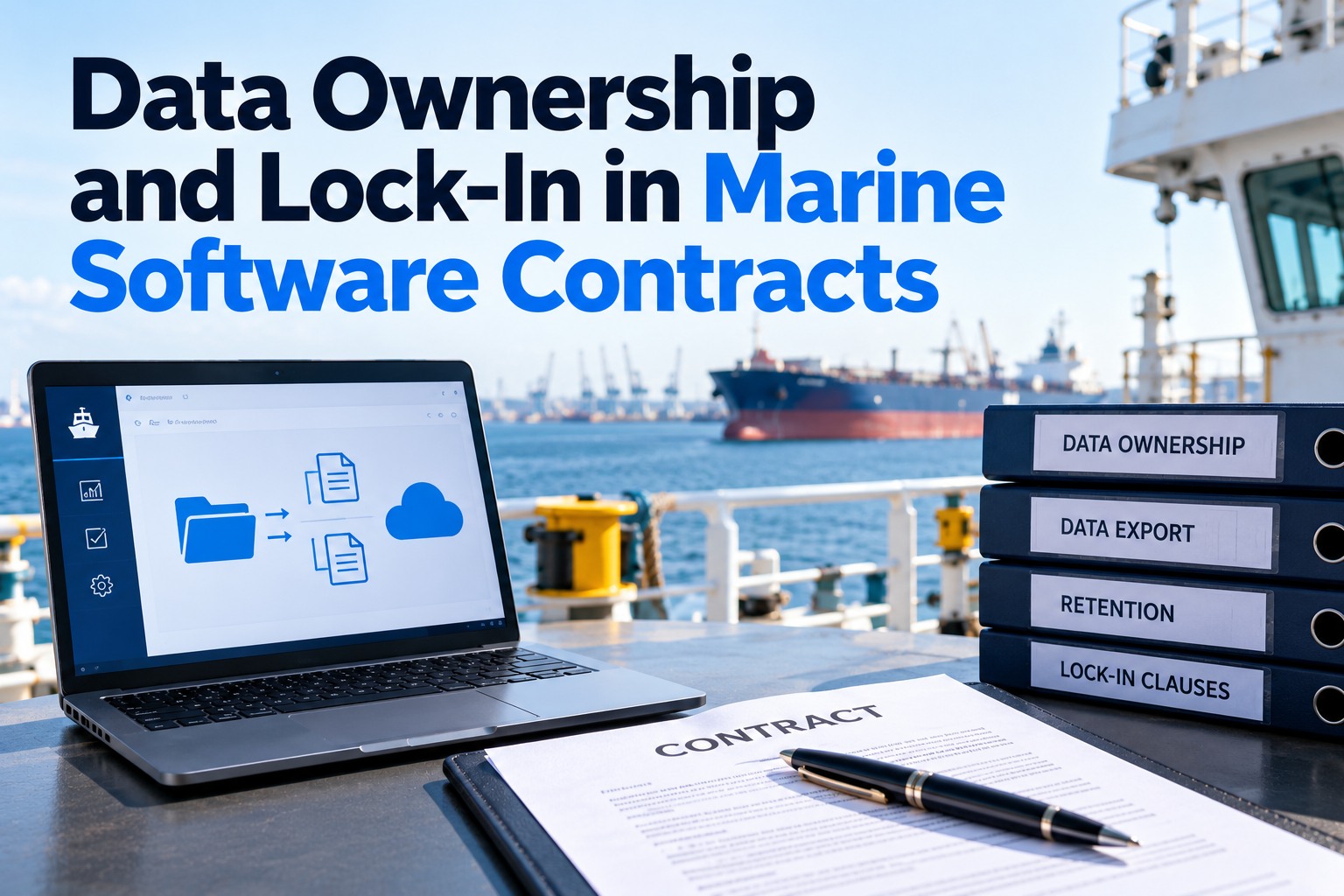
Years of inspection history, findings, photos and sign-offs pile up in your fleet software, and the contract decides whether you can take them with you. This guide covers the clauses on ownership, export, retention and exit that shipowners should read before signing, and the 2025 EU rules that changed the starting point. Book a demo and ask us for our exit terms.
Data ownership and lock-in in marine software contracts: if you left tomorrow, what would you get back?
Run this test on any vendor. Every “no” is a lock-in risk you are about to sign.
What data ownership in software contracts should cover
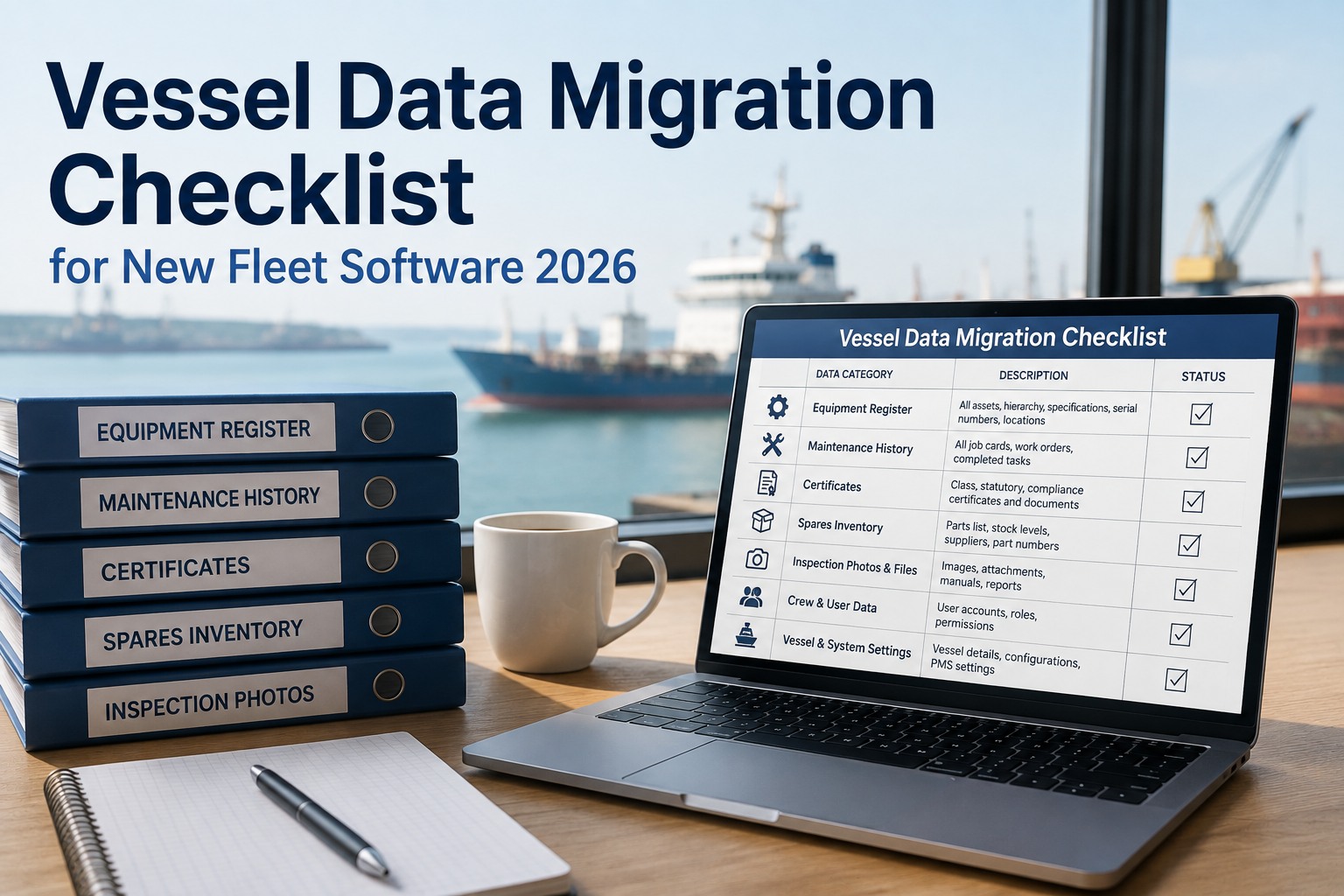
“You own your data” means little if the contract only defines data as the form answers. Your inspection history is several layers, and each one needs to be named as yours and able to be exported. Our vessel data migration checklist shows how these layers move between systems. Try the platform free.
| Data layer | Why you need it after you leave | Export format to ask for |
|---|---|---|
| Inspection records | Proof of what was inspected, when and by whom, for audits, vetting and claims | CSV or JSON, plus PDF reports |
| Findings and actions | Open items must carry on in the new system without being lost | CSV or JSON with status, owner and dates |
| Photos and attachments | Evidence behind each finding; often the biggest share of the data | Original files in folders, with a file that links each one to its record |
| Signatures and audit trail | Shows a signed record was not changed afterwards | CSV or JSON log with user, time and change |
| Checklists and templates | Your team’s work; rebuilding them costs weeks | Structured file of questions and logic |
| Users, roles and vessels | Speeds up setting up the next system | CSV |
Also ask whether the vendor may use your data, even anonymised, to train models or build benchmarks, and whether that right ends when you leave.
How vendor lock-in in shipping software builds up
Lock-in is rarely one clause. It is a set of small terms that together make leaving slow, costly or incomplete. The further down this ladder a contract goes, the harder the exit.
Data export clause: weak wording versus stronger wording
The examples below are illustrative wording to compare, not legal advice; have your own counsel draft the final terms. Use them to spot where a draft leaves room for lock-in. For where these terms fit in a tender, see our fleet software RFP template. Review our terms in a demo.
“Customer retains rights in data it uploads.”
“Customer owns all data entered, generated or uploaded through the service, including attachments, audit logs and templates.”
“Provider may use data to improve its services.”
“Provider uses data only to deliver the service. Any other use needs Customer’s written consent.”
“Data will be provided on reasonable request.”
“Customer may export all data at any time, self-service, in CSV or JSON, with original attachments.”
“Access ends on termination.”
“Read and export access continues for at least 30 days after the transition period ends.”
“Exit help at Provider’s current rates.”
“Export is free. Any exit help is priced in the order form.”
“Data is removed in line with Provider policy.”
“After retrieval, Provider erases all copies, including backups on their normal cycle, and confirms in writing.”
See the exit before you see the entry
In the demo we show the export, explain what you keep, and put the exit terms in writing before you commit a single vessel.
SaaS contract terms under the EU Data Act
Since 12 September 2025, the EU Data Act sets switching rules for cloud and data processing services, and they apply to existing contracts as well as new ones. If you or your vendor operate in the EU, these are now the floor, not something to negotiate. Check how they apply to your own contract with counsel.
Exit strategy for software: match retrieval to record retention
A 30-day retrieval window is short next to your record-keeping duties. Many records must be kept for years, so the exit plan has to move them into an archive you control, not leave them with the old vendor. If inspection software holds evidence for these records, the same applies to that evidence.
Minimum periods from the last entry. Flag states and company policy may require longer; check your own SMS.
Exit checklist for fleet software contracts
Tick these off before signing and once a year after. Our guide on switching marine inspection software safely covers the move itself.
Before you sign
Every year after
Questions for a fleet software vendor about lock-in
Ask these in the sales stage, when the vendor most wants to answer. Get the answers in writing. Our security due diligence checklist covers the security side of the same review.
Can I export everything myself today, without asking you?
Good answer: yes, here is the export screenDo photos come out as original files, linked to findings?
Good answer: yes, with a file that maps each oneWhat does leaving cost, and is it in the contract?
Good answer: export is free; any help is priced nowHow long can I reach my data after the contract ends?
Good answer: a stated number of days, in writingDo you use our data for anything beyond running the service?
Good answer: no, not without written consentCan I take my checklists and templates with me?
Good answer: yes, in a structured fileHow Marine Inspection approaches data ownership
Your inspection history belongs to you, and we would rather earn renewals than make leaving hard. In the demo we walk through each item on the manifest below, show the export, and confirm the exit terms in writing.
Data ownership and vendor lock-in FAQs
Who owns inspection data in marine software?
Whoever the contract says. Many contracts name the customer, but check that the definition covers attachments, audit logs and templates, not only form answers.
What is a data export clause?
A contract term that sets what data you can take out, in what format, how often and at what cost, both during the contract and after it ends.
Does the EU Data Act apply to my fleet software contract?
It covers cloud and data processing services offered in the EU, including existing contracts since 12 September 2025. Services used only for a limited test period are excluded. Confirm your case with counsel.
How long should the data retrieval window be?
At least 30 days after the transition, which is the EU Data Act minimum. Longer is better, but the real safeguard is exporting to your own archive before you leave.
Is a PDF export enough?
No. PDFs prove what a report said, but you cannot trend findings or move open actions from them. Ask for structured data as well.
How do we test the exit before signing?
During the trial, export everything, open it outside the vendor’s system, and check that record and photo counts match what you entered.
Sign the contract with the exit already planned
See the export, read the terms, and know what you keep before your inspection history moves in.