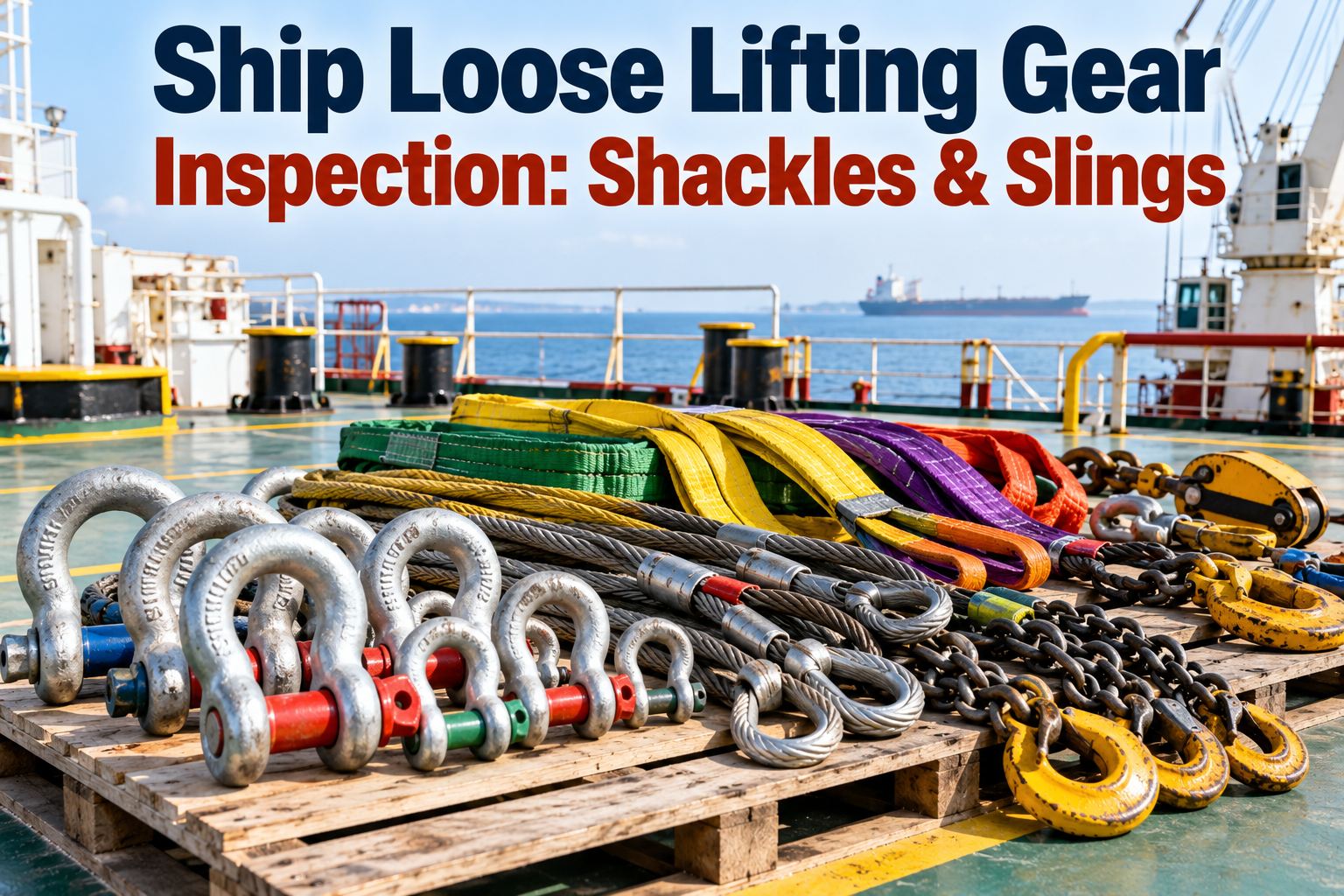
Shackles, slings, hooks and blocks are the smallest items on a ship's deck and the ones most often found worn, unmarked or out of date. They are also the gear that carries a load at every cargo, stores and maintenance lift. From 1 January 2026, SOLAS adds a new lifting appliance regulation on top of the older ILO-based practice. This guide sets out what the rules say, how to inspect each item and how to keep the register that proves it.
Every Shackle, Sling and Hook Marked, Examined and on the Register
SWL marking, colour coding, defect checks and the lifting gear register for ship loose gear, in line with the 2026 SOLAS lifting appliance rules.
Free trial available. Or book a walkthrough built around your own lifting gear records.
1 Jan 2026
SOLAS II-1/3-13 in force
Lifting appliances and associated loose gear, per Bureau Veritas.
12 months
Thorough examination
At least once every 12 months, per the ILO register.
4 × SWL
Single-sheave block test load
Per ILO Form No. 3.
2 × SWL
Shackle, hook, chain test load
For SWL up to 25 tonnes, per ILO Form No. 3.
What the Rules Say: SOLAS II-1/3-13, MSC.1/Circ.1663 and the ILO Register
What changed on 1 January 2026 for lifting appliances and their loose gear
Bureau Veritas reports that SOLAS Regulation II-1/3-13 on lifting appliances entered into force on 1 January 2026 and applies to appliances on ships certified under SOLAS, with exceptions such as mobile offshore drilling units. It covers cargo, stores, engine-room and personnel lifting appliances, and refers to lifting appliances and their associated loose gear. Loose gear must be designed to acceptable requirements and proof tested, with retesting after major repairs or alterations. The supporting guidelines are MSC.1/Circ.1663.
Which route existing ships follow: valid earlier certificates or a new test by the first renewal survey
For existing appliances, Bureau Veritas says a load test and thorough examination per MSC.1/Circ.1663, SWL marking and documentary evidence of SWL are due no later than the first renewal survey on or after 1 January 2026. Appliances with valid certificates issued before that date under another international instrument, such as ILO Convention 152, by the Administration or an acceptable competent person, are regarded as compliant. The flow below shows both routes.
SOLAS II-1/3-13 for Existing Ships: Which Route Applies to Your Lifting Appliances? (Bureau Veritas Summary)
Do the appliances have a valid test and thorough examination certificate issued before 1 January 2026 by the Administration or an acceptable competent person, for example under ILO Convention 152?
YES
Regarded as compliant, according to Bureau Veritas. Keep the certificates in the register.
NO
The company nominates the SWL to the Administration's satisfaction. That SWL sets the minimum test load. Load test and thorough examination per MSC.1/Circ.1663 by the first renewal survey on or after 1 January 2026.
Source: Bureau Veritas on SOLAS II-1/3-13 and MSC.1/Circ.1663. A class society summary: confirm against your flag state, which may set its own instructions. BV also notes flags decide how far rules apply to appliances below 1,000 kg SWL.
Why the older ILO register still shapes how ships keep their records
The ILO register of lifting appliances and loose gear is the older international model that many flag states follow. It sets out the register, the certificate forms and the 12-month thorough examination. It is a useful template even where your flag state has its own form, because it shows what an inspector expects to see. For the lifeboat side of lifting gear, see our lifeboat and life raft maintenance: annual servicing and inspection guide.
SWL Marking, Identification and Colour Coding: Making Every Item Traceable
Why every shackle and sling needs a mark that links it to a certificate
UK P&I Club Technical Bulletin 40 says shackles should be marked and stamped with the SWL, that manufactured shackles are batch tested and issued with a certificate of test, and that slings and lifting eyes also need clear marking. The ILO Form No. 3 records the distinguishing number or mark of each item. Together these mean an item can be matched to its certificate, which is what a surveyor will ask for.
How a colour-coding scheme shows at a glance which gear has been checked this period
The same bulletin suggests colour coding and notes that the offshore industry is ahead of merchant shipping on this. We did not find a single mandatory marine scheme, so the point is consistency: pick a scheme, write it in your procedure and use it on every item. The example below is ours, built around quarterly checks.
An Example Colour-Coding Scheme for Periodic Checks (Our Illustration, Not a Mandatory Standard)
Q1 colourChecked Jan to Mar
Q2 colourChecked Apr to Jun
Q3 colourChecked Jul to Sep
Q4 colourChecked Oct to Dec
UK P&I Club Technical Bulletin 40 suggests colour coding for slings and lifting eyes and notes the offshore industry is ahead of merchant shipping. We did not find a single mandatory marine colour scheme, so choose one, write it in your procedure and use it everywhere on the ship. The quarterly example is ours.
Put Every Item of Loose Gear on One Register
Track marks, SWL, certificates, examination dates and defects for every shackle, sling, hook and block, with photo evidence.
Free trial available. Or book a walkthrough built around your own lifting gear records.
Inspecting Shackles, Slings, Hooks and Blocks: What to Look For
What each item can show you when you handle it, and where to find the numerical limits
The P&I Club bulletin gives examples, not discard standards. For slings it cites frayed or broken strands as a sign the item is generally unfit for use, and for hooks it shows a broken spring-loaded retaining tongue as a safety-relevant defect. Numerical limits, such as wear on chain links or the number of broken wires in a rope, come from the manufacturer's instructions and the standards that apply to the item. Keep those instructions with the register.
Four Types of Loose Gear and What to Look For on Each (Our Simplified Icons)
SHACKLE
Pin, body and marking
Is the SWL stamped and legible? Is the pin the right one for the body, straight and fully seated? Look for bending, opening of the body, wear and corrosion pitting.
SLING
Rope, chain or webbing
Frayed or broken strands are a sign the sling is generally unfit for use (UK P&I Club). Check the tag or marking, eyes, terminations and any kinks, cuts or heat damage.
HOOK
Hook, latch and body
A broken spring-loaded retaining tongue is a safety-relevant defect (UK P&I Club). Check throat opening, wear, cracks, deformation and that the latch closes.
BLOCK
Sheave, pin and cheek plates
Check that the sheave turns freely, the pin and cheek plates are sound, the body is not cracked and the SWL and identification are legible. Our summary.
Shackle marking and sling and hook defects are from UK P&I Club Technical Bulletin 40. Block checks are our summary. Numerical discard limits (wear percentages, broken wire counts) come from the manufacturer's instructions and the applicable standards, which we did not reproduce.
How test load multiples differ between blocks, shackles, hooks, chains and wire rope
ILO Form No. 3 shows test loads of 4 times the SWL for single-sheave blocks and 2 times the SWL for chains, hooks, rings, shackles and swivels with SWL up to 25 tonnes. Wire rope is tested by sample to destruction, and the SWL is derived from the break load and a utilisation coefficient. These are test loads applied at manufacture or after repair, not loads to apply on board.
Proof Test Load by Item of Loose Gear (Multiple of Safe Working Load, ILO Form No. 3)
Single-sheave blocks
4 × SWL
Chains, hooks, rings, shackles and swivels (SWL up to 25 tonnes)
2 × SWL
Source: ILO register of lifting appliances and loose gear, Form No. 3. Wire rope is handled differently: Form No. 4 says it is tested by sample to destruction, with the SWL derived from the break load and a utilisation coefficient. Check your flag state and the certificate that came with the gear.
The Inspection Routine: Before Use, Annual, After Repair and Five-Yearly
Who looks at the gear, how often and what must be written down each time
The ILO register separates the regular inspection by a responsible person from the thorough examination by a competent person. The responsible person is appointed by the Master or gear owner and has enough knowledge and experience to inspect. The competent person has the knowledge and experience for thorough examinations and tests and is acceptable to the competent authority. The ladder shows each level.
The Inspection Ladder: Who Looks at Loose Gear, When and What Gets Written Down
BEFORE EACH USE
Responsible person, visual checkAppointed by the Master or gear owner. ILO says entries in Part II are required only when a defect is found.
AT LEAST EVERY 12 MONTHS
Competent person, thorough examinationAll lifting appliances and loose gear. Recorded in Part I of the register with certificate numbers.
AFTER REPAIR OR ALTERATION
Competent person, retest and examinationAfter substantial alteration, renewal or repair of a stress-bearing part.
AT LEAST EVERY 5 YEARS
Lifting appliances: retest and examinationThe five-year retest is stated for lifting appliances in the ILO register.
Source: ILO register of lifting appliances and loose gear (Form No. 1 notes). The ILO text is the older international basis and many flag states build on it. SOLAS II-1/3-13 now adds its own requirements, and MSC.1/Circ.1663 covers inspection, maintenance and testing.
How the thorough examination, any heat treatment and any repair go into the register
The ILO register records initial, 12-monthly, five-yearly, repair and heat-treatment examinations in Part I, with the competent person recording heat treatment. After substantial alteration, renewal or repair of a stress-bearing part, the item is retested and examined. Wrought iron is excluded from new loose gear. Where your own flag state or class gives different instructions, those apply.
The Lifting Gear Register: What to Keep and What the Surveyor Will Ask For
How the register, certificates and test forms fit together as one evidence trail
A register works when each item can be traced from certificate to examination to current condition. The map below shows the parts: the two register parts, the loose gear certificate and the wire rope certificate. Under SOLAS II-1/3-13, Bureau Veritas says the Register of Ship's Lifting Appliances and Cargo Handling Gear must be kept on board and that the Certificate of Test and Thorough Examination follows the format of Appendix 1 of MSC.1/Circ.1663.
The Paperwork Map: Which Document Proves What
REGISTER, PART I
Thorough examinations of lifting appliances and loose gear: certificate numbers, examination done, certification statement, remarks. Initial, 12-monthly, five-yearly, repair and heat-treatment entries.
REGISTER, PART II
Regular inspections of loose gear: the gear, the responsible person's signature and date, and remarks.
LOOSE GEAR CERTIFICATE (FORM NO. 3)
Distinguishing number or mark, description, number tested, test date, test load, SWL, maker or supplier and examiner.
WIRE ROPE CERTIFICATE (FORM NO. 4)
Sample tested to destruction. SWL from break load and utilisation coefficient.
Structure from the ILO register of lifting appliances and loose gear. Under SOLAS II-1/3-13, Bureau Veritas says a Register of Ship's Lifting Appliances and Cargo Handling Gear must be kept on board, with the Certificate of Test and Thorough Examination in the format of Appendix 1 of MSC.1/Circ.1663. The ILO register says to preserve it for at least five years after the last entry.
A loose gear checklist that gives each item a checkpoint type and a clear next action
Use the checklist below as a base for your own, then add the flag state's and the manufacturer's requirements. Each line has a checkpoint type, so it is clear whether the check is visual, a test or a record. For the wider LSA picture, see our SOLAS life-saving appliances Chapter III requirements and inspection guide.
Loose gear inspection checklist with a checkpoint type on every item (our suggested template)| Item | What to check | Checkpoint type |
|---|
| Identification | Each item has a unique mark that matches the register entry | Visual |
| SWL marking | SWL is stamped or tagged and legible | Visual |
| Certificate | Test certificate for the item is on board and filed | Record |
| Condition | No bending, cracks, wear, corrosion, cuts, kinks or broken strands | Visual |
| Function | Pins seat fully, latches close, sheaves turn freely | Test |
| Colour code | Marking shows the current check period | Visual |
| Defective gear | Tagged out and removed from use, with a record of why | Record |
| Register | Examination dates and next due date entered | Record |
Our suggested template, built on the sources above. Adapt it to your flag state, class and planned maintenance system.
Mistakes That Leave Loose Gear Compliant on Paper and Unsafe on Deck
Six habits that surveyors and investigators find with shackles, slings and hooks
1
Gear without identification
If an item has no unique mark, nobody can link it to its certificate or inspection record.
2
SWL marking worn away
A shackle or sling whose SWL cannot be read should not be used. Re-mark through the proper route or remove it.
3
Entries only when something fails
The ILO register needs Part II entries when a defect is found, but a clean record of checks helps you prove the routine ran. Log both.
4
Old certificates assumed to be enough
For appliances, SOLAS II-1/3-13 adds timing and documentation from 2026. Check which route your ship is on.
5
Mixing gear from different sources
Items from different suppliers may have different marking and certificate formats. Bring them into one register.
6
No clear owner
A responsible person should be appointed by the Master or owner, with enough knowledge and experience to inspect.
Systems That Keep the Gear Register, Certificates and Defects in One Place
How a dated photo repository, task ownership and deadlines keep loose gear under control
A loose gear register is a list of small items with many dates. Marine Inspection supports a dated photo repository, observations turned into tasks with owners, deadlines and evidence, and certificate and equipment tracking. A dated photo of an item's marking and condition, attached to the register entry, is evidence that stands up to a surveyor's question.
Frequently Asked Questions About Ship Loose Lifting Gear Inspection
Does SOLAS now require a lifting gear register?
Bureau Veritas says SOLAS II-1/3-13 entered into force on 1 January 2026 and requires a Register of Ship's Lifting Appliances and Cargo Handling Gear to be kept on board, with the Certificate of Test and Thorough Examination in the format of Appendix 1 of MSC.1/Circ.1663. Confirm the details with your flag state and class.
Does the new rule cover shackles and slings?
Bureau Veritas describes the regulation as covering lifting appliances and their associated loose gear, saying loose gear must be designed to acceptable requirements and proof tested, with retesting after major repairs or alterations. How far it reaches for small gear depends on your flag, so check.
How often must loose gear be thoroughly examined?
The ILO register says all lifting appliances and loose gear must be thoroughly examined by a competent person at least once in every 12 months, and retested and examined after substantial alteration, renewal or repair of a stress-bearing part.
What load are shackles and hooks tested at?
ILO Form No. 3 shows 2 times the SWL for chains, hooks, rings, shackles and swivels with SWL up to 25 tonnes, and 4 times the SWL for single-sheave blocks. Wire rope is tested by sample to destruction.
Who may inspect loose gear?
A competent person for thorough examinations, with the knowledge and experience required and acceptance by the competent authority. A responsible person appointed by the Master or gear owner carries out regular inspections before use.
Is colour coding mandatory?
We did not find a mandatory marine colour scheme. UK P&I Club Technical Bulletin 40 suggests colour coding for slings and lifting eyes. If you use one, document it in your procedure.
How long must loose gear records be kept?
The ILO register says the register and certificates for gear aboard must be preserved for at least five years after the date of the last entry. Your flag state or company may require longer.
Keep Every Item Marked, Certified and Ready to Lift
Gear marks, SWL, certificates, inspection dates and defects for every ship, in one system your deck team and superintendents can use.
Free trial available. Or book a walkthrough built around your own lifting gear records.