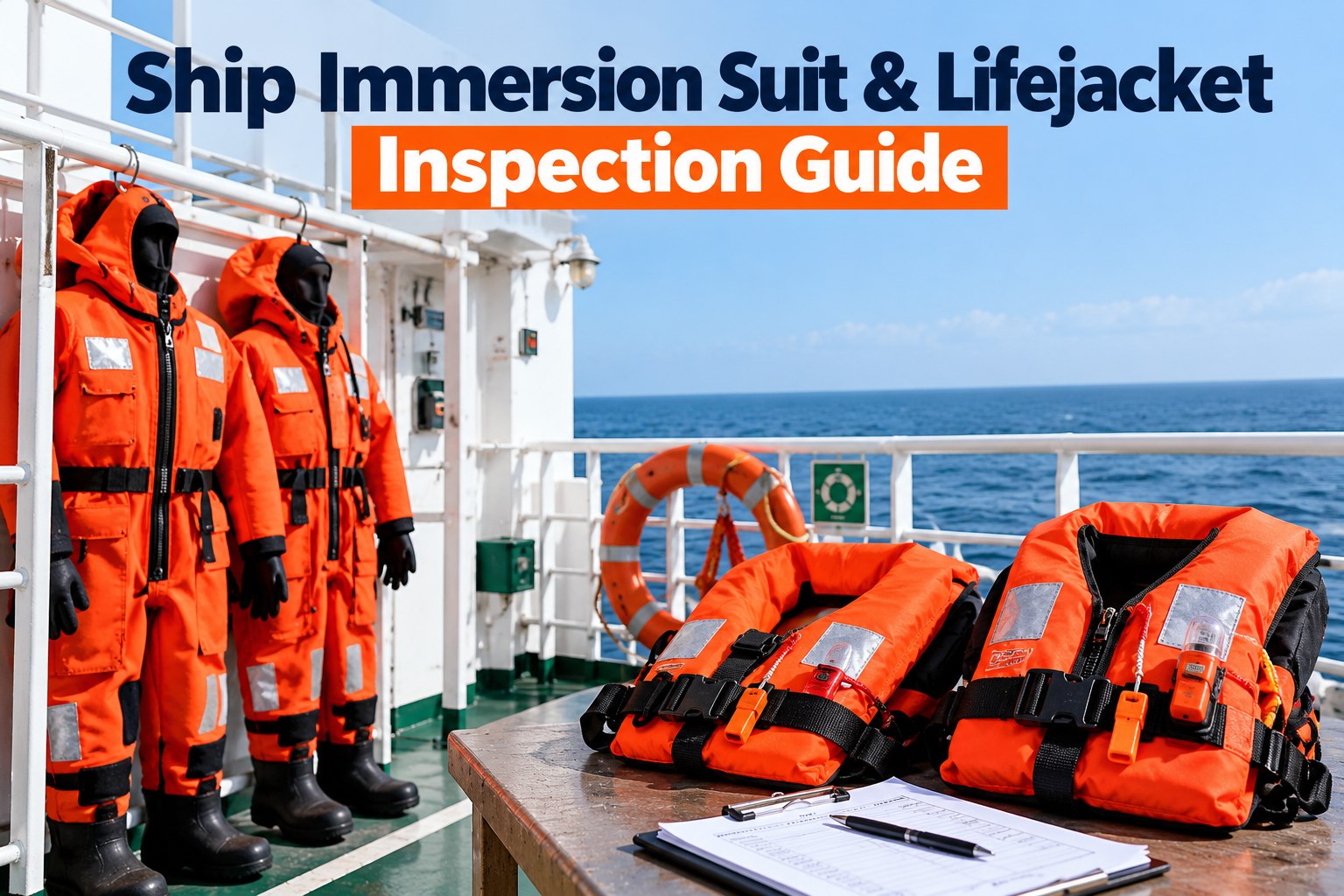
Immersion suits and lifejackets sit in lockers for years and are expected to work perfectly the one time they are needed. Coast Guard inspectors keep finding suits that would let water in at the zip and lifejackets with dead lights. This guide covers SOLAS quantity requirements, monthly immersion suit checks, seam and air pressure testing, lifejacket light and whistle checks, and the servicing intervals that keep personal survival equipment ready. Book a demo to track survival equipment checks.
Ship immersion suit and lifejacket inspection: seams, zips, lights and servicing
SOLAS lifejacket and immersion suit quantity requirements
SOLAS Chapter III sets how many lifejackets and immersion suits a ship must carry. The headline numbers are below; your Safety Equipment Certificate records what your ship carries.
- One for every person on board
- Extra for watchkeepers and remote survival craft stations, stowed on the bridge, engine control room and other manned stations
- Passenger ships: child lifejackets for at least 10% of passengers, or one per child if more
- Passenger ships: infant lifejackets for at least 2.5% of passengers on voyages under 24 hours, and one per infant on longer voyages
- Cargo ships: one for every person on board
- Extra for watchkeepers and remote survival craft stations
- Each rescue boat crew member assigned a suit
- Thermal protective aids carried in survival craft and rescue boats
Summary of SOLAS III/7 and III/32. Some flags allow cargo ships other than bulk carriers trading only in warm climates to be exempted from immersion suits; check your flag.
Immersion suit, anti-exposure suit and thermal protective aid
| Item | What it does | Where you find it |
|---|---|---|
| Immersion suit | Insulated, watertight survival suit for long immersion in cold water | Cabins, bridge, engine room, survival craft stations |
| Anti-exposure suit | Protective suit for rescue boat crew and marine evacuation system parties | With rescue boat crews |
| Thermal protective aid | Bag or suit that reduces heat loss for a person already in survival craft | Inside lifeboats, liferafts and rescue boats |
Monthly immersion suit inspection
Trained crew may carry out the monthly visual inspection following IMO guidance (MSC/Circ.1047). A US Coast Guard safety alert in January 2026 warned that suits often fail where the main zip is bonded to the suit body, and that this may not show in a quick look.
Hood, face seal and light
Light works and is in date; whistle attached; face seal undamaged.
Main zip and zip-to-body seam
Zip runs freely end to end; no lifting tape or adhesive failure where it joins the suit.
Seams and taped areas
Gloves, boots and hood tape intact; no cracks, holes or delamination.
Boots, gloves and buddy line
No damage; buddy line and lifting loop secure; bag and labels legible.
Store suits with zips fully open and use only maker-approved zip lubricant. Avoid petroleum-based lubricants and scented powders, which the USCG alert links to damage.
Seam integrity: immersion suit air pressure test
Visual checks miss slow seam failures, so IMO guidance (MSC/Circ.1114) calls for a periodic air pressure test. Testing at a shore facility that can repair suits is preferred; on-board testing is allowed with the right equipment and training.
Know the age and test date of every suit
Record each suit by serial and cabin, schedule monthly checks and air tests, and flag older suits for earlier testing.
Lifejacket inspection: light, whistle and fit
The LSA Code sets what a lifejacket must have. The monthly check makes sure it still does. See our lifesaving appliance checklist for the wider LSA inspection.
Lifejacket light
At least 0.75 cd for at least 8 hours; flashing lights at 50–70 flashes a minute. Check the battery or light expiry date.
Whistle
Present and firmly secured by a cord.
Body and buoyancy
Cover not torn or rotted; buoyancy material not crushed, hardened or missing.
Straps and fit
Straps, buckles and ties work; adult jackets fit larger crew, with accessories where needed.
Light and whistle requirements from the LSA Code as summarised by Cult of Sea.
Lifejacket and immersion suit servicing intervals
| Item | Interval | By |
|---|---|---|
| Immersion suits, visual | Monthly | Trained crew |
| Immersion suits, air pressure test | At least every 3 years; more often over 10 years | Shore facility, or crew with proper kit |
| Lifejackets, visual | Monthly, with other lifesaving appliances | Crew |
| Gas-inflated lifejackets | Every 12 months; extension up to 17 months only if the flag allows | Approved servicing station |
| Lights and batteries | Replace by expiry date | Crew |
Vacuum-packed suits follow the maker’s instructions; damaged packs should be inspected at once or sent to an approved station.
Personal survival drills: practise donning
The USCG alert recommends using monthly inspections to practise donning. Ship crews who have put a suit on recently get into it faster when it matters. See our SOLAS emergency drill guide for drill planning.
Use designated training suits where available, and follow the maker’s donning instructions.
Immersion suit and lifejacket checklist
Use this for the monthly personal survival equipment check.
How Marine Inspection tracks personal survival equipment
Marine Inspection records every suit and lifejacket by serial and location, schedules monthly checks and air tests, and flags expiring lights and service dates. It sits within our crew safety inspection module. The map below is illustrative.
Immersion suit and lifejacket FAQs
How often should immersion suits be inspected?
Visually every month by trained crew, with an air pressure test at least every three years, and more often for suits over ten years old.
What is the immersion suit air pressure test?
The suit is sealed and inflated to 0.7 to 1.4 kPa, and soapy water is applied to seams and closures to find leaks, under MSC/Circ.1114.
How many lifejackets must a ship carry?
One for every person, plus extras for watchkeepers and remote survival craft stations. Passenger ships also carry child and infant lifejackets.
What must a lifejacket light do?
Shine at least 0.75 cd for at least 8 hours. Flashing lights must flash 50 to 70 times a minute.
How often are gas-inflated lifejackets serviced?
At an approved servicing station at intervals not exceeding 12 months, unless the flag allows a short extension.
Can Marine Inspection track suit and lifejacket checks?
Yes. Book a demo to see per-suit records and test date alerts.
Ready for the water
Sealed seams, working zips, bright lights and a whistle on every jacket, checked every month and on record.