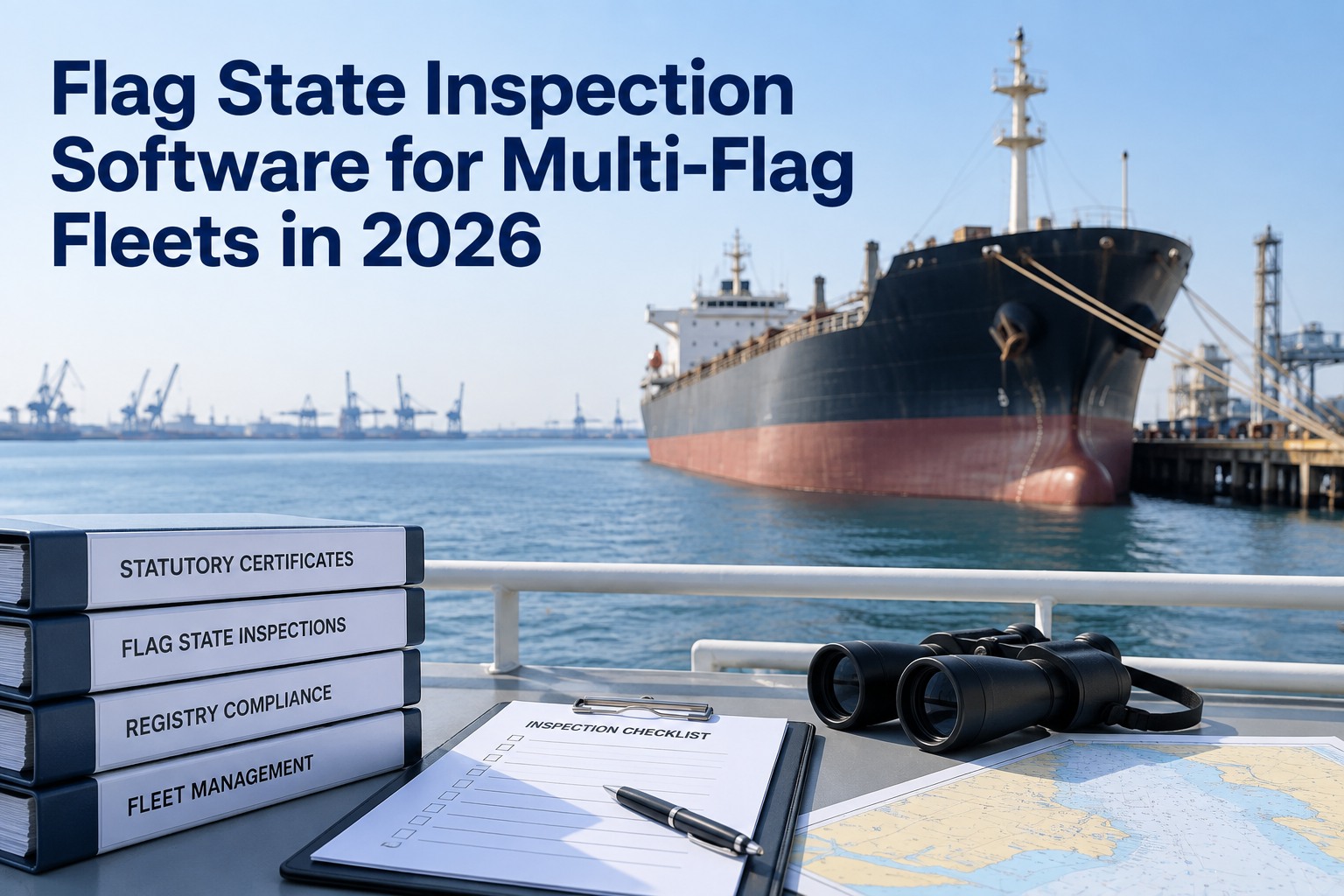
A fleet flying one flag has a compliance problem. A fleet flying five has a coordination problem, and it is a different thing entirely. Every registry enforces the same body of international conventions — SOLAS, MARPOL, Load Lines, ISM, ISPS, MLC — so the underlying obligations converge. What diverges is everything built on top: each administration runs its own annual safety inspection regime, issues its own circulars carrying requirements beyond the conventions, sets its own reporting and renewal mechanics, and authorises its own network of inspectors. Managing several registries at once therefore means holding several rulebooks in parallel, each applying to a different subset of vessels, while the statutory certificate cycle runs underneath all of them on the harmonised anniversary system. The failure mode is rarely ignorance of a convention. It is a flag circular that applied to four vessels and was actioned on three, or an annual safety inspection due under one administration's rules that nobody scheduled because the other four flags do it differently. This guide covers the two-layer structure, the parallel inspection streams, what actually differs between registries, why flag performance is now an operational variable, and how to hold it in one view. To manage multi-flag compliance from a single fleet position, book a demo or start a free trial.
MANAGEMENT GUIDE · MULTI-FLAG FLEETS
Flag State Inspection and Certificate Management Across Multi-Flag Fleets
Statutory certificates, annual verifications, flag circulars and registry reporting — the same conventions administered differently by every flag your fleet flies. Here is how to hold it all in one view.
Flag layer
Diverges by registry — annual safety inspections, circulars, reporting, renewal mechanics, inspector networks
Convention layer
Common to all — SOLAS, MARPOL, Load Lines, ISM, ISPS, MLC and the harmonised certificate cycle
Same Conventions, Different Rulebooks
The two-layer structure explains why multi-flag management is harder than it looks from the convention side. Under the harmonised system, statutory certificates across a vessel share a single anniversary date on a five-year cycle, with annual surveys falling within three months either side of it. That much is stable regardless of flag, and it is what most compliance thinking is built around.
The flag layer sits above it and is where the divergence lives. Each administration issues circulars setting requirements and interpretations that go beyond or clarify the conventions, and flag state inspections explicitly verify compliance with those circulars alongside the international instruments. Registries also differ in their renewal cycles, documentation sets, surveyor authorisation, fee structures and reporting expectations. For a single-flag fleet this is simply the operating context. For a multi-flag fleet it becomes a matrix: each requirement has to be mapped to the vessels it actually applies to, and a circular issued by one administration is irrelevant to the rest of the fleet — which is precisely why it gets missed on the ships it does cover. To map requirements to the vessels they apply to, book a demo or start a free trial.
Two Inspection Streams Per Vessel
A point that causes genuine confusion: statutory surveys and flag state inspections are not the same activity, and a vessel is subject to both.
Stream one
Statutory surveys, delegated to a Recognised Organisation
Most flag states delegate the technical work of statutory survey and certification to classification societies acting as Recognised Organisations. The surveyor verifies convention compliance and issues or endorses the statutory certificates, frequently during the same attendance as class survey work. This stream follows the harmonised anniversary cycle.
Stream two
The flag administration's own safety inspection
Separately, administrations run annual safety inspections through their own approved flag state inspectors to confirm standards are being maintained aboard vessels flying their flag. These cover statutory documentation, a general examination of structure, machinery and equipment, more thorough inspection and operational testing of firefighting, life-saving and safety equipment, and compliance with flag circulars and applicable ILO and health instruments.
The practical consequence is that a vessel can be fully current on its statutory certificates and still be overdue for its flag's own annual safety inspection, because the two streams are scheduled independently and by different parties. On a multi-flag fleet, the second stream is the one that fragments — since each administration has its own regime, its own authorised inspectors and its own expectations about scheduling, and a fleet manager accustomed to one flag's rhythm will apply the wrong assumption to another. Many inspection firms are authorised across several administrations at once, which helps with coverage, but it does not consolidate the underlying obligations.
What Actually Diverges
Knowing where registries differ tells you what a multi-flag system has to hold separately rather than once.
Annual safety inspection regime
Whether an inspection is compulsory, at what interval, by whose inspectors and against what scope beyond the statutory baseline.
Flag circulars
Requirements and interpretations issued by the administration, verified during flag inspection, applying only to that registry's vessels.
Documentation set
Registry-specific paperwork alongside the universal document types, with each administration defining its own complete set.
Renewal and reporting mechanics
Renewal cycles, fee schedules, submission channels and what must be reported to the registry, along with response times when something is needed urgently.
Authorised surveyor networks
Which organisations may act for that flag, and where geographically they can attend — a real constraint when a vessel needs attendance in an awkward port.
Convention ratification
Which instruments the flag has actually ratified. The major open registries have ratified the principal conventions, but this cannot be assumed further down the list.
One fleet position, however many registries
Statutory certificates on the harmonised cycle, flag safety inspections on each administration's own schedule, circulars mapped to the vessels they cover, and renewal obligations per registry — held in a single forward view rather than spread across separate trackers. Marine Inspection keeps certificate and inspection status visible fleet-wide regardless of flag.
Book a demo to see it against your own fleet, or
start a free trial.
Flag Performance Is an Operational Variable
Flag choice is often treated as a commercial or fiscal decision made once. In operational terms it is a live variable that affects how often your ships are inspected and how closely they are examined.
Regional port state control authorities maintain white, grey and black lists reflecting flag performance, and a vessel registered under an underperforming flag faces more frequent and more detailed inspection because flag performance feeds directly into the ship risk profile that drives targeting. This means a fleet's flag mix quietly determines part of its port state control exposure. The reassuring part is that scale and quality are not opposed: industry performance assessment measures flags against a wide set of criteria, and the largest open registers sit among the strongest performers alongside the major national flags, so the old shorthand equating open registries with poor standards is long out of date at the top of the market.
Enforcement posture has become its own risk factor
A newer dimension deserves attention from anyone managing a multi-flag fleet. Fraudulent and unrecognised registries have proliferated, with fraudulent operations pretending to represent national registries uncovered in numbers and hundreds of falsely flagged vessels recorded in international databases. At the same time, legitimate registries have been actively removing vessels — one major registry deflagging around seventy ships, another dozens more, another the majority of those it identified — as sanctions enforcement has tightened. For fleet managers this cuts two ways: the integrity of a registry matters when selecting it, and a flag's willingness to deflag means registration is not the permanent fixture it once felt like. Registry standing belongs on the risk register, not only in the original flag selection paper.
Re-flagging Is a Certificate Event
Because re-registration is a normal commercial occurrence — following a change of ownership, a change of operator, or a search for different regulatory or fiscal conditions — it is worth treating as an operational project rather than an administrative transfer.
A change of flag invalidates certificates issued under the previous administration and requires re-issue under the new one, so the vessel moves through a period where its documentary position is in transition precisely when commercial attention is focused elsewhere. Security certification is explicitly invalidated by a change of flag or of the operating company, with interim certification bridging the gap while full certification is achieved. The same logic applies across the statutory set, and the safety management documentation follows the company rather than the ship, so a management change carries its own certificate consequences independent of the flag.
The practical discipline is to plan re-flagging backwards from the certificate position: establish what must be re-issued, what interim instruments cover the gap, which surveys are triggered, what the new administration requires that the old one did not, and which of its circulars now apply to a vessel that has never been subject to them. A fleet that treats this as a checklist rather than a discovery exercise avoids the most common outcome, which is a vessel trading on interim documentation longer than intended while somebody works out what the new registry wants. To keep certificate positions visible through transitions, book a demo or start a free trial.
Holding It in One View
Everything above points to a single requirement: a multi-flag fleet needs one forward position covering every vessel, with flag-specific obligations attached to the vessels they actually apply to rather than maintained as separate parallel systems.
That view needs the statutory certificate set per vessel with anniversary dates and survey windows shown as open and close points rather than nominal deadlines, since an annual survey missed inside its window can invalidate the certificate and stop the ship trading. It needs each flag's own safety inspection tracked as a distinct obligation alongside the statutory stream, because the two are scheduled independently. It needs circulars and registry-specific requirements mapped to the affected vessels, so a requirement issued by one administration reaches every ship it covers and no others. It needs renewal and reporting obligations per registry with their own timings. And it needs all of this readable as one fleet picture, because the practical question a manager asks is not what Panama requires or what Liberia requires but what is due next across the fleet and which vessel is closest to a limit.
Two habits make it durable. Review incoming flag circulars against the vessel list at the point of receipt, deciding immediately which ships are affected rather than filing them by registry for later interpretation. And treat every flag change, management transfer or registry enforcement development as a trigger to re-verify the affected vessels' certificate positions rather than assuming continuity. Multi-flag operation is entirely manageable; it simply does not forgive the assumption that what is true for one vessel is true for the next. To build that single fleet position, book a demo or start a free trial.
Frequently Asked Questions
What is the difference between a statutory survey and a flag state inspection?
They are two distinct streams and a vessel is subject to both. Statutory surveys verify compliance with the international conventions and lead to the statutory certificates, and most flag states delegate this technical work to classification societies acting as Recognised Organisations — so the same surveyor often covers class and statutory requirements in one attendance, on the harmonised anniversary cycle. Separately, flag administrations run their own annual safety inspections through approved flag state inspectors, to confirm that standards are being maintained aboard vessels flying their flag. These cover statutory documentation, general examination of structure, machinery and equipment, thorough inspection and operational testing of firefighting, life-saving and safety equipment, and compliance with the administration's own circulars. A vessel can be current on certificates and still overdue for its flag's inspection.
Why is managing several flags harder than managing one?
Because compliance operates on two layers. The convention layer is common to every registry — SOLAS, MARPOL, Load Lines, ISM, ISPS and MLC, with statutory certificates sharing a single anniversary date on a five-year cycle under the harmonised system. The flag layer sits above it and diverges: each administration runs its own annual safety inspection regime, issues circulars carrying requirements and interpretations beyond the conventions, defines its own documentation set, sets its own renewal and reporting mechanics, and authorises its own surveyor network. For one flag that is simply the operating context. Across several it becomes a matrix, where each requirement must be mapped to the vessels it applies to — and a circular from one administration is irrelevant to most of the fleet, which is exactly why it gets missed on the ships it does cover.
What are flag circulars and why do they matter?
Flag circulars are requirements and interpretations issued by a maritime administration to vessels on its register, sitting above the international conventions. They matter operationally because flag state inspections explicitly verify compliance with them alongside the conventions and applicable labour and health instruments — so a circular is not advisory background but an inspectable requirement. In a multi-flag fleet they are a particular hazard, since a circular applies only to the vessels on that specific register while the rest of the fleet is unaffected. The practical discipline is to review each incoming circular against the vessel list at the point of receipt and decide immediately which ships are affected, rather than filing circulars by registry and interpreting them later, which is how a requirement gets actioned on some affected vessels but not all.
How does flag choice affect port state control exposure?
Directly, because flag performance is an input to the ship risk profile that drives port state control targeting. Regional authorities maintain white, grey and black lists reflecting how flags perform, and vessels registered under underperforming flags face more frequent and more detailed inspections. This means a fleet's flag mix quietly shapes part of its inspection burden. Encouragingly, scale and quality are not opposed: industry performance assessment measures flags against a broad set of criteria, and the largest open registers sit among the strongest performers alongside major national flags, so the assumption that open registries imply weak standards is outdated at the top of the market. It remains a fair concern further down, which is why a flag's list status on the regime governing your actual trading pattern is worth checking rather than assuming.
What happens to certificates when a vessel changes flag?
A change of flag invalidates certificates issued under the previous administration and requires re-issue under the new one, so the vessel passes through a transitional period exactly when commercial attention is focused on the transfer itself. Security certification is explicitly invalidated by a change of flag or of the company operating the ship, with interim certification bridging the gap while full certification is achieved, and comparable logic applies across the statutory set. Safety management documentation follows the company rather than the vessel, so a management change carries its own consequences independently of flag. The sensible approach is to plan re-flagging backwards from the certificate position — establishing what must be re-issued, what interim instruments apply, which surveys are triggered, and which of the new administration's circulars now cover a vessel that was never subject to them.
Should registry integrity be part of ongoing risk management?
Yes, and this is a relatively recent shift. Fraudulent and unrecognised registries have proliferated, with operations pretending to represent national ship registries uncovered in significant numbers and hundreds of falsely flagged vessels recorded in international databases. At the same time, legitimate registries have been actively removing vessels as sanctions enforcement has tightened — with individual administrations deflagging dozens of ships, in one case the majority of those identified. The implication for fleet managers runs two ways: registry integrity matters when selecting a flag, and a registry's willingness to deflag means registration is not the permanent fixture it may once have felt like. Flag standing therefore belongs on the ongoing risk register alongside the original selection decision, with enforcement developments treated as a trigger to re-verify affected vessels' positions.
Every Registry, One Forward View
Multi-flag fleets do not fail on the conventions — they fail on the layer above, where each administration runs its own inspections, circulars and reporting. Marine Inspection holds statutory certificates on the harmonised cycle, flag safety inspections as distinct obligations, and registry-specific requirements mapped to the vessels they cover, so the question a manager can always answer is what is due next across the fleet.
Book a demo or
start a free trial.