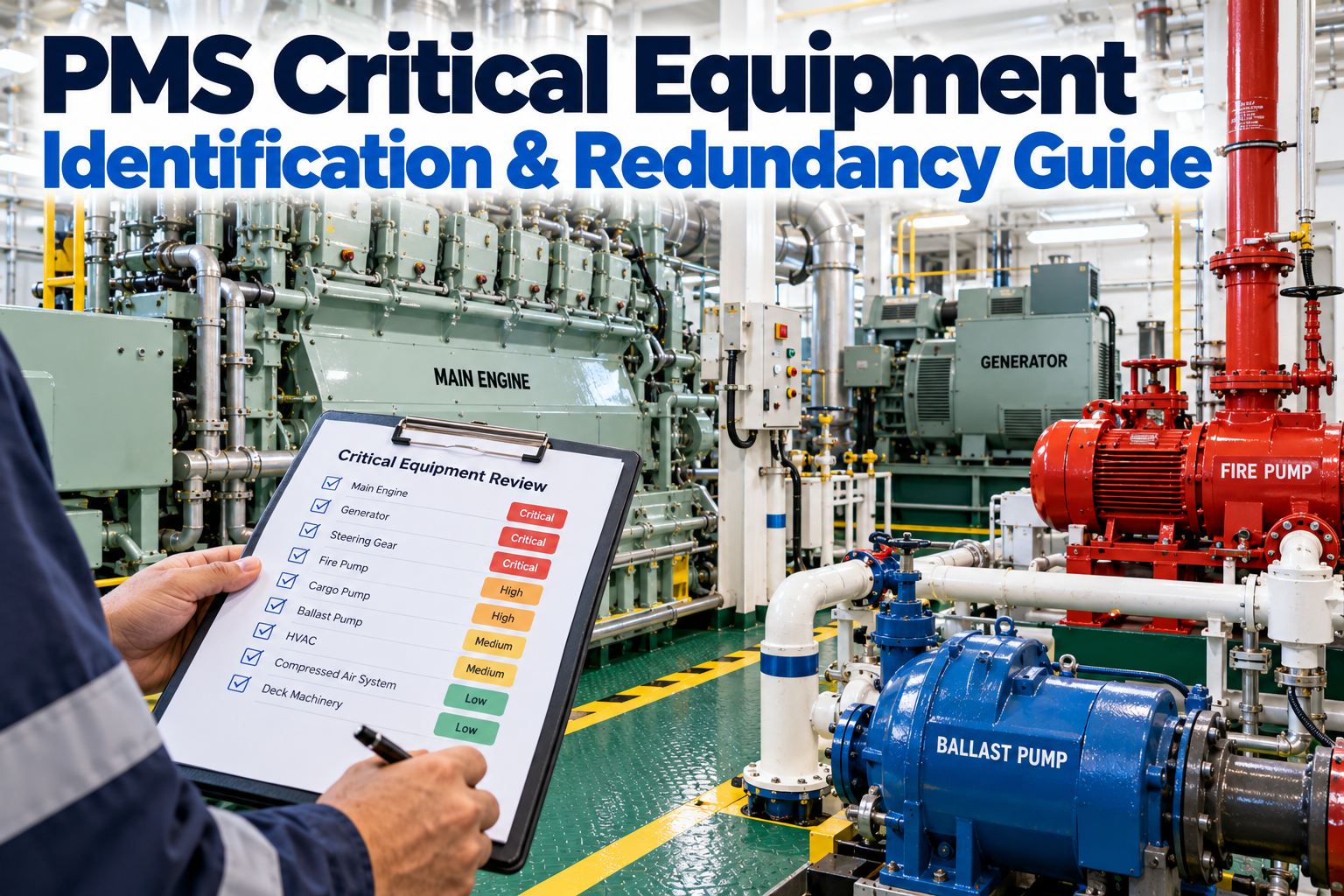
Not every machine on a ship deserves the same attention. A failed galley fan is an annoyance. A failed steering gear pump or a fire damper that will not close is a different matter. ISM Code clause 10.3 asks every company to separate the two, and the PMS then has to show it by treating critical equipment differently. This guide shows a Chief Engineer how to identify critical equipment, plan redundancy that works when it is needed and prioritise maintenance and spares where the risk is highest. For the wider system the list sits inside, see our planned maintenance system setup guide for ships.
What ISM Code 10.3 Asks For and What the Guidance Adds
The wording of the requirement and why it ties into the maintenance plan
A German ISM circular explains that the company should identify equipment and technical systems the sudden operational failure of which may result in hazardous situations. It recommends a formal procedure defining how the list is produced and who is responsible, and says maintenance that supports reliability should be integrated into the ship's maintenance plan. AMSA's guidance says the same in practical terms: operators should be able to identify such equipment and set specific measures, such as regular testing of standby equipment. Our {L2} covers the machinery side.
- Operations vital to safety and environmental protection
- Risk assessment of critical operations
- Root cause analysis of near misses and accidents
- List each function that must not fail
- Ask what happens if the equipment fails suddenly
- Check for a backup or a safe state
- Rank by consequence
- After SMS reviews
- After internal and external audits
- After reported incidents and accidents
Examples of critical equipment named in the IACS guide and why your list must still be your own
The IACS guide to managing maintenance under the ISM Code gives examples that include alarms and emergency shutdowns, fuel oil and cargo system integrity, emergency, safety, fire-fighting and life-saving equipment, generators and batteries, and pre-arrival and pre-departure tests of steering gear and propulsion. It adds that the critical list varies by ship type and operation and may include items with no mandatory requirement. Treat the examples as prompts, not a template.
Ranking Equipment by Consequence and Backup: A Practical Matrix
Why an untested backup should not lower an item's rating
A useful ranking looks at two things: what happens if the item fails suddenly, and whether a working backup exists. The matrix below is our template. Its main message is that a standby unit that has never been run does not reduce risk, which matches the circular's stress on testing standby arrangements. The matrix is a conversation starter, and your company's procedure decides the method.
A three-tier treatment that makes the ranking visible in the PMS
Ranking only matters if the PMS acts on it. The table below shows one way to give each tier its own intervals, spares, evidence and review frequency. The tiers are our suggestion, and intervals must still follow the maker's manual, class and the SMS.
| Tier | PMS treatment | Spares | Evidence | Who reviews |
|---|---|---|---|---|
| Critical | Short intervals, standby tests and alarm tests, flagged in the PMS | Held on board, with any exceptions risk-assessed | Dated photos and test results required to close | Chief Engineer weekly, Superintendent monthly |
| Important | Maker intervals, closed with a record | Held where lead time is long | Record at closure, photo where useful | Chief Engineer monthly |
| Routine | Maker intervals, simple closure | Normal stock rules | Tick and date | Periodic spot check |
How to share the list so the whole engine room knows what is critical
A critical list that only the Chief Engineer has seen will not change behaviour. Walk the engineers and ratings through it at the next safety meeting, explain the consequence of failure for each item and show where the standby tests and spares are recorded. When a critical job goes overdue, the whole team should know why it matters. Update the list after any audit or incident, as the circular advises, and tell the crew what changed.
Redundancy That Works: Testing, Alternating and Proving the Backup
The safeguards the ISM circular lists and the PMS jobs that deliver them
The circular lists safeguards for critical equipment, among them regular testing of standby arrangements, alarm function tests, preventive maintenance of critical components, alternate running of standby arrangements, oil analysis, filter cleaning, and extra procedures for redundancy during critical operations. Each can be written as a PMS job type. The diagram pairs each safeguard with a suggested job name.
What neglected critical equipment looks like in practice
AMSA's September 2024 bulletin describes a lifeboat that fell during a familiarisation launch because a critical interlock device on the davits had corroded from lack of maintenance, and a vessel detained after an inoperable purifier room fire damper and cargo hatch auto cleats. Neither case needs a complicated explanation. Required checks were missed, and the safety management system did not catch it.
Critical Spares and What to Do When a Part Cannot Be Supplied
Why the register should list the part as well as the equipment
A critical failure needs a part on board, not a purchase order. AMSA says operators should anticipate supply chain problems and plan maintenance to limit their impact, and should check that critical spares can be obtained quickly. Add a spares field to each critical item in the register, with location and quantity, and verify it on a physical walk-round.
A register that holds the whole picture for each critical item
The register below combines the function, consequence, backup, test results, linked PMS jobs, spares and review trigger in one place. The circular-sourced rows are marked. The rest is our suggested template.
| Field | What goes in it | Why it matters | Source status |
|---|---|---|---|
| Equipment and function | Tag, name and the function it protects | The list starts from functions that must not fail | ISM circular (inputs); layout ours |
| Failure consequence | What happens if it fails suddenly | This is the ISM 10.3 test | ISM Code 10.3 |
| Backup arrangement | Standby unit, manual mode or none | Shows where a single failure has no cover | Our suggestion |
| Test interval and last result | Date, result and who tested | Standby equipment needs regular testing | ISM circular |
| PMS jobs linked | The jobs that keep it reliable | Maintenance should be integrated into the maintenance plan | ISM circular (10.4) |
| Critical spares | Parts, location on board and quantity | A critical failure needs a part, not a purchase order | Our suggestion, with AMSA on supply |
| Review trigger | Audit, incident or SMS review that changed the entry | The list must be reviewed after these events | ISM circular |
The Critical Equipment Readiness Checklist for the Chief Engineer
A checklist with a checkpoint type on each item for the monthly review
Use the table in the monthly review and before audits. It covers the list, consequences, standby and alarm tests, PMS flags, spares and a physical check against the register.
| Item | What to check | Checkpoint type |
|---|---|---|
| Critical list | Approved, current and held under a documented procedure | Record |
| Failure consequence | Each critical item has a written consequence of sudden failure | Record |
| Standby tested | Standby units tested on schedule and results recorded | Test |
| Alarms tested | Alarm functions on critical systems tested and recorded | Test |
| PMS flags | Critical equipment flagged so overdue jobs are visible | Record |
| Critical spares | Counted, located and matched to the register | Visual |
| Condition on board | Critical items walked round and compared with the register | Visual |
| Review after events | List reviewed after audits, incidents and SMS reviews | Record |
Mistakes That Leave Critical Equipment Looking Safer Than It Is
Six habits that weaken a critical equipment programme
Systems That Keep Critical Equipment Tests, Spares and Evidence Together
How a dated photo repository, task ownership and deadlines support the critical list
A critical list on paper does not prove anything. Marine Inspection supports a dated photo repository, observations turned into tasks with owners, deadlines and evidence, and certificate and equipment tracking. A dated photo of a standby pump run, a task for each overdue alarm test with a named owner, and a tracked list of critical spares give a Chief Engineer and a superintendent one record to open. It does not replace the company's procedure or the SMS.