A calendar PMS tells you when a machine was last opened. Condition data tells you what state it is in now. The best maintenance programmes use both: the schedule as the safety net and the readings as the early warning. This guide shows a Technical Superintendent how to bring condition data into a planned maintenance system, how to set thresholds that can be defended, what class expects under IACS UR Z27 and which machinery to start with. For the sensor and analytics side, see our predictive maintenance for marine engines with AI, IoT and condition monitoring.
From Calendar to Condition: Sorting Machinery Into Three Lanes
Why most ships should add condition triggers before they replace any schedule
Condition-based maintenance is not a switch you flip for the whole engine room. A practical way to think about it is three lanes. Low-consequence or hard-to-measure equipment stays on the calendar. A middle lane keeps the schedule and adds condition readings that can bring a job forward. Only a small set of high-value, well-instrumented machines goes into a fully condition-based scheme that class has approved. The lanes are our concept, not a classification.
How to pick the first machines to instrument
Start where value and measurability meet. Rotating machinery with accessible measuring points gives the quickest return, and the Chief Engineer and the makers will know which machines already have usable data. The matrix is our own tool for the conversation. It does not rank any specific equipment, and the critical equipment list under ISM 10.3 should be part of the discussion.
What Class Expects: IACS UR Z27 for Condition Monitoring and CBM Schemes
When a condition-based scheme can change the class survey and what remains required
IACS UR Z27 covers approved condition monitoring and condition based maintenance schemes whose results influence the scope or frequency of class survey. As we read it, it applies to vessels on an approved PMS survey scheme, to surveys approved on or after 1 January 2020, and it requires the condition monitoring to give equivalent or greater confidence than traditional survey techniques. Class approval is needed before the survey cycle is changed on the basis of the scheme, and the Society keeps the right to test or open up machinery whatever the results say.
A requirements table with what to keep on board for each
The table below summarises the topics a superintendent should be able to evidence. Clause references come from the UR text we read, and your class society may add its own detail, so check the current UR and your rules. For how the schedule itself is set up, see our {L2}.
| Topic | What the UR says | What to keep | Checkpoint type |
|---|---|---|---|
| Confidence | Condition monitoring must give equivalent or greater confidence in machinery condition than traditional survey techniques (1.3.3) | Rationale and comparison for each item | Record |
| ISM Code | Condition-based maintenance must meet the ISM Code (1.4.1) | Link from the scheme to the SMS procedures | Record |
| Responsibility | The Chief Engineer is responsible on board, and personnel must be qualified (2.1.1, 2.1.4) | Training and competence records | Record |
| Baseline | Baseline readings taken at installation (3.1.1) | Original baseline data | Record |
| Onboard records | Condition data since the machine was last opened, original baseline and sensor calibration records (2.3.2) | The full record set, backed up regularly | Record |
| Remote monitoring | Must meet applicable cyber standards and keep working onboard if communications fail (2.2.5) | Cyber arrangements and a loss-of-link test | Test |
| Thresholds | Based on OEM guidelines or a recognised standard, with changes recorded (1.3.2, 1.4.3, 2.2.4) | Limit sheet with source and change log | Record |
| Class retains rights | Class may test or open up machinery whatever the condition results (1.3.7) | Readiness to open up when asked | Visual |
Thresholds, Alarms and Where the Limits Come From
A four-step ladder that ties each limit to an action
A threshold is only useful if crossing it triggers something. The ladder below is our template: log when normal, raise a task on a warning, review and plan on an alarm, and follow the maker's procedure at protection limits. What class says is narrower and more important: warnings and alarms must be based on the OEM guidelines or a recognised international standard, and changes made during operation must be recorded.
How to connect a condition reading to a PMS job and an audit record
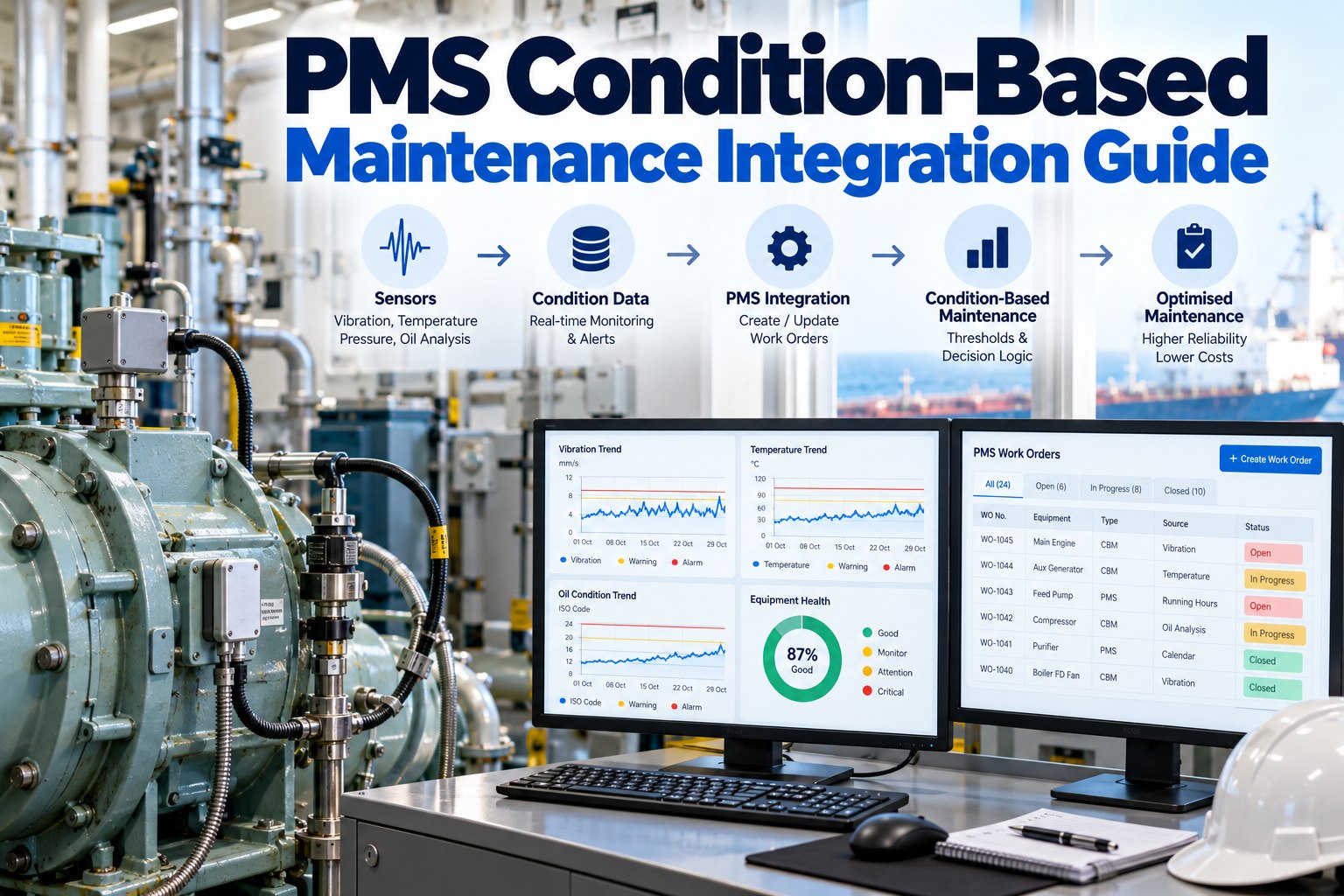
The workflow below shows the path from a reading to a record. A reading is compared with the baseline and approved limits, an alert creates a PMS job with an owner and deadline, and the result, photos and re-measurement are stored. That chain is what an annual audit reviews. The UR requires the scheme to produce a condition report and maintenance recommendations, and to identify defects that condition monitoring did not prevent.
Condition Techniques and What They Can Tell You
Which readings suit which machinery and how to avoid collecting data nobody uses
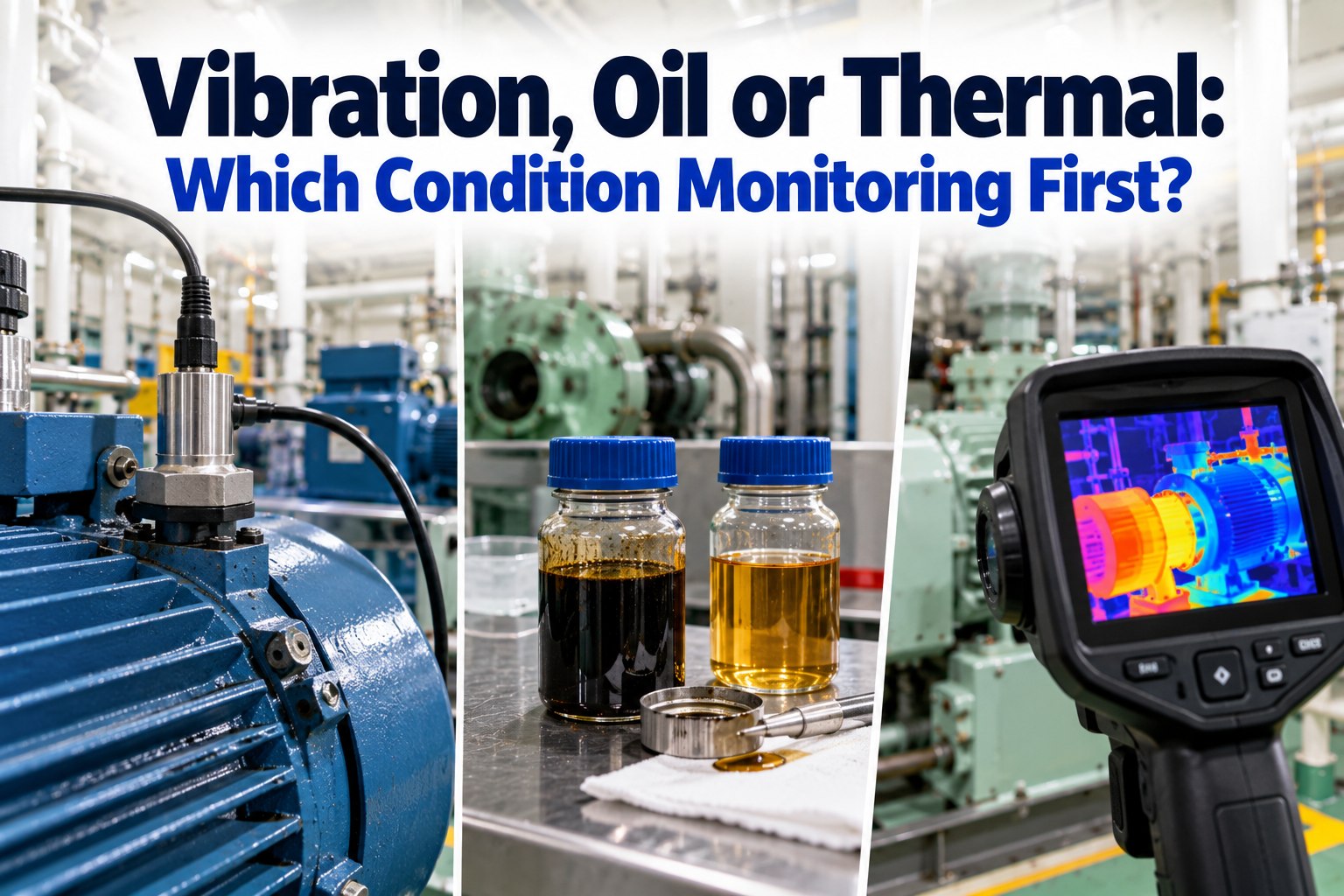
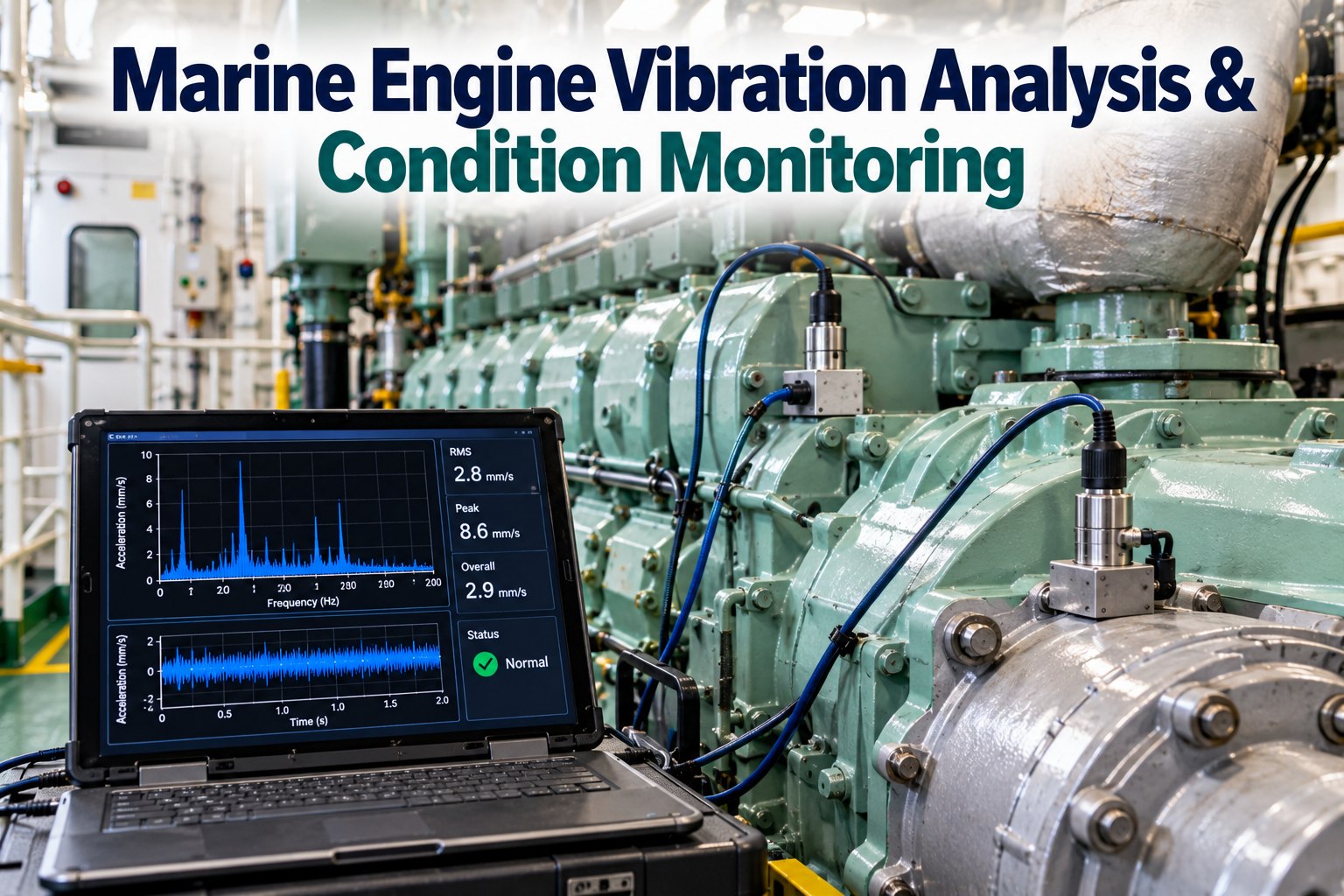
Condition monitoring is a toolbox, not a single sensor. Vibration readings suit rotating machinery, lubricating oil analysis suits engines and gearboxes, thermography suits switchboards and motors, and trend data from existing temperature and pressure sensors costs almost nothing. The table is a general engineering summary, not drawn from the standards we cite, so follow the maker's guidance on method and limits. The practical rule is to collect only what you will act on. Every reading should have a limit, an owner and a PMS job waiting if the limit is crossed.
| Technique | What it can show | Typical use on board | Checkpoint type |
|---|---|---|---|
| Vibration readings | Changes in balance, alignment and bearing condition on rotating machinery | Pumps, compressors, generators, fans | Test |
| Lubricating oil analysis | Wear particles, contamination and oil condition | Engines, gearboxes, hydraulic systems | Test |
| Thermography | Hot spots in electrical and mechanical equipment | Switchboards, motors, bearings | Visual |
| Temperature and pressure trends | Drift away from normal operating values | Cooling, fuel and lube systems | Record |
| Performance data | Changes in output against load | Engines, boilers, pumps | Record |
| Visual and borescope inspection | Surface condition and deposits | Where openings allow it | Visual |
Why a portable instrument and a clear routine often come before fixed sensors
Fixed sensors give continuous data, but they also bring calibration, cable, power, software and cyber duties. A portable instrument with a fixed route and set measuring points can build a baseline quickly and shows whether a machine is worth instrumenting permanently. UR Z27 expects baseline readings and sensor calibration records either way, so the discipline is the same. Start with the routine, prove the value and then decide where fixed monitoring earns its place.
The Condition-Based Maintenance Integration Checklist for Superintendents
A checklist with a checkpoint type on each item to keep the scheme audit-ready
Use the table before you integrate a new sensor feed, and again before each annual audit. It covers selection, baselines, calibration, thresholds, the PMS link, loss of link and the physical check.
| Item | What to check | Checkpoint type |
|---|---|---|
| Machinery selection | Candidates chosen on value and measurability, agreed with the Chief Engineer and makers | Record |
| Baselines | Taken and stored for every monitored machine | Record |
| Calibration | Sensor and instrument calibration recorded and in date | Record |
| Thresholds | Limits sourced from the maker or a recognised standard, change log kept | Record |
| PMS link | Alerts create PMS jobs with an owner and a deadline | Test |
| Loss of link | Onboard monitoring still works when the shore link is down | Test |
| Physical check | Inspect the machine to confirm the readings match its state | Visual |
| Annual audit pack | Results, reports, calibration and failures ready for class | Record |
Mistakes That Make Condition Data Less Useful Than the Calendar
Six habits that undermine a condition-based scheme
Systems That Keep Condition Records, Tasks and Evidence Together
How a dated photo repository, task ownership and deadlines support condition-based upkeep
Condition monitoring produces numbers, and numbers need a trail. Marine Inspection supports a dated photo repository, observations turned into tasks with owners, deadlines and evidence, and certificate and equipment tracking. A dated photo of an oil sample or a thermography image attached to a task, and a task for each warning with a named owner, give a superintendent a record they can bring to the annual audit. Our {CBMP} feature page describes this approach in more detail, and your own class rules and maker instructions remain the authority.