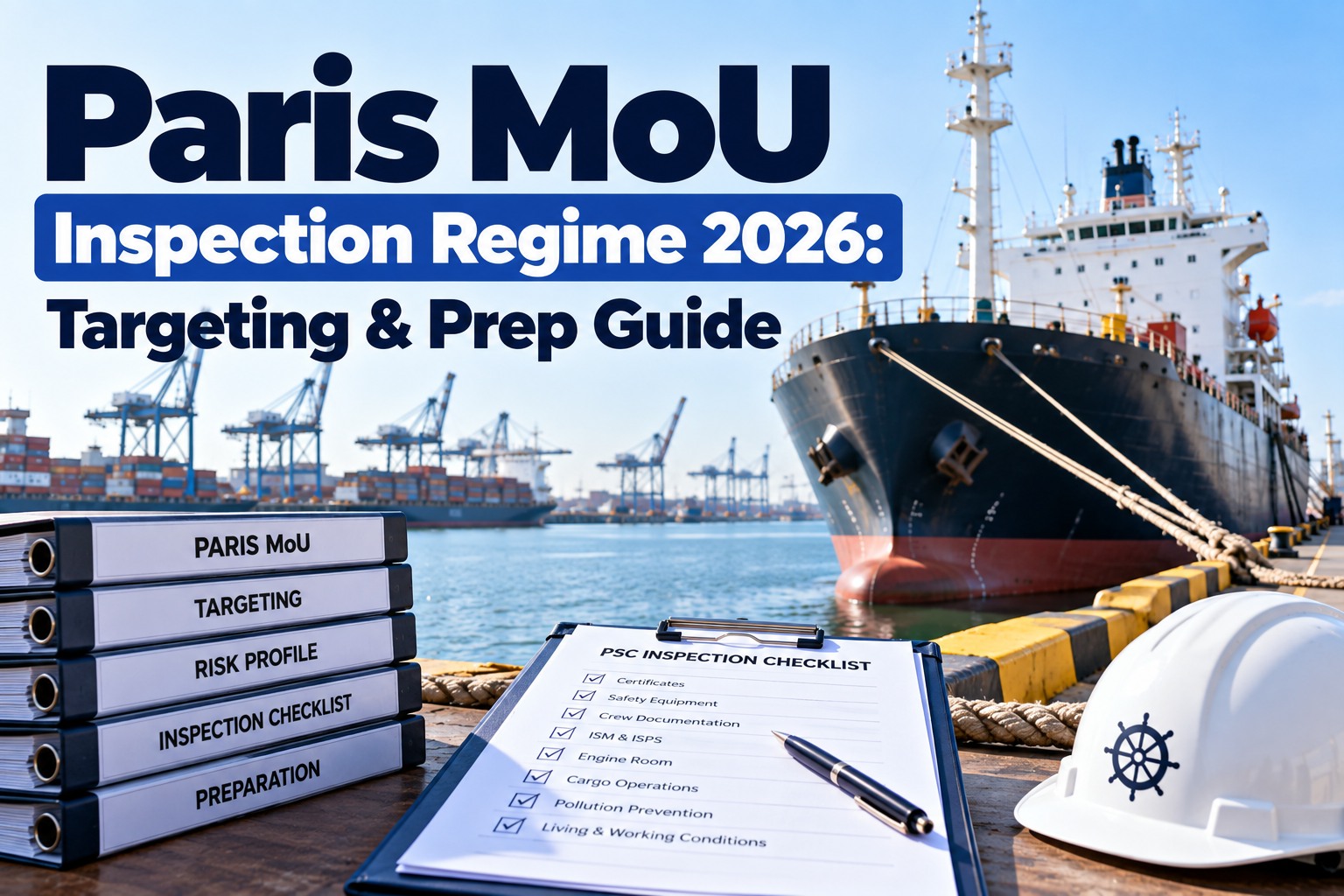
Paris MoU Inspection Regime 2026: Targeting & Prep Guide
Whether a ship is inspected in a European port is decided before anyone looks at it. The Paris MoU regime sorts arriving vessels into those that must be inspected and those that may be, and which bucket you land in depends on a time window, a risk profile, and a short list of events that override everything else. This guide covers Priority I and Priority II, the windows for each risk band, overriding factors, expanded inspections, the notification obligations, and the banning ladder at the end of the road.
Paris MoU · targeting and preparation
Two buckets: must be inspected, and may be inspected
Know which port calls carry exposure before the ship is fixed
The distinction is simple to state and carries most of the practical consequence of the regime.
Priority I
The ship must be inspected
Either the time window has passed, or an overriding factor has been recorded against the vessel. There is no discretion left in the system at this point — the inspection happens.
Priority II
The ship may be inspected
The window has opened but not closed, or an unexpected factor has been logged. Whether an inspection takes place depends on the authority’s capacity and what else is in port.
For planning purposes this is the question worth asking before a fixture rather than after: is this vessel going to arrive in a European port as Priority I, as Priority II, or as neither? The answer is knowable in advance from the date of the last inspection in the region and the ship’s own profile.
The time windows by risk band
Each band carries its own window, measured from the last inspection in the Paris MoU region. The window opening makes the ship Priority II; the window closing makes it Priority I.
High risk
5 – 6 months
A one-month window between may and must
Standard risk
10 – 12 months
Two months of discretion before it becomes mandatory
Low risk
24 – 36 months
A full year of window, and a long way between inspections
These are Paris MoU figures and they are tighter at the top end than the equivalent Tokyo MoU windows, where a high risk ship sits in a 5 to 8 month band. An operator trading between both regions is working to two different clocks on the same vessel — the comparison is set out in our guide to Paris MoU against Tokyo MoU, and the Asia-Pacific side in our guide to the Tokyo MoU regime and targeting.
What puts a ship in each priority
Trigger
Type
Result
What you can do about it
Time window closed
Periodicity
Priority I — must be inspected
Nothing at the time; plan the call knowing it will happen
Time window open
Periodicity
Priority II — may be inspected
Arrive prepared; whether it happens is not in your hands
Collision, grounding or similar
Overriding factor
Priority I, immediately
Expect inspection; have the incident record and class involvement ready
Discharge of harmful substances
Overriding factor
Priority I, immediately
Same — the regime treats it as requiring verification, not explanation
Outstanding deficiencies
Unexpected factor
Priority II
Close and evidence carried-forward items before arrival — the most controllable entry on this list
Failure to meet reporting obligations
Unexpected factor
Priority II
Send the notifications correctly and on time; this one is free to avoid
Overriding and unexpected factors
The two categories behave differently and are worth separating in the mind, because one is a consequence of something that happened to the ship and the other is frequently a consequence of something the office did or failed to do.
Overriding factors force an inspection
Events such as a collision or the discharge of harmful substances place the vessel in Priority I regardless of where it sits in its window. These are not negotiable and cannot be foreseen, but they are at least visible — if one has occurred, the next European call will involve an inspection.
Unexpected factors raise the probability
Outstanding deficiencies and failures to comply with reporting obligations move a ship to Priority II. Neither is an accident. Both are administrative positions the operator holds, and both can be cleared before arrival by somebody paying attention.
That second box is the practical message of the whole regime. A ship with closed deficiencies and correct notifications sits in its window and waits. A ship carrying an open item and a late report has moved itself up the queue without anybody inspecting anything.
Expanded inspections: who gets one
An expanded inspection is a different proposition from an initial one, and eligibility is defined rather than discretionary.
1
All high risk ships
The profile alone qualifies the vessel, independently of type or age. This is the strongest argument for getting out of the high risk band that exists.
2
Certain types over 12 years old
Each bulk carrier, chemical tanker, gas carrier, oil tanker or passenger ship older than twelve years is subject to expanded inspection. Age and type together, regardless of how well the ship is run.
3
Everyone else gets an initial inspection
Standard and low risk ships receive an initial inspection, which becomes more detailed only where grounds are established. The scope is earned rather than assumed.
The twelfth birthday of a tanker or bulk carrier is therefore a scheduling event in its own right. A vessel that has been receiving initial inspections for years will begin receiving expanded ones, with no change in condition and no warning beyond the date.
ETA24 and ETA72: the notification that becomes a factor
Pre-arrival notification is where an avoidable unexpected factor is most commonly generated, because it is an office task on a shore deadline rather than something the ship can fix on arrival.
ETA24
At least 24 hours in advance, for all ships.
ETA72
72 hours before arrival, for high risk ships and for the specified types over 12 years — in other words, for every ship eligible for an expanded inspection.
The logic is worth noticing: the ships that need the longer notice are exactly the ships facing the larger inspection, so the authority can resource it. Missing that notification is both a failure of the obligation and a signal about the operator, and it converts into Priority II on its own.
The notifications and the carried-forward items are the two avoidable triggers
Marine Inspection shows open deficiencies and their deadlines against each vessel before a port call, so the items that would place a ship in Priority II are visible while there is still time to close them.
The Paris MoU operates a refusal of access mechanism, and the thresholds depend on the flag the ship carries rather than on the ship alone.
The flag list sets the threshold
A ship flying a black-listed flag can be banned after its third detention in the last 36 months. On a grey-listed flag the same third detention counts over 24 months. The white, grey and black lists therefore do more than feed the risk profile — they set how much tolerance the ship has.
The ladder is cumulative
A first ban runs three months, a second twelve, a third twenty-four, and after that refusal of access becomes permanent. Each step is a different order of commercial consequence.
It is a slow outcome, not a sudden one
Nothing here happens without warning. A ship approaching a ban has had at least two detentions already and a profile that has been visible to its managers the whole time.
The white, grey and black lists in practice
The flag lists are published annually and are built from the inspection and detention record of every ship carrying that flag across the region over a rolling period. They are a judgement on the registry, not on your vessel — which is precisely why they are worth understanding, because your ship inherits the standing whatever its own condition.
White
Flags with a consistently low detention record. A ship on a white-listed flag earns a better starting position in the risk calculation and is not exposed to the banning thresholds that apply to the other two.
Grey
Between the two. The ship carries a weaker position in the profile, and the banning threshold applies at the third detention within 24 months.
Black
The weakest position in the profile, with the banning threshold applying at the third detention within 36 months — a longer look-back, so detentions stay relevant for longer.
Note what that means for the grey and black distinction. The black list uses a longer counting period, so an older detention that has aged out of relevance on a grey-listed flag may still count on a black-listed one. Two ships with identical detention histories can sit at different distances from a ban purely on the flag they fly.
The list moves without you
A flag can shift category on the performance of ships you have never heard of. Your risk position can worsen in a year in which your own fleet improved.
It is a slow signal, not a fast one
Because the lists are compiled over a rolling multi-year period, neither a good year nor a bad one moves them quickly. Treat the position as a standing condition of the registry rather than as news.
It belongs in the flag review
Where a registry has been drifting toward the wrong end of the lists, that is a data point for the periodic flag decision — alongside service quality, cost and the matters that usually dominate it.
Preparing for a European port call
Preparation that is specific to this regime, rather than general inspection readiness, comes down to a short list.
Know the priority before fixingWork out, from the date of the last inspection in the region and the current band, whether the ship arrives as Priority I, II or neither. It changes what the port call is likely to cost in time.
Clear carried-forward items firstOutstanding deficiencies are an unexpected factor. Closing and evidencing them before arrival removes a trigger you control entirely.
Send the notification on the right clock24 hours for every ship, 72 hours where the vessel is eligible for an expanded inspection. Getting this wrong is the cheapest possible way to raise your own priority.
Treat the twelfth year as a milestoneFor a bulk carrier, chemical tanker, gas carrier, oil tanker or passenger ship, crossing twelve years changes the inspection you will receive. Prepare the ship for an expanded scope before the birthday, not after the first one.
Brief the ship on scope, not just tidinessAn expanded inspection goes further and takes longer. Crews that know which areas are in scope perform differently from crews told only that an inspection is likely.
Watch the detention count against the flag thresholdIf the vessel carries a grey or black-listed flag, the tolerance before a ban is narrower than most managers assume, and it is counted over a rolling period.
Two of the triggers in this regime are administrative and entirely within the operator’s control: carried-forward deficiencies and notification compliance. Both are records problems, and both are routinely lost between a ship, an office and an agent.
01Open items visible before arrivalCarried-forward deficiencies and their deadlines shown against the vessel ahead of the port call, which is where the avoidable unexpected factor lives.
02Evidence ready to produceThe close-out record attached to each item, so a carried item can be shown as resolved rather than explained.
03Inspection history by regionWhen the vessel was last inspected and where, which is what the time window is measured from.
04Detention count in viewThe rolling detention history that sits behind the banning thresholds, rather than a number somebody reconstructs when it is nearly too late.
05Fleet patterns before an inspector finds themRepeat findings across vessels surfaced early, because a repeat is read as a management failure wherever it occurs.
Paris MoU inspection regime: frequently asked questions
What is the difference between Priority I and Priority II?
A Priority I ship must be inspected — either the time window has passed or an overriding factor has been recorded against it. A Priority II ship may be inspected, because the window has opened but not closed, or an unexpected factor has been logged. Whether a Priority II inspection happens depends on the authority’s capacity.
What are the Paris MoU inspection intervals?
Measured from the last inspection in the Paris MoU region: high risk ships between 5 and 6 months, standard risk between 10 and 12 months, and low risk between 24 and 36 months. The window opening makes the ship Priority II and the window closing makes it Priority I.
Which ships get an expanded inspection?
All high risk ships, and each bulk carrier, chemical tanker, gas carrier, oil tanker or passenger ship older than twelve years. Standard and low risk ships outside those types receive an initial inspection, which becomes more detailed only if grounds are established.
What is the difference between an overriding and an unexpected factor?
An overriding factor — such as a collision or a discharge of harmful substances — makes the ship Priority I immediately. An unexpected factor, such as outstanding deficiencies or a failure to comply with reporting obligations, makes it Priority II. The second category is largely within the operator’s control.
What notice does a ship have to give?
At least 24 hours in advance for all ships. Ships eligible for an expanded inspection — high risk vessels and the specified types over twelve years — give 72 hours. Missing the notification is itself an unexpected factor and raises the ship’s priority.
When can a ship be banned from Paris MoU ports?
A ship on a black-listed flag can face refusal of access after its third detention in the last 36 months; on a grey-listed flag the same third detention is counted over 24 months. The first ban runs three months, the second twelve, the third twenty-four, and after that it becomes permanent.
Do the white, grey and black lists matter beyond the risk profile?
Yes. Beyond feeding the risk calculation, the flag list sets the banning threshold — how many detentions, over what period, before refusal of access applies. Two identical ships on different flags have different tolerances.
Why does a ship’s twelfth year matter?
Because for bulk carriers, chemical tankers, gas carriers, oil tankers and passenger ships, passing twelve years brings the vessel into expanded inspection regardless of condition or history. The inspection you receive changes on a date rather than on performance.
Are the Paris and Tokyo windows the same?
No. Paris MoU high risk ships sit in a 5 to 6 month window and standard risk in 10 to 12 months, which is tighter at the top end than the Tokyo MoU equivalents. An operator trading between both regions manages two clocks on the same vessel.
Paris MoU · European calls
Arrive in your window, not above it
Marine Inspection keeps open deficiencies and their deadlines, inspection history by region and the rolling detention count against every vessel — so the two triggers you control are closed before a European port call rather than discovered during one.