A vessel inspection report is only worth what it can prove eighteen months later. That is the realistic horizon on which these documents are actually tested — not at the moment of the inspection, but when a cargo claim lands, when a surveyor reconstructs a casualty, when a charterer disputes the condition of a hold, or when a Port State Control officer asks who confirmed that a piece of equipment was found serviceable. At that point the question stops being whether the inspection was done and becomes whether the record can be relied upon. An unsigned report is an assertion. A scanned squiggle pasted onto a PDF is barely better, because it proves nothing about who applied it or whether the document changed afterwards. What carries weight is a record that can demonstrate who signed it, that they intended to sign it, when they signed, and that not one byte has been altered since. That is a specific technical and legal standard, and it is achievable on a tablet in an engine room. This page covers what makes a signature defensible, who signs what aboard a vessel, how the lock-on-signature lifecycle works, where signature capture sits inside a marine software platform, and the commercial case for getting it right.
CAPABILITY GUIDE · SIGN-OFF AND EVIDENCE
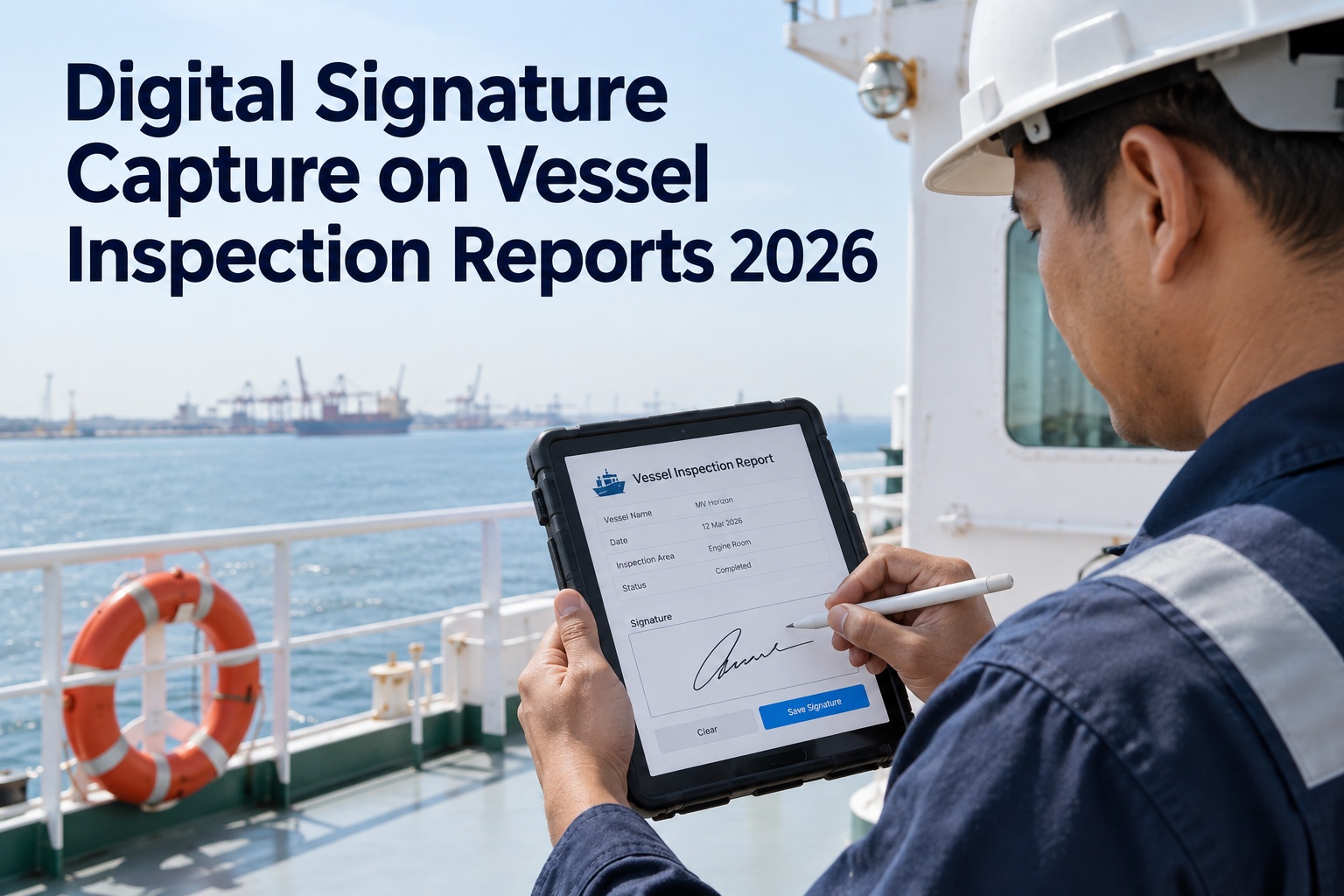
Digital Signature Capture on Vessel Inspection Reports
Master, chief engineer and surveyor sign on the device. The record locks at signature, and exports as a verifiable document that stands up when someone disputes it a year and a half later.
A Drawn Squiggle Is Not a Signature
The most common misunderstanding in digital sign-off is that capturing a finger-drawn signature image on a screen achieves what a wet signature achieved on paper. It does not, and the gap becomes apparent precisely when the document matters.
A signature image
A picture of a squiggle, or a typed name, embedded in a file
No proof of who applied it or from which device
No proof the document is unchanged since signing
Trivially copied from one document to another
Presenting this in a dispute proves very little
A verifiable signature
Bound to an authenticated user account, not just a drawn mark
Cryptographically tied to the exact content signed
Independently timestamped, so back-dating is not possible
Any later alteration is detectable rather than silent
This is what courts and auditors treat as evidence
The distinction is recognised in law rather than merely in good practice. Electronic records are admitted as primary evidence where the platform can demonstrate non-repudiation and prove the document was not modified after execution — the requirement running through the major electronic signature frameworks, including the European regulation's explicit test that any subsequent change to the signed data is detectable. The same logic sits inside maritime rules: the IMO guidelines governing electronic record books require data security, audit trails, role-based access and the ability to produce a signed, tamper-evident copy for inspection or legal proceedings. Digital alone is not the standard. A spreadsheet is digital and trivially editable. If you want to know which side of that line your current reports fall on, schedule a walkthrough with a specialist or open a trial account and sign one yourself.
Four Properties That Make a Signature Hold
Strip away the terminology and a defensible signature answers four questions. A record that answers all four survives challenge; one that misses any of them has a gap someone will find.
Identity
Who signed. The signature is bound to an authenticated account with a known role aboard, not to a name anyone could type. Device and session details are captured alongside it.
Intent
That they meant to sign this specific record. The act of signing is a deliberate, recorded step against a defined document, not an ambient setting or a default applied in bulk.
Integrity
That the content is unchanged since. A cryptographic digest of the document is fixed at signature, so any later modification — even a single character — breaks the match and is detectable.
Time
When it happened, from a trusted source rather than the device clock. This is what prevents back-dating and what lets a sequence of records be reconstructed reliably.
Two further properties matter in a fleet context. Corrections must remain possible — paper allows a struck line and an initial, and a digital record must allow the same — but the original entry and the correction should both stay visible to authorised users, so nothing is silently overwritten. And entries should chain, each one's digest incorporating the previous, so that removing or altering a record anywhere in a sequence breaks the chain rather than disappearing quietly. To see these four properties demonstrated on a live record, book a short technical session or try it on sample data.
Watch a report get signed, locked and verified in one sitting
The clearest way to judge this is to see the full sequence on a real inspection — signature applied on the device, record locked, PDF exported, then a deliberate attempt to alter it so you can watch the verification fail. It takes about twenty minutes.
Who Signs What Aboard
Sign-off on a vessel is not a single act by a single person. Different records require different signatories, sometimes in sequence, and a platform that treats signature as one generic field forces workarounds almost immediately.
Signatory
Typically signs
Why it matters later
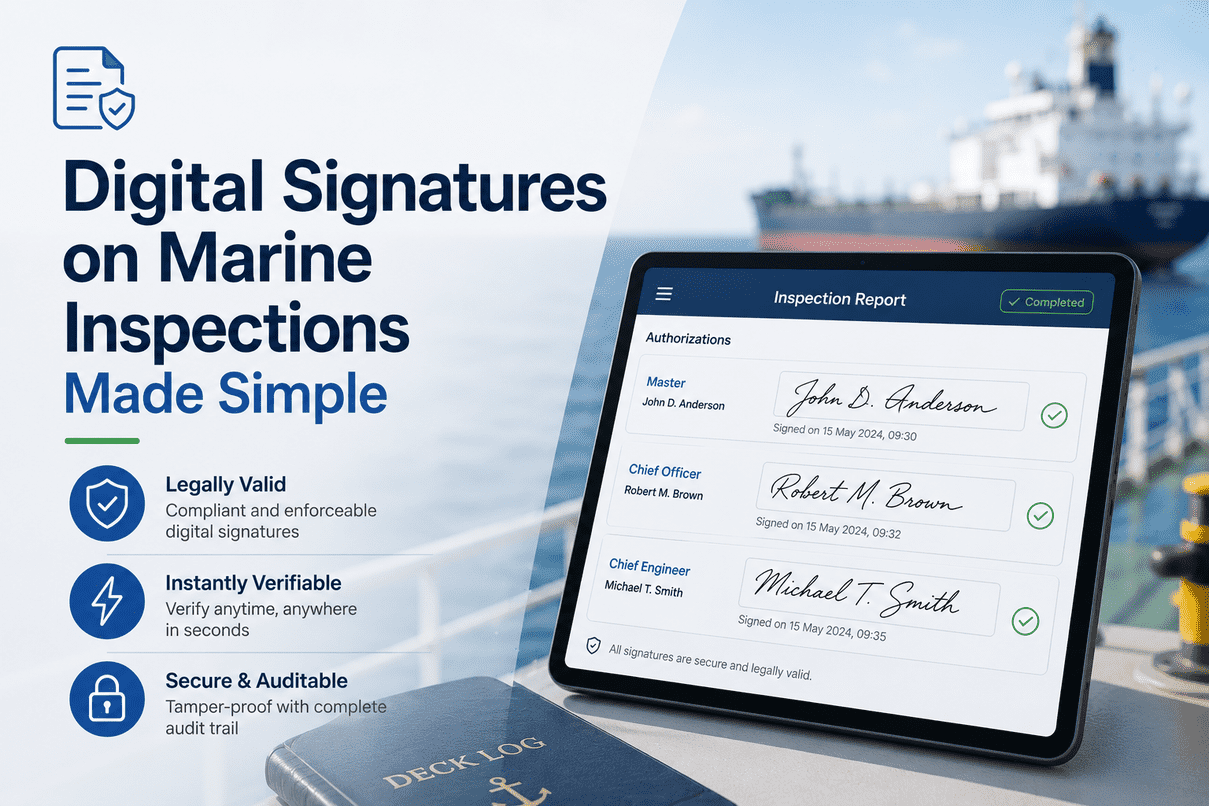
Master
Overall inspection records, statutory entries, incident reports, declarations of condition
The master's confirmation carries the most weight in any dispute and is the signature an investigator looks for first
Chief engineer
Machinery inspections, planned maintenance completion, machinery space and equipment checks
Establishes that maintenance was performed and verified by the responsible officer, not merely scheduled
Responsible officer
Departmental checks, drills, safety equipment inspections, corrective action completion
Attributes each finding and each closure to the person who actually carried it out
Attending surveyor or inspector
Third-party inspections, survey attendance records, condition assessments
An external signature on the same record removes any argument that the document was produced unilaterally
Shore superintendent
Verification of closure for significant findings, review sign-off
Demonstrates independent verification, which is exactly what auditors look for on major items
Countersignature matters more than most operators expect. Where a finding is significant, the discipline of having closure verified by someone other than the person who performed the work is what distinguishes a functioning management system from a self-certifying one — and a platform that supports sequential, role-aware signing makes that discipline automatic rather than aspirational. To map the signing roles your own records need, set up a scoping call or configure a trial around your workflow.
Lock at Signature, Then Export
The signature is not the end of the process — it is the point at which the record changes state. What happens immediately afterwards determines whether the document is evidence or just a file.
DraftFreely editable while the inspection is in progress, offline or online, with photographs and findings attached as work proceeds.
SignedSignatures applied by the required roles, each capturing identity, intent and trusted time against the exact content in front of them.
LockedThe record becomes immutable. Nothing can be silently altered or deleted; any subsequent correction is recorded as a new, attributed action with the original still visible.
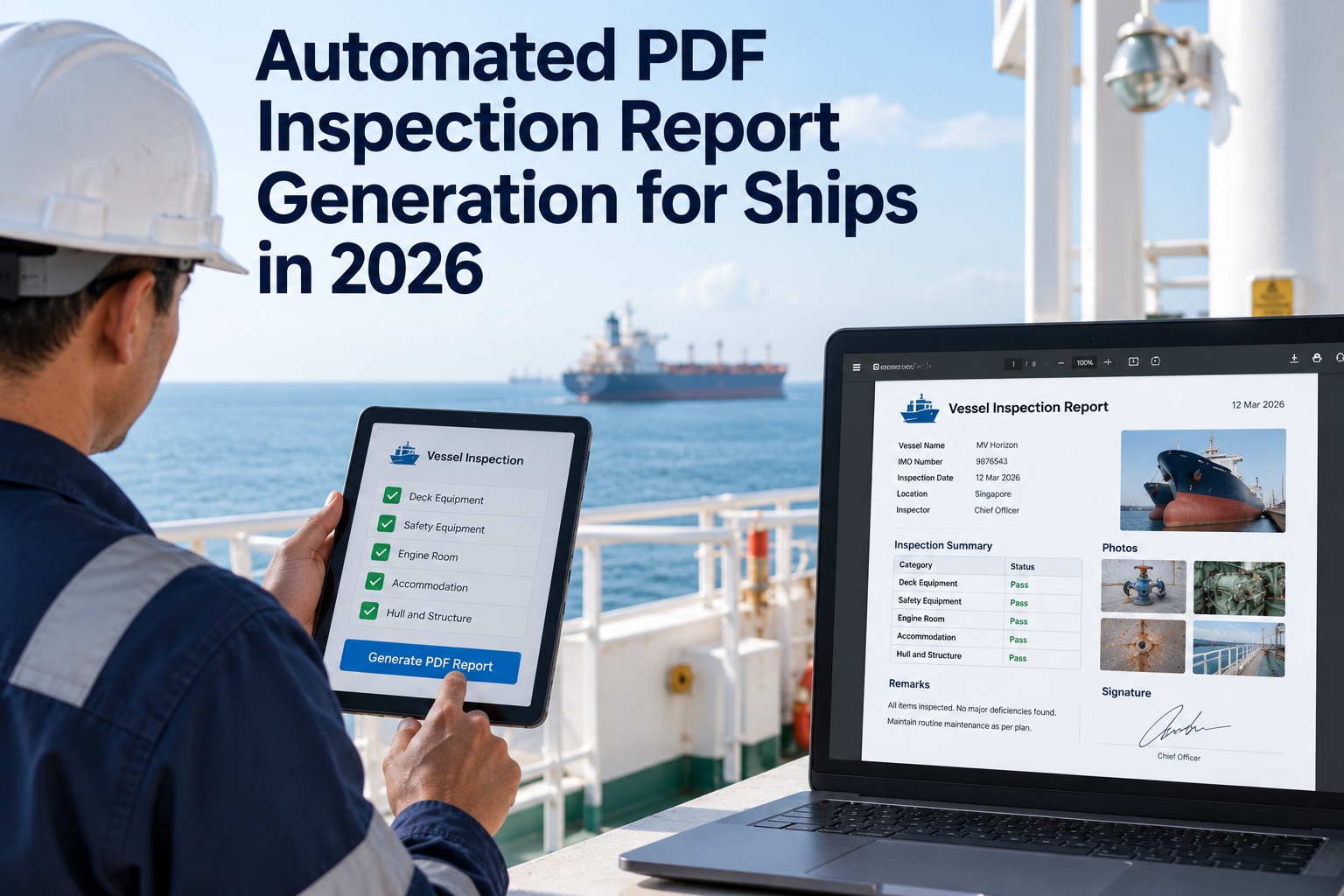
ExportedA signed, tamper-evident PDF produced on demand for an inspector, auditor, class surveyor, charterer or legal proceeding — the form the IMO framework expects a compliant electronic record to be able to produce.
VerifiedAnyone holding the exported document can confirm it matches what was signed. If a single character was changed, verification fails and says so.
That last state is the commercially important one, because it is what converts your internal record into something a third party can rely on without taking your word for it. A charterer's lawyer does not have access to your system, and should not need it. Handing over a document that verifies independently removes an entire category of argument before it starts. To watch an exported document verify — and then fail after a single character is changed — request a live demonstration or run the test in a free trial.
Where Signature Capture Sits in a Marine Software Platform
Signature capture is rarely bought as a standalone product, and it should not be. It is a capability that runs through the modules a fleet already operates, and its value comes from being applied consistently across all of them rather than bolted onto one.
Inspection and checklist module
The primary use. Every completed inspection — statutory, vetting preparation, internal audit, pre-arrival check — is signed by the responsible officer and locked, so the finding set is fixed at the moment of inspection rather than editable afterwards.
Planned maintenance and work orders
Completion sign-off by the chief engineer or responsible officer converts a closed job from a status field into evidence that the work was performed and verified — which is what a class surveyor or Port State Control officer is actually asking for when they request maintenance history.
Defect and corrective action tracking
Closure of a finding is signed, and where the item is significant, countersigned by an independent verifier. This is the mechanism that makes evidenced closure provable rather than asserted.
Electronic record books and logs
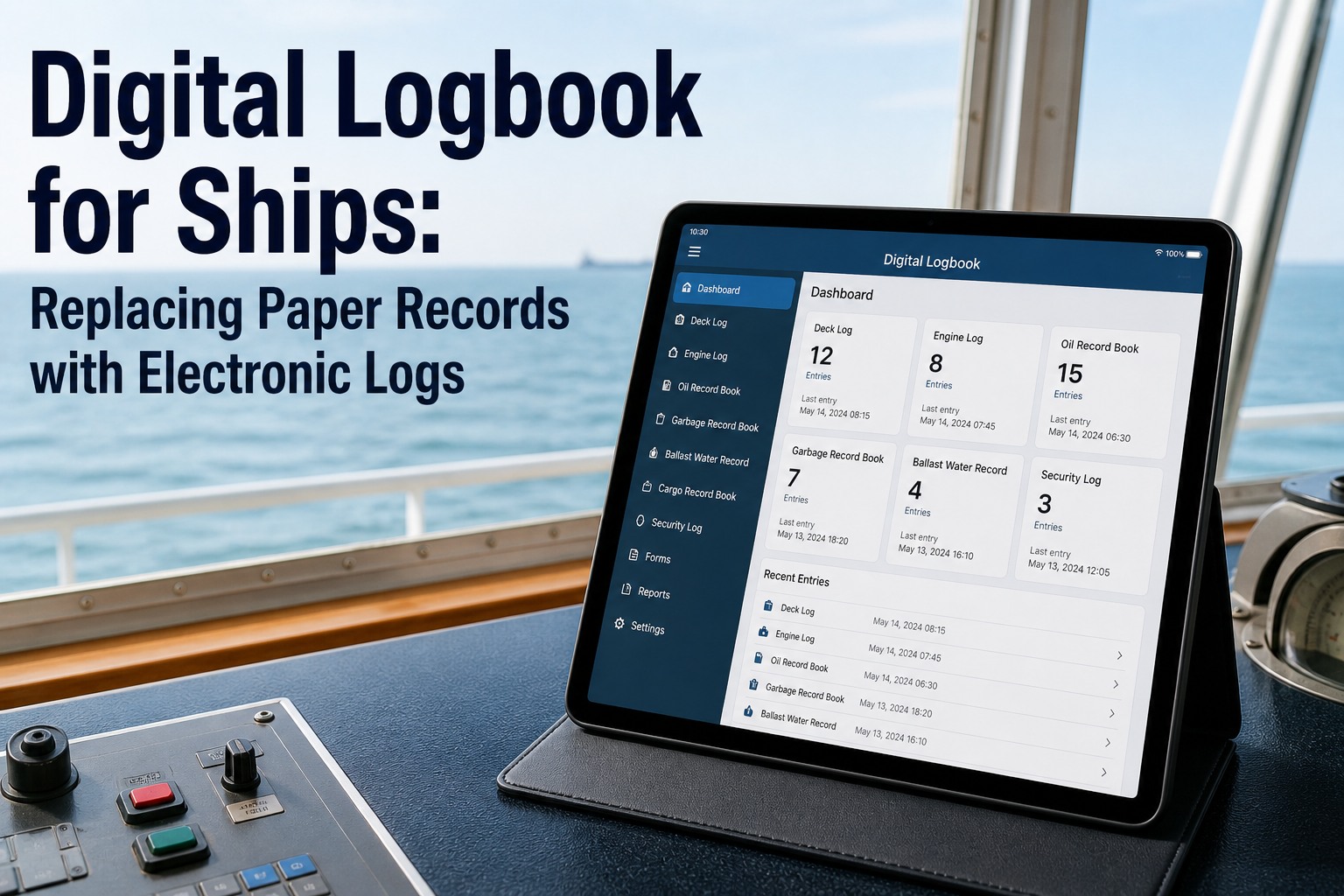
Entries signed and locked in line with the electronic record book framework, with the ability to produce a signed tamper-evident printout for inspection, which the guidelines specifically require.
Drills, training and familiarisation
Participation and completion signed by attendees and the officer conducting them, turning a drill register into attributable evidence rather than a list of dates.
Handovers and third-party attendance
Joint sign-off where an external surveyor, terminal representative or incoming officer confirms a shared record, producing a document neither party can later characterise as one-sided.
The consistency point is the one that decides value. A fleet that signs inspections but not maintenance completions has a defensible record of what was found and an undefended record of what was done about it — which is precisely the half a claimant will attack. Signature capture delivers its return when it is a property of the platform rather than a feature of one module. To review which of your modules currently produce unsigned records, arrange a review session or start exploring with your own data.
See it applied across your actual workflows
The useful conversation is not about signatures in the abstract — it is about which of your records currently go unsigned, what that exposes, and how sign-off would run across your inspection, maintenance and closure workflows. Bring a report format and we will work through it.
The Commercial Case
Signature capture is easy to treat as an administrative nicety. The financial argument sits in three places, and each of them is larger than the cost of the capability.
Claims defended on records made long before
A liability claim can arrive well over a year after the voyage that gave rise to it, and what defends it is the hold cleanliness record, the maintenance history, the defect close-outs, the drill logs and the inspection reports made at the time. Documentation that is missing, incomplete or open to challenge delays settlement or defeats the claim outright. A record that could plausibly have been altered carries little weight exactly when the vessel needs it most — and insurers explicitly list electronic records among the evidence preserved during a casualty investigation.
Inspections that move faster and find less
Retrieval speed is itself part of the impression a vessel makes. Electronic records are produced in seconds where paper archives take the better part of an hour, and searching through files during an inspection signals disorganisation, prolongs the attendance and invites additional scrutiny rather than easing it. Operators running structured electronic records report materially fewer documentation deficiencies and substantially shorter inspections than paper-based equivalents.
Disputes that end before they start
Much of what becomes a commercial dispute begins as an argument about whether a record is genuine, complete or contemporaneous. A signed, independently verifiable document removes that line of attack. Where a third party countersigned at the time, it removes it entirely — the counterparty is disputing a document they executed.
Set against that, the cost of the capability is marginal, because it is not a separate system but a property applied to records the fleet is already producing. The work is already being done and the inspections are already happening; signature capture determines whether the resulting record is an asset or a liability when someone challenges it. That is the entire argument, and it is why the question worth asking internally is not whether to sign records digitally but which of your current records would survive a determined challenge in their present form. If that question is worth twenty minutes, reserve a slot with our team or begin a free trial.
Frequently Asked Questions
Is a digitally signed inspection report legally acceptable?
Electronic records and signatures are recognised across the major legal frameworks, and within maritime specifically the IMO permits electronic record books as substitutes for paper equivalents where they meet defined technical requirements — data security, audit trails, role-based access, backup procedures and the ability to produce a signed, tamper-evident copy for inspection or legal proceedings. Acceptance is conditional rather than automatic: courts admit electronic documents as primary evidence where the platform demonstrates non-repudiation and proves the content was not modified after signing. A drawn signature image satisfies none of that. Where flag state approval is required for particular record types, that approval should be confirmed for your specific administration rather than assumed, since requirements vary between registries.
What is wrong with capturing a drawn signature on screen?
It captures the appearance of a signature without any of the properties that give one weight. An image proves nothing about who applied it, from which device or account, or at what time, and it can be copied from one document onto another. Critically, it says nothing about whether the document changed after it was applied — which is the question an opposing party will actually press. A defensible signature binds to an authenticated user, ties cryptographically to the exact content signed, carries a trusted timestamp rather than a device clock reading, and makes any later alteration detectable. The difference is invisible while nobody is arguing and decisive the moment somebody is.
Can a signed record still be corrected if there is a genuine error?
Yes, and any system that prevents correction entirely is unusable in practice. The requirement is that corrections work the way paper corrections work — a struck line and an initial, with the original still readable — rather than a silent overwrite. In a properly built system the locked record cannot be edited in place, but an authorised user can issue a correction that is recorded as a new, attributed and timestamped action, with both the original entry and the correction remaining visible. That approach preserves the integrity of the record while accommodating the reality that mistakes are made. A system where an entry can simply be changed after signature offers no evidential value at all, regardless of how it looks.
Can signatures be captured with no connectivity?
They must be, because the inspections that most need signing happen in engine rooms, cargo holds and tanks where no signal reaches. The signing step should be fully available offline — the record completed, signed by the responsible officer, locked and queued locally — with transmission occurring automatically when connectivity returns and no crew intervention required. Trusted timestamping needs particular attention here, since relying on a device clock offline weakens the time property, and a well-designed system handles this without pushing the problem onto the user. If signing requires a connection, crews revert to completing the inspection on paper and signing at a desk afterwards, which reintroduces exactly the gap between observation and record that undermines the evidence.
Who needs to sign an inspection report?
It depends on the record, which is why role-aware signing matters. The master typically signs overall inspection records, statutory entries and incident reports, and that signature carries the greatest weight in a dispute. The chief engineer signs machinery inspections and maintenance completions, establishing that work was performed and verified rather than merely scheduled. Responsible officers sign departmental checks, drills and corrective action completions, attributing each finding and closure to whoever carried it out. Attending surveyors or inspectors sign third-party records, which removes any argument that a document was produced unilaterally. Shore superintendents sign verification of closure on significant findings, demonstrating the independent verification auditors specifically look for. Sequential, role-aware signing makes this routine rather than dependent on individual diligence.
How does a third party verify a document we send them?
Through the exported document itself, without needing access to your system. A signed, tamper-evident export allows the recipient to confirm the content matches what was signed and to see who signed it and when. If any part of the file has been altered, verification fails rather than passing silently. This independence is the commercially valuable property: a charterer's lawyer, an insurer, a class surveyor or a Port State Control officer can rely on the document without taking the operator's word for it or being granted access to internal systems. It converts an internal record into third-party evidence, which is precisely what removes the argument about whether a report is genuine and contemporaneous before that argument can develop.
Which of Your Records Would Survive a Challenge?
That is the question worth answering before the next claim, vetting inspection or survey. Marine Inspection captures signatures on device and offline, binds them to authenticated users with trusted timestamps, locks the record at signature while preserving visible corrections, and exports verifiable documents a third party can check independently — across inspections, maintenance completions, closures, drills and logs. The fastest way to judge it is to put one of your own report formats in front of us.