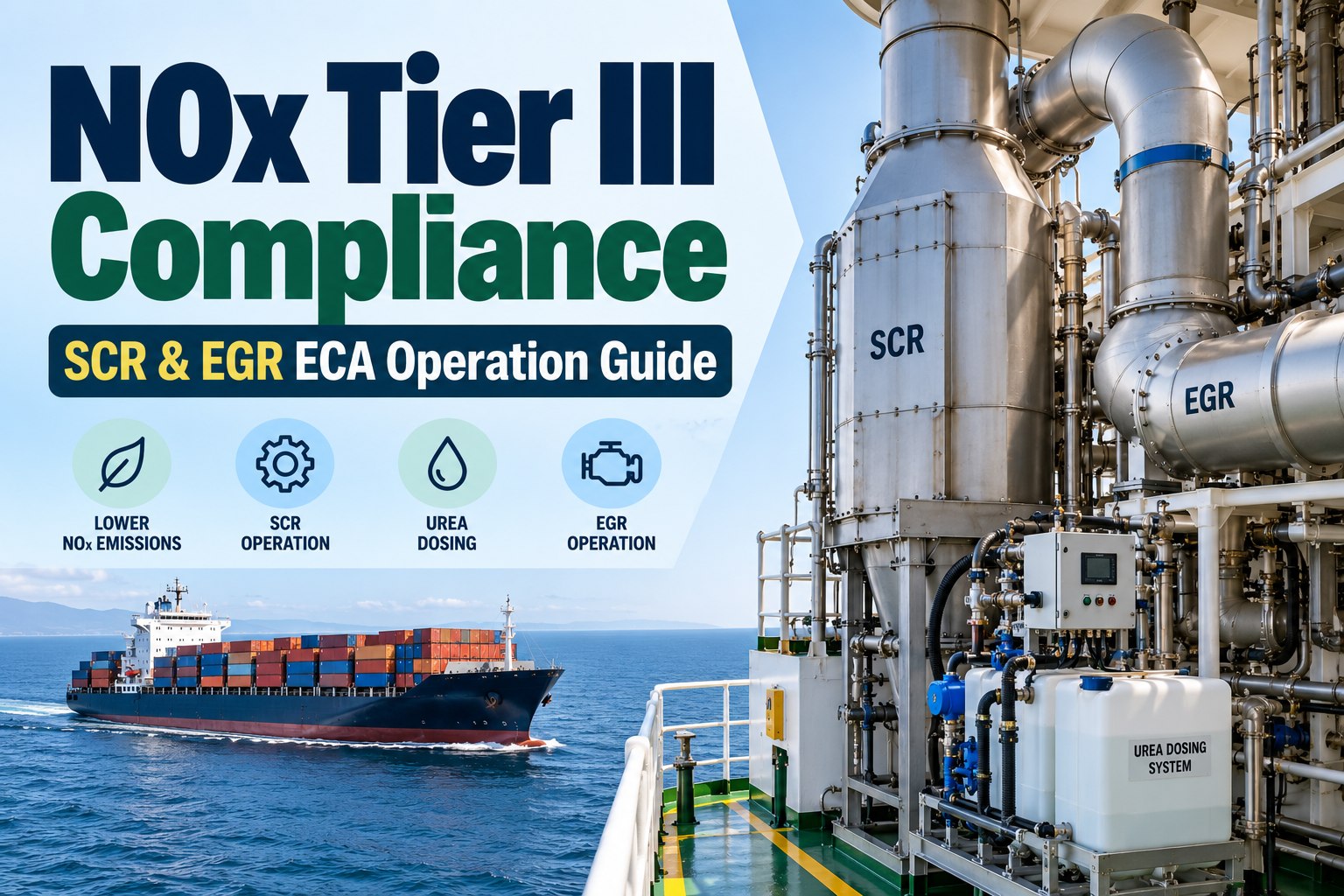
For a Chief Engineer, NOx Tier III is not a certificate on the wall. It is a promise that the engine will actually run in Tier III mode, every hour, inside a NOx Emission Control Area. Tier III cuts the permitted NOx limit by roughly 80% against Tier II, and no engine meets that by tuning alone. It takes selective catalytic reduction (SCR) or exhaust gas recirculation (EGR), a working technical file, and records that show the switch was made on time. This guide covers where Tier III applies, the limits, how SCR and EGR must be run, what to log at every ECA entry and exit, and what port state control looks at. Start a free trial of Marine Inspection to keep engine mode logs and NOx system checks in one trail.
One Engine, Two Modes: Run Tier III Where It Counts
Same engine, same load. Outside an ECA it may run in Tier II mode. Inside, the limit drops sharply. Limits in g/kWh for engines under 130 rpm:
Free trial available. Or book a walkthrough built around your own engine room.
2026 UPDATE
The Canadian Arctic and Norwegian Sea ECAs entered into force on 1 March 2026, and the North-East Atlantic ECA is adopted for 2027. Tier III applicability depends on the area and on the ship's build dates, so read the NOx page of your IAPP supplement for each area on the voyage plan before relying on a general rule.
| NOx ECA | Tier III applies from | Chief Engineer's check |
|---|
| North American and US Caribbean Sea | 2016, for ships with keel laid on or after 1 January 2016 | Engine certified Tier III, mode switch logged on entry and exit |
| Baltic Sea and North Sea | 2021, for ships built on or after 1 January 2021 | Older Tier II ships are not required to meet Tier III here |
| Canadian Arctic and Norwegian Sea | In force 2026 | Check the build-date tests in your supplement. They differ by area |
| North-East Atlantic (adopted) | Planned for 2027 | Add to voyage planning now for new tonnage |
Tier II vs Tier III NOx Limits by Engine Speed (g/kWh)
Under 130 rpm: Tier II
14.4
Under 130 rpm: Tier III
3.4
2000 rpm and over: Tier II
7.7
2000 rpm and over: Tier III
1.96
Between 130 and 2000 rpm the limits are 44 x n^-0.23 (Tier II) and 9 x n^-0.2 (Tier III). The 600 rpm values are our own calculation from those formulas, shown as an example. Check the exact value on your EIAPP certificate.
Know your engine's certified value before the ECA, not after. See how Marine Inspection stores engine certificates and NOx records per engine.
SCR or EGR: Two Ways to Reach Tier III, Two Different Watch Routines
SCR
Catalyst and reductant
Urea dosing: keep the reductant tank, quality and dosing pump in order. Wrong or contaminated solution damages the catalyst.
Exhaust temperature: the catalyst needs a minimum gas temperature to work. Low-load running can fall below it.
Sulphur fouling: sulphur in fuel can form deposits on the catalyst, so fuel choice and soot blowing matter.
Ammonia slip: watch for unreacted ammonia leaving the stack, a sign of over-dosing or a tired catalyst.
EGR
Recirculated exhaust
Scrubber water: recirculated gas is washed and cooled. The wash water needs treatment and correct handling of the bleed-off.
Fuel sulphur: EGR is sensitive to sulphur. Corrosion in the recirculation path rises with high sulphur fuel.
Fouling and wear: soot and acid affect coolers, blowers and the engine itself. Follow the maker's intervals.
Alarms and trips: know what the system does on a fault and how the engine reverts.
The watch points above are our suggested summary of common practice. Limits, temperatures and intervals are set by the engine and system maker, so follow the manual and approved technical file for your plant.
The Mode-Switch Timeline: What the Log Must Show
1
Before the ECA
Prepare the system, warm up the SCR, confirm reductant stock and alarms.
▶
2
Entry
Switch to Tier III mode. Log the status, date, time and position.
▶
3
Inside
Keep Tier III mode on. Watch exhaust temperature and dosing.
▶
4
Exit
Switch back if allowed. Log the new status with date, time and position.
Lloyd's Register notes that records must show the Tier III on or off status when it changes inside an ECA, with date, time and position, in the logbook the Administration specifies. Ships with both Tier II and Tier III engines should also record the Tier II engine status.
Never Miss a Tier III Switch Entry
Log mode changes with time and position, and keep SCR and EGR checks in the same trail as the engine log.
Free trial available. Or book a walkthrough built around your own engine room.
Technical File and Verification: The Paperwork Behind the Engine
| Document | What it proves | Check on board |
|---|
| EIAPP Certificate | The engine's certified NOx tier and approved parameters | Copy on board, matches the engine plate and serial number |
| Technical File | Approved components, settings and the NOx Technical Code method used | Latest approved version, with any changes approved and recorded |
| Record Book of Engine Parameters | Engine settings and changes that affect NOx | Up to date after overhauls and part replacements |
| On-board verification procedure | How compliance is checked in service | Crew know which method applies, such as parameter check or direct measurement |
| IAPP Certificate and supplement | Ship-level NOx details | Supplement matches the engines installed |
| SCR and EGR maintenance records | Reductant use, catalyst and cooler care | Tied to running hours and maker's intervals |
Document names follow MARPOL Annex VI and the NOx Technical Code 2008. Exact requirements for your engine are in its approved technical file.
Troubleshooting Board: Symptom, Likely Cause, First Check
SCR not dosing at low load
Exhaust temperature below the catalyst minimum
Check temperature trend and load profile
Rising pressure drop over the catalyst
Fouling from soot or sulphur deposits
Review soot blowing and fuel sulphur
Ammonia smell or slip alarm
Over-dosing or ageing catalyst
Check dosing rate and NOx sensor
EGR water foaming or carry-over
Water quality or treatment problem
Check water treatment and level control
Engine reverts to Tier II mode
System fault or alarm trip
Record time, position and cause in the log
Sensor reads out of range
Calibration or sampling fault
Check against the maker's calibration steps
This board is our own suggested starting point for the engine room, not a maker's procedure. Always follow the equipment manual.
What Port State Control May Ask the Chief Engineer
!Show the EIAPP certificate and technical file for each engine
!Show the logbook entry for the last ECA entry and exit
!Explain how the engine switches to Tier III mode
!Show reductant stock and SCR or EGR maintenance records
!Explain what happens on a system fault
These are our suggested prompts based on the record requirements above, to help you rehearse. Inspectors decide their own questions.
Does Tier III apply outside an ECA?
No. Tier III standards apply only inside NOx Emission Control Areas. Outside them, Tier II limits apply to the engine.
Which ships need Tier III engines?
Ships built on or after the date set for the ECA, with the build-date test depending on the area. For the North American and US Caribbean ECAs the date is a keel laying on or after 1 January 2016. Check your IAPP supplement for others.
What must be logged at ECA entry and exit?
When the Tier III on or off status changes inside an ECA, record the status with date, time and position, in the logbook the Administration specifies.
Book a walkthrough of NOx mode logging to see it on a vessel.
What if the SCR cannot work at low load?
Record the cause, time and position, and tell the master and company. Do not leave the gap unexplained in the logbook. Ask your flag or class for guidance on the case.
SCR or EGR: which is easier to run?
It depends on the fuel, the engine and the trade. SCR needs reductant and temperature management. EGR needs water treatment and attention to sulphur. Follow the maker's manual for your system.
Keep Tier III Proof Ready in the Engine Room
One trail for mode switch logs, SCR and EGR checks, certificates and technical file records, across every engine in the fleet.
Free trial available. Or book a walkthrough built around your own engine room.