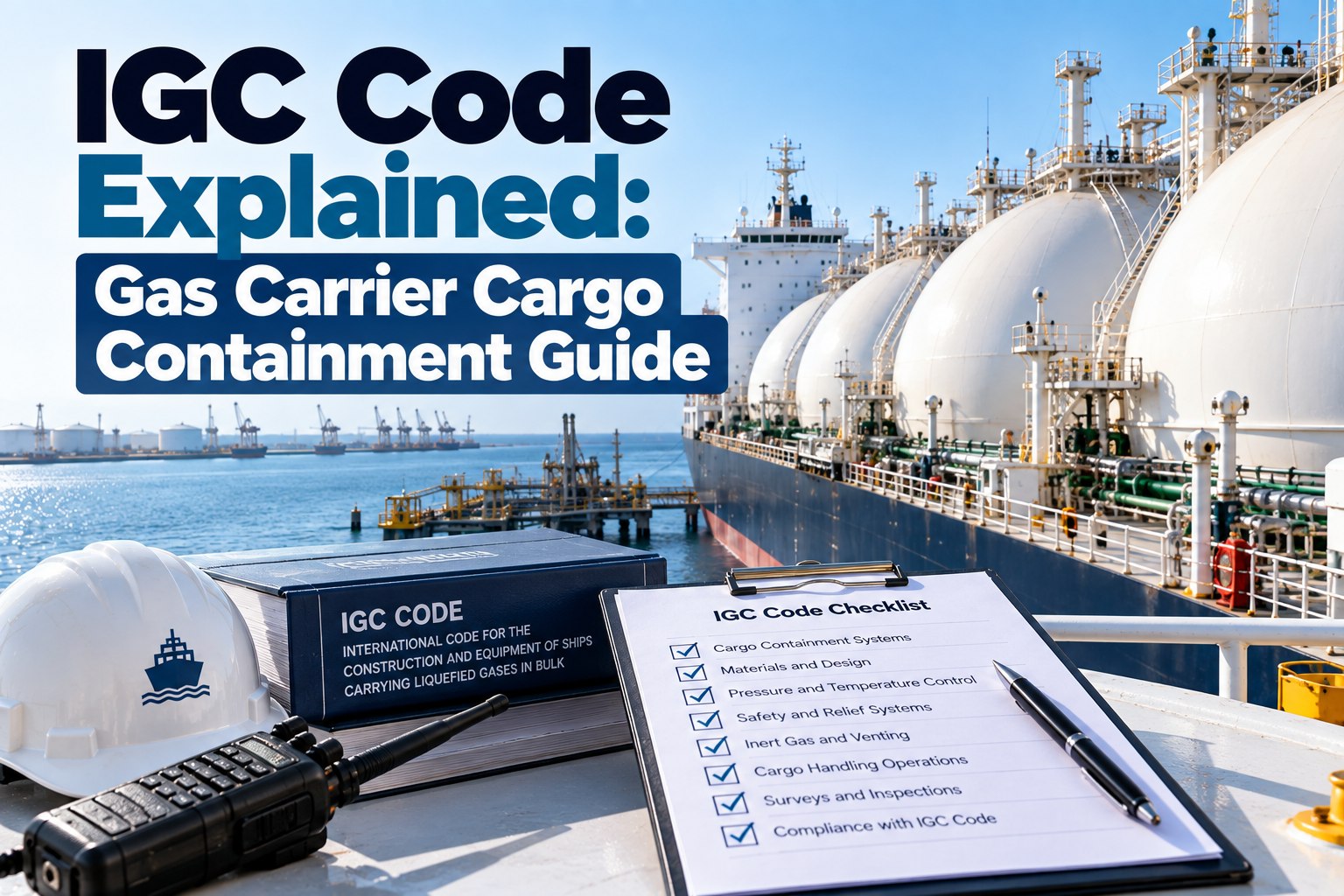
A gas carrier is a ship built around one question: how do you hold a cargo that boils at minus 163 degrees Celsius, or at ambient temperature under pressure, inside a steel hull without leaks, brittle fracture or an unsafe pressure rise? The IGC Code answers it with rules for containment type, materials, pressure and temperature control, instrumentation and safety systems. For the marine superintendent it decides what you look at on a gas tonnage inspection, which items are unique to LNG and LPG ships and where defects become expensive. This guide covers the main containment types, the cold-materials logic, the four ship types, boil-off and pressure control, the survey cycle and the gas-specific items to check. See how to plan your tank and cargo-system inspections in Marine Inspection, with findings, photos and actions tracked per vessel.
GAS CARRIER SUPERINTENDENT BRIEF
Five Ways to Hold a Liquefied Gas: Read the Tank Before You Read the Report
Containment type drives the pressure, the secondary barrier, the materials and the survey focus. Start there.
Free trial available. Or book a walkthrough built around your own gas fleet.
Membrane
Thin metal skin, hull-shaped, full secondary barrier
Type B
Spherical Moss or prismatic SPB, partial barrier
Type A
Prismatic, low pressure, complete barrier
Type C
Pressure vessel, no secondary barrier
Integral
Part of the hull, limited use in practice
The Containment Gallery: Shape, Barrier and Where You Meet It
Membrane
Pressure: low, near atmospheric. Barrier: complete secondary. Typical cargo: LNG on large carriers (GTT No96, Mark III).
Type B (Moss)
Pressure: low. Barrier: partial, drip trays and splash barriers. Design principle: leak before fail. Typical cargo: LNG.
Type A
Pressure: low, normally below about 0.7 bar. Barrier: complete secondary. Typical cargo: fully refrigerated LPG.
Type C
Pressure: above about 0.7 bar, up to pressurised LPG levels. Barrier: none required. Typical cargo: LPG, small LNG, ammonia.
Pressure bands are typical values summarised from industry references. Always take limits from the vessel's approved cargo containment documents and the IGC Code text, chapter 4.
Inside a Membrane Tank Wall: Five Layers, Two Barriers
Cargo sidePrimary barrier: thin metal membrane that touches the cargo
Layer 2Primary insulation
Layer 3Secondary barrier: holds any leakage
Layer 4Secondary insulation
Hull sideShip's inner hull structure
Why the Surveyor Cares
The secondary barrier must be able to hold leakage safely, typically for 15 days.
Ordinary hull steel turns brittle at cargo temperature, so barrier integrity protects the ship's structure.
Membrane tanks have class-set filling restrictions to avoid sloshing damage on passage.
Containment Comparison: What Changes the Inspection
Barrier and service entries follow the IGC Code containment concepts. The focus column is our suggested priority list, not an official survey list.
Barrier and insulation findings need photos and a trail that outlasts the voyage. Try inspection forms free to log tank findings with evidence and follow-up dates.
The Cold Ladder: Colder Cargo, Tougher Materials
LNGabout -163 C
9% nickel steel, Invar, aluminium 5083, 304L stainless
Ethyleneabout -104 C
Low-temperature alloy steels as specified by the Code
Propaneabout -42 C
3.5% nickel steel for refrigerated service
Ammoniaabout -33 C
Carbon steel. No copper, brass or zinc alloys on wetted surfaces
Temperatures are approximate boiling points at atmospheric pressure. Bar length shows relative depth of cold. Material examples are typical, and the vessel's approved materials list governs.
Four Ship Types: How Much Protection the Cargo Needs
1G
Maximum preventive measures
For products that need the most protection against escape. Tanks sit furthest from the shell and the ship faces the strictest damage survival standard.
2G
Significant preventive measures
Dominant type for LNG carriers. Ships above 150 m must survive damage anywhere along their length.
2PG
Significant measures, 150 m or less
Smaller ships with specified tank types. A ship over 150 m is type 2G instead.
3G
Moderate preventive measures
Least hazardous cargoes. Tanks at least 0.8 m inboard of the outer shell.
Pressure and Temperature Control: Four Ways to Handle Boil-Off
1
Burn as fuel
Boil-off gas feeds the engines or boilers where the plant allows it.
2
Reliquefy
A reliquefaction plant turns vapour back to liquid and returns it to the tank.
3
Burn in a gas combustion unit
Excess vapour is disposed of safely when it cannot be used or reliquefied.
4
Hold the pressure
Pressure vessel tanks can accept a rise within design limits for a period.
A typical guaranteed boil-off rate on an LNG carrier is about 0.15% of cargo volume per day, with newer ships closer to 0.10%. Options available depend on the ship's plant and cargo.
The Gas Carrier Survey Cycle: Certificate of Fitness Over Five Years
Start
Initial survey before the first certificate
Year 1
Annual survey, within 3 months either side
Year 2 or 3
Intermediate survey replaces one annual
Year 5
Renewal survey, certificate valid up to 5 years
The Certificate of Fitness records the ship type and the products the ship may carry, and sits within the harmonised survey system. The current IGC Code applies to ships with keels laid on or after 1 July 2016. Earlier ships follow earlier versions.
Walk Every Gas Tank With a Plan
Set up inspection forms for cargo tanks, pressure relief, gas detection and shutdown systems, then follow each finding to closure.
Free trial available. Or book a walkthrough built around your own gas fleet.
Gas-Specific Items on a Superintendent Inspection
These items reflect the Code's chapters on instrumentation, venting, environmental control and personnel protection. They are a working list, so add the items your class and charterer specify.
What is the IGC Code?
The International Code for the Construction and Equipment of Ships Carrying Liquefied Gases in Bulk. It is mandatory under SOLAS Chapter VII and covers containment, materials, piping, instrumentation, venting, fire protection and emergency shutdown for LNG and LPG ships.
Which IGC Code version applies to my ship?
The 2016 revision, adopted by MSC.370(93), applies to ships whose keels are laid on or after 1 July 2016. Older ships follow the earlier version in force when they were built, with later amendments applying as specified. Check the ship's Certificate of Fitness.
What are the main cargo containment types?
Independent tanks (types A, B and C), membrane tanks, semi-membrane tanks and integral tanks. Membrane and Type B systems dominate LNG carriers, while Type A and Type C are common on LPG ships.
Why does the secondary barrier matter?
It holds any cargo leakage from the primary barrier, so very cold liquid does not reach the hull steel. Membrane and Type A tanks need a complete barrier, Type B a partial one and Type C none.
See how Marine Inspection tracks barrier findings across the fleet.
What does the Certificate of Fitness cover?
It states the ship type (1G, 2G, 2PG or 3G) and the products the ship may carry with their conditions. It is valid for up to five years, with annual and intermediate surveys in between.
Prepare Your Next Gas Carrier Survey
One place for tank inspection forms, evidence, deficiencies and follow-up actions across your LNG and LPG tonnage.
Free trial available. Or book a walkthrough built around your own gas fleet.