Going paperless on vessel inspections is one of the highest-return, lowest-risk digital moves a fleet can make in 2026, and yet it is the projects that stumble on the human side, not the technology, that make operators hesitant. The business case is no longer in question: fleets replacing paper inspections with digital tools report administrative time falling by around seventy per cent, deficiencies dropping by three-quarters, and payback arriving within four to six months, with one major operator digitising more than two hundred vessels and saving twelve million dollars a year. Adoption has crossed the tipping point too, rising from roughly a quarter of the industry in 2023 to more than two-thirds in 2026, pushed by Port State Control now accepting digital records at a ninety-two per cent rate and by risk-scoring systems that inspect digitally-mature vessels far less often. But here is the part the ROI tables leave out: the single biggest determinant of whether a fleet realises those returns is not which tool it picks — it is whether the crew actually use it, because roughly seventy per cent of digital-transformation failures come down to change management, not technology. This guide is about going paperless well. It sets out the ROI you can expect, why adoption is the real variable, how to phase a rollout so it sticks, and what to expect month by month once you go fully digital. To start replacing paper inspections with a mobile, offline-capable digital system on your own vessels, start a free trial or book a demo.
REPORTS & SYSTEM · DIGITAL TRANSFORMATION 2026
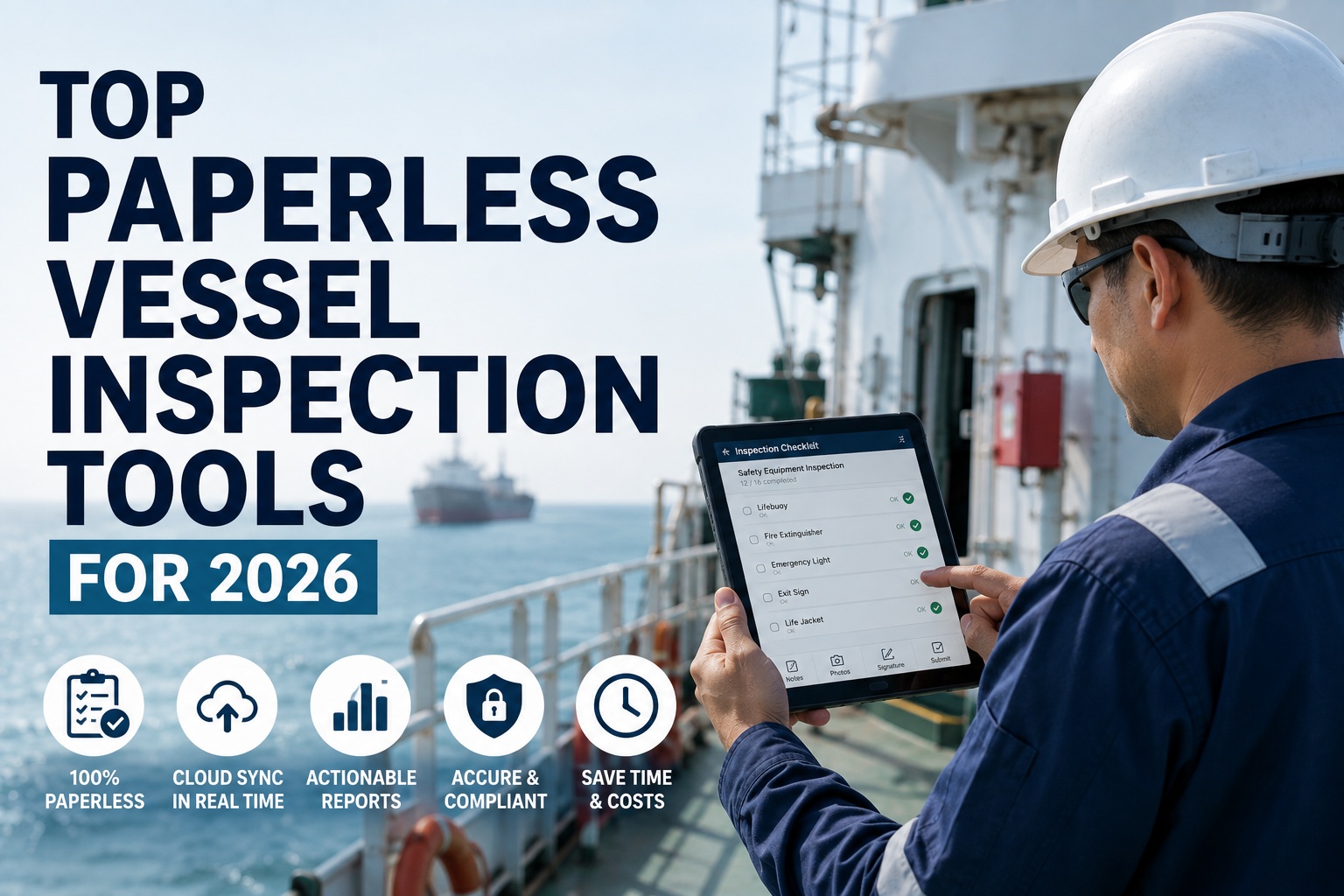
Top Paperless Vessel Inspection Tools for 2026
What to expect when your fleet goes fully digital — the ROI benchmarks paperless inspection delivers, why crew adoption decides whether you realise them, how to phase a rollout that sticks, and the month-by-month reality of leaving paper behind.
FROM
Paper checklists
Lost documents
End-of-watch typing
Audit-day scramble
TO
Mobile capture
Instant retrieval
Auto reports
Always audit-ready
The ROI Is Real and Fast
Economic pressure means every software decision now demands a measurable return, and paperless inspection is one of the few that pays back within a single year. The benchmarks reported across the industry are consistent enough to plan against.
70%
Administrative time reduction
Auto-population, templates and validation eliminate redundant data entry, worth around sixty-five thousand dollars a year in reported cases.
78%
Fewer deficiencies
Structured digital checks and proactive tracking cut inspection deficiencies sharply, worth around forty thousand dollars in avoided consequences.
4–6
Month payback period
Combined time, deficiency and efficiency savings mean the investment typically pays for itself within the first half-year of use.
92%
PSC digital-record acceptance
Port State Control now accepts digital records at a ninety-two per cent rate, so going paperless is no longer a compliance risk but an advantage.
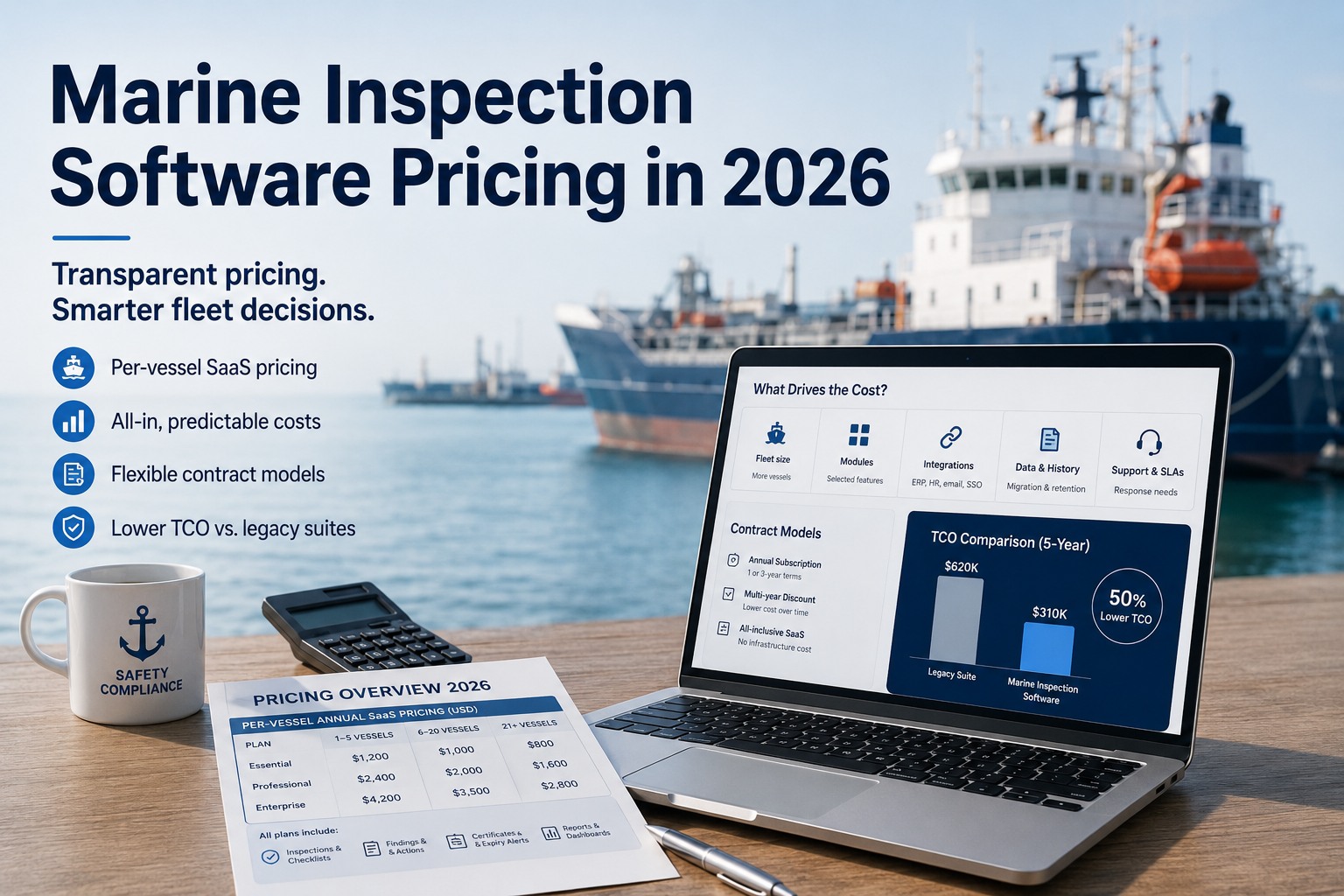
These figures scale dramatically with fleet size. One major operator that implemented digital inspection across more than two hundred vessels reported an eighty-two per cent reduction in administrative time, sixty-seven per cent faster Port State Control inspections, and twelve million dollars in annual savings fleet-wide. Even for a small operator, the logic holds: at typical SaaS pricing of roughly eight to fifteen thousand dollars per vessel per year, the administrative saving alone often covers the cost several times over, before counting fewer deficiencies, faster inspections and the value of never losing a document again. The market has noticed, with adoption climbing from around twenty-seven per cent in 2023 to sixty-eight per cent in 2026 as these returns became undeniable. To model the paperless return against your own fleet's inspection volume and admin cost, start a free trial or book a demo.
Adoption Is the Real Variable
Here is the truth that separates fleets that capture these returns from fleets that do not: the ROI is a function of adoption, not of the tool. A powerful platform that the crew avoid delivers nothing, while a good platform that everyone uses delivers everything the benchmarks promise. And the evidence on why projects fail is unambiguous.
Around 70% of digital-transformation failures are about change management, not technology
The software almost always works. The projects that fail do so because drivers will not open the app, technicians keep their paper clipboards, and managers never log into the dashboard. Low adoption means low return regardless of how capable the platform is. The encouraging corollary is that adoption is controllable: studies show no correlation between crew age or tech comfort and adoption success, and fleets that deploy with hands-on training rather than classroom lectures reach ninety-five per cent or higher adoption within thirty days. Digital inspections are actually faster than honest paper ones, and crews prefer them once they try — so the whole game is getting them past the first use, which is a change-management task, not a technology one.
This reframes the entire selection process. When people worry about which paperless tool is best, the more important question is which tool the crew will actually adopt, and what support the vendor provides to make that happen. The best platforms in 2026 understand this and invest in crew experience, guided onboarding, progressive feature rollout, and integrations that remove redundant data entry — they make the right thing easy and the wrong thing hard. Choose a tool the crew will use, the managers will review, and leadership will act on, and the ROI follows. Choose on feature count alone and you may buy a capable platform that never gets used. To see how onboarding and crew experience are designed to drive adoption from day one, start a free trial or book a demo.
The best tool is the one your crew will actually use
ROI tracks adoption, and adoption is a change-management outcome, not a feature. Marine Inspection is built mobile-first with guided onboarding and hands-on support, because a paperless tool only pays back when the crew reach for it instead of the clipboard.
The Rollout That Sticks — A Phased Path
Going paperless works best as a phased transformation rather than a fleet-wide switch overnight, because a phased approach builds momentum, surfaces problems early, and gives the organisation time to adapt. This is the sequence that consistently succeeds.
Phase 1
Pilot on two or three vessels
Start with a small pilot rather than the whole fleet. Testing on two or three vessels first identifies around eighty-five per cent of the issues before scale, in a setting where they are cheap to fix. Choose representative vessels, get the crew hands-on quickly, and prove the workflow against real inspection types on actual hardware, offline included.
Phase 2
Train hands-on and measure
Deploy with hands-on, practical training rather than classroom lectures — the difference that takes fleets to ninety-five per cent adoption within thirty days. Address concerns directly: if crews worry about surveillance, show how the record protects them; if about speed, show the guided checklist beating the paper form. Track adoption and early savings from the start.
Phase 3
Expand across the fleet systematically
With the pilot proven and the playbook refined, roll the system out vessel group by vessel group, carrying the lessons and the trained champions forward. Provide continuous support and refresher sessions, and keep monitoring adoption and utilisation so no vessel is left half-transitioned.
Phase 4
Optimise and quantify the return
Once running fleet-wide, refine workflows on real-world usage data, verify every regulatory requirement is met digitally, and quantify the time and cost savings achieved to validate the investment and identify the next digitisation opportunity, from certificates to maintenance to analytics.
What to Expect When You Go Fully Digital
Knowing the shape of the transition removes the fear from it. The timeline is well established, and the milestones arrive in a predictable order.
First 90 days
Early, visible wins. Inspection preparation time typically falls by around forty per cent in the first ninety days as the crew get comfortable and the digital record starts to build, which is exactly the momentum a rollout needs to sustain buy-in.
Documentation and retrieval
Paper Oil Record Books, checklists and maintenance logs give way to instant retrieval and automated, compliant formatting, cutting inspection preparation by around sixty per cent and ending the era of the lost document — a surveyor can be handed a complete history in minutes.
Full transformation
Most operators reach full digital transformation within roughly eighteen to twenty-four months through phased rollout, arriving at real-time compliance visibility, a seventy per cent administrative reduction, and a sixty to seventy-five per cent drop in deficiencies.
The competitive gap
Early adopters gain an eighteen-to-twenty-four-month operational advantage, and risk-scoring increasingly rewards digital maturity — strong digital vessels see inspection rates fall while paper-bound ones are targeted more often, turning the transition into a compliance edge.
The larger point is that going paperless is no longer an experiment with an uncertain outcome; it is a well-trodden path with known returns, a known timeline and a known failure mode that is entirely avoidable. The fleets that succeed treat it as the change-management project it really is — piloting small, training hands-on, rolling out in phases, and measuring the return at every step — rather than as a software purchase that will somehow adopt itself. Do that, and the paperless benchmarks stop being other companies' case studies and become your own numbers: the admin hours given back, the deficiencies that no longer happen, the documents that are never lost, and the payback that lands within the first year. In a 2026 where Port State Control expects digital records and risk-scoring rewards those who have them, the question is no longer whether to go paperless but how to do it well. To begin that transition on your own fleet with a platform built for adoption, start a free trial or book a demo.
Frequently Asked Questions
What ROI can a fleet expect from paperless inspections?
The reported benchmarks are consistent: around a seventy per cent reduction in administrative time, roughly seventy-eight per cent fewer deficiencies, faster inspections, and a payback period of four to six months. At scale the numbers grow — one operator across more than two hundred vessels reported an eighty-two per cent administrative reduction, sixty-seven per cent faster Port State Control inspections and twelve million dollars in annual savings. Against typical SaaS pricing of eight to fifteen thousand dollars per vessel per year, the administrative saving alone often covers the cost several times over. The exact return depends on your starting point, but paperless inspection is one of the few digital investments that reliably pays back within the first year.
Why do some paperless rollouts fail?
Almost always because of change management, not technology — studies attribute around seventy per cent of digital-transformation failures to poor change management. The software works; the projects fail when crews will not open the app, technicians keep paper clipboards, and managers never review the dashboard. Since ROI is a function of adoption, low adoption means low return regardless of how capable the platform is. The good news is that adoption is controllable: there is no correlation between crew age or tech comfort and success, and hands-on training rather than classroom lectures gets fleets to ninety-five per cent adoption within thirty days. Treating the rollout as a change-management project, not a software install, is what prevents failure.
How long does going fully paperless take?
Most operators reach full digital transformation within roughly eighteen to twenty-four months through a phased rollout, but meaningful returns arrive much sooner. Inspection preparation time typically falls around forty per cent within the first ninety days, and a well-run pilot on two or three vessels proves the workflow within weeks. The phased path — pilot, hands-on training, systematic fleet expansion, then optimisation — front-loads quick wins to build momentum while the full transformation completes over the following months. So while complete transformation is an eighteen-to-twenty-four-month journey, a fleet starts seeing and feeling the benefits within the first quarter.
Should I pilot before rolling out to the whole fleet?
Yes — piloting is the single most reliable way to de-risk the rollout. Testing on two or three representative vessels first surfaces around eighty-five per cent of the issues before scale, in a setting where they are cheap to fix, and it produces a proven playbook and trained champions to carry into the wider deployment. The pilot is where you confirm the workflow against real inspection types, test offline behaviour on actual vessel hardware, and refine training. Only once the pilot succeeds should you expand systematically, vessel group by vessel group. Skipping the pilot and switching the whole fleet at once is how avoidable problems become fleet-wide problems.
Will Port State Control accept digital inspection records?
Yes, and increasingly they expect them. Port State Control now accepts digital records at around a ninety-two per cent rate, and inspectors expect vessels to produce complete documentation histories within minutes using digital systems. Going paperless has shifted from a perceived compliance risk to a compliance advantage: digital records speed inspections, and risk-scoring systems increasingly favour digitally mature vessels, with strong digital vessels facing lower inspection rates while paper-bound ones are targeted more often. Rather than jeopardising compliance, a well-implemented paperless system strengthens it — producing cleaner records, faster retrieval, and the audit-ready documentation that reduces both inspection time and detention risk.
How do I get crew to actually use the new system?
Focus on the first use, because crews prefer digital inspections once they try them — the guided checklist is faster than an honest paper inspection. Deploy with hands-on, practical training rather than classroom lectures, which is what takes fleets to ninety-five per cent adoption within thirty days. Address concerns directly and specifically: if the worry is surveillance, show how the record protects the crew in any dispute or investigation; if it is speed, demonstrate the digital form beating the paper one. Use pilot-vessel champions to bring peers along, provide continuous support and refreshers, and choose a platform with guided onboarding designed for adoption. Getting past the first use is the whole challenge, and it is a solvable one.
Go Paperless the Way That Actually Works
The paperless ROI is real and fast — around seventy per cent less admin time, far fewer deficiencies, and payback within four to six months — but only fleets that treat the rollout as a change-management project capture it. Marine Inspection is built mobile-first with guided onboarding and hands-on support, so your crew adopt it and the benchmarks become your numbers. Pilot it on a few vessels and see the transition begin.