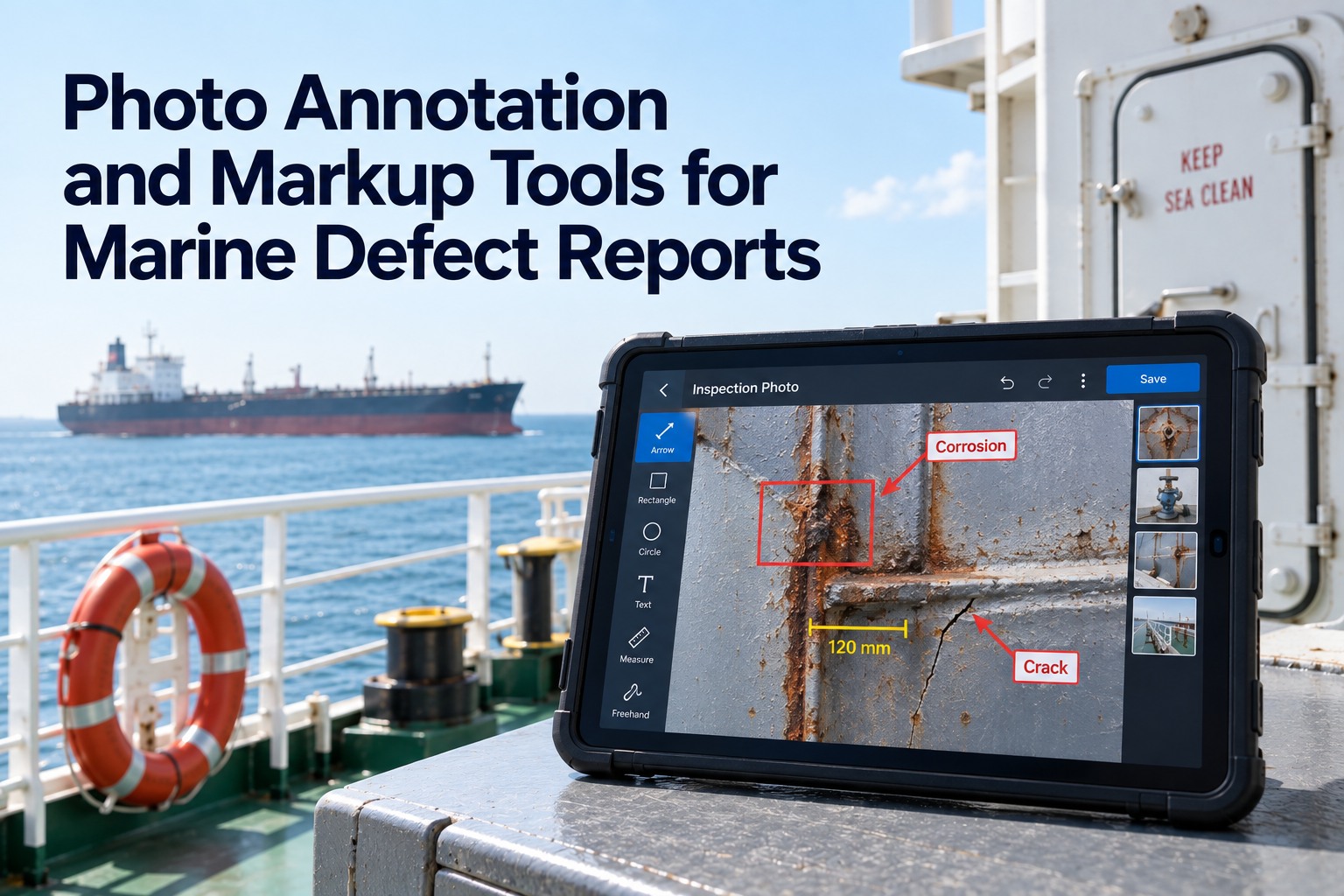
A superintendent opens an inspection report and sees a photograph of corrosion. It could be two centimetres across or two metres — nothing in the frame says which. It shows a pipe run with four valves and the finding refers to one of them, but not which one. So the superintendent picks up the phone, and a finding that was fully understood by the person standing in front of it three days ago now costs two people fifteen minutes and a satellite call to reconstruct. Multiply that across a fleet and the cost is substantial, but the real damage is subtler: findings that generate questions get deferred, and deferred findings become the ones nobody actioned. Photography guidance across inspection disciplines converges on the same requirements — provide a scale reference, avoid close-ups that lack context, and make the location, the feature of interest and the size of the subject readily discernible or clearly labelled. Annotation is how those requirements are met on a vessel, where a ruler is rarely to hand and the light is usually poor. This page covers what to mark and why, the tools that matter, how annotation should be stored so it remains evidence, and where it belongs in the inspection workflow.
CAPABILITY GUIDE · VISUAL EVIDENCE
Photo Annotation and Markup for Marine Defect Reports
Mark the defect, the extent and the dimension on the image itself, at the moment of inspection — so the office sees what the inspector saw and nobody has to ring the vessel to ask which valve.
The Phone Call an Unmarked Photo Creates
Every ambiguous photograph produces the same sequence: a question forms ashore, an email or call goes out, the vessel replies hours or days later depending on watch and connectivity, and a decision waits in the meantime. The inspector knew the answer while standing at the defect. The information was simply never attached to the image.
Three questions account for most of that traffic. Which item is meant, when the frame contains several similar components. How large is the affected area, when the image contains no reference of known size. And how bad is it, when the photograph shows a condition but the report text describes it in terms that could span a wide range of severity. All three are answerable in seconds at the point of capture with a pointer, an outline and a dimension — and unanswerable afterwards without the person who was there. If you want to see how much of your current report correspondence would simply disappear, a short working session against one of your recent reports will show it faster than any description.
What Actually Needs Marking
Annotation is not decoration on an image; each mark answers a specific question that the photograph alone leaves open. These are the marks that earn their place.
The subject
A pointer or arrow identifying precisely which component the finding concerns, which matters most in engine rooms and pipe runs where a frame contains several near-identical items.
The extent
An outline around the affected area, distinguishing a patch of coating breakdown from the surrounding sound surface and showing how far the condition runs.
The dimension
A measurement callout with units, since a photograph carries no inherent scale and the same image could represent a hairline crack or a structural one.
The location
A label tying the image to the ship's own geography — frame number, tank, deck, compartment — so the finding can be found again by someone who was not present.
The context shot
A wider image showing where the close-up sits, because structured sets of wide, medium and close-up views are consistently more useful than a collection of tight shots with no orientation.
The comparison
A paired image at closure showing the same view after rectification, from the same angle, which is what converts a claim of completion into evidence of it.
The dimension mark deserves particular emphasis because it is the one most often skipped and the hardest to reconstruct later. Inspection photography guidance across disciplines asks for a physical scale reference in the frame — a ruler laid against the subject — and where that is impractical in a tank or a confined space, an annotated measurement recorded at the time is the working substitute. What cannot be done is estimating the size afterwards from the photograph, because the information genuinely is not in the image.
Take one recent report and count the follow-up questions
Most operators find a meaningful proportion of findings generated at least one clarifying exchange with the vessel. We will take a report your fleet issued, identify which findings would not have needed a question if the images had been marked at capture, and show the same findings annotated.
Annotation Must Be a Layer, Not a Change
The technical requirement that determines whether annotated photographs survive scrutiny is straightforward and frequently got wrong. Marks must be stored as a separate layer over an unaltered original, never burned into the image file.
The reasoning follows from how photographic evidence is assessed. An image carries weight when it can be shown what it depicts, when and where it was taken, and that it has not been altered since capture. A photograph with annotations permanently flattened into the pixels fails the third test by construction — there is no longer an original to compare against, and a party challenging the finding can reasonably ask what else was changed. Keeping the original intact with a markup layer above it preserves both: the unmodified image remains available for verification, and the annotation is visible as the inspector's interpretation rather than as part of the scene. Metadata matters equally here, since timestamp and position embedded at capture are what establish the when and where, and testing how a platform stores originals and layers is worth doing before committing a fleet to it. The same principle explains why individual images should be held as discrete records rather than combined into a single document, which obscures which photograph evidences which finding.
Marking Up in the Conditions You Actually Work In
Annotation on a vessel is not annotation at a desk, and tools that assume otherwise get abandoned within a week.
Gloved hands, awkward posture
Marking has to work with large touch targets and simple gestures. A tool requiring precise fingertip placement fails when the inspector is braced against a ladder in gloves.
Poor and uneven lighting
Tanks and machinery spaces produce dark subjects and blown highlights. Annotation colours must remain visible against both, and a brief note about what the image fails to show is often worth more than a retake.
No connectivity
Capture and markup both happen where there is no signal, so the whole operation must run locally on the device and sync afterwards with annotations intact.
Immediately, not later
Marking at the point of capture takes seconds and is accurate. The same task at a desk that evening depends on memory and is where photographs get attached to the wrong finding.
That final point is the operational heart of the matter. Annotation done in the space is an act of recording; annotation done afterwards is an act of recollection, and the two produce different quality of evidence even when performed by the same person on the same day.
From Marked Image to Actioned Defect
A marked-up photograph is only worth the workflow it feeds. Where annotation sits inside the inspection system rather than in a separate image tool, several things follow automatically that otherwise require somebody to arrange them.
01
Bound to the checklist item
The image attaches to the specific finding at capture, so it never has to be matched to a finding afterwards and cannot be attached to the wrong one.
02
Carried into the defect record
When the finding becomes a tracked defect, the annotated image travels with it, so whoever is assigned the corrective action sees exactly what was found.
03
Scoped without a conversation
A superintendent ordering parts or arranging attendance works from a marked image with a dimension on it rather than from a description and a guess.
04
Closed with a comparison
The completion photograph is captured against the original view, producing a before-and-after pair that evidences the work rather than asserting it.
05
Rendered into the report
Annotated images place themselves with the findings they evidence when the report generates, rather than being inserted and resized by hand afterwards.
06
Available as evidence later
Retrievable with original, annotation layer, timestamp and position intact when an inspector, surveyor or claim asks about that component months afterwards.
Because step two carries the marked image into the defect record, seeing the full path from capture through to closure in one demonstration tends to be more persuasive than examining the markup tools alone — the annotation is easy to judge, but the value is in what happens to it next.
What Improves, Measurably
This is a capability that can be assessed on evidence rather than impression, and the measures are available from a trial on a single vessel.
The clearest is clarification traffic: how many findings in a reporting period generated a follow-up question to the vessel, before and after. Closely related is time from finding to action, since a defect that can be scoped from the report moves immediately while an ambiguous one waits for a reply. Repair scoping accuracy is a slower but more valuable measure — whether parts ordered from the report turn out to be the right parts, which depends almost entirely on whether dimensions and extent were recorded at the time. For claims and vetting, the measure is whether the evidence pack can be assembled without going back to the people involved, because photographs that need explaining are photographs that need a witness. And finally, coverage: structured sets combining wide, medium and close-up views make a stronger record than an equivalent number of undifferentiated shots, and it is worth checking whether your current photography is producing orientation or only detail.
Frequently Asked Questions
Why does an unannotated photograph cause so much rework?
Because it leaves three questions open that only the person present can answer. Which item is meant, when the frame contains several similar components such as valves in a pipe run. How large the affected area is, since a photograph carries no inherent scale and the same image could show a hairline crack or a structural one. And how severe it is, when the report text describes a condition in terms spanning a wide range. Each unanswered question becomes a call or an email, a delay of hours or days depending on watch and connectivity, and a decision waiting in the meantime. The more damaging effect is that findings requiring clarification tend to be deferred, and deferred findings are the ones that go unactioned.
Review one of your reports with us and see which findings would not have needed a call.
What should actually be marked on an inspection photo?
Six things, each answering a question the image alone leaves open. A pointer identifying the subject, which matters most where a frame contains near-identical components. An outline showing the extent of the affected area against sound surrounding material. A dimension with units, because scale is the information most often missing and least recoverable afterwards. A location label tying the image to the ship's own geography — frame number, tank, deck — so the finding can be located by someone who was not there. A wider context shot showing where the close-up sits, since structured sets of wide, medium and close-up views are more useful than tight shots without orientation. And at closure, a comparison image from the same angle.
Try marking up a finding with these six in a free trial.
How should measurements be recorded if there is no ruler to hand?
Inspection photography guidance across disciplines asks for a physical scale reference in the frame, and a ruler or measure laid against the subject remains the strongest option where it is practical. In tanks, confined spaces and awkward access it frequently is not, and the working substitute is a measurement taken and annotated onto the image at the time of inspection with its units stated. What does not work is estimating dimensions from the photograph afterwards, because the information genuinely is not present in the image — a close-up without a reference object is unscaled by definition. Recording the dimension at capture takes seconds and is the difference between a finding that can be scoped ashore and one that cannot.
See how measurement callouts are captured on device.
Does annotating a photo weaken it as evidence?
Only if the annotation is burned into the image file, which is why storage architecture matters more than the drawing tools. Photographic evidence carries weight when it can be established what the image shows, when and where it was taken, and that it has not been altered since capture. Flattening marks permanently into the pixels defeats the third test by construction, since no original remains for comparison and a challenging party can reasonably ask what else changed. Marks stored as a separate layer over an unaltered original preserve both properties: the untouched image stays available for verification while the annotation is visible as the inspector's interpretation rather than part of the scene. Embedded capture timestamp and position establish the when and where.
Check how originals and layers are stored before you commit.
Can markup be done back at the desk instead of in the space?
It can, and the quality difference is significant enough to matter. Annotation at the point of capture is an act of recording — the inspector is looking at the subject and marking what is in front of them. The same task performed that evening is an act of recollection, dependent on memory of which photograph showed which component, and it is precisely where images get attached to the wrong finding. Practical requirements follow from this: markup tools must work with gloved hands and large touch targets rather than precise fingertip placement, annotation colours must stay visible against both dark tank subjects and blown highlights, and the whole operation must run offline on the device since capture happens where there is no signal.
Test the markup tools in the conditions your crew work in.
How would we measure whether annotation is paying off?
Five measures, all obtainable from a single-vessel trial. Clarification traffic is the most direct — how many findings per reporting period generate a follow-up question to the vessel, compared before and after. Time from finding to action follows, since a defect scopeable from the report moves immediately while an ambiguous one waits for a reply. Repair scoping accuracy is slower to observe but more valuable: whether parts ordered from the report prove to be the right parts, which depends on dimensions being recorded at the time. For claims and vetting, whether an evidence pack can be assembled without going back to the people involved. And coverage, meaning whether your photography produces orientation as well as detail.
Start a trial and capture these baselines.
Everything the Inspector Knew, Attached to the Image
The person standing at the defect knows which component, how large the affected area is and how far it runs. None of that reaches the office unless it is marked on the photograph while they are still in front of it. Marine Inspection provides pointer, outline, dimension and label markup on device and offline, stored as a layer over an unaltered original with capture timestamp and position intact, bound to the finding and carried through to the defect record, the closure comparison and the generated report.