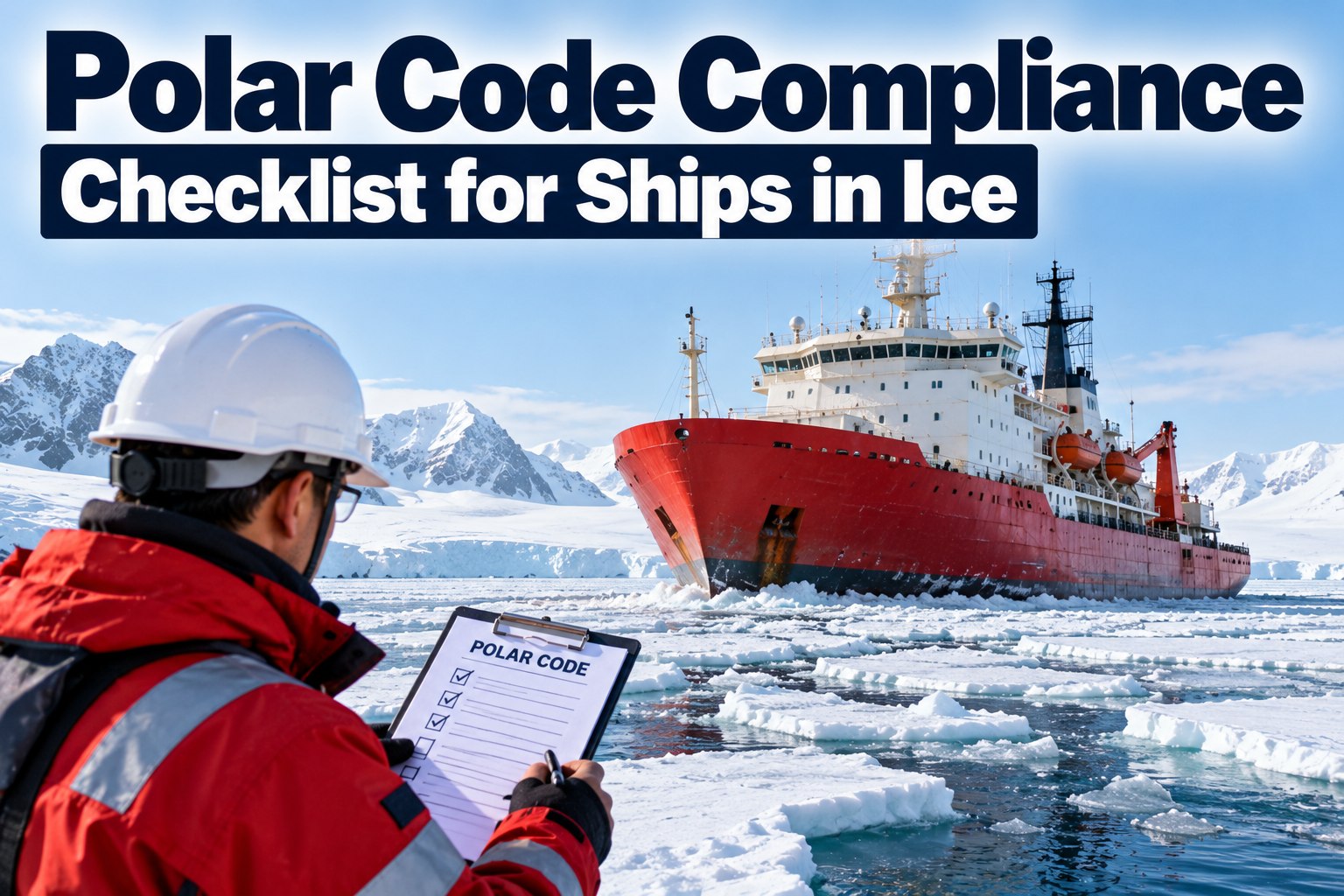
A polar voyage is won or lost in the paperwork and equipment checks before the ship reaches the ice. Which certificate is needed, what must be in the Polar Water Operational Manual, which survival gear is added and what will a port State control officer look for? This guide is a Polar Code compliance checklist for ships in ice: the Polar Ship Certificate, PWOM, winterisation items, life-saving appliances, crew training and inspection points. It draws on the IMO Polar Code page, a Paris MoU PSC instruction, ABS and PAME extracts of chapter 8, DNV and a Skuld article, and it flags where sources disagree. For certificate tracking, see our ship certificate tracking.
Ice-Ready Before You Sail: The Polar Code Documents, Gear and Training That Get Checked
Certificate, PWOM, survival equipment and training records in one checklist for polar voyages.
Free trial available. Or book a walkthrough built around your own Polar Code certificates and checks.
Read this first. Operating in ice and extreme cold is hazardous and the Polar Code is a mandatory instrument for ships in polar waters. This guide supports planning and record keeping. It does not replace the Polar Code, SOLAS chapter XIV, STCW, MARPOL, your flag State's and class society's requirements, the Polar Water Operational Manual or the Master's decisions. Never operate outside the limits on the Polar Ship Certificate, and confirm every requirement against the current official text before you rely on it.
Polar Code Scope, Dates and Ship Categories: What Applies to Your Ship
Entry into force, the 2026 and 2027 extension and the A, B and C ice categories
The Polar Code entered into force on 1 January 2017 and is mandatory under SOLAS and MARPOL. The Paris MoU instruction says Part I applies to SOLAS-certificated ships in polar waters and Part II applies according to the MARPOL annex, with Annexes I and V covering all ships. The dates below come from the IMO page and the Paris MoU instruction. The IMO page lists a different chapter numbering from the Paris MoU instruction, so we use the Paris MoU and PAME numbering (chapter 8 for life-saving appliances, chapter 12 for training) and recommend you check the Code itself.
1 Jan 2017Polar Code in force, mandatory under SOLAS and MARPOL
1 Jul 2018Mandatory STCW training for masters and deck officers
1 Jul 2024Arctic heavy fuel oil prohibition applies (certain ships by 1 Jul 2029)
1 Jan 2026Extension to new fishing vessels 24 m and above, new yachts 300 GT+ and new cargo ships 300 to under 500 GT
1 Jan 2027Same extension for existing ships in those categories
A
Category ADesigned for polar waters at least in medium first-year ice, which may include old ice inclusions
B
Category BNot Category A. Designed for polar waters at least in thin first-year ice, which may include old ice inclusions
C
Category CDesigned for open water or ice conditions less severe than those for Categories A and B
The geographic limits are set in the Code itself, and the IMO page we read gave no coordinates, so check the Code's definitions of Arctic and Antarctic waters. Temperature, ice operation, the maximum time to rescue and high-latitude conditions can add requirements or limitations that appear on the certificate.
The Polar Document Pack: Six Items to Have Ready
Certificate, Record of Equipment, PWOM, assessment, training and MARPOL books
Polar Ship CertificateRequired under SOLAS XIV reg. 3. Check validity, limitations and that survey dates align with the SOLAS certificates
Record of EquipmentMust list the Polar Code equipment. A missing item is a clear ground for a detailed inspection
Polar Water Operational ManualShip specific. May cross-reference other ship documents. Appendix 2 of the Code gives a model contents list
Operational assessmentCompleted before the certificate is issued and sets the ship's limitations (DNV and a trade guide)
Training certificatesSTCW polar training for the officers the flag State requires. Sources differ on who needs which level
MARPOL booksIOPP supplement, a Procedures and Arrangements Manual referring to stricter discharge criteria and a Garbage Record Book suited to polar operations
DNV states the sequence for the certificate: the owner completes an operational (risk) assessment, prepares a ship-specific PWOM and has the ship surveyed, after which the flag administration or its authorized representative issues the Polar Ship Certificate. Operators often use POLARIS (MSC.1/Circ.1519) to set ice limits, according to a trade guide. We did not read that circular, so treat the statement as secondary. The PWOM only needs to be checked by the officer if it is in a language they understand, and otherwise the officer notes this in the report.
Keep the Polar Certificate, Equipment List and Training Dates Together
Track certificate limits, equipment and crew training dates, and raise tasks before the next polar voyage.
Free trial available. Or book a walkthrough built around your own Polar Code certificates and checks.
What Port State Control Looks for Under the Polar Code
Seven clear grounds for a detailed inspection and three deficiency codes
The Paris MoU instruction PSCC 58/2025/05 is the most practical source we found. The officer first confirms the trading area and whether the next voyage is to a polar area, then checks the certificate and Record of Equipment, crew training certificates, PWOM and MARPOL documents. If there are no clear grounds, no further Polar Code consideration is needed. These are the clear grounds that trigger a detailed inspection.
1Polar Ship Certificate invalid or expired, or limitations exceeded or likely to be exceeded
2PWOM missing
3Required equipment missing from the Record of Equipment
4Third-party information about non-compliance
5Ship arrived from a polar area without a valid certificate
6No valid certificate and the next voyage is to a polar area
7STCW Chapter V training requirements not met
Paris MoU deficiency codes for the Polar Code (PSCC Instruction 58/2025/05)| Code | Defective item | Convention reference | Detainable |
|---|
| 01134 | Polar Ship Certificate | Polar Code Part I-A, Ch. 1, para. 1.3.1 | Yes |
| 01335 | Polar Water Operational Manual | Polar Code Part I-A, Ch. 2, reg. 2.3.1 | Yes |
| 11133 | Personal and group survival equipment | Polar Code Part I-A, Ch. 8, reg. 8.3 | Yes |
The detention decision rests on the officer's professional judgment, who may also report an ISM deficiency. The instruction lists missing or invalid certificates, a missing PWOM, missing or defective equipment and inappropriate training as detainable examples.
Polar Life-Saving Appliances and Survival Equipment: What Chapter 8 Adds
Seven items from the PAME and ABS extracts, and the survival-time check
Enclosed lifeboatsPartially or totally enclosed, protecting everyone from direct wind chill
Insulated personal gearInsulation to maintain core body temperature and protect extremities from frostbite
Group survival equipmentCarried where abandonment to ice or land is possible, unless normal LSA give an equivalent level
110 per cent coveragePersonal and group survival equipment for 110% of persons on board, stored near muster or embarkation stations
Rations for the METREmergency rations adequate for the maximum expected time of rescue
Ice and snow clearanceEscape routes, muster stations, survival craft and launching appliances kept clear of ice accretion
SearchlightsContinuous-use searchlights per lifeboat on ships operating in extended darkness
Survival Time Against One Common Battery Spec: ABS Note on the Polar Code Survival Period and a 48-Hour EPIRB Battery (Bars Out of 5 Days)
Minimum survival period noted by ABS
5 days
Single EPIRB with a 48-hour battery
2 days
ABS notes that a single EPIRB with a 48-hour battery does not meet the survival period, so extra EPIRBs or batteries and a PWOM procedure may be needed. The Polar Code survival duration is tied to the maximum expected time of rescue in the operational assessment. We read the 5-day figure in an ABS note and not in the Code, so confirm it against your own METR.
Chapter 8's goal is safe escape, evacuation and survival. Ships built on or after 1 January 2017 must arrange exposed escape routes so people in polar clothing can pass, and power-dependent devices must run independently of the main power. IMO interim LSA guidelines exist as MSC.1/Circ.1614, which we did not read. For routine servicing of the equipment, see our SOLAS LSA inspection guide for lifeboat and liferaft readiness. We have not seen the Code text itself, only the PAME portal chapter and an ABS note, so confirm figures such as the 110 per cent coverage.
Polar Crew Training: Where the Sources Disagree
Basic and advanced polar training under STCW, compared across three sources
Polar training as described by three sources (they do not agree on who needs which level)| Source | Basic polar training | Advanced polar training |
|---|
| Paris MoU PSC instruction (2025) | Officers of the navigational watch | Master and Chief Mate |
| Skuld article | All personnel operating in polar waters (STCW V/4-1) | Masters, chief mates and watchkeeping officers (STCW V/4-2) |
| Trade guide (AM Nautical) | Model Course 7.11 | Model Course 7.12 |
The Paris MoU instruction is the PSC guidance, so we treat it as the more reliable guide to what an inspector checks, but the STCW text is the authority. The instruction also says all crew must know the PWOM procedures for their duties. DNV mentions a planned STCW amendment for certain officers without a date. Do not assume a certificate level without checking your flag State.
Polar Code Compliance Checklist for Ships in Ice
A checklist with a checkpoint type on each item
Use the checklist before each polar voyage and after any change to certificates, crew or equipment. For the wider walk-round, see our ship inspection checklists, and for SOLAS context see SOLAS compliance. The checklist is our template and does not replace the Polar Code.
Polar Code compliance checklist with a checkpoint type on each item (our template built from the Paris MoU PSC instruction, the ABS chapter 8 note, DNV and the IMO page)| Item | What to check | Checkpoint type |
|---|
| Polar Ship Certificate | Valid, within limitations, endorsed and aligned with SOLAS survey dates | Record |
| Record of Equipment | Lists the Polar Code equipment and matches what is on board | Record |
| PWOM | On board, ship specific, in a language the crew understand, procedures known by duty | Record |
| Voyage plan | Prepared per the PWOM, ice information available, limits respected | Record |
| Training certificates | Officers hold the polar training the flag State requires | Record |
| Ice information and navigation | Equipment works in expected conditions, can detect ice in darkness | Test |
| Cold-weather lifeboats | Enclosed craft start and run, launching appliances free of ice | Test |
| Personal survival equipment | Insulated suits and protection for 110% of persons on board | Visual |
| Group survival equipment | Containers float, are accessible and stored near muster stations | Visual |
| Rations and EPIRBs | Rations for the METR, spare EPIRBs or batteries where needed | Visual |
| Ice removal gear | Tools for clearing ice from escape routes and equipment | Visual |
| MARPOL polar items | IOPP supplement, manuals and Garbage Record Book suited to polar waters | Record |
Our suggested template. Checkpoint types: Visual, Test and Record.
Six Polar Code Gaps Inspectors Pick Up
What the Paris MoU instruction and the ABS note point to
⚑Certificate limits exceededOperating beyond the limits on the Polar Ship Certificate is a clear ground for a detailed inspection.
⚑Missing or defective survival equipmentDeficiency code 11133 covers personal and group survival equipment and is listed as detainable.
⚑PWOM not on board or not knownA missing PWOM is detainable, and all crew must know the PWOM procedures for their duties.
⚑Training certificates do not match the voyageSTCW Chapter V training not met is a clear ground.
⚑Equipment not on the RecordRequired equipment missing from the Record of Equipment triggers a detailed inspection.
⚑Single EPIRB battery for the METRABS warns a 48-hour battery may not cover the survival period.
Keeping Polar Certificates, Equipment Checks and Training Records in One System
How a dated photo repository, task ownership and deadlines support polar readiness
Polar findings recur when certificates, equipment lists and training dates sit in separate files. Marine Inspection supports a dated photo repository, observations turned into tasks with owners, deadlines and evidence, and certificate and equipment tracking. A dated photo of an immersion suit store, a task for a missing item on the Record of Equipment with a named owner and due date, and tracked certificate and training expiry give the Master a record to show an inspector. It does not replace the Polar Code or class requirements. Raise follow-ups through maintenance work orders and see Marine Inspection pricing for plans.
Frequently Asked Questions About the Polar Code and Ice Operations
What is the Polar Code and when did it enter into force?
The Polar Code is the IMO International Code for Ships Operating in Polar Waters. It entered into force on 1 January 2017 and is mandatory under SOLAS and MARPOL. It has safety (Part I) and pollution (Part II) sections, each with mandatory and recommendatory parts.
Which ships need a Polar Ship Certificate?
SOLAS ships operating in the defined polar waters need one under SOLAS XIV reg. 3. The Paris MoU instruction says the Code applies to ships over 500 GT, extended on 1 January 2026 to new fishing vessels of 24 m and above, new yachts of 300 GT and above not in trade and new cargo ships of 300 to under 500 GT, with existing ships following on 1 January 2027.
What do Categories A, B and C mean?
Category A ships are designed for at least medium first-year ice, Category B for at least thin first-year ice (and not A), and Category C for open water or less severe ice. Temperature, ice operation and the maximum time to rescue can add limitations on the certificate.
What must the PWOM contain?
The Paris MoU instruction says it gives ship-specific operational capabilities and limits and may cross-reference other ship documents. Appendix 2 of the Polar Code has a model table of contents. We did not read the full appendix, so use it directly when drafting.
Who needs polar training?
Sources differ. The Paris MoU instruction says the Master and Chief Mate need advanced training and navigational watch officers need basic training. A Skuld article says all personnel need basic training and masters, chief mates and watchkeepers also need advanced training. Check the STCW text and your flag State.
What life-saving equipment does the Polar Code add?
Chapter 8 requires enclosed lifeboats, insulated personal protection, group survival equipment where abandonment to ice or land is possible, rations for the maximum expected time of rescue and cover for 110 per cent of persons on board, according to the PAME and ABS extracts we read.
What triggers a detailed Polar Code inspection?
The Paris MoU instruction lists seven clear grounds, including an invalid certificate, missing PWOM, missing equipment, third-party reports, arriving from a polar area without a valid certificate and unmet STCW training. It lists missing certificates, missing PWOM, missing equipment and inappropriate training as detainable examples.
Sail Into Polar Waters With Every Certificate, Item and Training Date on Record
Polar certificates, equipment checks, dated photos and follow-up tasks for every vessel, in one system.
Free trial available. Or book a walkthrough built around your own Polar Code certificates and checks.