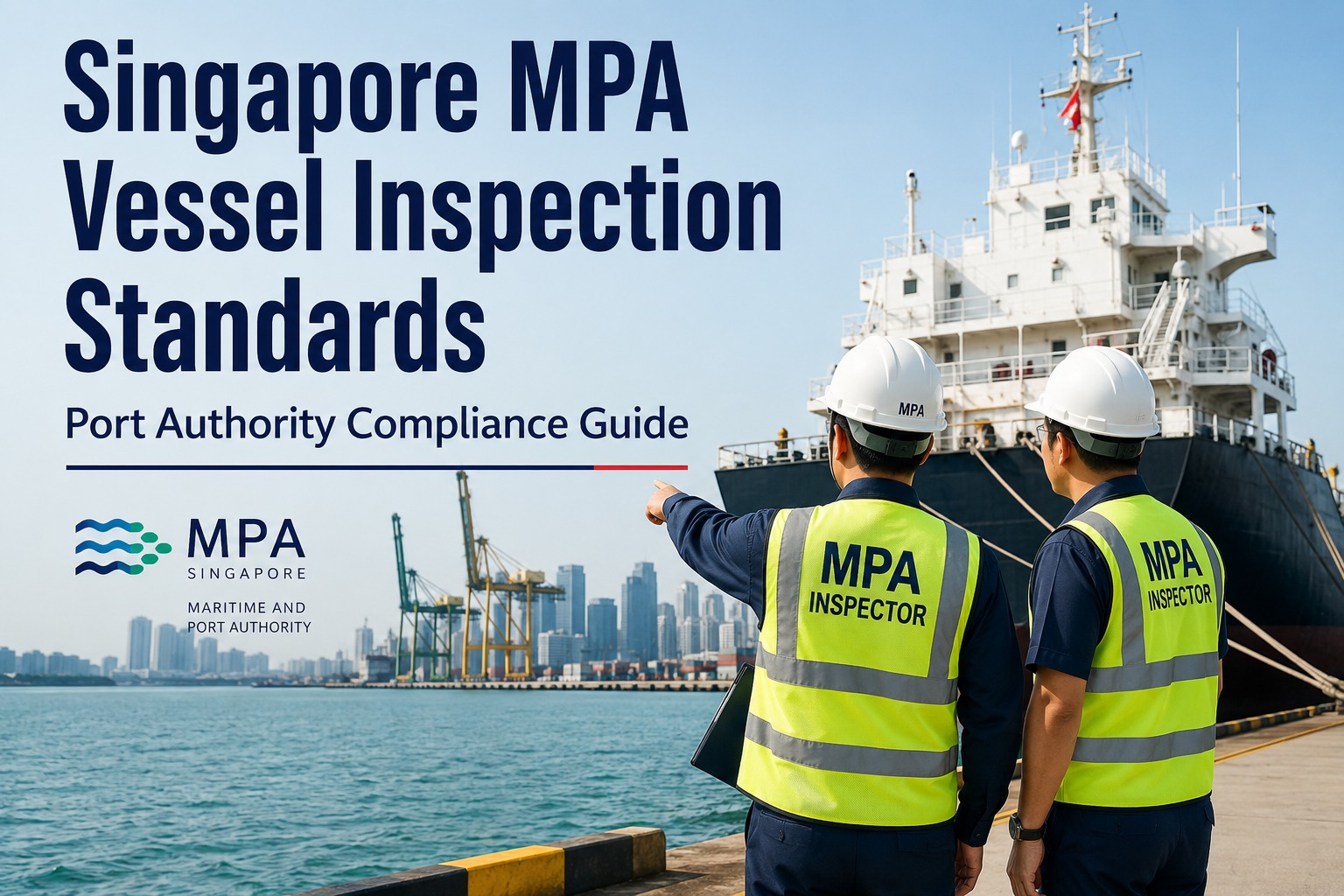
A Port State Control officer boards your vessel and requests the Oil Record Book. It's available. Then they ask for the maintenance log entry matching an overboard discharge from three weeks ago. Your chief engineer pulls it up—but the date stamp doesn't align with the discharge record. That single mismatch triggers a deeper inspection, two additional deficiency findings, and a 14-hour delay at port. The data existed. The problem was traceability. In 2024, the USCG conducted 8,711 safety exams and issued 82 detentions—and documentation gaps remain among the top deficiency categories across every major PSC regime. Vessels that treat data integrity as a paperwork exercise are the ones getting flagged. Vessels that treat it as an operational system use Marine Inspection's digital platform to connect every record to its source, timestamp, and context—which is exactly what inspectors verify first. You can sign up for free and start building tamper-proof audit trails across your fleet in under 10 minutes.
82
USCG Vessel Detentions
Issued across 8,711 SOLAS safety exams in 2024
67%
Documentation-Related
PSC deficiencies linked to record gaps or inconsistencies
$15K+
Per Detention Day
Average cost including port fees, delays, and crew overtime
What Data Integrity Actually Means for Vessel Compliance
Data integrity in the maritime context goes well beyond just keeping records. It means every piece of inspection and maintenance data is accurate at the point of entry, remains unaltered throughout its lifecycle, and can be traced back to its origin—who recorded it, when, under what conditions, and why. The ISM Code defines objective evidence as quantitative or qualitative information, records, or statements of fact pertaining to safety that can be verified. That last phrase is the critical part: which can be verified. When PSC officers audit your vessel, they don't simply check that records exist. They test whether those records hold up under scrutiny—whether dates align across documents, whether entries are consistent, and whether there's a clear chain from action to record to evidence. Marine Inspection software creates this verification chain automatically. Every maintenance task, every inspection finding, every compliance entry logged through the platform carries an automatic timestamp, user attribution, and cross-reference link. Schedule a quick demo to see how the audit trail works—our team will walk you through a live compliance scenario using your vessel type so you can evaluate it before your next inspection.
The Five Pillars of Marine Inspection Data Integrity
Accuracy
Data reflects actual vessel conditions at the time of recording. Marine Inspection enforces real-time entry—no estimations, no backfilling on critical parameters like discharge volumes, maintenance completion times, or equipment readings.
Completeness
Every required field is populated before submission. Marine Inspection's mandatory field validation prevents incomplete entries that create audit red flags and suggest broader compliance gaps to inspectors.
Consistency
Records across different logs match automatically. Marine Inspection cross-links Oil Record Book entries with engine room maintenance logs, drill records with crew training documentation—because inspectors cross-reference deliberately.
Timeliness
Records are created at the time of the event—not hours or days later. Marine Inspection's mobile-ready interface enables shipboard crew to log entries during operations, eliminating the delayed-entry problem inspectors catch most often.
Traceability
Every record links back to who created it, when, what triggered it, and what evidence supports it. Marine Inspection's tamper-proof audit trail transforms routine records into audit-proof compliance documentation.
How PSC Inspectors Verify Records: The Audit Trail Test
Understanding how Port State Control officers and ISM auditors actually verify your records changes how you approach documentation entirely. Inspectors don't read logs cover to cover. They use a sampling methodology—selecting specific events and tracing them across multiple document systems to test whether your records tell a consistent, verifiable story. A single inconsistency during this cross-referencing process can escalate a routine inspection into an expanded examination. Marine Inspection software is designed specifically around this verification pattern, ensuring every record your crew creates passes the exact cross-referencing tests inspectors perform.
Inspector Verification Workflow: What Gets Cross-Referenced
Step 1
Select a Compliance Event
Inspector picks a specific event from the Oil Record Book, maintenance log, or drill record—typically from the past 30-90 days.
Step 2
Cross-Reference Against Related Records
The event is checked against engine room logs, deck logs, work order systems, and certificate records to verify dates, personnel, and outcomes match.
Step 3
Verify Timestamp Integrity
Inspectors flag entries made significantly after the event—batch entries, backdated logs, and time gaps that suggest records were reconstructed rather than created live.
Step 4
Assess Personnel Attribution
Who signed off? Were they qualified and on duty at the recorded time? Crew watch schedules are compared against record signatures.
Result
Finding Classification
Consistent trail = no finding. Minor gap = observation or non-conformity. Systemic inconsistency = major non-conformity, potential detention.
The ISM Code is explicit: multiple small record-keeping deficiencies can collectively constitute a major non-conformity—a finding serious enough to prevent a vessel from sailing until corrected. Classification societies report that record-keeping deficiencies rank consistently among the top five PSC finding categories globally. Most of these failures are preventable with the right system in place—sign up for Marine Inspection today and your crew can start logging audit-proof records with automated cross-document linking, timestamping, and attribution by tomorrow.
Where Vessel Data Integrity Breaks Down: 6 Failure Points Marine Inspection Solves
Most data integrity failures aren't caused by negligence. They're caused by operational systems that make it structurally difficult to create accurate, timely, traceable records. Marine Inspection addresses each of these failure points at the system level—so your crew doesn't need to compensate for broken processes with extra manual effort.
The problem: Crew complete tasks during watch but record entries at shift end—or the next day. Timestamps lose precision, details get approximated from memory.
Marine Inspection fix: Mobile-ready interface with auto-timestamps lets crew log entries during operations. The system flags any entry attempted more than 2 hours after the recorded event time.
The problem: Oil Record Book shows a transfer at 14:30 but engine room log shows equipment secured at 13:45. Different crew recording in different systems without coordination.
Marine Inspection fix: Unified platform auto-links related entries across maintenance logs, compliance records, and operational logs—so dates, times, and personnel stay consistent by design.
The problem: A deficiency is identified in an internal audit, corrective action is taken, but records don't connect the finding to the action to the verification of closure.
Marine Inspection fix: Built-in corrective action workflows link every finding to its assigned action, responsible person, deadline, and closure verification—creating the complete audit chain ISM auditors specifically look for.
The problem: Forms are completed but not signed. Digital entries lack user attribution. No way to verify who performed the task or who confirmed the record.
Marine Inspection fix: Every entry is automatically tied to the logged-in user with digital signature capture. Unattributed entries cannot be saved—eliminating records that have zero evidentiary value during PSC inspection.
The problem: Updated procedures are issued from shore but old versions remain in use onboard. Crew follows outdated checklists, creating records against superseded requirements.
Marine Inspection fix: Automatic document version control pushes updates from shore to ship instantly and removes obsolete versions—directly satisfying ISM Code Section 11 document control requirements.
The problem: Paper logbooks are the sole record. If damaged, lost, or illegible, the compliance evidence disappears entirely with no recovery option.
Marine Inspection fix: Encrypted cloud backup with full restoration capability. All records are accessible for remote inspection submissions—supporting the pre-arrival digital documentation that maritime authorities increasingly require.
Close Your Data Integrity Gaps Before the Next Inspection
Marine Inspection's digital compliance platform creates tamper-proof audit trails with automatic timestamps, user attribution, and cross-document linking—eliminating the six failure points that trigger PSC deficiencies and ISM non-conformities.
Paper vs. Digital: Data Integrity Comparison for Vessel Records
The shift from paper-based to digital compliance documentation isn't about preference—it's about what inspectors increasingly require. Maritime authorities worldwide are adopting remote inspection capabilities that demand digital-ready documentation. Vessels maintaining paper-only systems face longer inspections, increased targeting for physical verification, and an inability to support pre-arrival data submissions becoming standard practice. If your fleet is still managing compliance on paper or fragmented spreadsheets, schedule a 20-minute demo with our marine compliance team to see how Marine Inspection replaces manual record-keeping with a unified digital platform built for PSC and ISM readiness.
Data Integrity Capability: Paper Records vs. Marine Inspection Platform
| Integrity Requirement |
Paper-Based Records |
Marine Inspection Platform |
| Timestamp Accuracy |
Manual entry, easily backdated |
Auto-generated, tamper-proof |
| User Attribution |
Signature required but often missing |
Logged automatically per user login |
| Cross-Document Linking |
Manual cross-referencing required |
Automated linking across all record types |
| Version Control |
Relies on manual document removal |
Automatic obsolete version replacement |
| Edit History / Audit Trail |
Corrections visible as strikethroughs |
Full change log with reason codes |
| Remote Inspector Access |
Not possible |
Secure cloud access for pre-arrival review |
| Backup & Recovery |
Photocopies only, no guarantee |
Encrypted cloud backup with full restore |
| Corrective Action Tracking |
Separate filing, manual follow-up |
Integrated finding-to-closure workflow |
Swipe left to see full comparison
Expert Review: Why Traceability Is the New Compliance Standard
Industry Analysis
The maritime regulatory landscape has fundamentally shifted from "do you have the record?" to "can you prove the record is reliable?" This shift accelerated significantly through 2024-2025 as multiple PSC regimes—Tokyo MOU, Paris MOU, and the USCG—increased their focus on SMS effectiveness rather than document presence alone.
The Tokyo MOU's 2024 annual report noted that under-performing ships nearly doubled compared to the previous year, with non-compliance spread across operational practices broadly rather than concentrated in any single deficiency area. This pattern suggests systemic documentation and management failures—exactly the kind of gaps that strong data integrity systems prevent.
Meanwhile, the USCG's Enhanced Exam Program now leverages data analysis to evaluate evolving risks, meaning vessels with clean surface records but poor data integrity infrastructure are increasingly identifiable through pattern analysis before inspectors even board. The new U.S. Coast Guard cybersecurity regulations (effective July 2025) add further requirements for secure data capture, protected logs, and encryption—making digital compliance infrastructure a regulatory necessity, not an optional upgrade.
For vessel operators, the takeaway is clear: traceability has become the mechanism through which inspectors determine whether your Safety Management System is functioning effectively or merely generating paper. Marine Inspection's platform provides the complete audit-trail infrastructure—from automatic timestamps to cross-document linking to shore-side visibility—that manual and paper-based systems structurally cannot deliver.
Building Audit-Proof Data Integrity With Marine Inspection: 4-Phase Approach
Moving from reactive record-keeping to proactive data integrity doesn't require replacing every system overnight. Marine Inspection's implementation follows a phased approach that builds each layer of integrity on the previous one, delivering measurable compliance improvements at each stage while working toward a fully integrated digital compliance ecosystem for your fleet.
Marine Inspection Implementation Roadmap
Digitize Core Records
Migrate Oil Record Book, maintenance logs, and drill records into Marine Inspection
Enable automatic timestamping and user attribution on all entries
Establish digital backup procedures for existing paper records
Outcome: Delayed entries and unsigned records eliminated immediately
Connect Document Systems
Link maintenance records to certificate tracking and equipment registers
Activate cross-document referencing for related compliance events
Deploy document version control with automatic obsolete removal
Outcome: Cross-document mismatches and version control failures resolved
Build Corrective Action Workflows
Activate finding-to-action-to-verification closure chains
Set automated reminders for open corrective actions nearing deadlines
Enable shore-to-ship visibility on audit findings and resolution status
Outcome: Complete audit trail from deficiency identification to verified closure
Continuous Compliance Monitoring
Deploy pre-inspection readiness checks simulating PSC verification methods
Generate automated compliance dashboards for fleet-level visibility
Support remote inspection submissions with digital-ready documentation
Outcome: Inspection-ready status maintained continuously across your fleet
Fleet operators managing multiple vessels need shore-to-ship visibility that manual systems simply cannot provide. When a superintendent can verify data integrity across the entire fleet from a single screen—before an inspector ever boards—detention risk drops measurably. Create your free Marine Inspection account now and get instant access to centralized compliance dashboards, automated audit trails, and fleet-wide inspection readiness tracking from day one.
Conclusion: Your Records Are Your First Line of Defense
Every PSC inspection, every ISM audit, every flag state verification begins and ends with your records. Not your equipment condition, not your crew competency, not your vessel age—your records. Because records are how inspectors verify everything else. When those records are accurate, complete, consistent, timely, and traceable, inspections become routine confirmations rather than discovery processes for deficiencies. The maritime industry's accelerating shift toward digital inspection methods, remote verification, and data-driven risk targeting makes this reality more consequential every year. Marine Inspection gives vessel operators the infrastructure to make every record audit-proof from the moment it's created—automatic timestamps, tamper-proof audit trails, cross-document linking, corrective action tracking, and fleet-wide compliance dashboards that keep your vessels inspection-ready at all times, not just when you know an inspector is coming.
Make Every Record Audit-Ready From Day One
Marine Inspection gives vessel operators tamper-proof audit trails, automated cross-referencing, and real-time compliance dashboards that transform documentation from a liability into your strongest defense during any inspection.
Frequently Asked Questions
What is data integrity in the context of marine inspections?
Data integrity in marine inspections means that every compliance record—maintenance logs, Oil Record Books, drill records, certificate documentation—is accurate at the point of entry, remains unaltered throughout its lifecycle, and can be traced to its source. Under the ISM Code, objective evidence must be based on observation, measurement, or test and must be verifiable. Inspectors test data integrity by cross-referencing records across multiple document systems to verify that dates, personnel, and outcomes align. Marine Inspection software enforces these integrity standards automatically through tamper-proof timestamps, mandatory user attribution, and cross-document linking built into every entry workflow.
How does poor data traceability lead to vessel detention?
Poor traceability creates cascading findings during inspections. When an inspector selects a compliance event and cannot trace it through supporting records—or finds inconsistencies between related documents—the inspection scope expands. Under ISM Code guidelines, multiple small record-keeping deficiencies can collectively constitute a major non-conformity, which prevents a vessel from sailing until corrected. The Tokyo MOU reported that under-performing ships nearly doubled in 2024, with patterns suggesting systemic documentation failures. Marine Inspection prevents this by linking every record to related entries across your maintenance, compliance, and operational systems.
What records do PSC inspectors cross-reference most frequently?
PSC officers most commonly cross-reference Oil Record Book entries against engine room logs, maintenance completion records against equipment condition reports, drill and training records against crew qualification documentation, and certificate validity against survey completion evidence. They also compare crew watch schedules against record signatures to verify personnel were on duty and qualified at the recorded time. Marine Inspection's unified platform automatically maintains these cross-references—so when an inspector checks any record, all related documentation is already linked and consistent.
Can Marine Inspection's digital platform satisfy ISM Code documentation requirements?
Yes. ISM Code Section 11 requires companies to establish and maintain procedures to control all documents and data relevant to the SMS, and specifies that documentation should be kept in a form the Company considers most effective. Marine Inspection meets and exceeds these requirements with automatic version control, tamper-proof audit trails, user attribution for every entry, and encrypted backup. Maritime authorities increasingly favor digital documentation, with remote inspection capabilities now requiring digital-ready records for pre-arrival submissions. Marine Inspection creates the evidentiary chain that inspectors verify during audits—automatically.
How quickly can a vessel transition to Marine Inspection from paper-based records?
Most vessels complete core digitization within 4-8 weeks using Marine Inspection's phased onboarding. Phase 1 (weeks 1-4) covers migrating primary compliance records with automatic timestamping and user attribution. Phase 2 (weeks 5-8) connects document systems for cross-referencing and version control. Full implementation including corrective action workflows and continuous compliance monitoring typically takes 12 weeks. Marine Inspection is designed for shipboard deployment with minimal training—crew members familiar with basic digital tools can create audit-ready records from day one, with advanced compliance features activated progressively.