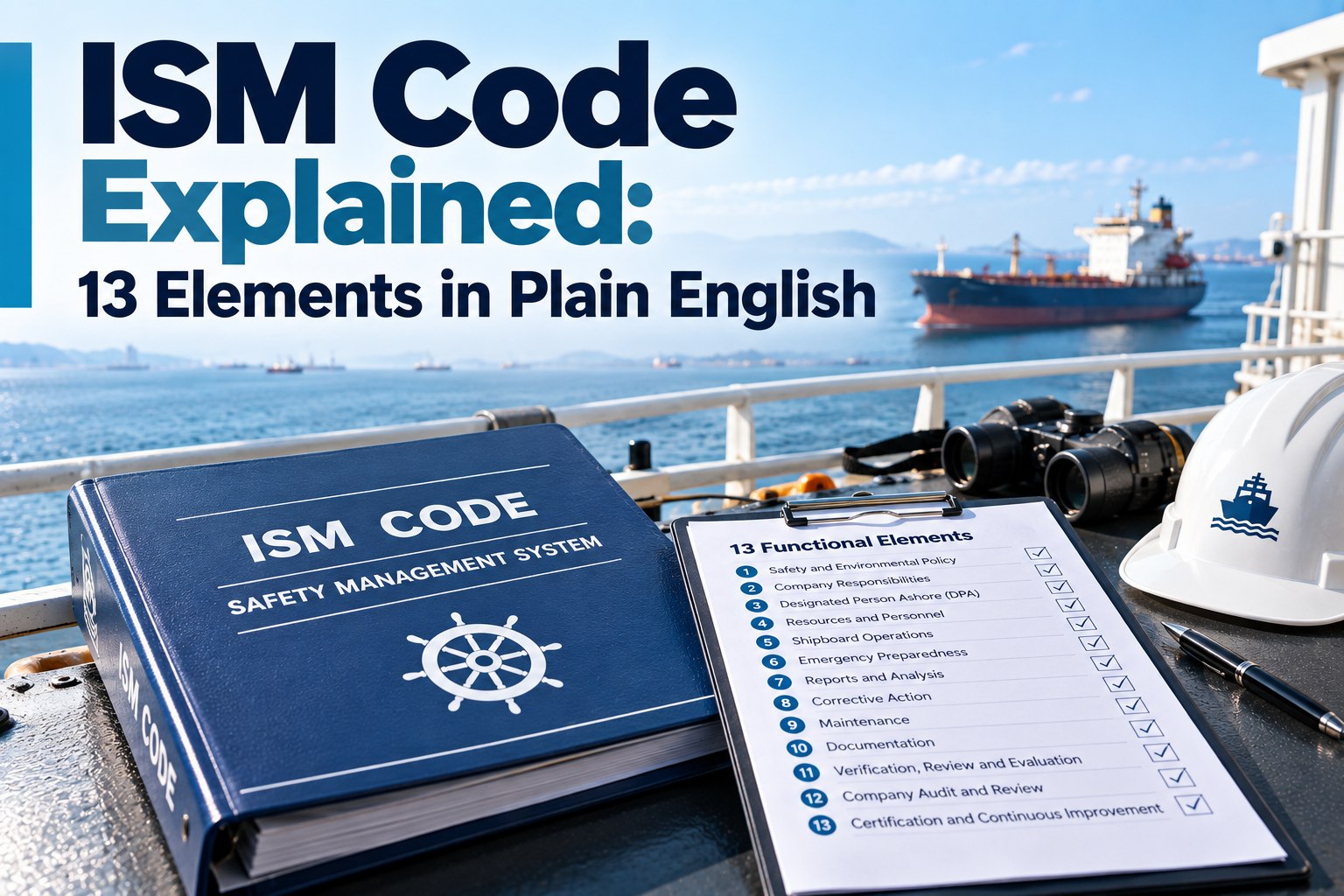
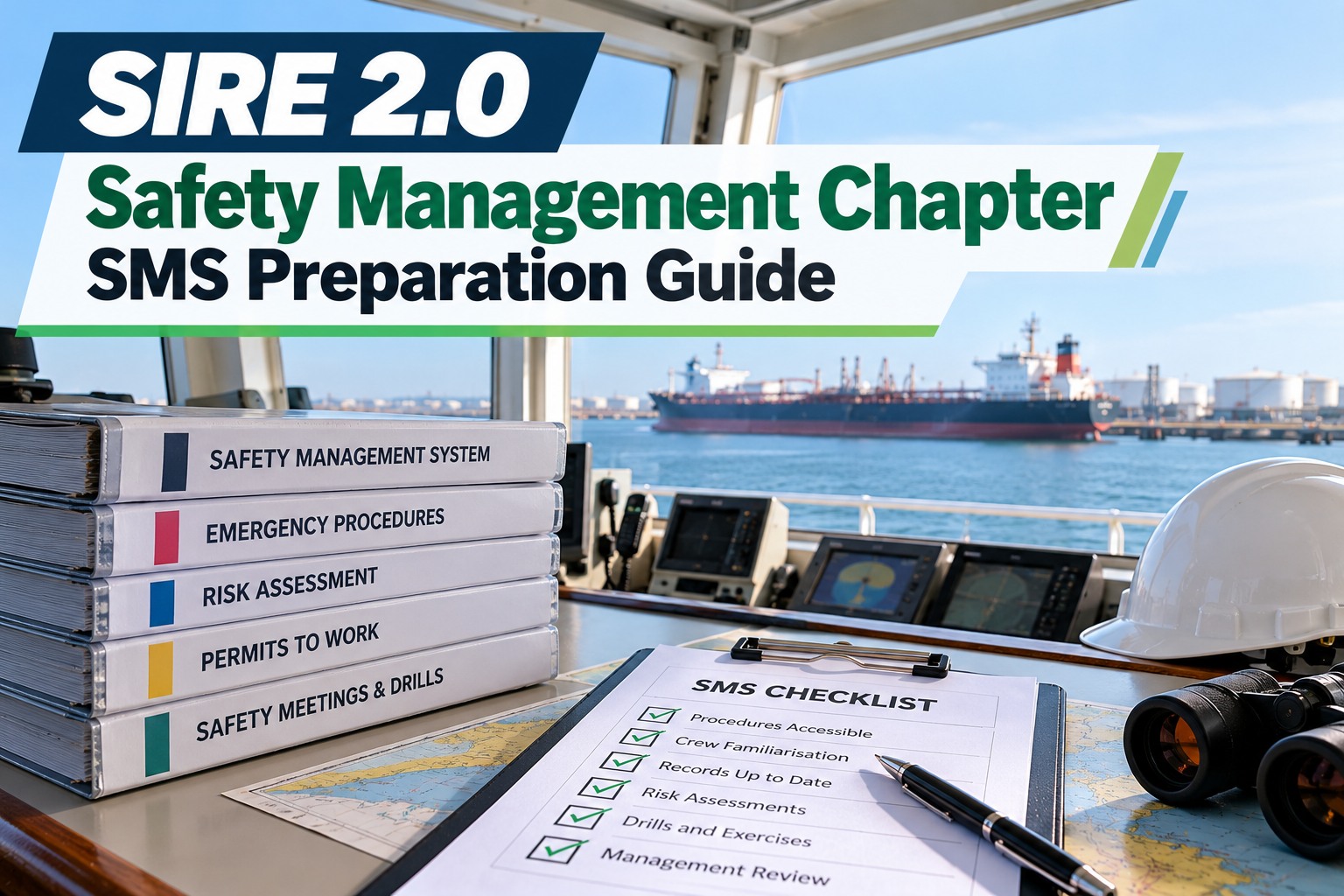
The ISM Code is the rulebook for how a shipping company runs its ships safely, and it reads like legal text until you see what each part is really asking for. In short, the company writes down how it works, trains people to follow it, checks that they do and fixes what it finds. Thirteen numbered sections carry that idea, from the safety policy in section 2 to certification in section 13, and port state control (PSC) inspectors and flag auditors test whether the ship actually runs the way its Safety Management System (SMS) says. For the Designated Person Ashore (DPA) it matters twice: you are named in section 4, and you are the person who answers when the paper and the practice do not match. This guide walks through each element in plain English, shows where the DPA acts, and explains why a weak SMS shows up as detention risk. See your SMS mapped to the 13 elements in Marine Inspection to keep the evidence for every element in one place.
The ISM Code in One Look: Why the Basics Still Decide Port Outcomes
13
Core Elements
Sections 1 to 13 of the ISM Code
4.18%
Detention Rate
Paris MoU, 2025 (4.03% in 2024)
668
Detentions
From 16,474 inspections in 2025
4.5%
ISM-Related
Share of deficiencies in the 2025 report
Free trial available. Or book a walkthrough built around your own SMS.
The 13 Elements, Grouped by What They Do
Set the Direction
1General
Purpose, objectives and what the SMS must cover.
2Safety and environmental policy
A written policy from top management that people can explain.
3Company responsibilities
Who owns which job, ashore and on board, with the authority to do it.
Put People in Place
4Designated person(s)
The DPA: a line from the ship to top management.
5Master's authority
The master has overriding authority on safety and pollution decisions.
6Resources and personnel
Qualified, trained crew and enough shore support to do the job.
Run the Ship
7Shipboard operation plans
Procedures and checklists for the key operations.
8Emergency preparedness
Identify likely emergencies, plan the response and drill it.
10Maintenance
Planned inspections, with extra care for critical equipment.
11Documentation
Controlled documents, current versions where they are used.
Learn and Prove It
9Reports and analysis
Report, investigate and correct non-conformities, accidents and hazards.
12Verification and review
Internal audits and management review of the SMS.
13Certification
DOC and SMC, backed by verification audits.
The element names follow the ISM Code section titles. The four groupings are our own plain-English way to read them, not part of the Code.
Where the DPA Acts: Four Elements That Rely on You
4
Designated Person
"Direct access to the highest level of management" to monitor safety and ensure adequate resources and shore support are applied.
DPA move: take ship concerns to top management and report back what was decided.
6
Resources and Personnel
Ships need qualified, trained crew, and the company must support them.
DPA move: flag manning, training or spares gaps before they become findings.
9
Reports and Analysis
Non-conformities, accidents and hazardous situations are reported, investigated and analysed.
DPA move: check reports are being filed, and corrective actions are closed on time.
12
Verification and Review
Internal audits verify SMS compliance, using independent auditors, with results sent to those responsible.
DPA move: make sure audit findings lead to action, not just a report.
The DPA works best when the evidence is easy to pull. Try the ISM audit forms free to log non-conformities, corrective actions and audit results against the right element.
Paper Versus Practice: Where an SMS Usually Breaks
What the SMS says
What an inspector may find
Emergency drills held as scheduled (element 8)
Drill records exist, but crew cannot describe their muster duties
Maintenance follows the planned schedule (element 10)
Overdue jobs on critical equipment, with no recorded reason
Non-conformities are reported and closed (element 9)
Corrective actions open for months, with no owner
Current documents are available on board (element 11)
Superseded procedure still in use at the work location
Master has overriding authority (element 5)
Crew believe commercial pressure overrides a safety call
These examples are illustrative of typical gaps between documents and practice. They are not taken from a single report.
Paris MoU Detention Rate by Year
Source: Paris MoU annual reports. Columns are scaled to a 5% axis. The rate is the share of inspections that ended in detention across the whole region, not a result for any one ship.
Show an Auditor Every Element Working
Link policies, drills, maintenance, reports and audits to the ISM elements they prove, so evidence is ready when the inspector asks.
Free trial available. Or book a walkthrough built around your own SMS.
ISM Jargon Buster
SMS
Safety Management System: the company's documented way of running its ships safely.
DOC
Document of Compliance: issued to the company once its SMS has been verified.
SMC
Safety Management Certificate: issued to each ship once its operation is verified against the SMS.
DPA
Designated Person Ashore: the link between the ship and the highest level of management.
Non-conformity
An observed situation where objective evidence shows a requirement is not being met.
Major non-conformity
A serious deviation that threatens people, the ship or the environment and needs immediate corrective action.
How many elements does the ISM Code have?
The Code has 16 sections. Sections 1 to 12 form the operating requirements for the company and ship, and section 13 covers certification and verification. "The 13 elements" usually means sections 1 to 13 as described here.
What does the DPA actually do?
Section 4 requires a person ashore with direct access to the highest level of management. The role monitors the safety side of ship operations and makes sure adequate resources and shore support are applied.
Does the ISM Code apply to every ship?
It applies to the ships and companies that SOLAS Chapter IX covers, mainly passenger ships and cargo ships of 500 gross tonnage and above, plus mobile offshore drilling units. Check your flag for the exact scope.
Can an SMS problem lead to detention?
Yes. Port state control inspectors check whether the ship works as its SMS describes, and ISM-related deficiencies appear in the Paris MoU figures. Serious or repeated gaps can contribute to detention.
See how to keep SMS evidence ready for inspection.
What is the quickest way to find SMS weaknesses?
Trace one event, such as a near miss or drill, through reporting, investigation, corrective action and audit. Wherever it stalls, that element needs attention.
Turn the 13 Elements Into Daily Practice
Give your DPA team one place for audits, non-conformities, corrective actions and fleet-wide ISM trends.
Free trial available. Or book a walkthrough built around your own SMS.