A generic CMMS is not a bad product being used badly. It is a good product built on four assumptions, every one of which is false at sea. It assumes the network is there, because on a factory floor it is. It assumes assets sit in a plant-floor layout, because that is what industrial estates look like. It assumes maintenance is an internal efficiency question, because in most industries it is. And it assumes the people doing the work will still be there next quarter, because on shore they usually are. Take that software to sea and all four assumptions break at once: satellite connectivity ranges from adequate in coastal waters to entirely absent on ocean passages for hours or days at a time, equipment follows a vessel-system-subsystem-component tree rather than a production line, a classification society survey clock runs in the background whether the software knows about it or not, and the crew rotates every few months so institutional memory has to live in the system rather than in people. Under ISM Code Element 10 a documented planned maintenance system is mandatory for every passenger ship, every cargo ship of 500 GT and above and every mobile offshore drilling unit on international voyages, and class verifies it is a genuine operational system rather than a folder of templates. Start a free trial of Marine Inspection and see what changes when the assumptions are correct.
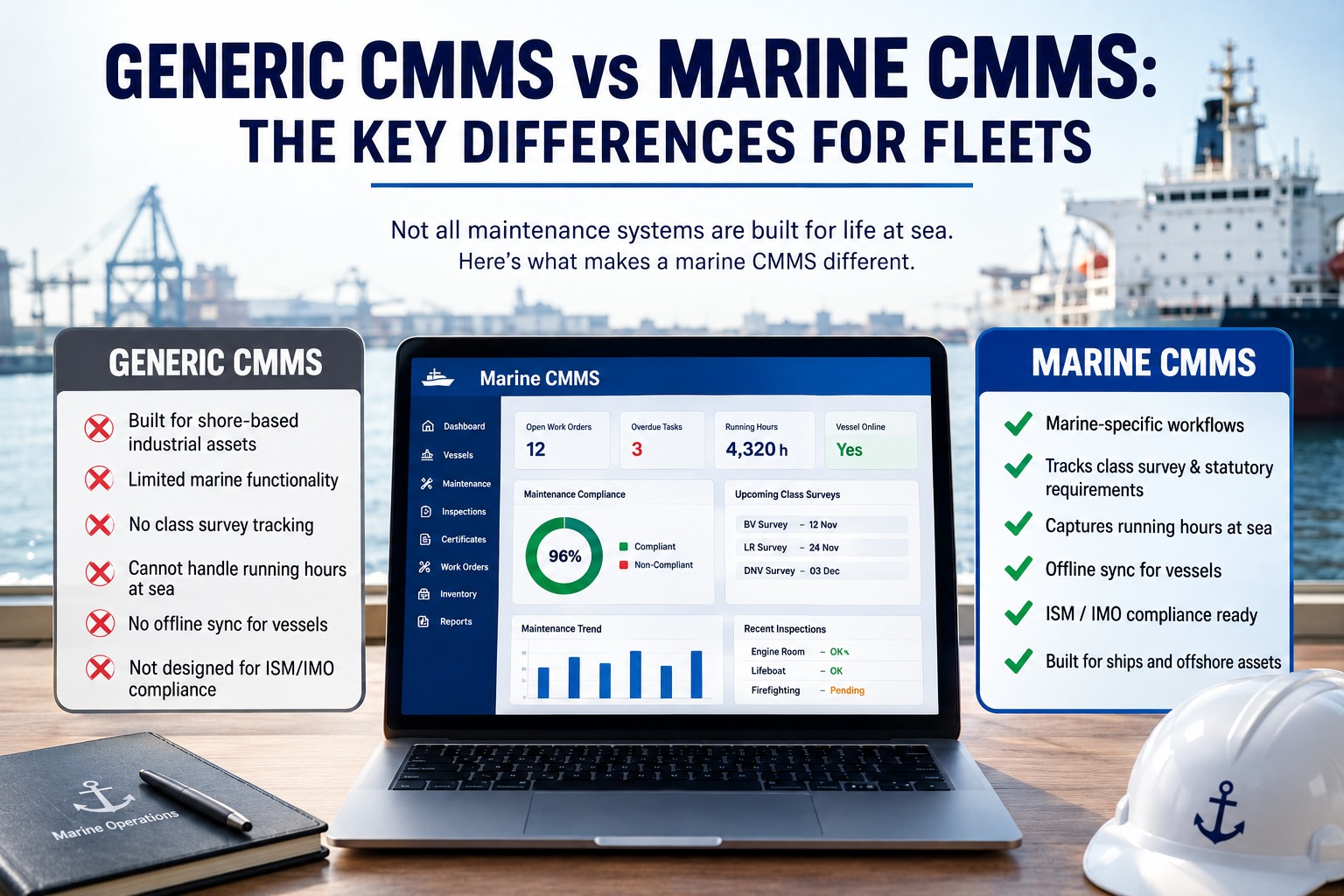
Four Assumptions a Generic CMMS Makes
AssumesThe network is available
At seaConnectivity ranges from adequate on VSAT in coastal waters to none at all across ocean passages, with outages lasting hours or days
AssumesAssets sit in a plant-floor layout
At seaEquipment follows a vessel, system, subsystem and component tree that mirrors class survey scope rather than a production line
AssumesMaintenance is an efficiency question
At seaA class survey clock runs continuously, and overdue class-related items lead to detention rather than to a productivity dip
AssumesThe same people will be there next quarter
At seaCrews rotate every few months, so knowledge held in a person leaves with them at the next crew change
The Hierarchy Problem
This is the difference people notice last and regret first, because it looks cosmetic during a demo and becomes structural during a survey. A class surveyor navigates by vessel systems. A generic CMMS was designed to navigate by location and production line. Book a Marine Inspection demo and load your own equipment register into a tree built the way class reads it.
Generic CMMS Structure
Site
Building or area
Production line
Machine
Part
Organised by physical location, because on shore the asset does not move and the location is the most stable identifier available.
Marine PMS Structure
Vessel
Engine room
Main engine
Cylinder unit
Piston rings
Organised by system and component, because the vessel is the location and a surveyor works down through machinery systems rather than across a floor plan.
Why it matters at survey
Class approval of a planned maintenance scheme involves a surveyor examining the asset hierarchy alongside planned job intervals and sample maintenance records. A hierarchy that does not mirror class survey scope turns every evidence request into a translation exercise, performed under time pressure, in front of the person deciding whether to grant credit.
The Four Marine Essentials
Generic platforms can run shore facilities and shipyard manufacturing assets very well. For vessels at sea they usually fall short on the same four capabilities, and those four are precisely where survey findings and detentions originate. Sign up for Marine Inspection and test all four in an afternoon.
Essential 1
Full Offline Operation
Not read-only caching. Create, edit, submit and close jobs with photographs attached, entirely without a connection, then reconcile on reconnection. A cloud-only tool stalls mid-ocean, which means it stalls exactly when the engineers are least distracted and most able to record properly.
Without itWork is recorded on paper and typed up in port, so the record becomes a reconstruction and completion timestamps stop being true.
Essential 2
Ship-to-Shore Synchronisation
Intelligent sync over satellite that handles low bandwidth, partial transfers and conflicting edits made in two places while the link was down. This is a data architecture problem, not a connectivity setting, and generic platforms rarely have a concept of it because on shore the problem does not exist.
Without itVessel and shore hold different versions of the truth, and superintendents work from a picture that is days old without knowing which days.
Essential 3
Class Survey Integration
Survey due dates, certificate windows and continuous machinery survey items tracked as first-class objects, with jobs taggable as class relevant so survey preparation is a filter rather than a project. Generic tools have no concept of continuous machinery survey or certificate windows at all.
Without itThe survey clock is tracked in a spreadsheet alongside the CMMS, which reintroduces exactly the problem the software was bought to solve.
Essential 4
Native ISM Audit Trail
Every completion attributed to a named person, timestamped, recorded against a quantified acceptance criterion, with the condition found captured. The system doubles as compliance documentation rather than producing it on request, because that is what class and PSC officers actually examine.
Without itYou hold maintenance records that prove work was scheduled, and not the evidence that proves it was done properly by someone competent.
Also
Running Hours From Onboard Systems
A vessel carries dozens of independently metered machines, and interval triggers depend on those counters being current. Marine platforms integrate with onboard data loggers and automation so running hours update without manual transcription. Generic tools expect a person to type them in, on every machine, every week, forever.
Without itRunning-hour jobs trigger against stale counters, so overhauls happen early, late, or on a number somebody guessed.
Where the Two Actually Differ
Both categories handle work orders, scheduling and spares competently. The lines below are where the difference is structural, and the final column is how to expose it inside a demo rather than after signature. Schedule a walkthrough and run each test against your own vessel data.
Table 1: Generic Industrial CMMS Compared With Marine CMMS
2026 EVALUATION REALITY
Class approval is per vessel, not per platform. Choosing a system that a society has seen before does not approve your fleet. For each vessel moving onto a planned maintenance scheme, a surveyor examines the system implementation, the asset hierarchy, planned job intervals and sample maintenance records, and approval is granted vessel by vessel. The obligation itself is not optional. ISM Code Element 10 requires every company holding a Document of Compliance to run a documented maintenance system, SOLAS Chapter IX makes ISM mandatory for SOLAS-certified ships, and IACS formalised planned maintenance scheme requirements in 2001. Class verifies operation, not existence. Societies conduct confirmatory surveys to check the system continues to run and that records reflect actual maintenance, so a well-configured platform with thin records fails the same test as no platform at all. Generic tools are not disqualified everywhere. For shore facilities, terminals and shipyard plant they remain a sound choice, and many operators legitimately run one of each.
Four essentials
Test All Four in One Afternoon
Offline job closure with photo evidence, ship-to-shore sync over a poor link, class survey and certificate windows as native objects, and an ISM audit trail attributed to named people. Load your own equipment register into a hierarchy built to mirror class survey scope, and see whether it fits without rework.
The Approval Path Nobody Costs Properly
This is where choosing a generic platform gets expensive, and the cost is measured in months rather than licence fees. Approval runs vessel by vessel, and each step examines something a generic tool was never structured to present. Start a free trial and see the artefacts each step asks for.
Step 1
System-level assessment
The society reviews the maintenance system itself: how jobs are defined, how intervals are set, how completion is recorded and how evidence is retrieved. A platform with no concept of survey credit starts this conversation at a disadvantage.
Step 2
Per-vessel implementation survey
For each vessel, a surveyor examines the implementation, the asset hierarchy, the planned job intervals and sample maintenance records aboard that ship. This repeats across the fleet, so hierarchy problems multiply by vessel count rather than being solved once.
Step 3 — Confirmatory survey
Class returns to verify the system is still operating and that records reflect actual maintenance rather than scheduled intent. Societies conduct confirmatory surveys for vessels on continuous survey arrangements, and a system that is configured but lightly used fails here even though it passed at approval.
The cost of getting this wrong
Discovering at step two that your hierarchy does not mirror class survey scope means rebuilding it, then re-presenting every vessel. Months of superintendent time, an approval timeline that slips past a survey window, and a platform that technically works but cannot carry the credit you bought it for.
What to Establish Before You Commit
If a generic platform is already in place for shore assets, none of this argues for removing it. The question is narrower: what a vessel needs that the shore system will not provide. Book a walkthrough and work down this list with your own fleet in front of you.
Table 2: Questions to Settle Before Signature
Frequently Asked Questions
Can we use a generic CMMS for our vessels?
Technically yes, and some operators do. The practical difficulty is that generic platforms typically fall short on the same four capabilities: reliable offline operation, ship-to-shore synchronisation over satellite, class survey integration, and native ISM audit trails. Those four are precisely where survey findings and detentions originate, so the gaps are not evenly distributed across low and high consequence areas. What usually happens is that the CMMS handles work orders while a spreadsheet handles certificates and survey windows alongside it, which recreates the fragmentation the software was bought to remove.
What exactly does a marine CMMS add?
Five things that generic tools were never designed to provide. An equipment hierarchy following vessel, system, subsystem and component conventions that mirror class survey scope. Running hours synchronisation across dozens of independently metered machines from onboard automation. A ship-to-shore data architecture built for satellite gaps rather than assuming a network. Class survey calendar and certificate window integration so maintenance can be coordinated with regulatory inspection. And reporting formatted for flag state inspectors and Port State Control officers rather than for internal management. Everything else — work orders, scheduling, spares, checklists — both categories do well.
Does class approve the software or our system?
Your system, vessel by vessel. This is the single most misunderstood point in the category. A society may be familiar with a platform, but approval of a planned maintenance scheme happens per vessel: a surveyor examines the implementation aboard that ship, the asset hierarchy, the planned job intervals and sample maintenance records. Class then conducts confirmatory surveys to verify the system continues to operate and that records reflect actual maintenance. A well-chosen platform makes each of those steps straightforward. It does not replace them, and no vendor can approve your fleet on your behalf.
We already run a CMMS ashore. Should we replace it?
Usually not. Generic platforms run shore facilities, terminals, workshops and shipyard manufacturing assets well, and there is no benefit in disturbing something that works. The sensible split is by asset environment rather than by vendor consolidation: fixed shore assets stay where they are, and vessels operating under ISM with a class survey obligation move to a platform built for that. Running two systems with a clear boundary is a normal and defensible architecture. Forcing every asset onto one platform to reduce vendor count is how fleets end up with a shore tool that cannot pass a machinery survey.
How long does it take to move a fleet onto a marine CMMS?
Roughly six to ten weeks for five to eight vessels with reasonably complete records, covering data audit, standardising component naming across vessels, importing the hierarchy, an opening stock count, a single-vessel pilot and phased rollout. The class approval sequence runs alongside and is the item most often underestimated, because implementation surveys happen per vessel rather than once for the fleet. Build the hierarchy correctly before the first vessel is presented, since a structure that does not mirror class survey scope has to be rebuilt and re-presented across every ship rather than corrected once.
A Vessel Is Not a Plant Floor That Happens to Move
It is a mobile asset with no reliable network, a rotating workforce, a survey clock running in the background and a regulator who can stop it earning. Marine Inspection is built for those conditions rather than adapted to them — offline by default, hierarchies that mirror class survey scope, certificate and survey windows as native objects, and an audit trail formatted for the people who actually ask to see it.
.png)
.png)