Bulk Carrier Dry Bulk Management Standard (DBMS) Guide
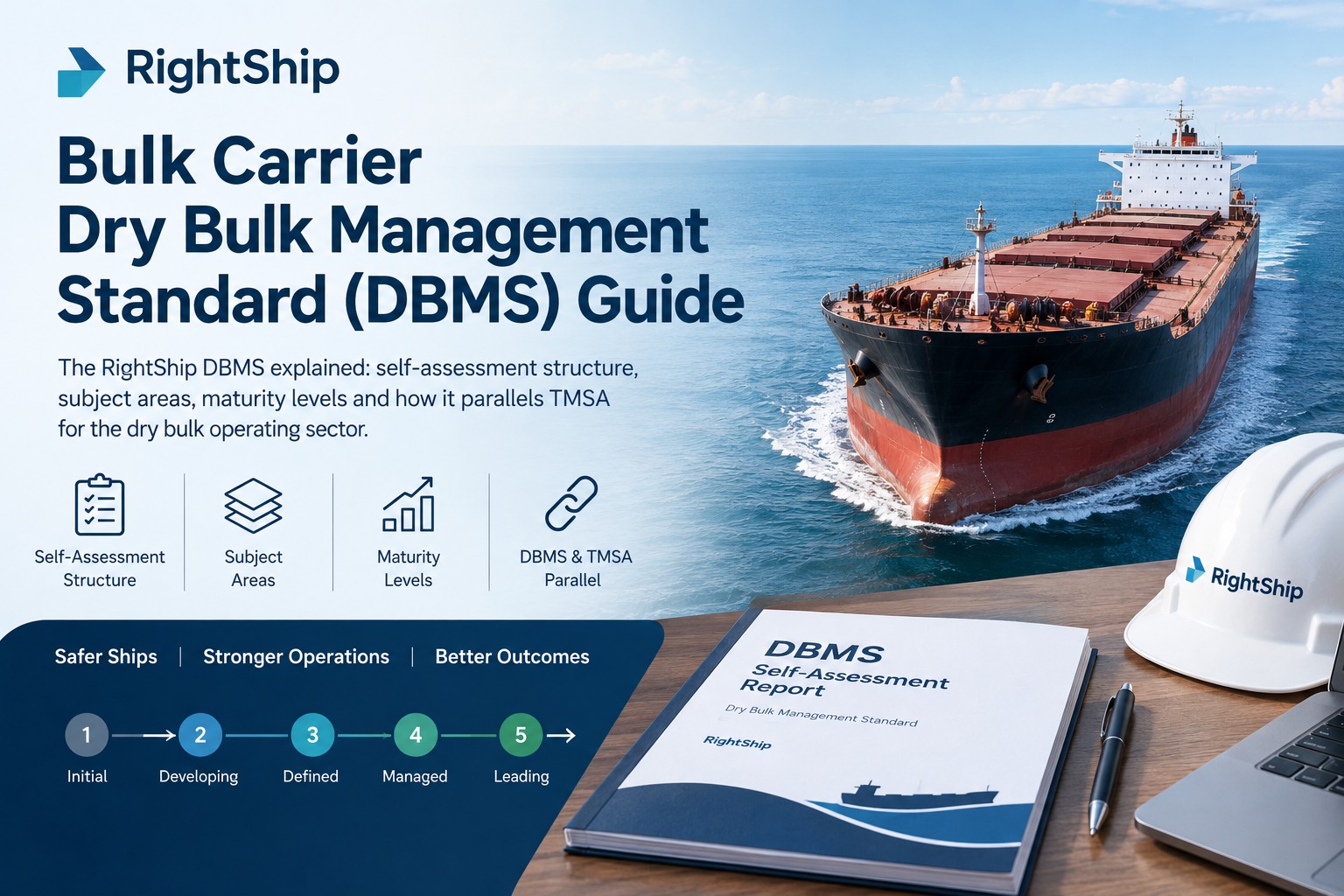
The tanker sector has had a management standard for twenty years. The dry bulk sector got one in January 2021, when RightShip and INTERCARGO launched the Dry Bulk Management Standard — DryBMS, also written DBMS — with support from the International Chamber of Shipping and BIMCO. It asks a bulk operator to hold its own safety management system up against thirty areas of management practice and say, honestly and in writing, how mature each one is.
Dry Bulk Management Standard · DryBMS / DBMS
Thirty subject areas, four maturity levels, and one honest answer per area about where you actually are
A voluntary standard, launched by RightShip and INTERCARGO, that gives the dry bulk operating sector the structured self-assessment the tanker sector has long had.
MI
Hold the evidence behind every subject area in one place
What the Dry Bulk Management Standard is, and what it replaced
Before DryBMS there was no common language for management quality in dry bulk. An operator could be excellent or barely compliant, and a charterer had very little structured way of telling the difference beyond inspection history and reputation. The tanker sector solved that long ago with a tiered self-assessment against defined expectations; the dry bulk sector simply did not have the equivalent.
DryBMS is that equivalent. It is a voluntary standard that lets a ship manager assess its safety management system against industry benchmarks across thirty areas of management practice, grouped into four categories of operational risk, with each area rated at one of four maturity levels. It is governed independently rather than by RightShip, and it was built so that a small operator and a large one can both use it honestly.
6
Performance
Leadership commitment, objectives, how the management system is governed and how audits and reviews actually close.
7
People
Recruitment and retention ashore and afloat, training, familiarisation, contractors and crew welfare.
5
Plant
Maintenance, dockings and surveys, critical equipment, engine room and bunkering, and inspection planning.
12
Process
The operating disciplines — mooring, cargo and ballast, bridge, risk, permits, environment, security, cyber, emergencies and incidents.
The thirty DBMS subject areas in full
The thirty areas are the whole standard. Everything else — levels, scoring, cycles — is machinery for answering a question about one of these.
Performance
6 areas
Commitment to HSSEVessel visits and communicationsSMS governing documentsHSSE objectives and KPIsAudit planning, review and close outMaster’s review and company evaluation
People
7 areas
HR management and recruitment (office)Technical and HSSE training (office)Crew management and recruitmentCrew technical and HSSE trainingCrew familiarisationContractor managementCrew welfare
Plant
5 areas
MaintenanceDry dock and surveysCritical equipmentEngine room operations and bunkeringInspection planning, review and close out
Process
12 areas
Mooring and anchoringCargo and ballastBridge procedures and standardsRisk assessment and managementPermit to workSafety culture improvementEnvironmental managementManagement of change, including vessel acquisitionSecurity managementCyber securityEmergency planning and crisis managementIncident reporting, investigation and training
Several of these map directly onto work an operator is already doing and can already evidence. Maintenance and critical equipment are answered out of the planned maintenance system; bridge procedures and standards sits on the same ground as the SOLAS Chapter V navigation safety regime; cyber security is answered by the same due diligence described in our software security checklist for shipowners. The standard is rarely asking for something new. It is asking whether what you have is systematic.
The four DBMS maturity levels
Each subject area is assessed against four progressive levels. They are cumulative in spirit: Excellence does not replace Basic, it presumes it.
Level 1
Basic
Mandatory compliance with IMO and flag state requirements. Industry guidelines are referenced, but adopting them is not mandatory in your system.
Level 2
Intermediate
A continuous improvement process is in place, and industry guidance has clear parameters inside the safety management system rather than sitting alongside it.
Level 3
Advanced
The improvement process takes in emerging legislation, and specialised HSSE risk management tools are in use rather than discussed.
Level 4
Excellence
A pro-active improvement process that analyses leading indicators and manages emerging risk systematically, before it becomes an incident to investigate.
The shift that matters is between Intermediate and Advanced. Below that line the organisation reacts well; above it the organisation anticipates. Most operators sit somewhere either side of it depending on the subject area, which is exactly what the assessment is designed to reveal.
DBMS maturity levels and the evidence each one needs
The difference between claiming a level and holding it is evidence. This is the only place that distinction can be set out plainly.
Level
What it describes
Evidence that holds it up
How operators overstate it
Basic
Statutory and flag compliance met; guidance acknowledged but optional
Valid certification, a documented system, closed external audit findings
Rarely — this is the level most under-claimed, because it feels unambitious to write down
Intermediate
Improvement runs as a process; industry guidance is built into the system
Procedures referencing the guidance by name, measured objectives, review minutes that show decisions
A circular with the guidance attached is not the guidance being built in
Advanced
Emerging legislation is absorbed early; specialised risk tools in active use
Gap analyses done ahead of entry into force, risk tools with completed outputs, trend analysis across the fleet
Owning a tool and using it on one vessel once is counted as fleet practice
Excellence
Leading indicators analysed; emerging risk managed before it materialises
Defined leading indicators with a history behind them, and decisions that demonstrably followed from them
Lagging data presented as leading — injury rates describe the past, not the next incident
How the DBMS self-assessment is scored
Scoring is not a single mark per area. For each subject area the organisation gathers evidence against the expectations, judges strengths and weaknesses, and then scores each level at 0, 25, 50, 75 or 100 per cent according to how fully the expectations at that level are met.
Two things follow from that structure. First, you can score 100 per cent at Basic and 25 per cent at Advanced in the same area, and that is a perfectly coherent and useful answer. Second, the honest middle bands are where the value is. An assessment that returns 100 per cent across thirty areas tells the organisation nothing it can act on, and tells anybody reading it that the exercise was not taken seriously.
Scores are only as good as the evidence underneath them
Marine Inspection keeps the maintenance history, inspection records, close-out evidence and crew records that every subject area asks for against the vessel and the fleet — so a self-assessment is a reporting job rather than an archaeology project.
Thirty areas assessed at four levels each is a large first bite, and the standard anticipates that. Seventeen subject areas are identified as priorities for initial focus, with the rest addressed once the first pass is done. Smaller operators in particular are expected to begin there rather than attempt everything at once.
Begin where incidents happenMooring and anchoring, cargo and ballast, bridge procedures, permit to work, risk assessment. These are the areas with the shortest line between a weak practice and a casualty, and the areas a charterer asks about first.
Then the enabling systemsMaintenance, critical equipment, inspection planning and close out. They are the easiest to evidence well, because the records already exist, and they carry weight across half the other areas.
Then the people answersCrew recruitment and retention, training and familiarisation. Slower to move and harder to evidence, but they are what distinguishes an operator whose good scores will still be good in three years.
Leave nothing permanently unansweredThe remaining areas are deferred, not excused. An assessment that has carried the same thirteen blanks for two cycles is a finding in itself.
Running the self-assessment: who does it and how
The process is led and managed by a senior figure in the organisation, with broad participation from staff. That sentence does most of the work, and the operators who get little out of DryBMS are almost always the ones who delegated it to one person in the HSSE department to complete quietly.
1
Name a senior owner
Someone with the authority to accept an uncomfortable score. If the owner cannot say “we are at 25 per cent here” without clearing it, the assessment will drift upward on its own.
2
Gather evidence before scoring
Per area, assemble what you would hand over if asked to prove the level. Scoring first and looking for evidence afterwards reverses the exercise and produces numbers nobody can defend.
3
Involve the ships
Masters and chief engineers know which procedures are followed and which are worked around. An office-only assessment measures the system as written rather than as operated.
4
Score each level separately
Four bands per area, judged on coverage and consistency across the fleet rather than on the best ship in it.
5
Turn gaps into dated actions
A gap without an owner and a date is an observation about yourself. The assessment earns its cost in the action plan, not the scores.
6
Reassess annually
Managers conduct the self-assessment annually. Two cycles are worth more than one, because the second shows movement, and movement is what a reader is looking for.
DryBMS and TMSA: a parallel, not a copy
The comparison with the tanker sector’s management self-assessment is the fastest way to understand DryBMS, and also the fastest way to get it wrong. The architecture is deliberately familiar — defined subject areas, tiered expectations, annual self-assessment, an improvement plan behind it. The commercial weight is not the same.
What runs in parallel
Subject areas with written expectations rather than a general duty to manage wellProgressive maturity tiers, from statutory compliance up to pro-active managementAnnual self-assessment owned at senior level, with an improvement plan attachedA shared vocabulary that lets charterers, managers and owners discuss management quality in the same terms
What does not
DryBMS is voluntary, and its use and reporting have no influence on the risk rating issued by RightShip’s star systemIt is not an inspection regime and produces no inspection reportThe guidance sets out voluntary self-assessment submitted through an online platform, with no independent external verification mechanism specifiedCharterer expectations around it are still forming, and vary by trade and counterparty
The point worth being precise about
Completing a DryBMS self-assessment does not raise a RightShip rating, and anybody selling it on that basis is overselling it. What it does is give an operator a structured, defensible account of its own management maturity, and give a counterparty something concrete to read. In a sector where the only other guide is reputation and inspection history, that is worth having on its own terms.
What a charterer or manager actually reads
Assume the reader is competent and short of time. Three things decide what they take away.
The shape of the scores
A credible profile is uneven. Strength in plant and process with softer people scores is a recognisable, believable operator; a flat wall of high marks is not, and reads as an assessment nobody challenged.
The movement between cycles
Last year at 25 per cent, this year at 50, with the actions that moved it. Direction is more persuasive than position, because it is much harder to fake.
Whether the evidence exists
The moment a score is questioned, the answer is either a record or a reassurance. Operators who can produce the record in minutes are describing a real system; the rest are describing an intention.
A voluntary standard launched by RightShip and INTERCARGO in January 2021, with support from the International Chamber of Shipping and BIMCO, that lets dry bulk ship managers assess their safety management system against industry benchmarks across thirty areas of management practice in four risk categories, at four maturity levels. It is written DryBMS and also referred to as DBMS.
How many subject areas does DBMS have?
Thirty, grouped as Performance (6), People (7), Plant (5) and Process (12). Seventeen of the thirty are identified as priority areas for initial focus, which is where smaller operators are expected to begin.
What are the four DBMS maturity levels?
Basic (mandatory IMO and flag compliance, industry guidelines referenced but not mandatory), Intermediate (a continuous improvement process, with industry guidance given clear parameters inside the management system), Advanced (improvement taking in emerging legislation, with specialised HSSE risk tools in use) and Excellence (a pro-active process analysing leading indicators and managing emerging risk systematically).
How is the self-assessment scored?
For each subject area the organisation gathers evidence against the expectations, identifies strengths and weaknesses, and scores each of the four levels at 0, 25, 50, 75 or 100 per cent according to how fully that level’s expectations are met. A single area therefore carries four scores rather than one.
Does DryBMS affect my RightShip rating?
No. DryBMS is an independent standard for the dry bulk sector, and its voluntary use and reporting have no influence on the risk rating issued by RightShip’s star system. Its value is as a structured account of management maturity, not as a route to a better score elsewhere.
Is DryBMS externally verified?
The guidance describes a voluntary self-assessment submitted through an online platform and does not specify an independent external verification mechanism. In practice that puts the weight on the honesty of the assessment and on whether the evidence behind each score can be produced when asked.
How often should the assessment be done?
Annually. The second and subsequent cycles carry most of the persuasive value, because they show movement against the previous year’s gaps rather than a position in isolation.
Is DryBMS the same as TMSA?
It is a parallel rather than a copy. The architecture is similar — defined subject areas, tiered expectations, senior-owned annual self-assessment, an improvement plan behind it — but DryBMS is voluntary, is not an inspection regime, and carries different commercial weight in the dry bulk trades than the tanker standard does in tankers.
Who should lead it inside the company?
A senior figure in the organisation, with broad participation from staff ashore and afloat. Assessments completed quietly by one person in a single department produce scores the company cannot defend and gaps nobody acts on.
Ready when they ask
Make the evidence behind every score easy to produce
Marine Inspection holds inspections, maintenance history, critical equipment status, close-out evidence and crew records against each vessel and across the fleet — so a DryBMS cycle, a charterer’s question or a vetting request is answered from the same records instead of a fresh search each time.