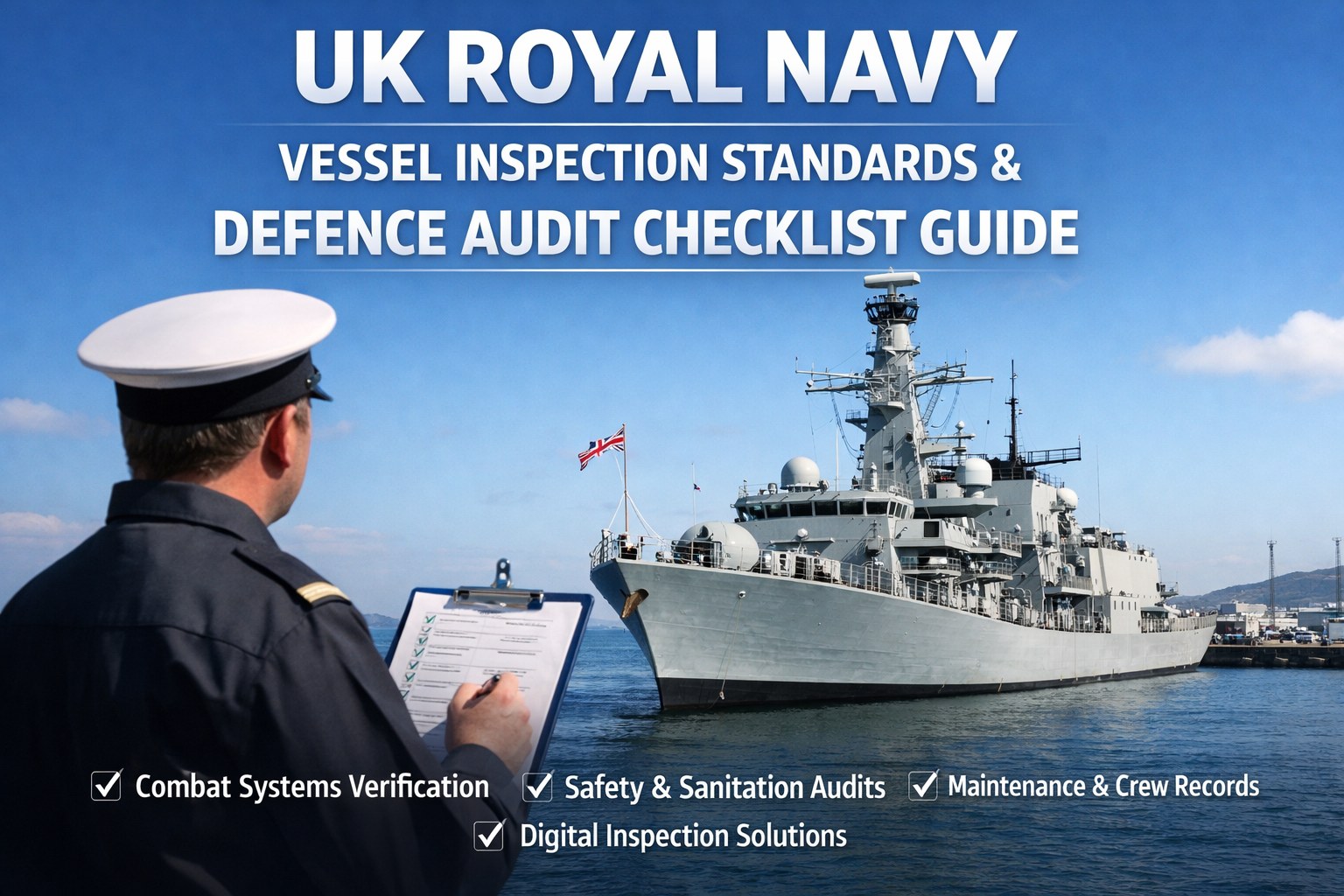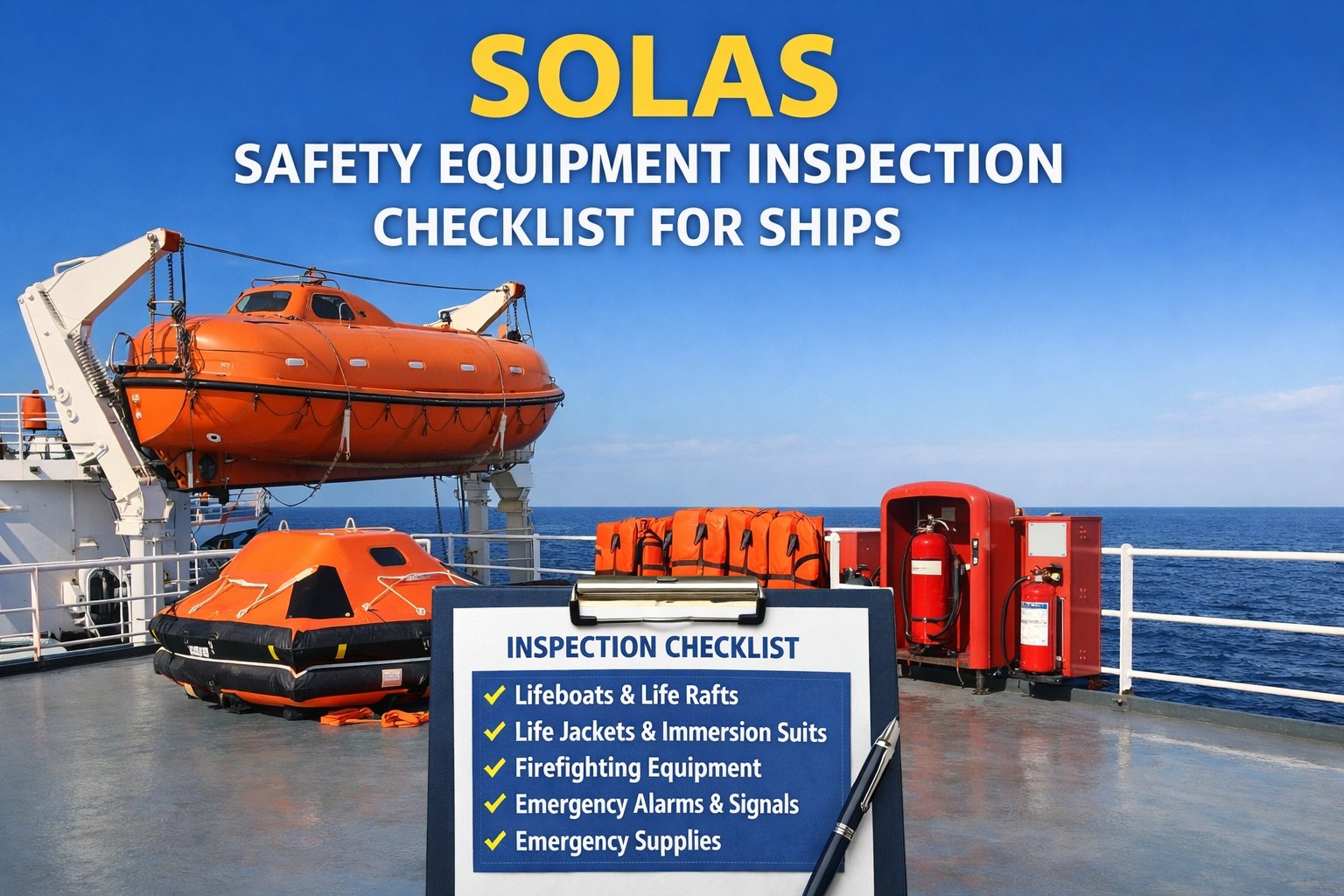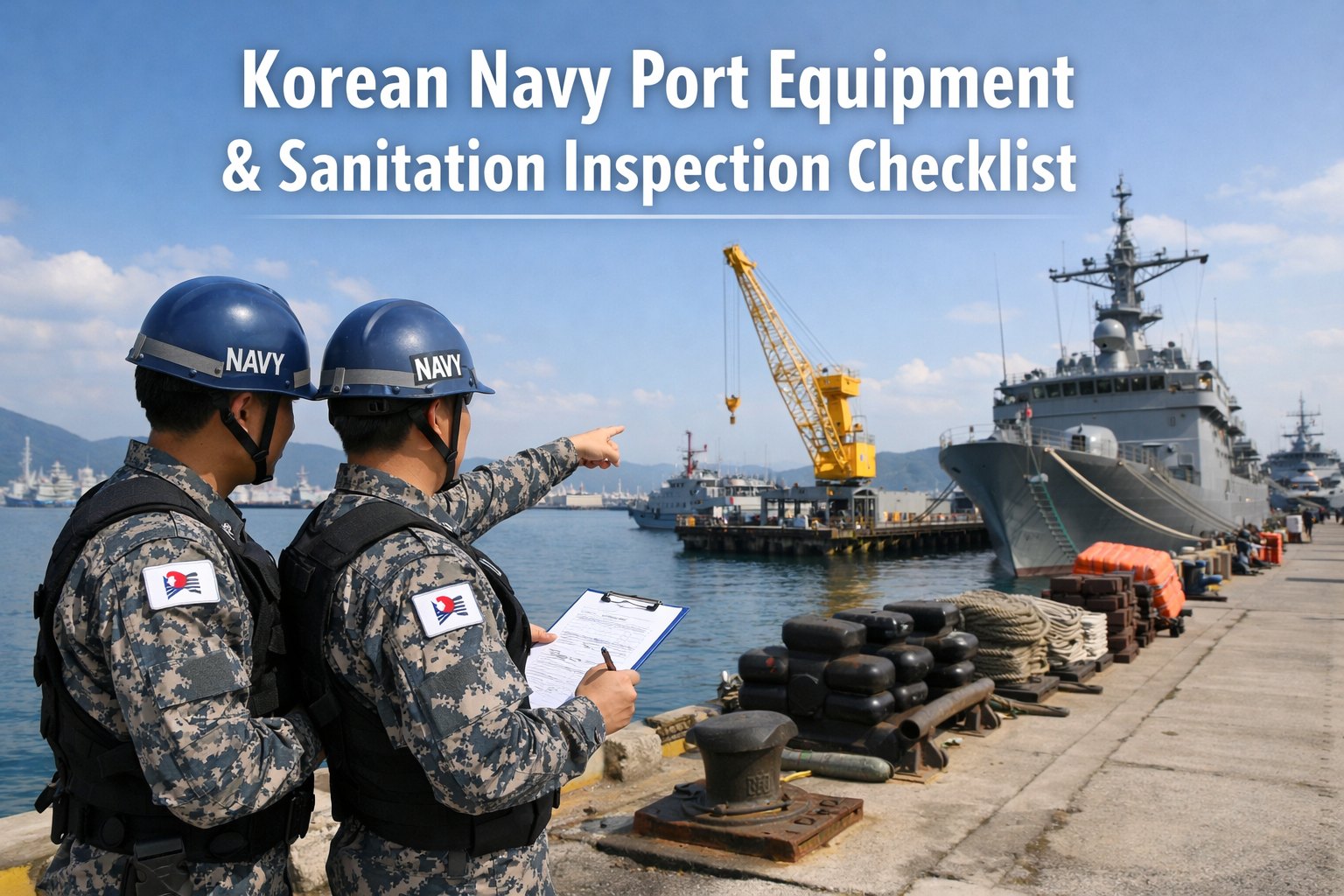
Ensuring Korean Navy inspection and port equipment specialist readiness is essential for ROKN vessel compliance, naval base entry protocols, and maritime safety across Korean naval operations. Systematic verification across 20 critical areas—from ROKN pre-arrival security clearance and combat systems safety to NQS sanitation quarantine, MARPOL compliance, and Korea Coast Guard PSC documentation—supports effective Korean naval port operations. Start your free Korean Navy port inspection trial
Korean Navy Inspection & Port Equipment Specialist Software
Comprehensive Korean Navy Port Equipment & Sanitation Inspection Checklist
Importance of Korean Navy Port Equipment & Sanitation Inspections
Naval Base Security & Entry Readiness
- Inspections of ROKN pre-arrival notices, security certificates, Declaration of Security, and personnel manifests ensure compliant naval base entry throughout ROKN operations.
Port Equipment & Structural Safety
- Assessment of quay structures, fendering, cranes, mooring hardware, bollards, and gangway systems ensures Korean naval base port equipment meets safe operational and load certification standards.
Sanitation & Environmental Compliance
- Documentation of NQS quarantine procedures, galley food safety, pest control records, and MARPOL compliance demonstrates adherence to Korean MOF regulations and international maritime environmental standards.
Combat Readiness & Systems Verification
- Verification of weapons and combat systems safety at berth, damage control readiness, LSA equipment, navigation and communications systems, and KR N-CAP compliance ensures ROKN vessels maintain complete operational readiness for Korea Coast Guard PSC examinations.
Ready to enhance Korean Navy port inspection compliance? Schedule a personalized demo or start your free trial today.
1. ROKN Vessel Pre-Arrival Security Clearance & Naval Base Entry
ROKN Vessel Pre-Arrival Security Clearance & Naval Base Entry inspection requirements:
2. Korean Navy Hull Structural & Underwater Body Readiness Inspection
Korean Navy Hull Structural & Underwater Body Readiness Inspection requirements:
3. Korean Navy Propulsion Machinery & Engineering Systems Inspection
Korean Navy Propulsion Machinery & Engineering Systems Inspection requirements:
4. Korean Navy Weapons & Combat Systems Safety Protocol at Berth
Korean Navy Weapons & Combat Systems Safety Protocol at Berth inspection requirements:
5. Korean Navy Electrical Navigation & Communications Systems Inspection
Korean Navy Electrical Navigation & Communications Systems Inspection requirements:
✓ Transform Korean Navy Port Inspection Compliance: With 186 comprehensive verification points across 20 critical naval and port safety areas, maintaining ROKN readiness requires systematic tracking and documentation. Schedule your demo now to discover automated Korean naval inspection tracking and compliance reporting.
6. Korean Navy Damage Control & Fire-Fighting Readiness at Berth
Korean Navy Damage Control & Fire-Fighting Readiness at Berth inspection requirements:
7. Korean Navy LSA Safety Equipment & Medical Stores Inspection
Korean Navy LSA Safety Equipment & Medical Stores Inspection requirements:
8. KR Naval Vessel Condition Assessment Programme (N-CAP) Compliance
KR Naval Vessel Condition Assessment Programme (N-CAP) Compliance inspection requirements:
9. Naval Base Berth Quay Structure & Fendering Assessment
Naval Base Berth Quay Structure & Fendering Assessment inspection requirements:
10. Naval Base Crane Cargo Handling & Ammunition Handling Equipment
Naval Base Crane Cargo Handling & Ammunition Handling Equipment inspection requirements:
11. Naval Base Mooring Hardware Bollard & Quick Release Hook Inspection
Naval Base Mooring Hardware Bollard & Quick Release Hook Inspection requirements:
12. Naval Base Gangway Shore Ramp & Personnel Access Equipment
Naval Base Gangway Shore Ramp & Personnel Access Equipment inspection requirements:
13. Naval Base OPS Shore Power Fuel & Utility Supply Connection
Naval Base OPS Shore Power Fuel & Utility Supply Connection inspection requirements:
14. Korean Port-MIS Pre-Arrival Notification & MOF Compliance
Korean Port-MIS Pre-Arrival Notification & MOF Compliance inspection requirements:
15. Korean NQS Vessel Sanitation Quarantine & Pratique Procedures
Korean NQS Vessel Sanitation Quarantine & Pratique Procedures inspection requirements:
16. MARPOL & Korean Marine Pollution Prevention Act (MPPA) Compliance
MARPOL & Korean Marine Pollution Prevention Act (MPPA) Compliance inspection requirements:
17. Korean ECA Fuel Sulphur & Air Emission Compliance at Port
Korean ECA Fuel Sulphur & Air Emission Compliance at Port inspection requirements:
18. Pest Rodent & Vector Control at Korean Naval & Commercial Ports
Pest Rodent & Vector Control at Korean Naval & Commercial Ports inspection requirements:
19. Vessel Sanitation Accommodation Galley & Food Safety Inspection
Vessel Sanitation Accommodation Galley & Food Safety Inspection requirements:
20. Korea Coast Guard PSC Self-Inspection & Post-Call Documentation
Korea Coast Guard PSC Self-Inspection & Post-Call Documentation inspection requirements:
Why Use Digital Fleet Management for Korean Navy Port Inspections?
Marine Inspection App Benefits for Korean Navy Port Management:
- ✓ Mobile checklists covering all 20 ROKN compliance areas
- ✓ Digital records for vessel certificates, N-CAP compliance, and port equipment assessments
- ✓ Automated NQS quarantine and Port-MIS notification scheduling
- ✓ Real-time deficiency tracking and corrective action management
- ✓ Compliance reports for Korea Coast Guard PSC, KR Classification, and MOF
- ✓ Alerts for certificate expirations and ECA fuel changeover requirements
Schedule your demo or sign up for free to experience automated Korean Navy port inspection tracking.
Frequently Asked Questions About Korean Navy Port Equipment & Sanitation Inspections
1. What areas are covered in the Korean Navy port equipment and sanitation inspection checklist?
The checklist covers 20 critical areas totalling 186 verification points: ROKN vessel pre-arrival security clearance, hull structural and underwater body readiness, propulsion machinery and engineering systems, weapons and combat systems safety at berth, electrical navigation and communications systems, damage control and fire-fighting readiness, LSA safety equipment and medical stores, KR N-CAP compliance, naval base berth quay structure and fendering, crane cargo and ammunition handling equipment, mooring hardware bollard and quick release hook inspection, gangway shore ramp and personnel access equipment, shore power fuel and utility supply connection, Korean Port-MIS and MOF compliance, NQS vessel sanitation quarantine and pratique procedures, MARPOL and Korean MPPA compliance, Korean ECA fuel sulphur and air emission compliance, pest rodent and vector control, vessel sanitation accommodation galley and food safety, and Korea Coast Guard PSC self-inspection and post-call documentation.
2. How often should Korean Navy port equipment and sanitation inspections be conducted?
Conduct inspections prior to every naval base entry for security clearance, at each Korean port call for NQS quarantine and MARPOL compliance, monthly for vessel condition assessments, and annually for major equipment load testing and certification renewal. Additional inspections are required following any deficiency finding or Korea Coast Guard PSC examination. Sign up for automated inspection scheduling to maintain consistent compliance.
3. What are the most critical items to verify?
Critical items include ROKN pre-arrival notice submitted to naval base, ISSC certificate confirmed valid, Declaration of Security completed, KR N-CAP certificate of classification confirmed, IOPP Certificate valid, pre-arrival notification submitted through Port-MIS, Maritime Declaration of Health submitted to NQS, fuel sulphur content within Korean ECA requirements, all statutory certificates valid for PSC, and Port-MIS departure clearance submitted before sailing.
4. What documentation is required for Korean Navy port compliance?
Required documentation includes ROKN ISSC and naval security certificates, Declaration of Security, KR N-CAP classification certificates, IOPP Certificate, Port-MIS pre-arrival confirmations, Maritime Declaration of Health and NQS pratique confirmation, deratting certificates, Ship Sanitation Control Certificate, bunker delivery notes for ECA-compliant fuel, KOEM oil spill nomination certificate, STCW and MLC 2006 DMLC documentation, ISM company DOC and vessel SMC, and Tokyo MOU PSC self-inspection records. Schedule a demo to see how digital documentation simplifies compliance reporting.
5. How can digital management improve Korean Navy port inspection compliance?
Digital management provides mobile checklists for all 20 inspection areas, automated Port-MIS notification scheduling, real-time deficiency reporting, certificate and NQS quarantine expiry tracking, complete inspection history for PSC reviews, and compliance reports for KR Classification, Korean MOF, and KOEM audits. Start your free trial to experience automated Korean Navy port inspection management.
Take Action: Implement Comprehensive Korean Navy Port Inspection Management
Download our FREE Korean Navy Inspection & Port Equipment Specialist & Sanitation Checklist and start implementing systematic ROKN compliance verification across all 20 inspection areas.
Get Started Today: Start your free trial or schedule a personalized demo to see how we help ROKN vessel operators and Korean port authorities maintain naval port compliance.
Master Korean Navy Port Equipment & Sanitation Compliance
186 verification points across 20 critical areas—ROKN security clearance, combat systems safety, KR N-CAP compliance, NQS sanitation quarantine, MARPOL and Korean MPPA compliance, and Korea Coast Guard PSC documentation—all tracked automatically.