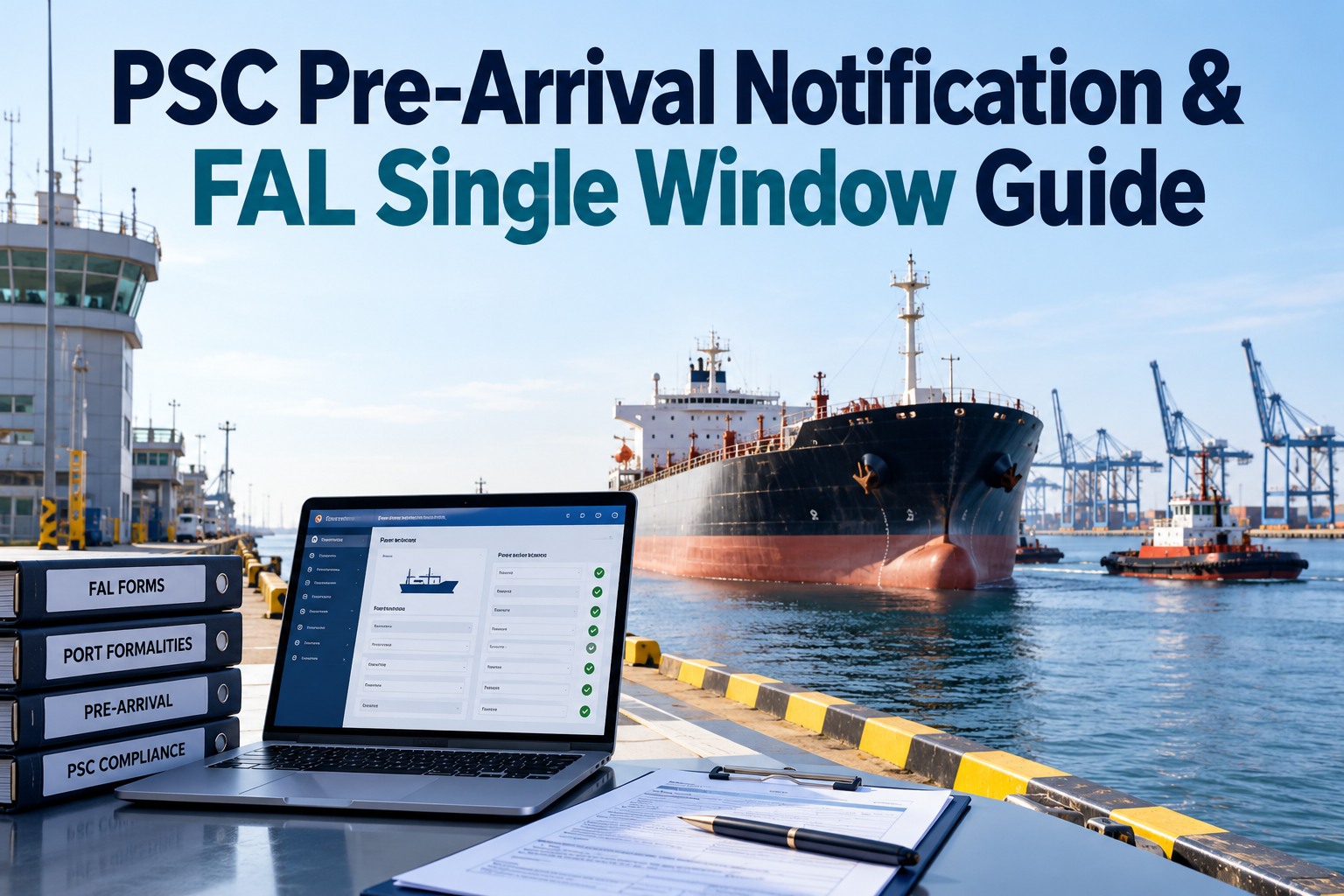
Port State Control starts before the ship arrives: pre-arrival notifications help decide whether an inspector is waiting at the gangway, and late or inconsistent ones bring delays, fines and closer scrutiny. This guide covers the timings, the FAL forms and the checks that keep port entry smooth. Book a demo to keep port call data consistent.
PSC pre-arrival notification and the FAL single window: send it on time, make it match
Every port call runs on a clock that starts days before arrival. Miss a deadline and the inspection risk goes up.
Why pre-arrival notification matters to port State control
In the Paris MoU region, the notification is part of PSC targeting. Ships due an expanded inspection must give 72 hours’ notice, and the Netherlands authority states that failing to report this eligibility is an offence, leading to mandatory inspection, possible delay and a fine. Our guide to how PSC inspections get triggered explains the risk profile behind it. Try the platform free.
The pre-arrival notification clock
Timings differ by country and port, so always check the local requirements and the agent’s instructions. These are common examples for international voyages.
IMO FAL forms and what authorities check them against
The FAL Convention standardises arrival declarations so the same data serves every authority. Our guide to vessel pre-arrival documentation covers each document in detail; the right-hand column here shows what each declaration is usually compared with.
| FAL form | Declaration | Usually compared with |
|---|---|---|
| FAL 1 | General Declaration | Ship certificates, registry and particulars |
| FAL 2 | Cargo Declaration | Manifest and bills of lading |
| FAL 3 | Ship’s Stores Declaration | Bonded and controlled stores on board |
| FAL 4 | Crew’s Effects Declaration | Items declared by crew members |
| FAL 5 | Crew List | Passports, seafarer documents, safe manning and STCW certificates |
| FAL 6 | Passenger List | Passenger travel documents |
| FAL 7 | Dangerous Goods Manifest | Stowage plan, DG documentation and segregation on board |
Maritime single window in 2026: IMO mandatory, EU harmonised
Since 1 January 2024, FAL amendments require public authorities to provide a maritime single window for electronic data exchange. In Europe, the European Maritime Single Window environment (EMSWe) has applied since 15 August 2025.
The legal requirement is uniform, but how ports implement single windows still varies. Agents remain the main submitters in many ports.
Declare it once, match it every time
Keep crew, certificate and ship data current on board, so every pre-arrival notice matches what the inspector finds.
Data consistency: what each pre-arrival notification must match on board
Clearance problems usually come from data that does not match, not from missing rules. Check each item before sending.
Common pre-arrival errors that cause delays and deficiencies
Most of these are avoidable with a final check against current records.
After the notice: PSC inspection readiness on arrival
A clean notification sets expectations; the ship still has to meet them. Our PSC inspection preparation guide and USA pre-arrival checklist cover what follows.
Pre-arrival notification and FAL compliance checklist
Run this for every port call, starting at least four days out.
How Marine Inspection keeps pre-arrival data consistent
Marine Inspection keeps the records behind every notification current: certificates with expiry alerts, crew documents, record books and open findings, all per ship. Before each call, a pre-arrival checklist confirms the data matches. The board below is illustrative.
PSC pre-arrival notification FAQs
What is a pre-arrival notification?
The data a ship or its agent sends to port authorities before arrival, covering ship details, ETA, crew, cargo, security, waste and, in some regions, PSC inspection eligibility.
What are the IMO FAL forms?
Seven standard declarations: General Declaration, Cargo Declaration, Ship’s Stores, Crew’s Effects, Crew List, Passenger List and Dangerous Goods Manifest.
Is the maritime single window mandatory?
Yes. Under amendments to the FAL Convention, public authorities must provide a maritime single window for electronic data exchange from 1 January 2024.
What is the 72-hour notice in the Paris MoU?
Ships eligible for an expanded inspection must notify at least 72 hours before arrival, or before leaving the previous port if the voyage is shorter.
How early must a US Notice of Arrival be sent?
At least 96 hours before arrival; for voyages under 96 hours, before departure and at least 24 hours before arrival.
Can Marine Inspection help with port call readiness?
Yes. Book a demo to see certificate alerts and pre-arrival checklists per ship.
Arrive with the paperwork already proven
On-time notices that match the ship’s records turn port entry into a formality, not a reason to look closer.