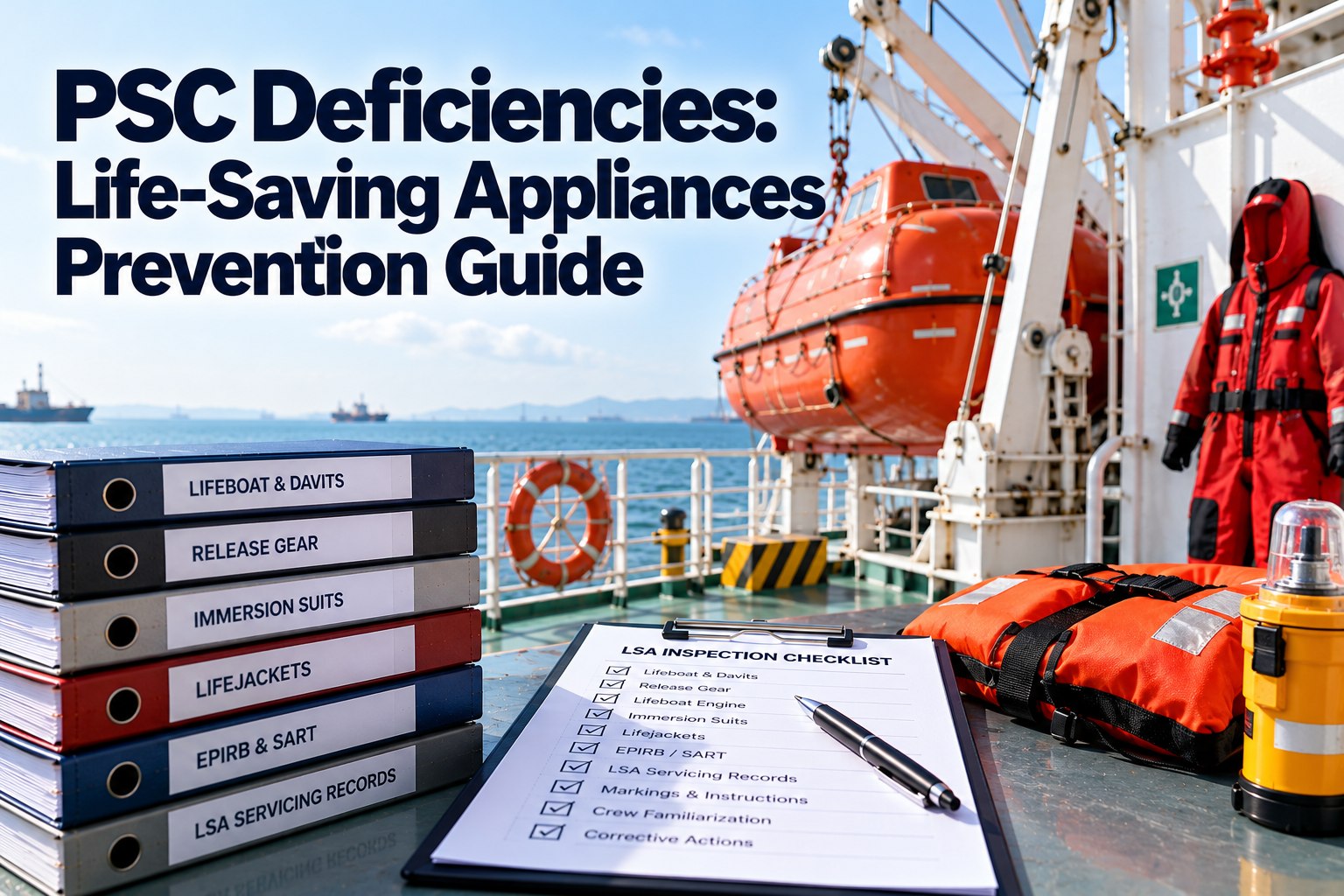
When an inspector asks to see a lifeboat engine start, a hook reset or a davit moved, the answer is rarely a surprise to the crew, yet the same items fill the deficiency tables year after year. Which life-saving appliance items cause the most trouble, and what can a Safety Officer check before the pilot boards? This guide ranks the items using ClassNK port State control reports for 2025, 2016 and 2011, a Lloyd's Register and UK P&I checklist and the Paris MoU 2019 campaign, labels what is old or secondary, and sets out a five-week routine with a checkpoint type on every item. For the underlying requirements, see our SOLAS life-saving appliances Chapter III requirements and inspection guide.
Where Life-Saving Appliances Sit in the Deficiency Tables
What the 2025 ClassNK figures show, and the limits of a single classification society
The most recent figures we found come from the ClassNK Port State Control Annual Report 2026, summarised by the International Institute of Marine Surveying and covering ships inspected during 2025. ClassNK recorded 425 detentions and 1,752 detainable deficiencies on its classed ships of 500 GT and over, of which fire safety was the leading category at 426, followed by life-saving appliances at 172, emergency systems at 169, ISM at 159, safety of navigation at 136 and water and weathertight conditions at 119. These are detainable deficiencies, not detentions. The summary does not break down the 172 by appliance, so it shows that LSA matters but not which appliance drives the number.
The picture agrees in direction with the Tokyo MoU 2025 coverage, where trade reports name fire safety, life-saving appliances and working and living conditions as recurring areas of concern, but those reports gave us no LSA figure. A June 2026 paper from the survival equipment company Survitec, reported by Maritime Executive, also names fire safety, life-saving appliances and ISM failures as the focus of inspectors and says most detentions come from preventable maintenance and training lapses. It is a vendor paper with a commercial interest, so we treat it as context, not as proof.
Twenty Years of the Same Lifeboat Problems: Three Older Datasets Compared
The 2005 to 2007 ranking, the 2011 breakdown and the 2014 to 2016 counts
The older datasets are useful because they show that the same items repeat. The Lloyd's Register and UK P&I pocket checklist, published in 2008, ranked PSC findings on ships surveyed in 2005 to 2007 and put lifeboats first at 309, then launching arrangements for survival craft at 105, lifebuoys at 94, lifeboat inventory at 76 and inflatable liferafts at 63. The numbers are old, the fleets and rules have moved on, and we use the ranking only to show which items have long been in the frame.
ClassNK data for 2011, summarised in a 2012 blog article, recorded 277 lifeboat arrangement deficiencies and 78 detentions, with engines at 71, releasing gear at 32, starter batteries at 26 and reflective tape at 15. The article is secondary and did not give causes. It also noted that individual deficiencies may be rectified before departure, while two or more found together can be taken as evidence of non-conformity with ISM Code section 10, which often leads to detention.
The 2014 to 2016 series: lifeboats stay near the top while davits swing
The ClassNK report of June 2017 counts lifeboat detainable deficiencies of 57, 55 and 63 in 2014, 2015 and 2016, with survival craft launching arrangements at 14, 4 and 14 and rescue boat launching arrangements at 5, 5 and 13. The common causes it noted for 2016 were engines that were not started, poor battery maintenance, inadequate resetting of on-load release gear and inoperative davits with seized components. The report does not give LSA detention totals, and it is now nearly a decade old.
| Item | 2014 | 2015 | 2016 | Noted in 2016 |
|---|---|---|---|---|
| Lifeboats | 57 | 55 | 63 | Engine not started, poor battery maintenance, on-load release gear not reset properly |
| Launching arrangements for survival craft | 14 | 4 | 14 | Inoperative davit with seized components |
| Launching arrangements for rescue boats | 5 | 5 | 13 | Inoperative davit with seized components |
| Rescue boats | 11 | 17 | 9 | Rescue boat engine not started, poor battery maintenance |
The Lifeboat Readiness Chain: Engine, Release Gear, Davit, Inventory, Tape and Crew
Why every link counts, one item at a time
Engines and starter batteries
Engine failures are the clearest repeat item in the sources: lifeboat and rescue boat engines that would not start in the 2016 report, and 71 engine-related lifeboat deficiencies in the 2011 summary. The ClassNK 2012 article ties the fix to the SMS and the makers' plans. Run each engine on the weekly schedule, record it, check fuel, lubrication and cooling, and test the starter battery and its charger. Keep a dated record, because the weekly test record is one of the documents the LR and UK P&I checklist says inspectors expect to see.
Release gear, hooks and interlocks
Release gear had 32 deficiencies in the 2011 summary, and the 2016 report listed inadequate resetting of on-load release gear. The report's photographs show an improperly reset interlock lever, and the 2012 article's figure captions illustrate hook reset position, hook gap, a corroded hook-side bracket, interlock springs and a detached interlock cable. Because release gear is directly tied to the safety of anyone in the boat, follow the maker's instructions and the ship's procedures for checks, and do not improvise on-load or off-load tests.
Davits, falls and the launching arrangements
Inoperative davits with seized components were named for both survival craft and rescue boats in 2016, with launching arrangements at 14 and 13 detainable deficiencies. Seizure points to missing lubrication and exercise. Operate the davit, grease the points the maker names, inspect falls and wires, and test cut-out and limit switches. The Survitec paper adds a separate point for lifting chains, saying there is no mandatory SOLAS replacement interval and recommending a five-year test or replacement. That is a vendor recommendation, so confirm intervals with the maker, class and flag.
Liferafts, lifejackets, lifebuoys, EPIRB and the rest
The LR and UK P&I checklist lists what inspectors check: raft HRU mounting with the painter attached, stowage, servicing dates, lifejacket numbers, lights and whistles, immersion suits, lifebuoy lights and lines, float-free EPIRB with HRU and battery dates verified, SARTs on each side of the bridge, in-date flares, lifeboat stores and survival craft radio batteries. In the 2005 to 2007 ranking lifebuoys and lifeboat inventory sat well above rafts and lifejackets, a reminder that small items are inspected too.
Reflective tape and markings
Reflective tape appears in both the 2011 counts, with 15 deficiencies, and the 2016 report photographs. It is cheap to fix and easy to photograph, which makes it a good candidate for a dated photo record before arrival.
Drills, Muster Lists and the 2019 Emergency Systems Campaign
What the Paris MoU campaign measured and what it left out
The 2019 Paris MoU concentrated inspection campaign covered emergency systems, not LSA as such. The questionnaire has 11 questions on damage control plans, public address, water level detectors, steering gear, muster lists, emergency power and lighting, emergency fire pumps, drills and crew familiarisation. Muster lists produced 201 deficiencies, emergency lighting, batteries and switches 169 and public address 109, and 6.6% of the fire or abandon ship drills judged were unsatisfactory. Forty-eight ships were detained as a direct result. The campaign gives no lifeboat, liferaft or breathing apparatus figures, so we use it for the drill and muster picture only.
| Finding | Figure | Relevance to LSA |
|---|---|---|
| Questionnaire completed | 4,009 ships | Lifeboats, liferafts and breathing apparatus were not questionnaire items |
| Muster list deficiencies | 201 | Muster lists are part of emergency organisation and training, close to LSA but not an appliance |
| Emergency lighting, batteries and switches | 169 | Includes lighting at survival craft locations |
| Fire or abandon ship drills judged unsatisfactory | 6.6% of answered cases (120) | The abandon ship drill is where LSA knowledge shows |
| Ships detained as a direct result | 48 | Detention rate 1.2% overall |
A Five-Week Prevention Routine Before Arrival
Order the checks so that problems can still be fixed
The routine puts records first, then engines, release gear and davits, then personal gear, and ends with a realistic drill. It is our suggestion, built from the items the sources name, and it should be adjusted to the voyage. The idea is that findings from the early weeks can still be closed before an inspector arrives.
LSA Readiness Checklist for the Safety Officer
A checklist with a checkpoint type on each item for the final weeks
Use the checklist on each vessel, together with the makers' instructions and the ship's maintenance plan. For servicing detail, see our lifeboat and life raft maintenance, annual servicing and inspection guide, for the inspection as a whole our complete port state control preparation guide for ship masters, and for a readiness view of lifeboats and rafts our SOLAS LSA inspection guide for lifeboat and liferaft readiness.
| Item | What to check | Checkpoint type |
|---|---|---|
| Lifeboat engine | Starts promptly, runs ahead and astern, fuel and lubrication correct, no leaks | Test |
| Starter batteries | Charged, secured, terminals clean, charger working | Test |
| Release gear and hooks | Hooks reset, interlocks set correctly, springs and cables free of corrosion or damage | Visual |
| Davits, falls and winches | Moving parts free, no seized components, wires and falls in good condition, limit and cut-out switches work | Test |
| Liferafts and HRUs | Painter attached to the HRU, stowage clear, servicing label and HRU date current | Visual |
| Lifejackets and immersion suits | Right numbers and sizes, lights and whistles fitted, reflective tape intact, suits not damaged | Visual |
| Lifebuoys | Numbers and positions correct, lights and lines fitted, smoke floats in date | Visual |
| EPIRB and SART | Float-free EPIRB with HRU and battery dates verified, SARTs on each side of the bridge | Record |
| Lifeboat stores and radios | Stores, water and equipment complete and in date, spare sealed batteries in date | Record |
| Marking and reflective tape | Tape present and undamaged on boats, rafts and lifejackets, markings legible | Visual |
| Drill and training records | Abandon ship drills recorded, training manual aboard, crew can demonstrate their duties | Record |
Six LSA Habits That Invite a Deficiency
What the ClassNK reports and the 2012 article point to
Systems That Keep LSA Evidence, Service Dates and Findings Together
How a dated photo repository, task ownership and deadlines support life-saving appliance readiness
LSA findings recur when service dates slip and nobody owns the fix. Marine Inspection supports a dated photo repository, observations turned into tasks with owners, deadlines and evidence, and certificate and equipment tracking. A dated photo of a reset hook, a task for a seized davit point with a named owner and due date, and tracked raft servicing and HRU dates give a Safety Officer a record to show an inspector. It does not replace the ship's SMS, class or the maker's instructions. For inspection software for life-saving appliances, see our lifesaving appliance inspection software for commercial ships.