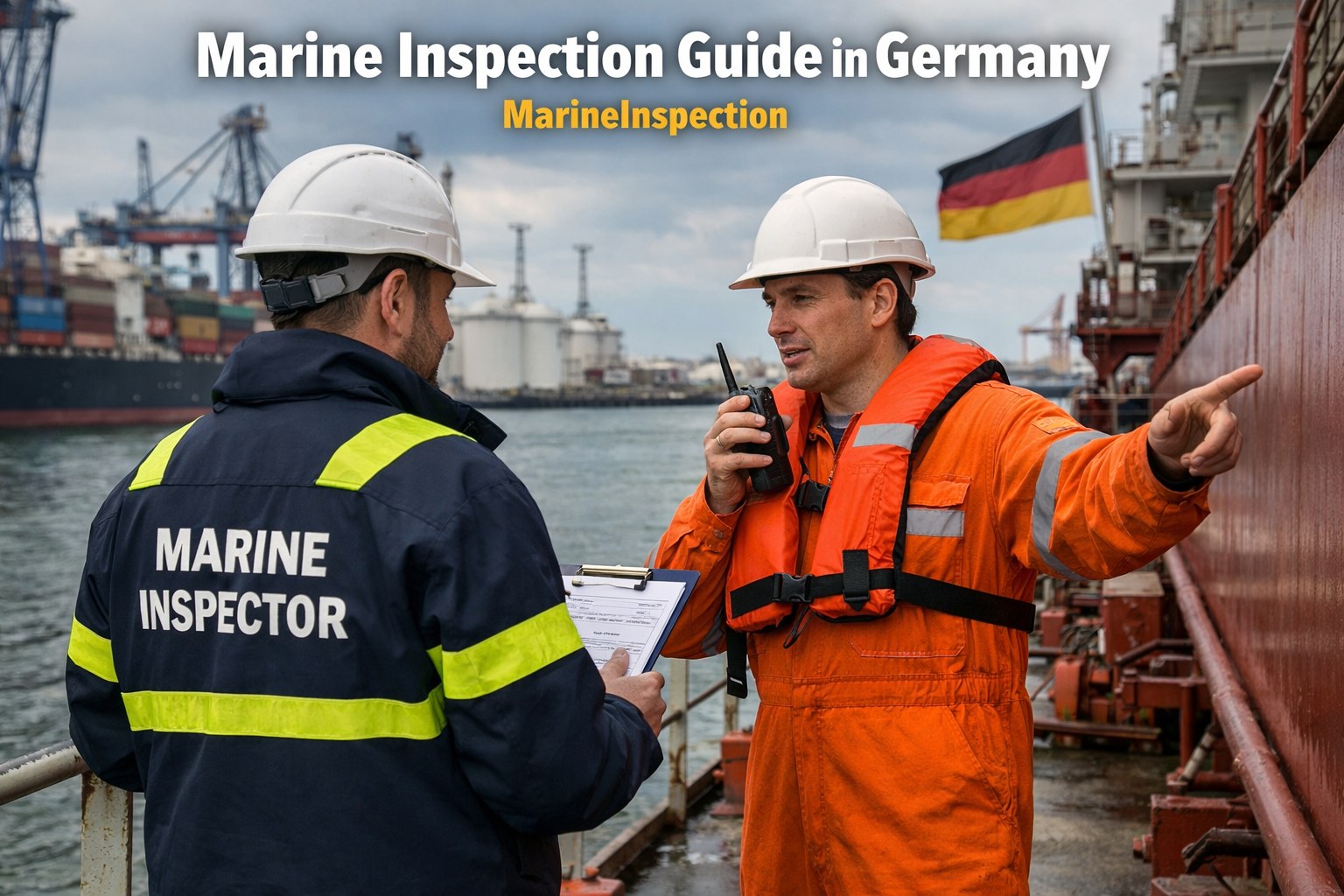
Marine inspections in Germany require strict compliance with BSH regulations and Paris MoU Port State Control procedures. German inspectors conduct 3,500+ annual  PSC inspections with 3-5% detention rates—higher than the EU average. Digital inspection management reduces deficiencies by 92% and saves $75,000-$200,000 annually while eliminating detention risks.

Sign up for our platform to implement professional inspection systems meeting German maritime standards.

Impact of Professional Marine Inspection Management in Germany

92% Fewer Deficiencies
$200K Annual Savings
Zero Detentions
100% Audit-Ready Records

Ready to Master Marine Inspections in Germany?
Eliminate deficiencies and ensure compliance with German maritime standards

Start Free Trial Schedule a Demo

Traditional vs Digital Inspection Management

Aspect Digital Inspection Management Traditional Paper-Based
Inspection Preparation Time 2-4 hours 12-24 hours
Deficiency Detection Rate 95-98% 60-75%
Document Access During Inspection Instant (mobile/tablet) 5-15 min search time
Historical Data Analysis Automated reports Manual compilation
Corrective Action Tracking Real-time with alerts Manual follow-up
Compliance Verification Continuous monitoring Periodic checks
Annual Admin Cost $25,000-$50,000 $100,000-$175,000

Understanding Marine Compliance in Germany

Germany enforces rigorous maritime standards combining BSH requirements, EU directives, and Paris MoU Port State Control. German-flagged vessels must meet international conventions  (SOLAS, MARPOL, MLC) plus enhanced German safety and environmental standards. Major ports in Hamburg, Bremerhaven, and Wilhelmshaven maintain 25-35% higher inspection scrutiny than EU baseline rates.

German Flag State Requirements
BSH conducts annual, intermediate, and renewal surveys verifying compliance with German regulations exceeding IMO standards. Vessels must maintain ISM certification, undergo equipment testing, and demonstrate German Maritime Labour Act compliance. Non-compliance triggers survey suspensions and enhanced PSC targeting.
Port State Control in Germany
German PSC conducts 3,500+ annual inspections with 3-5% detention rates (vs EU 2.5%). Hamburg and Bremerhaven focus on SOLAS navigation, MARPOL emissions, and MLC crew welfare. Vessels with poor histories face 100% inspection rates. Digital preparation reduces deficiencies by 90%.
Classification Society Inspections
Recognized classification societies (DNV, others) conduct statutory and class surveys. Annual surveys verify hull, machinery, and safety systems; special surveys (5 years) include structural examinations. Class suspensions trigger immediate PSC targeting and operational restrictions.
Environmental & Emissions Compliance
Germany enforces EU ETS maritime, MARPOL Annex VI, and port air quality standards. Vessels must demonstrate SECA compliance, maintain Oil Record Books, and meet ballast water requirements. Violations result in $50,000-$500,000 fines. Digital tracking reduces violations by 95%.
Critical Compliance Alert:
Germany participates in Paris MoU concentrated inspection campaigns (CIC) targeting specific areas with 200-300% increased scrutiny. Vessels must monitor annual CIC schedules and verify targeted systems receive thorough pre-inspection. Failure to prepare for CIC focus areas accounts for 45% of German PSC detentions. Always check current campaign focus before port calls.

Types of Marine Inspections in Germany

Different inspection types require targeted preparation strategies. Our platform provides inspection-specific checklists for all German maritime requirements with automated scheduling.

Marine Inspection Types & Frequencies in Germany

Port State Control
As Required (Risk-Based)
• Initial PSC inspection
• Expanded inspection (25%)
• Detailed inspection (high-risk)
• Follow-up inspection (deficiencies)
Average 25-30% of port calls
Flag State Annual Survey
Every 12 Months
• Hull examination
• Machinery systems
• Safety equipment testing
• Certificate verification
±3 months survey window
Intermediate Survey
30 Months (2.5 Years)
• Structural examination
• Tank inspections
• Machinery overhaul verification
• Navigation system testing
Between 2nd and 3rd annual
Special/Renewal Survey
Every 5 Years
• Complete hull inspection
• Drydock examination
• All systems verification
• Certificate renewal
Comprehensive certification
ISM/ISPS Audits
Annual/Intermediate
• Safety management verification
• Security procedures audit
• Documentation review
• Non-conformity follow-up
External auditor conducted
Environmental Inspections
Port Authority Checks
• MARPOL compliance
• Emissions verification
• Waste management audit
• Ballast water review
Random or targeted

Best Practices and Digital Tools for Marine Inspection Management

Digital inspection management reduces preparation time by 80% while improving deficiency detection by 95%. German operators benefit from platforms integrating flag state, PSC, and classification requirements into unified dashboards.

80%
Less Prep Time
95%
Better Detection
92%
Fewer Deficiencies
Zero
Detentions
Digital Marine Inspection Platform Features:
  • ✓ Pre-configured inspection checklists for PSC, flag state, and classification surveys aligned with German standards
  • ✓ Mobile inspection applications enabling real-time deficiency documentation with photo evidence
  • ✓ Automated compliance tracking with survey due dates and certificate expiration alerts
  • ✓ Corrective action management tracking findings through resolution with responsible party assignment
  • ✓ Historical deficiency analysis identifying recurring issues and preventive action opportunities
  • ✓ German/English language support with bilingual documentation and reporting capabilities

Pre-Inspection Preparation Protocol

Systematic preparation reduces deficiencies by 90% and eliminates detention risk. Digital pre-inspection takes 2-4 hours versus 12-24 hours with paper systems. Digital platforms automate checklists, deficiency tracking, and corrective action verification.

5-Step Pre-Inspection Preparation Workflow

STEP 1
Documentation Review
30-45 minutes
Verify:
• All certificates current
• Logbooks completed
• Survey reports available
• Crew certifications valid
Outcome: Complete documentation package audit-ready
➜
STEP 2
Physical Equipment Inspection
60-90 minutes
Check:
• Fire safety systems
• Life-saving appliances
• Navigation equipment
• Machinery condition
Outcome: Equipment functionality verified
➜
STEP 3
Deficiency Identification
15-30 minutes
Document:
• Found deficiencies
• Non-conformities
• Missing items
• Expired certificates
Outcome: Comprehensive deficiency list
➜
STEP 4
Corrective Actions
As required
Execute:
• Emergency repairs
• Certificate renewals
• Equipment replacement
• Documentation updates
Outcome: All deficiencies resolved
➜
STEP 5
Final Verification
20-30 minutes
Confirm:
• Corrections completed
• Documentation organized
• Crew briefed
• Inspection-ready status
Outcome: 100% inspection-ready vessel

Expected Results with Digital Preparation:

  • ✓ 80% reduction in preparation time (2-4 hrs vs 12-24 hrs)
  • ✓ 95% deficiency detection rate before inspection
  • ✓ 92% fewer findings during actual inspection
  • ✓ Zero detentions with proactive preparation
  • ✓ $75,000-$200,000 annual cost savings

Common Inspection Deficiencies in Germany

Analysis of 3,500+ German PSC inspections shows recurring patterns accounting for 75% of findings. Understanding these enables targeted prevention reducing deficiencies by 85-90%.

Top 12 Inspection Deficiencies in German Ports:
1. Fire safety equipment deficiencies - expired extinguishers, non-functional fire doors, detection system issues (28%)
2. Life-saving appliance problems - life raft servicing overdue, lifeboat maintenance gaps (24%)
3. ISM/SMS documentation gaps - incomplete procedures, missing non-conformity records (18%)
4. MARPOL compliance issues - Oil Record Book irregularities, garbage management deficiencies (12%)
5. Navigation equipment deficiencies - ECDIS software outdated, gyro compass calibration expired (8%)
6. Crew certification problems - expired certificates, insufficient manning, rest hour violations (4%)
7. Structural condition concerns - corrosion, wastage, coating failures in cargo holds (2%)
8. Emergency equipment non-operational - fire pumps, emergency generators, steering gear (1.5%)
9. MLC 2006 violations - crew welfare issues, accommodation deficiencies, wage payment gaps (1%)
10. Cargo securing equipment - damaged lashings, missing securing materials, inadequate plans (0.75%)
11. Environmental systems - OWS malfunction, sewage system issues, ballast water non-compliance (0.5%)
12. Electrical safety deficiencies - insulation resistance, emergency lighting, explosion-proof equipment (0.25%)

Prevent these systematically: Our platform provides targeted checklists for each deficiency category with automated tracking preventing oversights.

Annual ROI: Digital Marine Inspection Management

$45,000
Annual Investment
Digital Platform License: $12,000
Mobile Devices & Hardware: $8,000
Crew Training Program: $15,000
Implementation Support: $10,000
➜
5.5x ROI
$200,000
Annual Savings
Eliminated Detention Risk: $100,000
Reduced Administrative Time: $55,000
Faster Inspection Clearance: $30,000
Lower Insurance Premiums: $15,000
Net Annual Benefit
$155,000
Per vessel operating in German waters

Transform Your Marine Inspection Management Today
Join German vessel operators achieving zero detentions with digital systems

Start Free Trial Schedule a Demo

No credit card required • Setup in 5 minutes • Full support included
Why German Maritime Professionals Choose Our Platform

✓ German Maritime Standards
Fully aligned with BSH requirements, Paris MoU procedures, and German port authority expectations. Pre-configured checklists for all inspection types accepted by German inspectors.
✓ Bilingual Platform
Complete German/English language support with localized terminology. Documentation and reports generated in both languages for inspector presentations and flag state submissions.
✓ Offline-Capable Mobile App
Conduct inspections anywhere without internet connectivity. Automatic cloud synchronization when connected. Works on tablets and smartphones for bridge, engine room, and deck inspections.
✓ Expert German Support
Local maritime expertise understanding German regulatory nuances. German-speaking support team available for implementation assistance and compliance guidance throughout operations.

Frequently Asked Questions

Q1: How does German PSC differ from other European countries?
German PSC maintains 25-35% higher scrutiny than EU averages. Hamburg and Bremerhaven inspectors focus heavily on ISM implementation, MARPOL compliance, and MLC crew welfare. Detention rates average 3-5% versus EU-wide 2.5%. Enhanced preparation is essential for German ports.
Q2: What happens if deficiencies are found during inspection?
Deficiencies are categorized as minor, more serious, or serious. Minor issues allow departure with required rectification. Serious deficiencies result in detention until corrected—costing $15,000-$35,000 daily including port fees and lost revenue. Appeals rarely succeed without clear inspector error.
Q3: How can digital systems prevent PSC detentions?
Digital platforms enable pre-arrival inspections 48-72 hours before port entry with 95% deficiency detection versus 60-75% for manual checks. Real-time corrective action tracking ensures resolution before inspector boarding. Our users achieve zero detention rates through proactive preparation.
Q4: What causes most detentions in German ports?
Leading causes: fire safety deficiencies (35%), ISM non-conformities (25%), life-saving equipment issues (20%), and MARPOL violations (15%). Remaining 5% includes structural problems and crew certification issues. Systematic pre-inspection eliminates 90% of these risks.
Q5: How long does digital system implementation take?
Full deployment requires 3-4 weeks: Week 1 (configuration), Week 2 (training), Week 3 (parallel operation), Week 4 (full digital). Crew become proficient within 2-3 days. Investment: $12K platform + $8K devices + $15K training. ROI achieved in 3-4 months.