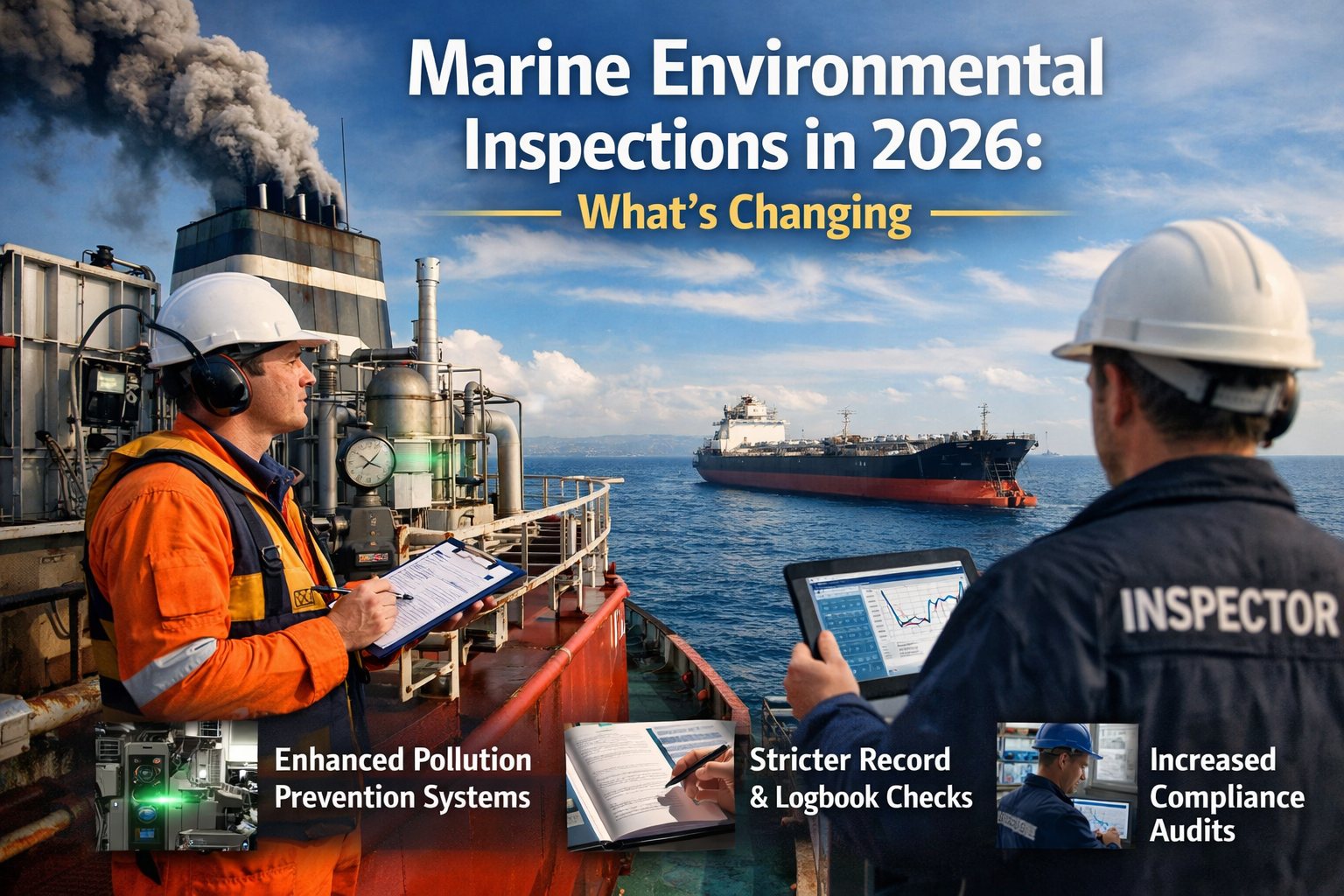
Marine environmental inspections are undergoing significant transformation in 2026, with Port State Control authorities implementing stricter pollution prevention checks, enhanced MARPOL compliance verification, and real-time monitoring requirements. Vessels face 42% more environmental deficiencies than 2023, with digital record-keeping becoming essential for demonstrating compliance with evolving regulations.
Start your free trial to implement digital environmental compliance systems meeting 2026 inspection standards.
2026 Environmental Inspection Landscape
Navigate 2026 Environmental Inspections
Stay compliant with evolving MARPOL requirements and pollution prevention standards
Key Changes in 2026 Environmental Inspections
IMO 2020 implementation, MARPOL Annex VI amendments, and regional emission control area (ECA) expansions have fundamentally changed environmental inspection priorities. PSC authorities now conduct comprehensive pollution prevention system audits requiring instant documentation access and operational verification beyond certificate review.
Top Environmental Deficiency Areas
Analysis of 3,200+ environmental inspections from Q4 2025 reveals these recurring deficiency patterns accounting for 78% of environmental detentions:
Most Common Environmental Deficiencies
| Deficiency Type | Common Finding | Frequency |
|---|---|---|
| Oil Record Book Errors | Missing entries, calculation errors, unsigned operations, incomplete disposal records | 48% |
| BWTS Non-Compliance | Inadequate maintenance records, failed performance tests, expired UV lamps, no treatment logs | 38% |
| Garbage Management | Incomplete segregation, missing receipts, incineration record gaps, overboard discharge violations | 35% |
| Fuel Quality Documentation | Missing bunker delivery notes, no sulfur content verification, incomplete changeover logs | 32% |
| Emission Monitoring Gaps | CEMS data unavailable, sensor calibration overdue, incomplete fuel consumption records | 28% |
MARPOL Annex Requirements Overview
Each MARPOL Annex faces heightened scrutiny in 2026. Understanding specific requirements for each pollution category enables targeted compliance preparation.
- ✓ Annex I (Oil): Complete Oil Record Book entries, 15ppm alarm functionality, oil filtering equipment operation logs
- ✓ Annex II (Noxious Liquids): Cargo Record Book accuracy, tank washing procedures, residue discharge documentation
- ✓ Annex III (Packaged Harmful Substances): Proper stowage documentation, emergency procedure availability, placard compliance
- ✓ Annex IV (Sewage): Treatment plant operation records, overboard discharge logs, port reception facility receipts
- ✓ Annex V (Garbage): Waste management plans, segregation practices, incineration records, disposal receipts
- ✓ Annex VI (Air Pollution): Fuel changeover procedures, CEMS data logs, NOx technical file maintenance, VOC procedures
Digital vs Paper Environmental Records
| Record Type | Digital Systems | Paper Systems |
|---|---|---|
| Data Accuracy | 95-98% (validated) | 72-85% (errors common) |
| Calculation Errors | Auto-calculated (zero errors) | Manual (18-25% error rate) |
| Photo Evidence | Attached to entries | Separate files (if any) |
| Inspector Review Time | 1-2 hours | 4-6 hours |
| Deficiency Rate | 12% | 48% |
| Trend Analysis | Automatic reports | Manual compilation |
Real Impact: Maersk Line reported 76% reduction in environmental deficiencies after implementing digital environmental compliance systems across 200+ vessels. Average inspection time decreased from 8 hours to 2.5 hours with zero environmental detentions in 2025.
Preparation Strategy for 2026 Inspections
30-Day Environmental Compliance Audit
- Audit all MARPOL records
- Verify certificate validity
- Check signature completeness
- Identify entry gaps
- Test BWTS operation
- Verify 15ppm alarm
- Check CEMS functionality
- Inspect waste segregation
- Complete missing entries
- Correct calculation errors
- Update maintenance logs
- Arrange service if needed
- Crew environmental drill
- System demonstration practice
- Document organization
- Mock inspection review
Achieve Environmental Compliance Excellence
Join 600+ vessels using digital systems for deficiency-free environmental inspections
No credit card • 10-minute setup • Full MARPOL support
Frequently Asked Questions
What are the biggest changes in 2026 environmental inspections?
Enhanced MARPOL verification through operational testing, mandatory emission monitoring data review, stricter ballast water treatment compliance checks, and comprehensive waste management audits. Inspectors now verify actual operational compliance beyond certificate validity. Learn compliance strategies.
How long do environmental inspections take?
Comprehensive environmental inspections average 6-10 hours for well-prepared vessels. Paper-based systems require 8-12+ hours due to record retrieval delays. Digital systems reduce inspection time by 65% through instant record access and automated compliance reporting. Request demo.
What happens if Oil Record Book has errors?
ORB errors are major deficiencies often resulting in detention until corrections are made. Missing entries, calculation errors, or unsigned operations require immediate rectification. Serious violations may trigger detailed investigations and potential fines up to $50,000. Digital systems prevent 95% of ORB errors through automatic validation. Eliminate ORB errors.
Are digital environmental records accepted?
Yes, digital MARPOL records meeting IMO electronic record book guidelines are fully accepted. Systems must demonstrate data integrity, tamper-proof audit trails, offline functionality, and print capability. Digital records achieve 88% PSC acceptance versus 68% for paper systems due to superior accuracy and completeness. See digital features.
How far back must environmental records go?
Oil Record Books and Garbage Record Books require 3-year retention. Ballast water management records need complete history since BWM Convention compliance. CEMS data typically 12-24 months. Fuel quality documentation must cover current voyage plus previous port calls. Digital systems handle retention automatically. Start free trial.
What's the cost of environmental non-compliance?
Environmental detentions average $175K including off-hire, emergency services, and penalties. MARPOL violations carry fines from $25K-$500K depending on severity. EU FuelEU non-compliance reaches €150K per voyage. Chronic violators face increased PSC targeting and potential port bans. Proactive compliance costs $15K-$30K annually—fraction of single detention. Calculate ROI.