A public vessel fleet answers to two masters at once, and that is what makes managing one genuinely different from managing a commercial fleet. Like any operator, a coast guard unit, port authority or municipal marine department must satisfy the maritime regulator — certificates current, safety management working, crews competent, vessels seaworthy. But unlike a commercial operator, it must simultaneously satisfy the public purse: every maintenance decision, every repair invoice, every asset purchase and disposal may be examined by an auditor, a council committee, an oversight body or a records request, and the agency must be able to show not only that a decision was sound but that it was properly authorised and documented at the time. Commercial fleet software is built for the first obligation and largely ignores the second, which is why agencies so often end up running maintenance in one system, procurement approvals in another, and budget justification in a spreadsheet assembled under deadline pressure. This guide sets out what a government marine fleet actually needs from its software — the dual accountability it must serve, the audit trail that is really the deliverable, the lifecycle and budget evidence that defends funding, and the procurement and security requirements agencies must satisfy before they can buy anything at all. To see an audit-ready system running against a public fleet, book a demo or start a free trial.
SECTOR GUIDE · PUBLIC AND GOVERNMENT FLEETS
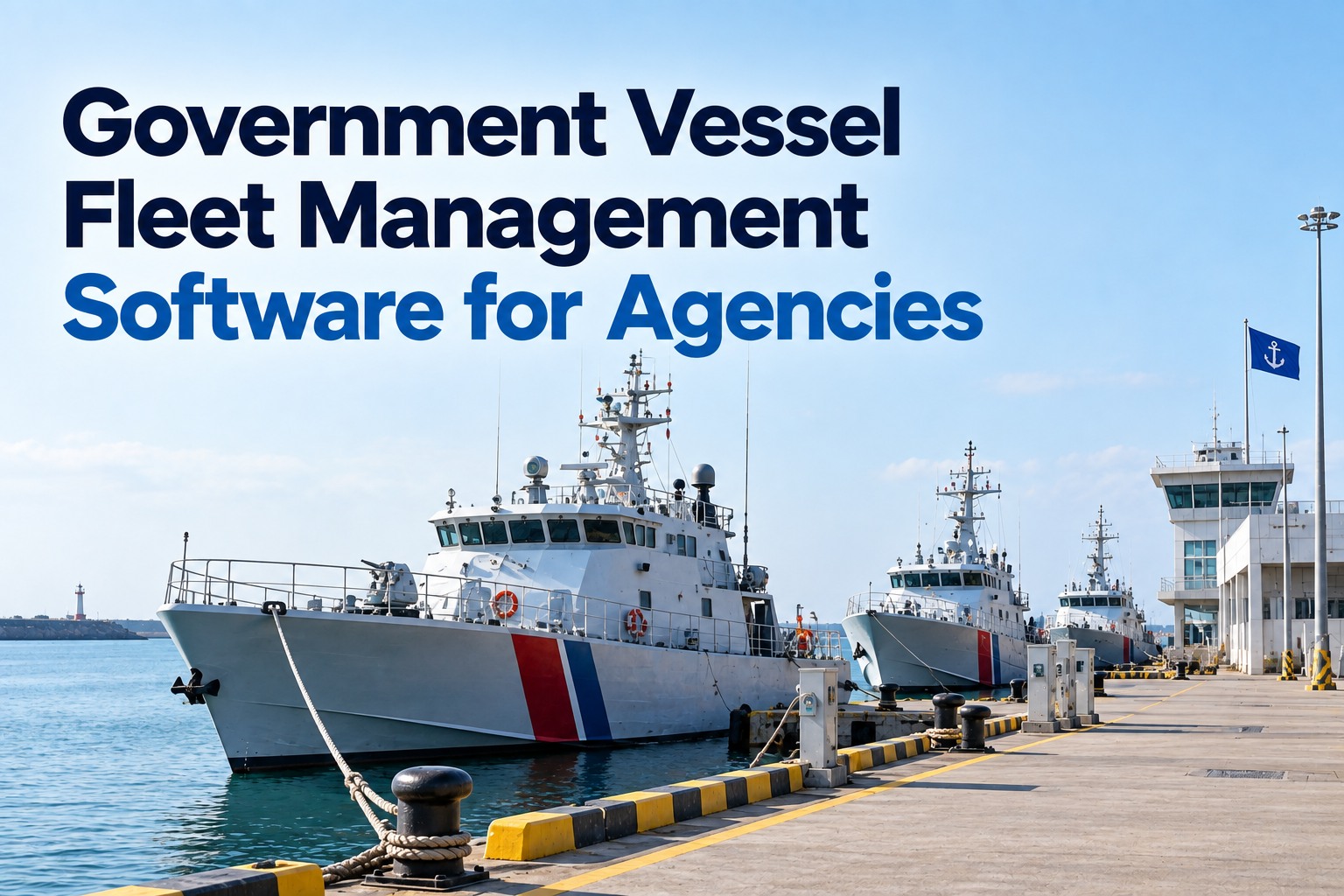
Government Vessel Fleet Management Software for Public Agencies
Coast guards, port authorities, pilot services and municipal marine units answer to the regulator and to the public at the same time. Here is what that dual accountability demands from a fleet system — audit trails, procurement discipline, lifecycle evidence and reporting built to withstand scrutiny.
The Double Accountability
Understanding the public-sector fleet problem starts with recognising that two entirely separate review processes examine the same operational records, and they ask different questions of them.
To the maritime regulator
Is the vessel safe, certified and properly maintained?
Certificates and survey windows current. Safety management system implemented rather than merely written. Maintenance performed and evidenced against a plan. Defects raised, tracked and closed. Crew competent and drilled. This is the familiar operator obligation, and it is judged on operational evidence — the same standard any commercial fleet faces.
To the public purse
Was the spending authorised, justified and traceable?
Every repair cost attributable to an asset and a funding source. Purchases approved through the correct tier before commitment. Asset lifecycle traceable from acquisition to disposal. Records durable and disclosable under open-records rules. This obligation is judged on governance evidence, and commercial software rarely captures it.
The critical point is that these are not two separate record sets — they are two readings of the same underlying operational data. A pump replacement is simultaneously a maintenance event, a cost against a budget line, a draw on a funding source, and a decision someone authorised. If the system captures only the maintenance dimension, the agency reconstructs the rest later under audit pressure, which is exactly where tracking gaps become liability. To see both dimensions captured in one record, book a demo or start a free trial.
What Public Marine Fleets Actually Operate
Government marine fleets are unusually mixed, and the regulatory position varies sharply across them — which is itself a management challenge, since one agency may hold vessels sitting under three different regimes.
Enforcement and patrol craft
Coast guard cutters, police marine units and border patrol boats, often operating around the clock on two-watch crewing with very short maintenance windows and high readiness expectations.
Port authority and pilot vessels
Pilot boats making a dozen transfers a day, line boats, mooring launches and survey craft — high-cycle assets where availability directly affects port throughput.
Service and public-duty vessels
Fire and rescue boats, dredgers, buoy tenders, research and survey vessels, and municipal ferries, spanning small craft to larger tonnage under full international convention.
Most public workboats sit below the SOLAS threshold
This is the regulatory nuance agencies most often navigate. The majority of workboats fall below SOLAS cargo-ship thresholds and instead operate under national codes — the UK Workboat Code 3, USCG Subchapter T and Subchapter L, the Australian NSCV, Canadian TP 1332 and equivalent flag-state instruments. Workboat Code 3 in particular changes the paradigm, moving from prescriptive equipment lists toward risk-based safety management systems and applying retrospectively to existing fleets, which obliges small public operators to produce documented SMS evidence they may never have needed before. Larger agency vessels, meanwhile, may sit under the full international framework with a Document of Compliance and Safety Management Certificate. A single agency can therefore be running vessels under national codes and international convention simultaneously, and its system has to hold both without forcing everything into one template.
The Audit Trail Is the Deliverable
For a public agency, the maintenance record is not merely an operational tool — it is the artefact that will be produced to auditors, oversight committees and, potentially, the public. That changes what the record has to contain.
Attribution on every entry
Every status change, inspection result and work order time-stamped and attributed to a named user, so the record shows who did what and when without reliance on memory or email archaeology.
Preserved change history
Amendments visible rather than overwritten, so a record that changed can be explained. Immutability is what makes an audit trail defensible rather than merely tidy.
Funding-source tagging
Costs attributable to the capital budget, operating budget or specific grant that funded them, so a grant-funded asset can be traced back to its award when the funder asks.
Approval capture
Multi-tier procurement approvals recorded against the requisition they authorised, evidencing that commitment followed authorisation rather than preceding it.
Evidence attached at source
Photographs, readings and comments captured at the point of inspection and bound to the record, since evidence gathered later is weaker and often disputed.
Disclosable output
Reports exportable in formats suited to oversight bodies and open-records obligations, without a manual assembly exercise every time a request lands.
Build the record before the audit asks for it
Attribution, preserved history, funding-source tagging and evidence captured at source are what turn routine maintenance into defensible governance. Marine Inspection captures inspections and work at the point they happen, offline and time-stamped, with findings tracked to evidenced closure across every vessel in the fleet.
Book a demo to see it against your own fleet, or
start a free trial to load a vessel yourself.
Lifecycle Evidence and Budget Defence
Public marine assets are typically held far longer than commercial equivalents, and the case for replacing or refitting one has to be argued rather than simply decided. That argument is only as good as the lifecycle record behind it.
1AcquisitionPurchase price, supplier, funding source and authority reference recorded at the point of entry into the fleet.
2AllocationAssignment by department, station or duty, with in-service and out-of-service status tracked over time.
3Operation and upkeepRunning hours, planned maintenance, defects, inspections and every cost accumulating against the asset.
4Refit or replacementWhole-life cost history supporting the business case for major works or renewal, evidenced rather than asserted.
5DisposalEnd-of-service decision, valuation and disposal recorded, closing the traceable chain from public money spent to asset retired.
The practical value of this chain shows up in budget season. An agency that can produce defensible cost history per vessel — what each asset has consumed, how failure rates are trending, what a replacement would avoid — argues from evidence when funding is contested. An agency that cannot is left asserting a need it cannot substantiate, which is a weak position in front of a committee reviewing rising costs. The same record also supports replacement planning rather than reactive purchasing, and demonstrates operational efficiency to the stakeholders who authorise the next capital cycle.
Procurement, Security and How Agencies Buy
Even when a platform is operationally right, a public agency cannot simply buy it. Procurement and information-security requirements sit in front of the purchase, and a vendor unable to satisfy them is not a viable option regardless of product quality.
Procurement pathway
Compatibility with formal tender and request-for-proposal processes
Availability through cooperative purchasing agreements or approved vendor lists where the agency uses them
Procurement-ready documentation, references from comparable public bodies and defined service-level agreements
Transparent, verifiable pricing that survives comparison and challenge
Security and access
Recognised information-security certification and documented hosting arrangements
Role-based access control so departments see their own scope and oversight sees the whole
Single sign-on compatibility with the agency's existing identity system
Comprehensive system audit logging, distinct from the operational audit trail
These requirements are worth establishing early in an evaluation rather than discovering late, because they eliminate candidates. It is a familiar and avoidable frustration to run a thorough operational assessment, select a preferred platform, and then find it cannot be contracted through the pathway the agency is obliged to use. To discuss procurement documentation and security requirements for your agency directly, book a demo or start a free trial.
What to Require in an Evaluation
Bringing it together, a public marine fleet should test any candidate platform against a short list of requirements that reflect both accountabilities rather than only the operational one.
Genuine offline capture on the water, since patrol craft, pilot boats and survey vessels work well beyond reliable connectivity and a cloud-only tool simply stops where the work happens
Support for mixed regulatory regimes, so vessels under national workboat codes and vessels under international convention coexist without forcing one template on both
Immutable, attributed audit trails with preserved change history rather than overwritten records
Cost and funding-source tracking per asset, tagged to the budget or grant that paid for it
Multi-department visibility with role-based access, so each station manages its own vessels while oversight sees the whole fleet
Reporting formatted for oversight bodies and open-records obligations, produced without manual assembly
Usability sufficient that skippers and engineers without back-office support actually use it, because an unused system produces no evidence at all
That last requirement deserves emphasis, because it decides whether any of the others matter. Public marine crews are typically small, busy and without administrative support, running high-cycle operations in short windows. A platform that demands significant desk time will be worked around, and a system that is worked around generates precisely the tracking gaps that become liability at audit. Mobile-first capture that a skipper can complete during a turnaround is not a convenience feature for this sector — it is the mechanism by which the whole accountability chain actually gets populated. To test that with your own crews, book a demo or start a free trial.
Frequently Asked Questions
How is government vessel fleet software different from commercial fleet software?
Commercial platforms are built to satisfy the maritime regulator; public agencies must satisfy the regulator and the public purse simultaneously. That second obligation requires capabilities private tools generally lack: funding-source tagging so costs trace to the capital budget, operating budget or grant that paid for them; multi-tier procurement approval capture proving commitment followed authorisation; immutable audit trails with attribution and preserved change history; and reporting formatted for oversight bodies and open-records obligations. Public fleets also hold assets far longer, span multiple departments, and face the reality that any maintenance decision or repair invoice may be examined by an auditor or committee. The operational requirements overlap heavily with commercial fleets, but the governance layer sitting on top of them is what makes public-sector needs distinct.
Which regulations apply to government and port authority vessels?
It varies by vessel, and many agencies operate across several regimes at once. Most workboats fall below SOLAS cargo-ship thresholds and instead operate under national codes such as the UK Workboat Code 3, USCG Subchapter T and Subchapter L, the Australian NSCV, Canadian TP 1332 or equivalent flag-state instruments. Workboat Code 3 is significant because it shifts the inspection paradigm from prescriptive equipment lists toward risk-based safety management systems, and it applies retrospectively to existing fleets, meaning small public operators must produce documented SMS evidence many have not needed before. Larger agency vessels may sit under the full international framework, carrying a Document of Compliance and Safety Management Certificate. A single agency can therefore hold vessels under national codes and international convention at the same time, so the system must accommodate both.
What makes an audit trail defensible rather than just detailed?
Three properties. First, attribution: every status change, inspection result and work order time-stamped and tied to a named user, so the record establishes who did what and when. Second, preserved change history: amendments visible rather than overwritten, so any record that changed can be explained rather than looking as though it was quietly revised. Third, evidence bound at source: photographs, readings and comments captured at the moment of inspection and attached to the record, since evidence assembled afterwards is weaker and more easily disputed. Add funding-source tagging and captured approvals, and the trail answers not only what happened operationally but whether the spending was authorised and traceable. That combination is what withstands examination by an auditor or oversight body, as opposed to a detailed log that cannot prove its own integrity.
How does fleet software help defend a budget request?
By replacing assertion with evidence. Public marine assets are held for long lifecycles and replacement or refit decisions must be argued in front of bodies reviewing rising costs, so the strength of the case depends on the record behind it. A complete lifecycle chain — acquisition price, supplier and funding source; allocation and in-service history; accumulated maintenance, defects and costs; then refit or disposal — produces defensible whole-life cost history per vessel. With it, an agency can show what each asset consumes, how failure rates are trending, and what a replacement would avoid. Without it, the agency asserts a need it cannot substantiate, which is a weak position when funding is contested. The same data also supports planned replacement rather than reactive purchasing, and demonstrates operational efficiency to the stakeholders authorising the next capital cycle.
What should an agency check before starting a procurement?
Establish the procurement and security constraints first, because they eliminate candidates regardless of product quality. On procurement: whether the vendor supports formal tender and request-for-proposal processes, whether the platform is available through any cooperative purchasing agreement or approved vendor list the agency uses, whether procurement-ready documentation, references from comparable public bodies and defined service-level agreements are available, and whether pricing is transparent enough to survive comparison and challenge. On security: recognised information-security certification, documented hosting, role-based access control, single sign-on compatibility with the agency's identity system, and comprehensive system audit logging separate from the operational trail. Confirming these early avoids the familiar and avoidable outcome of completing a thorough operational evaluation only to discover the preferred platform cannot be contracted through the required pathway.
Why does offline capability matter so much for public marine fleets?
Because public marine work happens where connectivity does not reach, and because the accountability chain depends entirely on records being captured rather than remembered. Patrol craft, pilot boats, survey vessels and rescue boats operate offshore, in engine spaces and during short turnarounds, so a platform that requires a live connection stops working exactly where inspections and defect reporting occur. Crews then fall back on paper and re-enter data later, which is when entries get delayed, attribution weakens and details are lost — producing precisely the tracking gaps that become liability under audit. This compounds with the sector's staffing reality: public marine crews are typically small and without back-office support, so any system demanding significant desk time will be worked around. Offline, mobile-first capture that a skipper can complete during a turnaround is how the audit trail actually gets populated.
Built to Withstand Scrutiny
A public vessel fleet has to prove its vessels are safe and its spending was authorised, from the same records, whenever either question is asked. Marine Inspection captures inspections and maintenance at the point of work — offline, time-stamped and attributed — with findings tracked to evidenced closure and reporting available across the whole fleet, so the audit trail exists before anyone requests it.
Book a demo or
start a free trial.