SOLAS Chapter V Regulation 26 is unambiguous: every vessel must check and test all machinery within twelve hours before leaving port, and the fact must be recorded in the Deck Logbook. US 33 CFR 164.25 carries the parallel requirement. Bridge Procedures Guide, OCIMF, and every flag state administration treat the pre-departure check as the operational gate between port and open water — a gate that, when passed sloppily, surfaces as the next PSC detention, the next charter dispute over delay, the next near-miss. The 2026 amendments tightened the bar. SOLAS Regulation II-1/3-13 effective January 1, 2026 added mandatory lifting appliance checks. MSC.535, MSC.554, and MSC.559 added new lifesaving appliance verification requirements. Paris MOU 2024 detention rate climbed to 4.03% with fire safety the leading cause — and most of those fires would have been prevented by tighter pre-departure discipline. Digital pre-departure checklist software replaces clipboard-and-tick-box with structured verification of navigation, steering, engines, communications, lifesaving, and crew readiness — recorded with timestamp, signed by master and chief engineer, and instantly retrievable for PSC defence. Start a free trial of Marine Inspection to run every pre-departure check against the 2026 SOLAS standard.
Pre-Departure Inspection Checklist Software · 2026
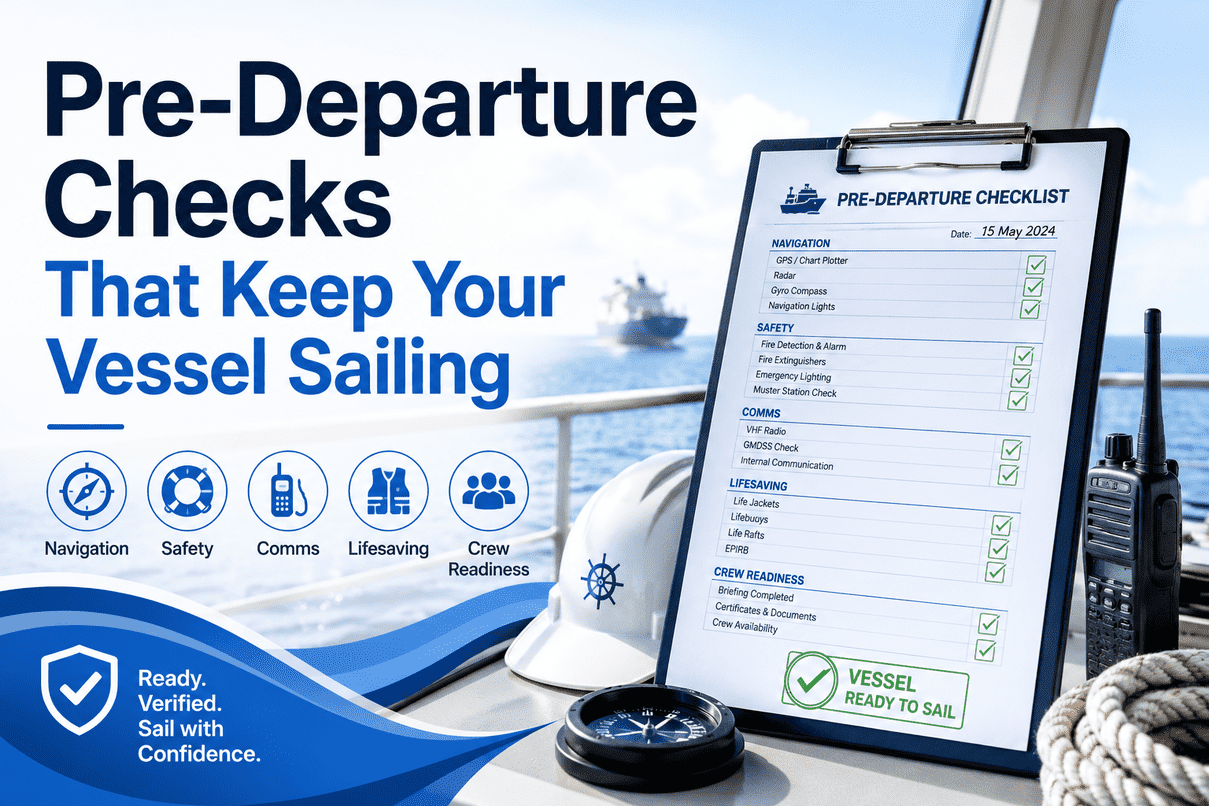
Navigation. Steering. Engines. Comms. Lifesaving. Crew. Six Systems Verified Before Every Sailing.
SOLAS Chapter V Reg 26 compliant pre-departure verification, 12-hour rule enforced, master and chief engineer signatures captured, Deck Logbook entry automated.
M/V Pacific Star · Outbound Rotterdam
Live
The Six System Categories Every Pre-Departure Check Must Cover
SOLAS, USCG 33 CFR 164.25, Bridge Procedures Guide, and flag state regulations converge on six system categories that every pre-departure check must verify. Skip any one and the vessel sails with a gap that will surface as a PSC finding, an incident, or a charter dispute.
01
Navigation Systems
ECDIS chart currency, voyage plan loaded, GPS positioning verified, radar functioning, gyrocompass aligned, magnetic compass error checked, AIS transmitting, VDR recording, BNWAS armed, navigation lights tested.
02
Steering Gear
SOLAS Chapter V Reg 26 mandates steering gear test before departure. Main steering, auxiliary steering, emergency steering procedure, rudder angle indicators, helm response timing, hydraulic pressure all verified.
03
Main & Auxiliary Engines
Main engine warmed and ready, auxiliary engines online, fuel system primed, lubrication confirmed, cooling water flow verified, alarms tested, telegraph-engine room communication confirmed, emergency generator ready.
04
Communications & GMDSS
VHF Channel 16 monitored, GMDSS equipment tested, satellite communications verified, internal communications confirmed, EPIRB and SART verified, port and pilot station contact established.
05
Lifesaving & Fire Safety
Lifeboats and rafts verified per SOLAS Ch III plus 2026 MSC.554/559 amendments. Fire main pressure tested, fire pumps confirmed, CO2 system armed, fire detection panel clear, emergency escape routes unobstructed.
06
Crew Readiness & Watertight Integrity
Crew muster confirmed against MSMD, no stowaways check, watertight doors and hatches secured, mooring lines clear, gangway retracted, draft and trim verified, bridge team and engine watch posted.
The SOLAS Pre-Departure Mandatory Checks Matrix
The matrix below maps each pre-departure check item to its governing regulation, required frequency, and evidence standard the platform must capture. Scroll horizontally on mobile for the full view. Book a pre-departure walkthrough to map your fleet's current checklist against the regulatory baseline.
| Check Item |
Regulation |
Frequency |
Evidence Required |
| Steering gear test |
SOLAS V/26 |
Within 12 hours of departure |
Logbook entry + photo |
| Machinery test |
SOLAS V/26 · 33 CFR 164.25 |
Within 12 hours of departure |
Engine room log + readings |
| Navigation equipment |
SOLAS V/19 |
Before each voyage |
Bridge log + functional test |
| ECDIS chart currency |
SOLAS V/19.2.1.4 |
Before each voyage |
Update log + ENC version |
| VDR functional check |
SOLAS V/20 |
Before each voyage |
Annual + voyage start log |
| BNWAS armed |
SOLAS V/19.2.2.3 |
Before sailing |
Test record + watch posting |
| GMDSS test |
SOLAS IV/15 |
Daily plus pre-departure |
Radio log + test record |
| Lifeboat readiness |
SOLAS III · MSC.554 |
Weekly + pre-departure |
Photo + counter-signature |
| Fire main pressure |
SOLAS II-2/10 |
Weekly + pre-departure |
Pressure reading + photo |
| Watertight closures |
SOLAS II-1/22 |
Before sailing |
Tour record + photos |
| Lifting appliance checks |
SOLAS II-1/3-13 (2026) |
Per use + pre-departure |
Test record + load chart |
| Crew muster verification |
STCW Reg I/14 · MSMD |
Before each voyage |
Master signature + log |
The Five-Phase Pre-Departure Cycle From T-24 Hours To Sailing
A credible pre-departure workflow runs five phases against the sailing time, not as a single rushed final-hour scramble. Each phase has its own activities, sign-offs, and decision gates. Compressing the cycle to the last 60 minutes is how defects get missed.
T-24h
Voyage Planning & Documentation
Voyage plan finalized, ECDIS charts updated, port documents prepared, crew change confirmed, fuel and stores bunkered, departure clearance lodged with agent and port.
T-12h
SOLAS V/26 Mandatory Checks Begin
12-hour window opens for SOLAS V/26 machinery and steering tests. Engineering team begins systematic checks. Logbook entries initiated. Defects surfaced now have time for corrective action.
T-6h
Bridge System Verification
Navigation systems tested, communications verified, voyage plan loaded to ECDIS, weather routing updated, bridge team briefed, pilot booking confirmed.
T-2h
Lifesaving & Crew Readiness
Lifesaving equipment verified per SOLAS Chapter III plus 2026 amendments. Fire systems tested. Crew muster verified. Watertight doors and hatches secured. Mooring lines and gangway prepared.
T-0
Master Authorization & Sailing
Master reviews complete pre-departure pack, signs Deck Logbook entry, chief engineer counter-signs, pilot briefing completed, port authority cleared, vessel sails with full audit trail.
PSC Deficiency Hot Zones In Pre-Departure
Paris MOU and Tokyo MOU detention data identifies the deficiency categories that recur in pre-departure inspection failures. The table below maps the eight hot zones with their typical risk weight and the pre-departure check that prevents each. Mobile users scroll horizontally for the full view.
| Hot Zone |
Deficiency Code |
Risk Weight |
Pre-Departure Check That Prevents It |
| Fire Safety |
07000-series |
Critical |
Fire main pressure + CO2 system + detection panel |
| Life-Saving |
11000-series |
Critical |
Lifeboat readiness + raft HRU + EPIRB battery |
| Safety of Navigation |
10000-series |
High |
ECDIS charts current + VDR functional + BNWAS armed |
| Radio Communication |
09000-series |
High |
GMDSS test + VHF Ch 16 monitoring + sat com verified |
| ISM Implementation |
15150 |
Critical |
SMS pre-departure procedure followed + signatures |
| Maintenance of Ship |
15109 |
High |
SOLAS V/26 machinery tests + 12-hour rule |
| Propulsion & Auxiliary |
13000-series |
Critical |
Main engine + aux engines + emergency generator |
| Steering Gear |
14101 |
Critical |
SOLAS V/26 steering gear test + emergency procedure |
Pre-Departure Demo · 30 Minutes
See Every System Verified Before Sailing — On Your Fleet's Routes
A 30-minute session with a Marine Inspection product expert. Bring a recent departure from your fleet. Walk through the six-system verification, five-phase cycle, SOLAS V/26 12-hour rule enforcement, and master-signature Deck Logbook automation on real data.
The Six Workflows Pre-Departure Checklist Software Should Cover
Beyond the basic checklist, six workflows separate a credible pre-departure platform from a glorified PDF. Each workflow handles a recurring operational pattern that paper or generic checklist apps miss.
A
12-Hour Window Enforcement
SOLAS V/26 mandates checks within 12 hours of departure. Platform enforces the window — checks completed outside it flag for re-execution. No paper backdating, no convenience-window cheating.
B
Master-Signature Deck Logbook Entry
Completion of pre-departure pack triggers automated Deck Logbook entry with master's signature, chief engineer counter-signature, and timestamp. The regulatory record SOLAS requires, captured by default.
C
Defect-To-Action Hand-Off
Failed check item triggers defect workflow — work order generated, parts requisitioned, deadline assigned. Departure delayed or proceeded with documented mitigation. No silent ignored finding.
D
Vessel-Type Adaptation
Tanker, bulker, container, LNG, passenger, offshore variants automatically applied. Crude tanker adds cargo system checks, LNG adds gas detection, container adds lashing verification. One checklist, vessel-aware.
E
Port-Specific Overlays
Departure from a Paris MOU port adds MOU-specific verification. Singapore-bound voyage adds AMSA-style items. Panama Canal transit adds canal authority items. Port-specific gates layered on the standard checklist.
F
Drift Detection Across Departures
Same item failing across multiple departures triggers root cause review. Engine starting issues, recurring navigation anomalies, fire main pressure trends — patterns surface across the fleet rather than dying in individual voyage records.
Why Marine Inspection For Pre-Departure Checklist Software
Marine Inspection delivers digital pre-departure checklist software on the six-system framework, 12-system regulatory matrix, five-phase cycle, eight PSC hot-zone coverage, and six workflow capabilities — built for SOLAS Chapter V Reg 26 compliance with 2026 amendments pre-loaded. Start a free trial or book a 30-minute demo to see pre-departure verification on your fleet.
SOLAS V/26 Compliance Built In
12-hour rule enforced. Steering gear test, machinery test, navigation equipment verification, GMDSS test, lifeboat readiness — all mandatory checks pre-loaded with current 2026 amendments.
2026 Amendments Pre-Loaded
SOLAS II-1/3-13 lifting appliances, MSC.535 enclosed lifeboat ventilation, MSC.554 personal LSA, MSC.559 annual examination updates — all applicable from January 1, 2026 ready in the checklist library.
Master Signature + Deck Logbook
AdES-grade digital signature on completion. Automated Deck Logbook entry with master and chief engineer counter-signatures. Regulatory record captured by default, retrievable for PSC defence.
Vessel-Type Adaptation
Tanker, bulker, container, LNG, passenger, offshore supply variants applied automatically. One platform, vessel-aware checklists matching the equipment and operational profile of each ship.
Mobile-First Offline Capture
Engine room, lifeboat deck, navigation bridge captures supported offline. Auto-sync on connectivity. Crew app respects the actual environment where pre-departure work happens.
Fleet-Wide Drift Detection
Same item failing across multiple departures triggers root cause review. Patterns surface across the fleet rather than dying in individual voyage records. Capex and maintenance decisions informed by clean data.
Frequently Asked Questions
What is pre-departure inspection checklist software?
Pre-departure inspection checklist software runs structured verification of every system that SOLAS, USCG, Bridge Procedures Guide, and flag state regulations require before a vessel sails. Six system categories are covered — Navigation (ECDIS, GPS, radar, AIS, VDR, BNWAS, lights), Steering Gear (main, auxiliary, emergency, indicators), Main and Auxiliary Engines (warmup, fuel, lubrication, cooling, alarms), Communications and GMDSS (VHF, satellite, EPIRB, SART, internal), Lifesaving and Fire Safety (lifeboats, rafts, fire main, CO2, detection), Crew Readiness and Watertight Integrity (muster, stowaway check, watertight closures, mooring lines, draft and trim). SOLAS Chapter V Regulation 26 mandates checks within 12 hours before departure with Deck Logbook recording. The platform enforces the 12-hour window, captures master and chief engineer digital signatures on completion, generates the automated Deck Logbook entry, and feeds failed items into the defect resolution workflow.
What does SOLAS Chapter V Regulation 26 require?
SOLAS Chapter V Regulation 26 is unambiguous about pre-departure checks. Every vessel must check and test all machinery within twelve hours before leaving port, and the fact must be recorded in the Deck Logbook. US 33 CFR 164.25 carries the parallel requirement. The mandatory checks include steering gear test (main, auxiliary, emergency, rudder angle indicators, helm response), navigation equipment verification, communication equipment test, propulsion machinery functional check, and emergency systems readiness. The recording requirement is not optional — Deck Logbook entries must be timestamped, signed by the master, and retrievable for PSC inspection, class survey, or flag state audit. Failure to maintain SOLAS V/26 evidence is a recurring PSC deficiency in the 15109 series (maintenance of ship and equipment) and 14101 (steering gear) — leading to detention in serious cases.
What changed in 2026 pre-departure requirements?
Four 2026 SOLAS amendments tightened pre-departure verification. SOLAS Regulation II-1/3-13 effective January 1, 2026 added mandatory safety requirements for onboard lifting appliances and associated loose gear including cargo cranes, engine-room cranes, stores cranes, and hose handling cranes. MSC.535(107) introduced ventilation requirements for totally enclosed lifeboats applying to lifeboats installed on or after January 1, 2029. MSC.554(108) updated personal life-saving appliances, lifeboat fittings, and launching appliance standards applying to equipment installed on or after January 1, 2026. MSC.559(108) added ventilation system checks to the annual lifeboat examination requirements. Paris MOU 2024 detention rate climbed to 4.03% with fire safety as the leading cause — and most fires would have been prevented by tighter pre-departure discipline. Operators using outdated pre-departure templates risk both 2026-specific findings and the broader pattern of compounding deficiencies.
What are the five phases of pre-departure?
A credible pre-departure workflow runs five phases against sailing time. T-24 hours Voyage Planning and Documentation — voyage plan finalized, ECDIS charts updated, port documents prepared, crew change confirmed, fuel and stores bunkered, departure clearance lodged with agent and port. T-12 hours SOLAS V/26 Mandatory Checks Begin — 12-hour window opens for SOLAS V/26 machinery and steering tests, engineering team begins systematic checks, logbook entries initiated, defects surfaced now have time for corrective action. T-6 hours Bridge System Verification — navigation systems tested, communications verified, voyage plan loaded to ECDIS, weather routing updated, bridge team briefed, pilot booking confirmed. T-2 hours Lifesaving and Crew Readiness — lifesaving equipment verified per SOLAS Chapter III plus 2026 amendments, fire systems tested, crew muster verified, watertight doors and hatches secured, mooring lines and gangway prepared. T-0 Master Authorization and Sailing — master reviews complete pre-departure pack, signs Deck Logbook entry, chief engineer counter-signs, pilot briefing completed, port authority cleared, vessel sails with full audit trail.
Which PSC deficiency areas does pre-departure prevent?
Paris MOU and Tokyo MOU detention data identifies eight hot zones where pre-departure failures recur as PSC deficiencies. Fire Safety (07000-series, Critical) prevented by fire main pressure plus CO2 system plus detection panel checks. Life-Saving (11000-series, Critical) prevented by lifeboat readiness plus raft HRU plus EPIRB battery checks. Safety of Navigation (10000-series, High) prevented by ECDIS chart currency plus VDR functional plus BNWAS armed verification. Radio Communication (09000-series, High) prevented by GMDSS test plus VHF Channel 16 monitoring plus satellite communication verification. ISM Implementation (deficiency code 15150, Critical) prevented by SMS pre-departure procedure followed plus master and chief engineer signatures captured. Maintenance of Ship (deficiency code 15109, High) prevented by SOLAS V/26 machinery tests within the 12-hour rule. Propulsion and Auxiliary (13000-series, Critical) prevented by main engine plus auxiliary engines plus emergency generator readiness. Steering Gear (deficiency code 14101, Critical) prevented by SOLAS V/26 steering gear test plus emergency procedure verification.
How does the software integrate with the Deck Logbook?
Completion of the pre-departure pack triggers an automated Deck Logbook entry with master's digital signature, chief engineer counter-signature, and authoritative timestamp. The regulatory record that SOLAS Chapter V Regulation 26 requires gets captured by default rather than as a separate clerical step. Each item in the pack is logged with timestamp, responsible officer identity, evidence attachment (photo, measurement, document), and pass-or-fail status. Failed items hand off to the defect resolution workflow with work order generation, parts requisition, and deadline assignment. The PSC inspector boarding a vessel hours later can pull the Deck Logbook entry plus the underlying pre-departure pack in seconds — every check, every signature, every timestamp, every piece of evidence available immediately rather than requiring crew to re-assemble paper records.
How does Marine Inspection handle pre-departure inspections?
Marine Inspection delivers digital pre-departure checklist software on the six-system framework (Navigation, Steering, Engines, Communications, Lifesaving, Crew Readiness), 12-item regulatory matrix, five-phase cycle from T-24 hours to sailing, and eight PSC hot-zone coverage. SOLAS V/26 compliance built in with 12-hour rule enforced. 2026 amendments pre-loaded — SOLAS II-1/3-13 lifting appliances, MSC.535 enclosed lifeboat ventilation, MSC.554 personal LSA, MSC.559 annual examination updates. Master AdES-grade digital signature plus chief engineer counter-signature on completion with automated Deck Logbook entry. Vessel-type adaptation across tanker, bulker, container, LNG, passenger, offshore supply. Mobile-first offline capture for engine room and bridge environments where WiFi does not reach. Fleet-wide drift detection surfaces patterns across multiple departures. 6-12 week deployment for typical mid-size fleets. Free trial available with full functionality before any commitment.
Ready When You Are
Every System Verified. Every Signature Captured. Every Departure Defensible.
Six-system pre-departure framework, SOLAS V/26 12-hour rule enforced, 2026 amendments pre-loaded, master and chief engineer digital signatures, automated Deck Logbook entry, vessel-type adaptation, mobile-first offline capture — all in one platform built for the 2026 pre-departure reality.