A critical defect logged on a vessel at 02:00 is worth nothing to the shore team if it sits unseen in an inbox until morning. The certificate that quietly lapses because the one person who tracked it was on leave becomes a detention at the next port. The overdue inspection that no one was warned about becomes a gap in the compliance record that a Port State Control officer finds before the office does. Fleet operations run on events — defects raised, certificates expiring, inspections due, thresholds crossed — and the difference between a well-run fleet and a firefighting one is often simply whether the right person hears about the right event at the right time, through a channel they will actually see. That is what a marine fleet notification system does. It watches every vessel for the events that matter, decides who needs to know, reaches them on the channel that fits the urgency, and escalates automatically if no one responds, so nothing critical falls through the cracks between ship and shore. This page explains why event notifications are foundational to fleet operations, the events worth alerting on, how multi-channel delivery and tiered escalation work, and the operational payoff of never missing a critical event again. To put the right fleet alert in front of the right person the moment it matters, start a free trial or book a demo.
REPORTS & SYSTEM · NOTIFICATIONS
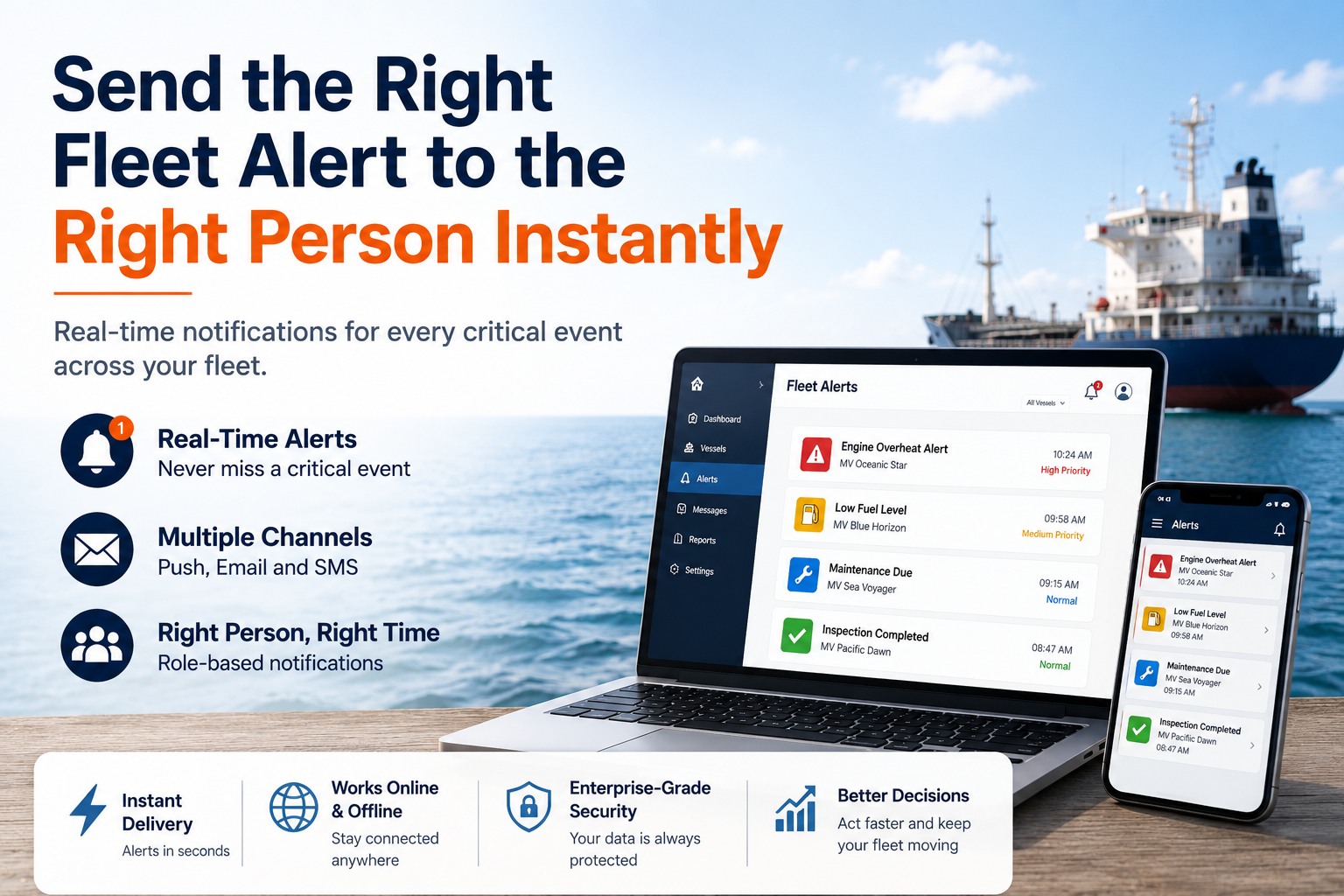
Send the Right Fleet Alert to the Right Person Instantly
A marine fleet notification system that watches every vessel for critical events and delivers the right alert to the right person at the right time — through push, email, SMS and in-app notifications, with automatic escalation so nothing critical is ever missed.
Why Alerts Are Foundational, Not a Feature
The most effective fleet operations are proactive — catching problems before they escalate into crises — and that is only possible if the system that detects an event can reach the person who needs to act on it. Automated alerting is what turns a database of fleet information into an operation that responds, and without it even the best-recorded data just waits, unread, for someone to happen to look.
The failure mode is familiar on fleets that rely on manual communication. Certificate expiry is tracked in a spreadsheet only one person watches; inspection findings are emailed and lost in a busy inbox; a critical defect logged aboard depends on someone ashore checking the system at the right moment. The shore office and the vessel end up operating from different versions of the truth, and events that should trigger immediate action instead surface late — sometimes only when a Port State Control officer or a charterer finds them first. A notification system closes that gap by making the flow of critical information systematic rather than dependent on habit, attention and luck. It is the connective tissue that keeps ship and shore genuinely in sync, which is why it belongs at the foundation of fleet operations rather than bolted on as an afterthought. To make critical fleet events reach the right people automatically instead of by luck, start a free trial or book a demo.
The Events Worth Alerting On
A good notification system is driven by the events that carry operational or compliance consequence. These are the triggers a fleet most needs to know about the moment they occur.
Critical defects
A critical-severity defect logged on the vessel triggers immediate shore notification with its photo evidence, so a superintendent knows within minutes rather than at the end of a watch, and corrective action begins at once.
Certificate expiry
Statutory and class certificates alert on a tiered countdown — amber at ninety days, red at thirty, and at expiry — because aged and lapsed certificates are a leading indicator of Port State Control detention.
Overdue inspections
When a scheduled inspection, drill or compliance check is not completed on time, the system flags it, so the office intervenes before a missed check becomes a gap in the compliance record.
Maintenance due
Planned maintenance approaching its due date triggers a reminder to the responsible engineer and office, keeping the planned maintenance system on schedule and defensible at audit.
Thresholds and anomalies
Configurable rules on operational data — a reading crossing a threshold, an abnormal rate of change, a flagged anomaly — fire alerts so emerging problems are caught while they are still small.
Port and voyage events
Arrivals, departures and other voyage milestones notify the shore team so berth allocation, pilotage, inspections and resource planning can be coordinated around real events rather than estimates.
i
From event to action, automatically
The strongest systems do not just notify — they act. A rule-chain approach detects the condition, evaluates the logic, and triggers the response, so a critical defect can both alert the superintendent and auto-generate a work order in the same motion. In practice this collapses the time from a defect being logged to shore action from days to minutes: the captain logs it, the shore team is notified by push, a work order is created, parts are checked and a technician dispatched — with reported days-to-closure dropping from around fourteen days to four as a result. The notification is the trigger; the automated action is what makes it pay off.
The Right Person, Through Escalation
Sending an alert is easy; making sure it is seen and acted on is the real problem, and it is solved by tiered escalation. Rather than firing one notification and hoping, the system moves up a defined chain until someone acknowledges, so a critical event cannot be silently ignored.
TIER 1
Responsible officer
The alert goes first to the person directly responsible — the duty officer or responsible engineer — who is best placed to act. A defined time window opens for them to acknowledge and respond.
TIER 2
Master
If the first tier does not acknowledge within the set window, the alert escalates to the master, so command is aware and the event is not sitting unattended aboard the vessel.
TIER 3
Shore DPA / superintendent
Still unacknowledged, the alert reaches the shore Designated Person Ashore or superintendent, guaranteeing that a critical event always lands with someone accountable, ship or shore.
The mechanism that makes escalation work is acknowledgment: each alert requires the recipient to confirm they have received and are acting on it, and configurable time windows govern how long each tier has before the alert moves up. This turns notification from a fire-and-forget message into a closed loop with accountability built in — every critical alert is either acknowledged by the right person or escalated until it is, and the system records who was notified and when. To route alerts up a chain that guarantees someone accountable always responds, start a free trial or book a demo.
No critical event sits unacknowledged
Alert the officer, escalate to the master, then the shore DPA — with acknowledgment required and time windows configurable at every step. Marine Inspection closes the loop so a critical defect or lapsing certificate is always seen by someone accountable, ship or shore.
The Right Channel for the Urgency
Different events warrant different channels, and matching the channel to the urgency is what makes alerts effective rather than either missed or overwhelming. A multi-channel system delivers each notification where its recipient will actually see it in time.
Push notifications
Instant alerts to the mobile app for time-sensitive events, reaching crew and shore staff on the device already in their hand, ideal for critical defects and urgent operational alerts.
Email
Detailed notifications with full context and evidence for events that need a documented, forwardable record — certificate countdowns, inspection summaries and daily digests.
SMS
Text alerts for the highest-urgency events and for recipients who may not have the app open, cutting through to reach someone even when other channels go unwatched.
In-app and task inbox
Actionable alerts land in an in-app inbox with assignment, priority and status tracking, so a notification becomes a task that is owned, worked and resolved rather than just read.
Because delivery is bandwidth-aware, the system prioritises what it sends when connectivity is limited, so a critical alert and its acknowledgment get through even on a constrained satellite link while bulk detail waits. The combination of the right channel, the right recipient and automatic escalation is what ensures an alert is not just sent but seen and acted on — the whole point of a notification system.
What Changes When Nothing Is Missed
The value of a notification system shows up as events caught in time, actions started sooner and a fleet that runs ahead of its problems instead of behind them.
Faster defect resolution
Immediate shore notification with evidence, coupled with automatic work-order generation, compresses the time from a defect being found to being fixed — with days-to-closure reported falling from around fourteen days to four.
Fewer compliance surprises
Tiered certificate and inspection alerts mean lapses are caught weeks ahead rather than discovered at a port, cutting the detention risk that aged certificates and overdue checks carry.
Ship and shore in sync
Both sides work from the same live picture of events, so the office is never blind to what is happening aboard and the vessel is never waiting on a shore team that does not yet know.
Accountability on every alert
Acknowledgment and escalation create a record of who was notified, when, and who acted — a clear audit trail that shows critical events were handled, not just logged.
The underlying shift is from reactive to proactive. A fleet without systematic notifications is always discovering problems after they have grown; a fleet with them is catching the same problems while they are still small, routing each to the person who can act, and confirming it was handled. That is the difference between managing a fleet by attention and habit and managing it by a system that never forgets to raise the alarm. Across a fleet of vessels and thousands of events a month, that reliability is what keeps small issues from becoming detentions, downtime and lost revenue. To give your fleet a notification system that catches every critical event and routes it to the right person on the right channel, start a free trial or book a demo.
Frequently Asked Questions
What is a marine fleet notification system?
It is a system that monitors every vessel in a fleet for events that carry operational or compliance consequence — critical defects, certificate expiries, overdue inspections, maintenance due, threshold breaches, port events — and automatically delivers alerts to the right people through channels like push, email, SMS and in-app notifications. Rather than relying on someone happening to check a spreadsheet or inbox, it makes the flow of critical information systematic, reaching the person who needs to act and escalating if they do not respond. It is the connective tissue that keeps ship and shore working from the same live picture and ensures nothing critical falls through the cracks.
What events should trigger a fleet alert?
The events worth alerting on are those with operational or compliance consequence: critical-severity defects logged aboard, which need immediate shore notification with evidence; certificate expiries on a tiered countdown, typically amber at ninety days and red at thirty, since lapsed certificates are a leading detention indicator; overdue inspections, drills and compliance checks; planned maintenance approaching its due date; configurable thresholds and anomalies on operational data; and port and voyage events like arrivals and departures for coordinating shore resources. The best systems let you configure rules on any data point, so the alerts match what actually matters to your operation rather than a fixed list.
How does escalation work?
Escalation moves an alert up a defined chain until someone acknowledges it, so a critical event cannot be silently ignored. Typically the alert goes first to the responsible officer or engineer, who has a configurable time window to acknowledge and act; if they do not, it escalates to the master; and if it is still unacknowledged, it reaches the shore Designated Person Ashore or superintendent. Each step requires the recipient to confirm receipt, and the time windows governing how long each tier has are configurable. This turns notification into a closed loop with accountability built in — every critical alert is either acknowledged by the right person or escalated until it is.
Which notification channels are supported?
A strong system offers multiple channels so each alert reaches its recipient where they will see it in time: push notifications to the mobile app for instant, time-sensitive events; email for detailed, documented notifications with full context and evidence; SMS for the highest-urgency alerts and recipients who may not have the app open; and in-app notifications that land in a task inbox with assignment, priority and status tracking. Matching the channel to the urgency is what makes alerts effective rather than missed or overwhelming, and bandwidth-aware delivery ensures critical alerts get through even on a constrained satellite link while bulk detail waits.
Can a notification trigger an action, not just a message?
Yes, and this is where the value compounds. The strongest systems use a rule-chain approach that detects a condition, evaluates logic, and triggers an action — so a critical defect can both alert the superintendent and automatically generate a work order in the same motion. This collapses the time from an event being logged to shore action from days to minutes: the defect is logged, the shore team notified, a work order created, parts checked and a technician dispatched. Reported outcomes include days-to-closure on defects falling from around fourteen days to four. The notification is the trigger, and the automated action is what turns awareness into resolution.
How does it help with Port State Control?
In two main ways. First, it prevents the lapses that lead to detention: tiered certificate alerts at ninety and thirty days and at expiry, plus overdue-inspection flags, mean statutory gaps are caught and closed weeks before a vessel reaches a port, and aged certificates and overdue checks are among the leading detention indicators. Second, the acknowledgment and escalation trail creates a record showing critical events were seen and handled, contributing to the clean evidence chain that reduces detention risk. By keeping certificates current, inspections on schedule and defects resolved quickly, a notification system removes many of the findings a Port State Control officer would otherwise raise.
Never Miss a Critical Event Again
Marine Inspection watches every vessel for the events that matter, delivers each alert to the right person through push, email, SMS or in-app notification, and escalates automatically from officer to master to shore DPA until someone acknowledges — with rule-chain automation that turns a critical defect into a work order in the same motion. Turn scattered, missed alerts into a systematic loop that keeps your whole fleet ahead of its problems.
.png)