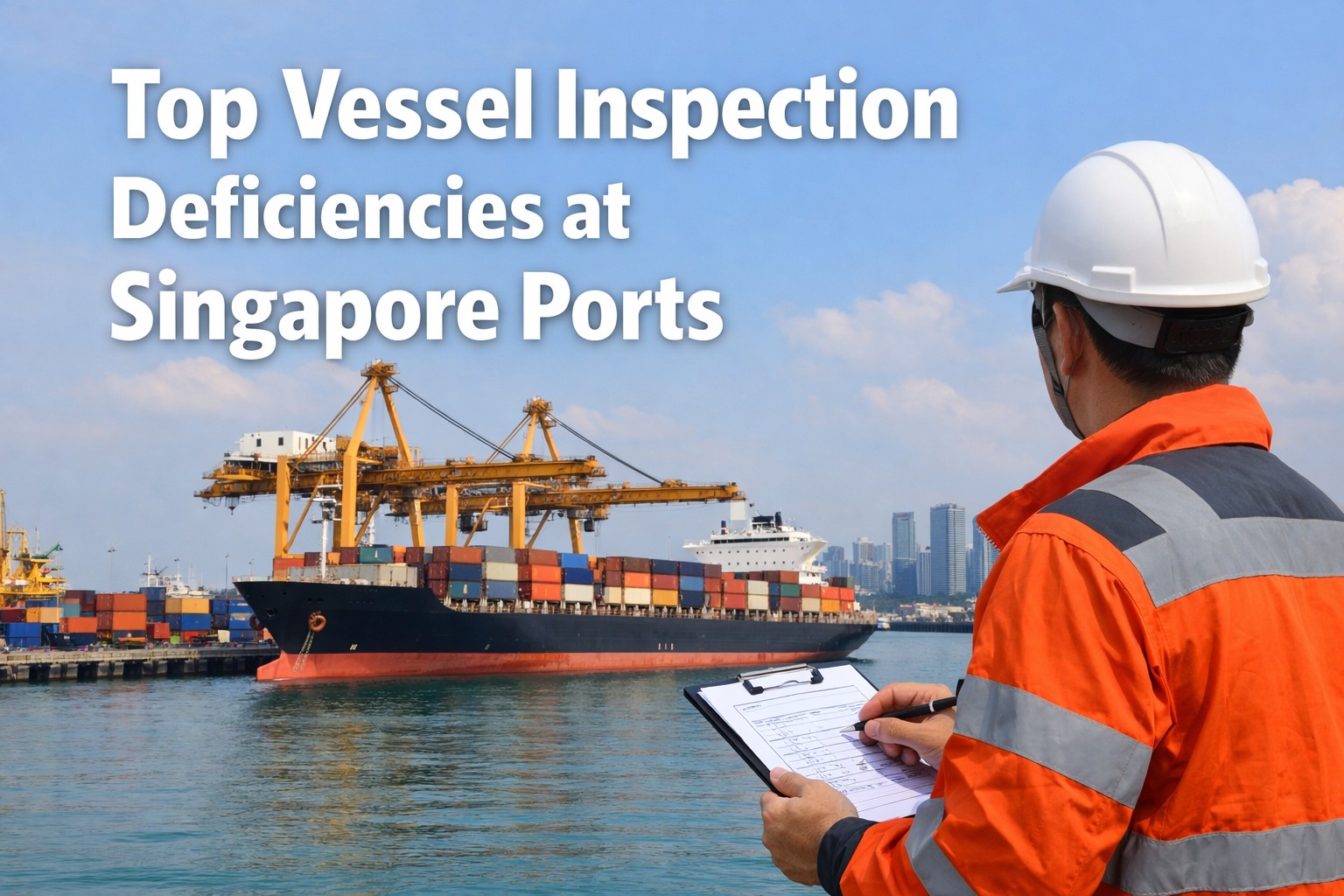
Singapore processed a record 44.66 million TEU and 3.22 billion gross tonnage of vessel arrivals in 2025 — making it the world's leading container port and one of the highest-volume PSC inspection environments in the Asia-Pacific region. Under the Tokyo MoU's New Inspection Regime, Singapore's MPA inspects over 1,000 vessels annually from more than 20 flag states, recording thousands of deficiencies each year. In the 2024 Tokyo MoU regional data, 77,526 total deficiencies were found across 32,054 inspections, with fire safety measures alone accounting for 15,406 findings — the single largest deficiency category. For cargo operators calling at Singapore, understanding which deficiency categories trigger detentions and how to prevent them is the difference between smooth port calls and costly delays. Operators ready to digitize their inspection readiness and deficiency tracking can start with Marine Inspection's compliance platform built for high-volume port environments like Singapore.
Singapore Maritime: 2025-2026 Overview
44.66M
TEU Throughput (2025)
Record, +8.6% year-on-year
130,000+
Annual Vessel Calls
~1,000 ships in port at any time
137.46M GT
SRS Registry (2025)
4th largest globally, +27% YoY
9
Green Shipping Corridors
India, Korea, China + 6 partners
Top Deficiency Categories: Tokyo MoU 2024 Data
The Tokyo MoU's 2024 Annual Report reveals persistent patterns that directly affect vessels calling at Singapore. Out of 77,526 total deficiencies recorded across the Asia-Pacific region, four categories alone represented 54% of all findings. These are not abstract statistics — they are the specific equipment areas, documentation gaps, and operational shortcomings that Singapore's MPA inspectors check during every PSC inspection. Operators who track these categories proactively using Marine Inspection's deficiency monitoring tools resolve issues before port arrival rather than during inspection.
Top Deficiency Categories — Tokyo MoU Region (2024)
1
Fire Safety Measures
15,406 deficiencies
2
Life-Saving Appliances
10,263 deficiencies
3
Working & Living Conditions
8,193 deficiencies
4
Safety of Navigation
8,066 deficiencies
ISM Code Compliance
Rising trend — leading detention cause
MARPOL Annex VI
Continuous increase noted
What Each Deficiency Category Means for Cargo Operators
Understanding the specific equipment and documentation items within each deficiency category helps operators build targeted pre-arrival checklists rather than generic compliance reviews. Here is what Singapore's MPA inspectors examine in each of the top categories — and what triggers detention versus a recorded deficiency. Sign up for Marine Inspection to build category-specific inspection checklists for your fleet.
Common Findings
Fire detection and alarm system malfunctions, fire door defects (not self-closing, damaged seals), fire pump failures, fixed fire-fighting system pressure/charge issues, fire extinguisher expiry or damage, crew inability to demonstrate fire equipment operation during drill
Detention Triggers
Non-functional fire detection in machinery spaces, inoperable fixed fire-fighting systems, unsatisfactory fire drills (8.44% failure rate in 2023 CIC), blocked fire escapes, missing fireman's outfits
Common Findings
Lifeboat launching gear defects, life raft hydrostatic release issues, lifebuoy light/smoke signal expiry, EPIRB battery expiry or incorrect MMSI registration, personal life jacket condition, embarkation arrangement obstructions
Detention Triggers
Lifeboat unable to be launched, expired or missing life rafts, crew unable to demonstrate abandon ship procedures, davit wire defects, missing or non-functional EPIRB/SART
Common Findings
Rest hour violations, missing or unsigned Seafarer Employment Agreements (16% of CIC deficiencies), crew unable to access employment condition information (28% of CIC deficiencies), accommodation sanitation, food storage, galley hygiene
Detention Triggers
Systematic rest hour violations, absent employment agreements, substandard crew accommodation, inadequate food and potable water provisions, health and safety hazards in living spaces
Common Findings
Voyage planning deficiencies, chart correction backlogs, ECDIS software update failures, AIS malfunction or incorrect data, bridge equipment testing gaps, magnetic compass deviation records, navigation light defects
Detention Triggers
Non-functional ECDIS/radar, absent or grossly inadequate voyage plans, crew unable to demonstrate bridge equipment operation, GPS/AIS system failures, navigation in Singapore Strait with defective positioning equipment
Prevent Deficiencies Before Singapore Port Call
Marine Inspection's digital checklists cover every Tokyo MoU deficiency category — fire safety, life-saving appliances, navigation equipment, and MLC compliance — with photo evidence capture, expiry date tracking, and corrective action workflows that close findings before MPA inspectors find them.
MPA Singapore: How PSC Inspections Work
Singapore operates its PSC programme under the Tokyo MoU's New Inspection Regime (NIR), which classifies vessels by risk profile — high, standard, or low — based on flag state performance, classification society record, vessel age, type, and previous inspection history. Understanding this targeting system helps operators predict inspection likelihood and prepare accordingly. Singapore's MPA recorded approximately 1,097 initial inspections in a recent reporting period, with 392 on high-risk ships, 463 on standard-risk, and 242 on low-risk vessels.
MPA PSC Inspection Process — Singapore
1
Vessel Targeting (NIR)
Tokyo MoU algorithm calculates ship risk profile based on flag performance, class society record, vessel age/type, deficiency history, and time since last inspection. High-risk vessels prioritized.
2
Initial Inspection
MPA inspector boards vessel. Verifies certificates, crew documentation, and overall condition. Checks crew competency through questioning and observation. If "clear grounds" exist, proceeds to more detailed inspection.
3
Detailed / Expanded Inspection
For high-risk or suspect vessels: structural checks, fire safety testing, emergency system verification, machinery examination, crew drill observation. Each deficiency recorded with action code and rectification deadline.
4
Outcome
Three possible results: no deficiency (clear), deficiencies recorded with rectification required (before departure or at next port), or detention — ship cannot sail until hazardous conditions resolved. MPA authorizes 8 Recognised Organisations for follow-up inspections of detained vessels.
Singapore's 2026 Compliance Landscape: What's Changing
Singapore's maritime environment in 2026 adds new compliance dimensions beyond traditional PSC deficiency categories. Digital bunkering is now fully implemented, ammonia bunkering standards are arriving, and green shipping corridors are expanding. These developments create both new inspection focus areas and new opportunities for operators who adopt digital compliance systems. Schedule a demo to see how Marine Inspection integrates traditional PSC readiness with emerging compliance requirements.
Live
100% Digital Bunkering
All bunker suppliers in Singapore implemented digital bunkering by August 2025. Electronic Bunker Delivery Notes (e-BDNs) verified through MPA's enquiry facility. Saves 40,000 man-days annually. Operators must ensure their bunkering documentation systems are digitally compatible.
Q2 2026
Ammonia Bunkering Technical Reference
Singapore's first Technical Reference for Ammonia Bunkering publishes Q2 2026. Guides safe operations and supports trials. Keppel-led consortium conducting FEED studies for ammonia power generation and bunkering infrastructure.
Q2 2026
LNG Bunkering Standard Upgrade
TR56 Technical Reference for LNG Bunkering upgraded to full Singapore Standard. New LNG bunker supply licences opened January 2026. Standards cover equipment, operational performance, and efficiency for port-limit LNG bunker vessels.
Expanding
9 Green Shipping Corridors
New corridors with India and Korea established 2025. China corridor elevated to national level. 2026 projects include common emissions-reporting protocols, digital data exchange, and fuel trials along participating routes. Three methanol bunkering licences awarded November 2025.
Expert Review: Singapore's Inspection Environment in 2026
Singapore's PSC environment demands a different level of operational readiness than most ports. With over 130,000 vessel calls annually and approximately 1,000 ships in port at any given time, the MPA operates one of the most efficient and high-throughput inspection programmes in the world. The Tokyo MoU's 2024 data reveals two trends that cargo operators calling at Singapore must internalize: first, fire safety remains the dominant deficiency category by a wide margin, with 15,406 findings representing nearly 20% of all regional deficiencies; second, ISM Code compliance has shown a continuous increase as both a deficiency category and a detention cause, meaning that safety management system documentation and implementation — not just equipment condition — is under growing scrutiny.
The 2024 regional detention rate of 3.71% across 32,054 inspections, with 1,189 ships detained under 67 flags, underscores that detention is not rare — it affects roughly 1 in 27 inspected vessels. The Tokyo MoU noted that the number of under-performing ships (detained 3 or more times in 12 months) nearly doubled compared to the previous year, triggering heightened monitoring. For operators with vessels flagged to under-performing registries, every Singapore port call carries elevated inspection probability.
Singapore's simultaneous push toward digital compliance — 100% digital bunkering, electronic delivery notes, and AI-enhanced port operations — signals that the MPA's inspection capability is becoming increasingly data-driven. Operators who maintain digital records of equipment condition, maintenance histories, drill logs, and crew documentation will find that their inspection preparation naturally aligns with where Singapore's regulatory environment is heading — sign up for Marine Inspection to build that digital compliance foundation.
Conclusion
Singapore's position as the world's leading container port creates an inspection environment where preparation quality directly determines port call efficiency. The Tokyo MoU's 2024 data makes the priorities clear: fire safety systems, life-saving appliances, working and living conditions, and navigation equipment account for over half of all deficiencies found in the region. ISM Code compliance and MARPOL Annex VI findings are trending upward. And Singapore's expanding green shipping corridors, digital bunkering mandate, and ammonia bunkering preparations in 2026 add new compliance layers that forward-thinking operators are already integrating into their inspection readiness workflows. The operators who avoid detention and maintain smooth Singapore port calls are those who treat deficiency prevention as a continuous digital process — tracking equipment condition, certificate expiry, crew competency, and maintenance completion in real-time rather than scrambling before arrival. Book a demo to see how Marine Inspection prevents deficiencies across every Tokyo MoU category.
Zero-Deficiency Singapore Port Calls Start Here
Marine Inspection's platform tracks every deficiency category Singapore's MPA inspectors evaluate — fire safety equipment status, life-saving appliance expiry dates, navigation system compliance, crew documentation, and ISM implementation evidence — with automated alerts, photo evidence, and corrective action workflows that close findings before your next port call.
Frequently Asked Questions
What are the most common vessel inspection deficiencies at Singapore ports?
Based on Tokyo MoU 2024 regional data (which covers Singapore as a founding member), the top deficiency categories are fire safety measures (15,406 findings), life-saving appliances (10,263), working and living conditions (8,193), and safety of navigation (8,066). Together these four categories represent 54% of all 77,526 deficiencies recorded. ISM Code compliance and MARPOL Annex VI deficiencies are also showing continuous increases. Singapore's MPA follows the same deficiency coding system and inspection focus areas as the broader Tokyo MoU framework.
How does MPA Singapore select vessels for PSC inspection?
Singapore uses the Tokyo MoU's New Inspection Regime (NIR), which calculates a risk profile for each vessel based on flag state performance, classification society record, vessel age, vessel type, previous deficiency and detention history, and time since last inspection. Vessels are classified as high risk (inspected approximately every 5 months), standard risk (every 10 months), or low risk (every 24 months). In a recent reporting period, MPA conducted 1,097 initial inspections split across 392 high-risk, 463 standard-risk, and 242 low-risk vessels, recording over 3,000 deficiencies.
What happens if my vessel is detained at Singapore port?
If serious deficiencies posing an immediate threat to safety or the environment are found, MPA will detain the vessel until all issues are rectified. The vessel must apply for a follow-up inspection before release. MPA authorizes 8 Recognised Organisations (including major classification societies) to conduct follow-up inspections of detained vessels. The shipowner has the right to appeal within 30 days. Detention is recorded in the Tokyo MoU database, affecting the vessel's risk profile at every future port call in the Asia-Pacific region. The 2024 regional detention rate was 3.71%, with 1,189 ships detained across 32,054 inspections.
What new compliance requirements affect vessels calling at Singapore in 2026?
Several developments affect Singapore port calls in 2026. All bunker suppliers have implemented 100% digital bunkering since August 2025, requiring electronic Bunker Delivery Notes (e-BDNs). Singapore's first Technical Reference for Ammonia Bunkering publishes Q2 2026. The LNG Bunkering Technical Reference (TR56) is being upgraded to a full Singapore Standard in Q2 2026, with new LNG bunker supply licences opened January 2026. Nine Green and Digital Shipping Corridors are now established, with 2026 projects including common emissions-reporting protocols and fuel trials. The Singapore Registry of Ships reached a record 137.46 million GT in 2025, becoming the 4th largest globally.
How can digital inspection software reduce deficiencies at Singapore?
Digital inspection platforms address the root causes of the most common deficiency categories. For fire safety (the #1 category): automated alerts for extinguisher expiry dates, fire door condition tracking with photos, and drill documentation with crew participation records. For life-saving appliances: EPIRB/SART battery expiry tracking, lifeboat launching gear maintenance schedules, and life raft service date management. For ISM compliance (the fastest-growing detention cause): documented SMS implementation evidence, non-conformity tracking with corrective action workflows, and drill records with timestamps. The key is continuous monitoring — not pre-arrival scrambles — because inspectors assess operational reality, not prepared presentations.