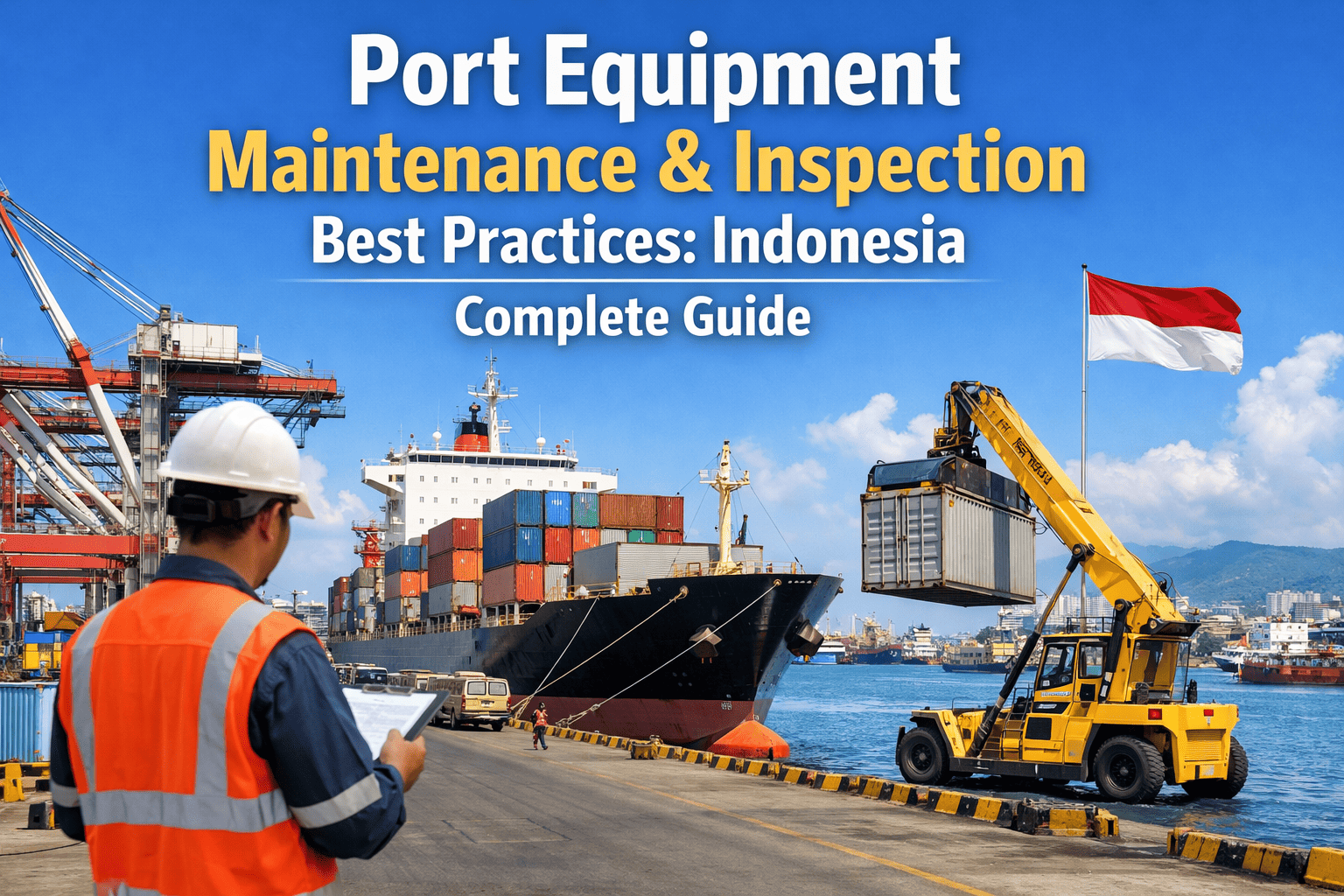
Port Equipment Maintenance & Inspection Best Practices: Indonesia Complete Guide
At Tanjung Priok, a Super Post Panamax quay crane goes down mid-shift. The maintenance team scrambles for the inspection logbook—it's three months out of date. Nobody can confirm when the wire ropes were last tested or whether the gearbox oil was changed on schedule. The crane stays idle for 36 hours while engineers troubleshoot what turns out to be a bearing failure that a simple vibration check would have caught weeks ago. Every hour of STS crane downtime costs a container terminal an estimated $5,000-$15,000 in lost throughput. Multiply that across Indonesia's 350+ ports—from the 7.6-million-TEU operations at Tanjung Priok to regional gateways at Tanjung Perak, Makassar, and Belawan—and the true cost of poor equipment maintenance becomes staggering. With Pelindo's Green Port Initiative accelerating, new equipment arriving at terminals like TPK Koja (which received 3 new Super Post Panamax cranes and 4 electric RTGs in December 2025), and Indonesia's smart port digitalization expanding to 246 ports, the gap between operators who maintain equipment digitally and those still relying on paper is widening fast. Port operations teams already using Marine Inspection's platform to digitally schedule, track, and optimize equipment maintenance report 20-30% reductions in unplanned downtime and near-zero compliance gaps during DJPL inspections.
Indonesia Port Equipment Maintenance: The Operational Reality
350+
Active Ports
across Indonesia's archipelago requiring equipment maintenance programs
$5-15K
Lost per Hour of Crane Downtime
in throughput revenue, vessel waiting charges, and cascading delays
~40%
of Port OPEX on Maintenance
equipment upkeep is the largest controllable cost at most terminals
246
Ports Digitizing by 2024-25
Pelindo's smart port rollout—maintenance tracking is the missing link
The Six Equipment Categories Every Indonesian Port Must Maintain
Indonesian ports operate vastly different equipment depending on their size and function—from mega-terminal STS cranes at Tanjung Priok to mobile harbor cranes at regional ports. But regardless of scale, maintenance failures follow the same pattern: missed inspections lead to breakdowns, breakdowns lead to downtime, and downtime costs money and credibility. Marine Inspection's platform lets port operators track every asset category from a single dashboard—here's what you need to cover.
Port Equipment Maintenance Map
What to maintain, what to inspect, and how Marine Inspection keeps each category covered
Ship-to-Shore (STS) Cranes
Wire rope testing, gearbox oil analysis, structural crack inspection, spreader maintenance, hoist brake verification, and electrical system checks
RTGs & RMGs (Yard Cranes)
Wheel and rail alignment, motor performance, anti-sway system calibration, tire condition (RTG), and electrical/diesel hybrid system monitoring
Reach Stackers & Forklifts
Engine and transmission service, hydraulic system inspections, tire/load chain wear, mast and spreader checks, and operator safety device verification
Terminal Tractors & Chassis
Brake systems, coupling mechanisms, chassis twist-lock integrity, lighting and signals, and scheduled engine/transmission preventive maintenance
Conveyor & Bulk Handling Systems
Belt tension and alignment, roller bearing monitoring, chute and hopper inspection, dust suppression systems, and motor/drive unit servicing
Berth & Shore Infrastructure
Fender system integrity, bollard load testing, OPS electrical systems, quay wall condition surveys, lighting, and navigation aid maintenance
Where Paper-Based Maintenance Fails Indonesian Ports
Indonesia's tropical climate—high humidity, saltwater corrosion, monsoon exposure—accelerates equipment wear faster than temperate-climate ports. Combined with the geographic spread across 17,000 islands and the push toward Green Port standards, three types of invisible cost leaks erode every port's bottom line when maintenance is managed manually. Port operators who switch to Marine Inspection's digital maintenance platform eliminate all three simultaneously.
The Unplanned Downtime Trap
Without Digital Tracking
Inspection intervals tracked on paper or spreadsheets. Running-hour thresholds missed. Minor wear becomes catastrophic failure. One STS crane breakdown can cascade into vessel queue delays affecting the entire terminal for days.
With Marine Inspection
Auto-triggered inspections at exact running-hour or calendar intervals. Digital checklists completed on-site and synced to the central dashboard. Every task tracked from creation to sign-off. Breakdowns caught weeks before they happen.
The Compliance Documentation Gap
Without Digital Tracking
DJPL inspectors arrive. Maintenance logs incomplete. Crane certification records scattered across binders. DGST Decree 365/2025 demands harmonized, digitally monitored survey documentation—paper systems can't keep up.
With Marine Inspection
All equipment certifications tracked with 90/60/30-day expiry alerts. Inspection histories retrievable in seconds. Audit-ready reports generated instantly for any regulatory visit. Full compliance with MOT Reg. 7/2024 standards.
The Spare Parts Gamble
Without Digital Tracking
No visibility across equipment fleets. Critical parts under-stocked, non-critical parts over-ordered. Emergency procurement from overseas OEMs adds 40-60% markup and weeks of lead time while equipment sits idle.
With Marine Inspection
Centralized inventory tracking across all equipment. Consumption patterns drive procurement forecasting. Parts ordered ahead of need at standard pricing. Zero emergency freight charges for avoidable stockouts.
The Three-Phase Approach to Digital Port Equipment Maintenance
Reducing port equipment OPEX by 20-30% isn't a single switch—it's the cumulative result of three distinct phases, each building on data from the previous one. Marine Inspection's platform guides Indonesian port operators through this progression naturally. Terminals that begin with Phase 1 today start seeing savings within weeks.
Phase 1
Months 1-3
Digitize & Record
Migrate equipment records into Marine Inspection
Activate digital checklists per equipment category
Set certification expiry and inspection interval alerts
Automate work order creation with running-hour triggers
8-12%
OPEX saved by eliminating missed inspections and reducing emergency repairs
Phase 2
Months 4-9
Optimize & Prevent
Condition-based scheduling from accumulated data
Equipment-to-equipment performance benchmarking
Data-driven overhaul planning with defined scope
Centralized spare parts and procurement forecasting
15-20%
OPEX saved through optimized scheduling and smarter procurement
Phase 3
Months 10-18
Predict & Scale
Predictive failure analytics from fleet-wide data
Automated maintenance planning across all terminals
Green Port alignment with energy-efficient operations
Continuous improvement with compounding data value
25-30%+
OPEX saved with full predictive capability and multi-terminal optimization
Five KPIs That Separate High-Performing Indonesian Ports
The port operators who keep equipment OPEX under control aren't guessing—they're measuring. Marine Inspection's dashboard automatically calculates these metrics from your terminal's maintenance data, giving operations managers real-time visibility into where money is being saved and where it's leaking.
95%+
Equipment Availability
Percentage of operational hours equipment is available for use. Below 90% signals your maintenance program needs attention. Marine Inspection tracks this in real time.
Trending Up
Mean Time Between Failures
Average hours between breakdowns per equipment type. A rising MTBF confirms your inspections prevent failures, not just document them.
< 20%
Reactive Maintenance Ratio
Unplanned vs. total maintenance. Ports above 35% reactive work are overspending by definition. Digital tracking drives this down fast.
Declining
Cost per Move (Crane)
Maintenance cost normalized per container lift. Indonesia's busiest terminals track this weekly. Digital CMMS makes optimization visible and actionable.
"Indonesia's ports face a maintenance environment unlike anywhere else in the world—tropical corrosion, monsoon exposure, massive equipment diversity across 350+ ports, and a regulatory landscape that's digitizing rapidly under Pelindo's smart port initiative. The terminals achieving the best uptime numbers aren't necessarily running the newest equipment. They're running the best maintenance programs. A platform like Marine Inspection gives port operations managers the visibility to schedule maintenance around actual equipment condition and operational windows, rather than arbitrary calendars. That shift alone typically improves crane availability by 10-15% without increasing the maintenance budget—and it produces the audit-ready documentation that DJPL inspectors now expect."
Port Equipment Operations Review
Terminal Maintenance Engineering • Southeast Asia Port Operations Analysis
Start Reducing Equipment Downtime This Month
Marine Inspection's digital maintenance platform is built for Indonesian port operators managing diverse equipment across terminals. Automate PM scheduling, track every work order from creation to sign-off, manage spare parts inventory, and generate the audit-ready reports DJPL inspectors expect.
What types of port equipment can Marine Inspection track maintenance for?
Marine Inspection handles all port equipment categories: STS cranes, RTGs, RMGs, reach stackers, forklifts, terminal tractors, chassis, conveyors, bulk handling systems, and shore infrastructure including fenders, bollards, and OPS electrical systems. Each equipment type gets customized inspection checklists, running-hour triggers, and spare parts catalogs while feeding into a single terminal-wide dashboard. Multi-terminal operations can benchmark performance across locations.
How does digital maintenance tracking help with DJPL compliance?
Indonesia's DGST Decree 365/2025 emphasizes harmonized, digitally monitored inspection and certification systems. Marine Inspection automatically tracks equipment certifications with 90/60/30-day expiry alerts, maintains complete inspection histories with timestamps and sign-offs, and generates audit-ready reports instantly. When DJPL inspectors arrive, every document is retrievable in seconds—not the 30+ minutes paper-based operations typically lose scrambling for records.
How quickly can a port see results after implementing digital maintenance?
Most terminals see measurable improvements within 1-3 months. Immediate wins come from eliminating missed PM intervals (auto-triggered work orders), reducing the time maintenance teams spend on documentation, and catching equipment issues before they cause downtime. These Phase 1 improvements typically deliver 8-12% OPEX reduction. Deeper savings of 20-30% accumulate over 6-18 months as condition-based and predictive capabilities build from your terminal's data.
Can Marine Inspection work across multiple terminals operated by the same company?
Yes. Marine Inspection is designed for multi-site port operations. All terminals feed into a centralized dashboard giving corporate-level visibility, while each site maintains its own equipment hierarchy, checklists, and work order queues. Terminal-to-terminal benchmarking identifies best practices and performance gaps. Spare parts inventory can be managed across locations to optimize procurement and reduce emergency stockouts.
How does predictive maintenance differ from the planned maintenance most ports use?
Traditional planned maintenance follows fixed schedules—service a crane gearbox every 2,000 hours regardless of condition. This leads to unnecessary work on healthy equipment and missed issues between intervals. Marine Inspection enables condition-based and predictive maintenance by analyzing accumulated inspection data to determine when equipment actually needs attention. Research shows predictive approaches can reduce maintenance costs by up to 45% versus conventional strategies because you maintain what needs it, exactly when it needs it.
Ready to Maintain Smarter and Operate Leaner?
Marine Inspection helps Indonesian port operators digitize equipment maintenance, track every inspection and work order, manage spare parts across terminals, and build the data foundation for predictive operations—with dashboards built for the busiest ports in the archipelago.