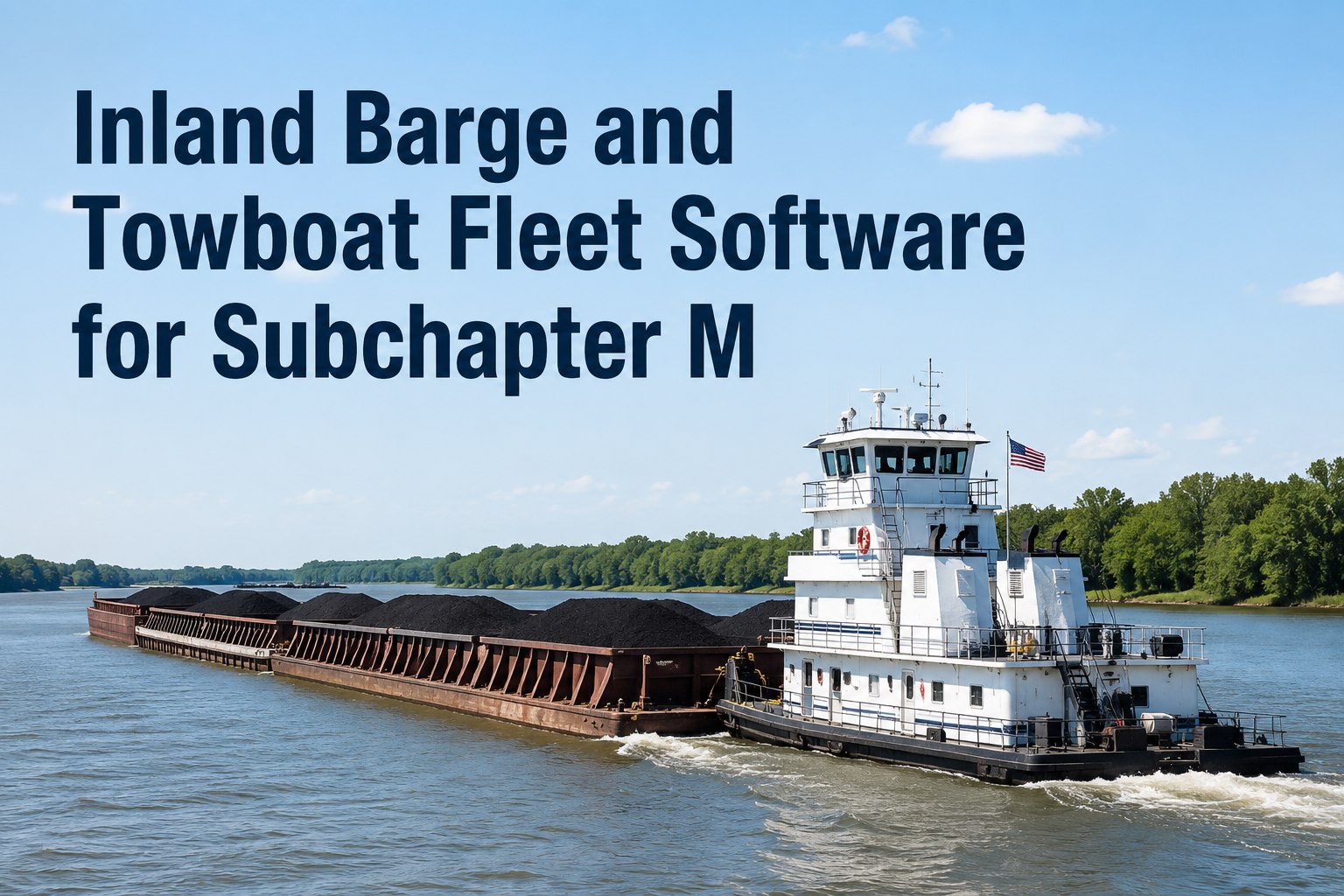
Inland towing is the only sector in commercial shipping where most of what you maintain is not what gets certificated. A towboat is a single inspected vessel holding a Certificate of Inspection under 46 CFR Subchapter M. Behind it sits a tow of fifteen, thirty or forty barges — separate unpowered assets, frequently owned by somebody else, assembled into a configuration that has never existed before and will never exist again after this trip. Subchapter M applies to all US-flag towing vessels engaged in pushing, pulling or hauling alongside, excepting vessels under 26 feet unless they are moving a barge carrying oil or hazardous materials, and it is emphatic that all towing vessels regardless of size involved in the movement of barges carrying oil or hazardous material in bulk must be certificated and manned in accordance with their COI. The rule published in July 2016 and every vessel subject to it required a valid COI by July 2022. The requirements themselves have not changed since inception, though the Coast Guard has published a great deal of additional guidance on interpretation. What has not changed either is the underlying problem: the towboat is inspected, the tow is verified, and the barges are neither. Start a free trial of Marine Inspection and hold all three.
One Certificate, Three Different Maintenance Objects
01
The towboat
A certificated vessel with a COI, an inspection option, annual surveys, periodic audits and a manning requirement. This is the asset the regulation is written around and the one every compliance conversation focuses on.
02
The tow
A configuration rather than an asset. Verified as safely and securely made up before departure under the operational requirements, then broken and rebuilt differently at the next fleeting area. Checked constantly, owned by nobody, recorded thinly.
03
The barges
Hundreds of unpowered units with hull condition, coamings, hatch covers, rakes and void spaces that determine whether a tow is safe and whether cargo arrives dry — and which carry no Certificate of Inspection of their own to organise the record around.
Why Subchapter M Exists at All
The rule was not written because towboats were mechanically unsound. Understanding what it was actually aimed at explains what a compliance system has to capture. Book a Marine Inspection demo and see a management system that produces evidence rather than a binder that describes one.
The problem the rule targeted
Through the 1990s and 2000s inland waterways saw a rise in major incidents — collisions between towboats, barges and other vessels, and allisions with shore infrastructure including bridges, producing fatalities and significant local economic impact.
The industry's own analysis put the cause squarely in one place. Studies indicate that 60 to 80 percent or more of these incidents are primarily caused by human-system interface failure, or more plainly, human factors. Equipment was rarely the root cause.
That is why the response looked beyond the existing regulations for uninspected towing vessels and adopted consistent, lasting procedures aimed at the human element. Subchapter M is a management system regulation that happens to include equipment standards, rather than an equipment regulation with procedures attached.
What that means for records
The evidence that matters is behavioural as much as technical: who was trained, who performed the check, who signed the log, what was found and what was done about it. Equipment condition is necessary and insufficient.
The cornerstone, as the industry describes it
Well laid out procedures, good documentation, commitment, competence, attitude and motivation of everyone in the company — onshore and afloat. Three of those six are cultural and cannot be bought. The other three are what a system is for.
The reach of the rule
Subchapter M supersedes OSHA jurisdiction over these vessels and preempts state regulation on design, construction, alteration, repair, maintenance, operation, equipping and personnel qualification. It is the whole regime, not one layer of it.
Two Options, Two Different Burdens
Every operator chose one of two paths, and the choice determines the entire compliance calendar. There is no single right answer, and the trade-off is between external cost and internal capacity. Sign up for Marine Inspection and configure the system to whichever path your fleet actually runs.
The Coast Guard Option
All inspections conducted by the Coast Guard
The cycleEach vessel undergoes annual inspection within three months of its Certificate of Inspection anniversary date, with the Coast Guard contacted directly to schedule.
The appealNo TSMS certificate to obtain and maintain, no third-party organisation relationship to manage, and no external audit programme to schedule and fund.
The costAvailability is on the Coast Guard's terms and timetable, and there is no safety management framework sitting between you and a finding.
The TSMS Option
Oversight through a USCG-approved Third Party Organization
The cycleA TSMS certificate must be obtained six months before the COI. The TPO conducts a management audit and issues the TSMS certificate to the company, then after a successful vessel audit issues one to the vessel and transmits the report to the Coast Guard.
The appealScheduling control, a framework the fleet operates inside, and a properly credentialed licensed mariner or surveyor acting on the operator's behalf is authorised in lieu of an external surveyor.
The costA four-clock audit calendar described below, and a system that has to be genuinely operated rather than merely written.
Common to both
Regardless of the option chosen, the Coast Guard is responsible for issuing the towing vessel COI and may board a vessel at any time to verify compliance and take appropriate action. The TSMS option does not create distance from the regulator — it changes the verification path, not the exposure. Separately, the cognizant OCMI issuing the COI may give special consideration to authorising departures from specific requirements where unusual circumstances or arrangements warrant it and an equivalent level of safety is provided, and that review takes account of the TSMS applicable to the vessel.
Four separate clocks
The TSMS Calendar Is More Precise Than Most Fleets Track It
Annual vessel surveys, annual internal audits, a five-yearly external vessel audit and a mid-period management audit inside a six-month window three years into a five-year certificate. Four cycles, four due dates per vessel, on a fleet where nobody looks at the TSMS certificate between renewals — held with escalation instead of in somebody's calendar.
The Audit Calendar Nobody Reads Until Month Thirty-Four
The TSMS option carries a schedule that is unusually specific, and one of its requirements sits in a six-month window three years out from a certificate issue date. It is the single easiest thing in Subchapter M to miss. Schedule a walkthrough and see all four cycles escalating independently.
Annual
Towing vessel survey
Owners under the TSMS option must schedule an annual towing vessel survey meeting the scope set out in 46 CFR 137.220. This is the recurring technical verification of the vessel itself.
Annual
Internal audit of each vessel
An annual internal audit runs on every vessel, separately from the survey. It is the operator's own verification that the management system is being applied aboard, and it produces findings that a later external audit will look for evidence of having been closed.
5-yearly
External TSMS vessel audit
A vessel audit must be scheduled once every five years covering the elements outlined in 46 CFR 138.220 for a TSMS, conducted externally by the third-party organisation.
Month 27-33
Mid-period management audit
Shoreside management audits are carried out twice in five years, with the mid-period audit occurring between the 27th and 33rd month of the TSMS certificate's five-year validity period. That is a six-month window opening more than two years after issue, on a document most operators do not revisit until renewal approaches. It is the requirement that catches fleets who are otherwise fully compliant.
What Has to Be Tracked, and Against Which Asset
The register below separates by object, because a towboat, a barge and a tow are genuinely different things and forcing them into one hierarchy is where inland fleets lose the thread. Start a free trial and load one boat and its regular barge pool during the evaluation.
Table 1: The Inland Register by Asset Class
Three asset classes, one record — the boat with its COI, the barges by identity, and the tow as a verified configuration between them.
The Tow Is a Configuration, Not an Asset
This is the structural feature that breaks conventional maintenance software on inland work, and it is worth being precise about what the regulation actually requires. Book a walkthrough and see a tow verification recorded with the barges actually in it.
What must be verified
Before getting underway, the operational requirements call for confirmation that the barges, vessels or objects making up the tow are properly configured and secured; that equipment, cargo and industrial components on board the tow are properly secured and made ready for transit; and that the towing vessel is safely and securely made up to the tow.
Why it is not a survey item
Because the object being verified is temporary. This particular arrangement of these particular barges in these particular positions with these particular couplings exists for one trip. It cannot be scheduled against a maintenance interval because it has no life cycle — only a beginning and an end.
What conventional software does with it
Reduces it to a checkbox on a pre-departure form, because there is nowhere in the data model to put a configuration. The check happens properly in reality and is recorded meaninglessly, so the record proves that somebody said yes rather than what they said yes to.
What a useful record holds
The barge identities in the tow, their positions, the coupling arrangement, who verified it, when, and any finding raised at make-up. That turns a tick into evidence, and it means a defect found on a specific barge follows that barge rather than evaporating when the tow breaks.
The compounding benefit
Once tows are recorded with barge identities attached, the operator gains something no barge-by-barge inspection programme delivers: a history of which units have been in which tows, how often each has been handled, and where a recurring defect is following a particular hull rather than a particular crew.
And the operational one
A finding at make-up that is captured against the barge is visible to the next boat that picks it up. A finding captured against the trip disappears when the trip ends, which is why the same coupling problem gets rediscovered at three consecutive fleeting areas by three different crews.
The Barge Fleet Nobody Certificates
Barges carry no Certificate of Inspection of their own, which removes the natural organising principle that every other maintenance system relies on. That absence has to be replaced deliberately rather than left as a gap. Start a free trial and build a barge register organised by hull identity rather than by trip.
Why the barge record is hard
A barge may be owned by the operator, chartered, or belong entirely to a third party whose equipment you are simply moving. It passes between fleets, between fleeting areas and between crews, and no single party sees its whole history.
It has no COI to anchor a survey cycle, no engine hours to drive an interval, and no permanent crew to notice gradual deterioration. What it has is a hull identity, and that identity is the only stable thing about it.
Which means the record has to be built around the identity rather than around a schedule. Every observation, every defect, every loading and every tow it appeared in attaches to that number, and the picture assembles itself from encounters rather than from inspections.
What to capture at every encounter
Hull identity, date, who saw it, condition of rakes and coamings, hatch cover condition and seal, void space status where accessible, and any damage observed. Thirty seconds at a fleeting area, repeated across a fleet, builds a condition history nobody currently has.
Why cargo condition follows from it
Hatch cover integrity and coaming condition determine whether grain arrives dry. Cargo damage claims on inland moves frequently trace to a hatch condition somebody noticed and nobody recorded, on a barge that has since been in four other tows.
The exemption worth checking
A fleet boat may be exempt from Subchapter M provided it operates exclusively within a Limited Geographic Area as defined in 46 CFR §136.110, as determined by the local Captain of the Port, and meets the excepted vessel provisions coordinated with the local OCMI. Establish that status formally rather than assuming it.
Evaluating a Platform for an Inland Fleet
Deep-sea maintenance software assumes one vessel, one crew, one voyage and one certificate. Inland work has none of those assumptions intact. These questions expose whether a platform can carry it. Schedule a demo with a port captain and a compliance manager present.
Table 2: Buyer Questions Specific to Inland Towing Operators
2026 INLAND COMPLIANCE REALITY
The requirements have not changed, but the guidance has. Subchapter M requirements are substantially unchanged since inception, while the Coast Guard has published considerable additional guidance on interpretation, and nomenclature changes to Part 136 were made through a 2025 rulemaking. Work from the current text and the Towing Vessel National Center of Expertise material rather than from any summary including this one. The Coast Guard retains full access under either option. Whichever compliance path is elected, the Coast Guard issues the COI and may board a vessel at any time to verify compliance and take appropriate action. Exemptions are determined locally. A fleet boat may be exempt where it operates exclusively in a Limited Geographic Area as defined in 46 CFR §136.110, as determined by the local Captain of the Port, and meets excepted vessel provisions coordinated with the local OCMI — so status is a conversation with your local office rather than a reading of the rule. Alternative safety management frameworks exist. The American Waterways Operators Responsible Carrier Program was approved by the Coast Guard as an approved safety management system in the autumn of 2016.
Frequently Asked Questions
Which vessels does Subchapter M apply to?
All US-flag towing vessels engaged in pushing, pulling or hauling alongside, with a principal exception for vessels less than 26 feet in length unless they are moving a barge carrying oil or hazardous materials. The rule is explicit that all towing vessels regardless of size involved in the movement of barges carrying oil or hazardous material in bulk must be certificated and manned in accordance with their Certificate of Inspection. A fleet boat may be exempt where it operates exclusively within a Limited Geographic Area as defined in 46 CFR §136.110, as determined by the local Captain of the Port, and meets the excepted vessel provisions coordinated with the local Officer in Charge of Marine Inspection.
What is the difference between the Coast Guard option and the TSMS option?
Under the Coast Guard option all inspections are conducted by the Coast Guard, with each vessel inspected annually within three months of its Certificate of Inspection anniversary date and the Coast Guard contacted directly to schedule. Under the TSMS option a Coast Guard-approved Third Party Organization provides oversight: the TSMS certificate must be obtained six months before the COI, the TPO conducts a management audit and issues a certificate to the company, and following a successful vessel audit issues one to the vessel and transmits the report to the Coast Guard. Regardless of option, the Coast Guard issues the COI and may board at any time to verify compliance.
What does the TSMS audit calendar actually require?
Four separate cycles. An annual towing vessel survey meeting the scope of 46 CFR 137.220. An annual internal audit of each vessel. A vessel audit once every five years covering the elements outlined in 46 CFR 138.220. And shoreside management audits carried out twice in five years, with the mid-period audit occurring between the 27th and 33rd month of the TSMS certificate's five-year validity period. That last one is the requirement most often missed, because it opens a six-month window more than two years after certificate issue, on a document few operators revisit until renewal approaches.
Why is Subchapter M described as a human factors regulation?
Because that is what it was aimed at. Following a rise in major inland incidents through the 1990s and 2000s — collisions between towboats and barges and other vessels, and allisions with bridges and shore infrastructure producing fatalities and economic impact — industry analysis indicated that 60 to 80 percent or more were primarily caused by human-system interface failure rather than by equipment. The response looked beyond the existing regulations for uninspected towing vessels toward consistent procedures addressing the human element. The practical consequence is that compliance evidence is behavioural as well as technical: who was trained, who performed the check, what was found and what was done.
How should barges be tracked when they have no Certificate of Inspection?
By hull identity rather than by schedule, because identity is the only stable attribute a barge has. It may be owned, chartered or belong to a third party, it passes between fleets and crews, it has no COI to anchor a survey cycle and no engine hours to drive an interval. Build the record so that every encounter attaches to the hull number — condition of rakes and coamings, hatch cover condition and seal, void space status where accessible, damage observed, who saw it and when. Thirty seconds at a fleeting area, repeated across a fleet, produces a condition history that no periodic inspection programme delivers.
What has to be verified before a tow gets underway?
The operational requirements call for confirmation that the barges, vessels or objects making up the tow are properly configured and secured, that equipment, cargo and industrial components aboard the tow are properly secured and made ready for transit, and that the towing vessel is safely and securely made up to the tow. The difficulty for record-keeping is that a tow is a configuration rather than an asset — this arrangement of these barges exists for one trip. A useful record captures the barge identities and positions along with the verification, so a defect found at make-up follows the barge rather than disappearing when the tow breaks.
Inland towboat and barge fleets
The Boat Is Certificated. The Barges Are Not. Both Need a Record.
COI and TSMS certificate dates with the month 27 to 33 management audit window flagged, four audit cycles escalating independently, towing gear held per item with discard criteria, tow verifications capturing barge identities and positions, and a barge register keyed to hull number so a defect follows the unit between tows, fleets and crews — captured in seconds at a fleeting area, offline where the river has no signal.